TL;DR:
- Most organizations have process issues, such as bottlenecks and rework, that hinder productivity. Business Process Improvement provides a structured method for mapping, analyzing, redesigning, piloting, and monitoring workflows to eliminate waste and sustain gains. Effective success depends on thorough process mapping, redesign before automation, and ongoing performance accountability.
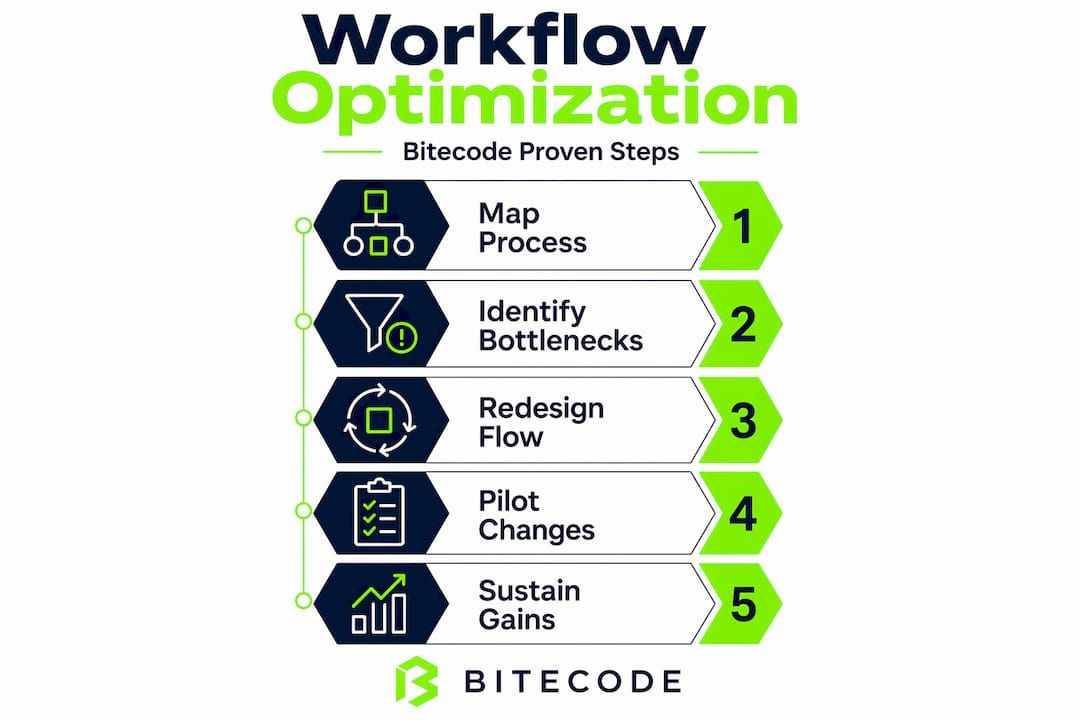
Most organizations don’t have a productivity problem. They have a process problem. Bottlenecks compound quietly, approval chains multiply, and teams spend hours on rework that nobody explicitly authorized. The cost is real: wasted labor, delayed outputs, and decisions made on stale data. A structured workflow optimization process, known formally as Business Process Improvement (BPI), gives operations managers a repeatable method to cut through that chaos. This guide covers the full cycle, from mapping and analysis through redesign, pilot rollout, and sustained monitoring, with practical guidance on where AI fits and where it doesn’t.
Key Takeaways
| Point | Details |
|---|---|
| Map the real process first | Document how work actually flows today, not how the SOPs say it should. |
| Measure before you change anything | Collect 5 to 10 baseline data points to avoid optimizing against noise. |
| Redesign before automating | Automating a flawed process accelerates waste, not productivity. |
| Pilot for 30 to 60 days | Test improvements on a small group and measure against baseline before full rollout. |
| Assign named ownership | Every improved process needs one accountable owner and monthly check-ins to sustain gains. |
The workflow optimization process starts with mapping
The most common mistake organizations make is skipping directly to solutions. Before any improvement effort begins, teams need an accurate picture of how work actually moves through the organization. That picture rarely matches the documented procedures hanging in a shared drive. Real processes include informal detours, undocumented handoffs, and decision points that only exist because someone worked around a system limitation three years ago.
Effective process mapping captures all of it: every step, every handoff, every approval gate, and every decision point where work can branch or stall. Tools like Lucidchart and Miro support this visually, but the method matters more than the tool. Walk the process with the people who actually do it, not just their managers. What you discover will frequently contradict the official version.
The mapping phase should produce a current-state process map that documents:
- Every task and the role responsible for it
- All handoff points between individuals, teams, or systems
- Decision nodes and the criteria used to make those decisions
- Wait states where work sits idle between active steps
- Any rework loops where outputs are rejected and reprocessed
Pro Tip: Film a short screen recording walkthrough of someone completing a process in real time. You will catch micro-steps and informal workarounds that structured interviews miss entirely.
A well-built current-state map is the foundation for everything else. Without it, analysis is guesswork, and redesign is speculation. Teams that invest two to three days building an accurate map consistently save weeks of misdirected improvement effort downstream.
Identifying bottlenecks and measuring what’s actually broken
Once the process map is complete, the analysis phase begins. This is where structured methodology pays off. The DMAIC framework from Lean Six Sigma provides a proven structure: Define the problem, Measure the current state, Analyze root causes, Improve the process, and Control the gains. Each phase has recommended durations, with Measure and Analyze together typically running six to twelve weeks.
The most common inefficiency types that surface in this phase fall into three categories:
- Rework loops. Output is produced, rejected, and sent back for correction. This often signals unclear requirements upstream rather than execution failures downstream.
- Wait states. Work sits idle while waiting for approval, input, or a dependent task to complete. Long approval chains are a frequent culprit.
- Redundant steps. The same information is entered, verified, or reported by multiple people in multiple systems. This is especially common in organizations that have grown through acquisitions.
Measuring baseline performance is non-negotiable before drawing conclusions. Key metrics include cycle time (the total elapsed time from start to finish), throughput (how many units are completed per time period), error rate, and Process Cycle Efficiency (PCE), which measures the ratio of value-added time to total elapsed time. Cycle time and throughput must be measured together because optimizing one in isolation can create misleading results.
| Metric | What it measures | Why it matters |
|---|---|---|
| Cycle time | Total elapsed time per process instance | Identifies how long work actually takes end to end |
| Throughput | Units completed per time period | Reveals capacity constraints and bottlenecks |
| PCE | Value-added time / total time | Exposes how much time is pure waiting vs. productive work |
| Error rate | Defects or rejections per 100 units | Pinpoints where rework is consuming capacity |
Pro Tip: Collect at least 5 to 10 baseline measurements before making any changes. A single data point tells you almost nothing. Multiple points reveal patterns.
Root cause analysis should focus on the highest-impact bottlenecks identified in the data. The goal is not to fix every inefficiency at once. It is to understand which constraints, if resolved, would produce the greatest measurable gain.
Redesigning workflows before introducing any automation
This is the step most organizations skip, and it is the most expensive skip they make. The instinct is to automate quickly. The problem is that automating a broken workflow speeds up the waste, not the productivity. Errors propagate faster. Rework loops cycle more quickly. The dysfunction becomes harder to see because it is now moving at machine speed.

Effective redesign follows a clear sequence. First, eliminate. Remove every step that does not add measurable value. Redundant approvals, duplicate data entry, and status update meetings that exist only because the system doesn’t provide real-time visibility are all candidates for elimination. Second, consolidate. Combine steps that have been artificially separated and reduce handoff points. Each handoff is a coordination cost and a failure opportunity. Third, standardize. Define the one right way to execute each remaining step, document it clearly, and make that standard the default.
A useful comparison when evaluating redesign decisions:
| Approach | Risk profile | When to use |
|---|---|---|
| Eliminate step entirely | Low if step has no downstream dependency | Redundant approvals, duplicate reporting |
| Consolidate two steps | Medium, requires role clarity | Sequential steps owned by adjacent roles |
| Automate the step | High if process is not yet stable | Only after elimination and standardization |
| Leave step unchanged | Low but opportunity cost | Steps with complex judgment requirements |
Only after this redesign work is complete does automation belong in the conversation. Simplifying and redesigning first consistently produces PCE improvements of 10 to 15 percent within a single quarter, before a single automation tool is deployed.
When AI is introduced, the approach should be deliberately narrow. AI integration works best when it starts with a tightly scoped pilot, after process mapping is complete and success metrics are defined. Human oversight should be maintained at every step requiring judgment or exception handling. AI handles rule-based execution well. It handles ambiguous decisions poorly.
Pro Tip: Before deploying any automation, classify each process step as either rule-based or judgment-based. Automate the rule-based steps. Keep humans accountable for the judgment steps. This distinction is the difference between automation that helps and automation that creates audit problems.
Implementing changes through pilots and phased rollout
A redesigned process is a hypothesis. The pilot phase tests that hypothesis under real conditions before the organization commits to full-scale change. According to a practical BPI framework, pilots should run for 30 to 60 days and be measured against the baseline metrics established during analysis.
The implementation sequence that consistently produces better outcomes:
- Select a pilot group that represents typical workload and team composition. Avoid choosing the highest performers. You need a representative sample, not a showcase.
- Define specific success metrics before the pilot begins. PCE improvement, cycle time reduction, and error rate are good starting points. Vague goals produce vague results.
- Brief frontline teams honestly. Explain what is changing, why, and what you are measuring. Teams that understand the purpose of a pilot engage with it. Teams that feel like subjects resist it.
- Measure weekly during the pilot. Do not wait for the 60-day mark to look at data. Early signals allow course corrections that prevent wasted time.
- Document every deviation from the redesigned process. If teams are consistently working around a new step, that step has a design problem, not an adoption problem.
Pro Tip: Assign one person as the pilot process owner, not a committee. Committees diffuse accountability. A single named owner makes faster decisions and creates a clearer feedback loop.
Phased rollout after a successful pilot should proceed department by department, not all at once. Each phase reinforces learning and reduces the risk that a design flaw affects the entire organization simultaneously. For operations managers looking at fintech workflow applications, phased rollout also provides a defensible audit trail for compliance purposes.
Monitoring performance and sustaining the gains
Improvement work does not end at rollout. This is where most organizations lose the gains they worked to create. Without a structured monitoring cadence, processes drift. Teams reintroduce workarounds. Handoffs accumulate. Within six to twelve months, the new process looks a lot like the old one.
Sustaining gains requires a few non-negotiable practices:
- Named process ownership. One accountable owner with authority to enforce the standard and a mandate for monthly check-ins prevents drift from becoming invisible.
- Quarterly performance reviews. Pull PCE, cycle time, and throughput data every quarter and compare against the original baseline. Trends matter more than point-in-time readings.
- Separation of measurement and action. Collecting data and making changes should not happen simultaneously. Separating measurement from action prevents the “tampering” error, where teams adjust processes in response to noise rather than genuine signals.
- Structured feedback from frontline teams. The people doing the work will spot emerging inefficiencies before the metrics do. Build a simple, low-friction channel for that input.
- AI-assisted monitoring. Once processes are stable, AI tools can flag anomalies in cycle time, error rate, or throughput in real time, surfacing problems before they compound. Classifying steps by rule versus judgment informs which monitoring signals are worth automating.
The organizations that sustain workflow gains the longest are the ones that treat improvement as a continuous function, not a project. One high-impact process improved per quarter, owned explicitly, and measured consistently produces compounding returns that no single large-scale overhaul can match.
What I’ve actually learned about why optimization efforts fail
I’ve seen a consistent pattern across organizations that attempt workflow improvement and fall short. The technical work, the mapping, the analysis, the redesign, is usually done reasonably well. The failure happens in two places: before automation is introduced and after the pilot concludes.
The automation misconception is persistent and expensive. Leaders watch a competitor deploy an AI-powered process tool and assume the tool is doing the heavy lifting. What they don’t see is the six months of redesign work that made the automation possible. When teams skip that foundation and go straight to tooling, they get faster chaos. The data on automation without redesign is clear: it degrades efficiency rather than improving it.
The second failure point is cultural. A redesigned process is only as durable as the team’s belief that following it matters. If senior leaders tolerate workarounds, the standard erodes immediately. If process ownership is assigned by committee, nothing gets enforced. I’ve found that a single named owner with genuine authority, combined with transparent performance data visible to the team, is more effective than any governance framework. People change behavior when they can see the outcome of their behavior.
My honest take: most organizations are two to three focused quarters away from material efficiency gains. The methodology is not complicated. The discipline to execute it without shortcuts is the actual constraint.
— Bitecode
How Bitecode accelerates workflow automation after redesign
Once your workflows are mapped, analyzed, and redesigned, the next challenge is deploying automation without a lengthy build cycle. That is where Bitecode’s modular approach changes the calculus.
Bitecode’s AI Assistant module provides a ready-built AI chat interface that integrates directly into business systems, handling rule-based workflow steps, routing exceptions to human reviewers, and surfacing process anomalies in real time. Because the module ships pre-built and configurable, organizations avoid the months of custom development that typically delay automation rollout. For teams that have completed the redesign phase and are ready to scale, Bitecode’s modular foundation means up to 60% of the baseline system is already in place before the first line of custom code is written.
Explore how the AI Assistant module fits your post-redesign automation goals.
FAQ
What is the workflow optimization process?
The workflow optimization process, formally called Business Process Improvement (BPI), is a structured cycle of mapping, analyzing, redesigning, piloting, and monitoring workflows to eliminate waste and improve efficiency. It follows a repeatable methodology rather than ad hoc fixes.
How do you identify bottlenecks in a workflow?
Map the current process in full detail, then measure cycle time, throughput, and error rates across each step. Bottlenecks typically appear as wait states, rework loops, or steps with significantly longer elapsed times than adjacent steps.
Should you automate before or after redesigning a workflow?
Always redesign before automating. Automation applied to a flawed process accelerates inefficiency rather than removing it. Eliminate and standardize first, then introduce automation to the stable, simplified version of the process.
How long should a workflow improvement pilot run?
A pilot should run for 30 to 60 days and be measured against documented baseline metrics before any decision on full rollout. Shorter pilots rarely produce enough data to distinguish real improvement from statistical noise.
How do you sustain workflow improvements long-term?
Assign one named process owner, conduct quarterly performance reviews against baseline metrics, and maintain a feedback channel for frontline teams. Continuous small improvements managed by an accountable owner outperform periodic large-scale overhauls.