TL;DR:
- Many organizations invest heavily in digital tools but find operations become more complicated and less efficient. Digital efficiency requires orchestrating multiple tools through disciplined operational design, not just automation. Failing to integrate workflows or address verification and governance risks can cause automation initiatives to backfire and diminish competitive advantage.
Many organizations have poured significant investment into digital tools, cloud migrations, and automation platforms, only to find that operations feel more complicated than before. The counterintuitive reality is that simply adding more technology does not produce efficiency. In fact, poorly coordinated digital initiatives frequently introduce new layers of friction, create redundant workflows, and fragment decision-making rather than streamlining it. Understanding what genuine digital efficiency requires, and where most efforts quietly go wrong, is what separates organizations that capture measurable competitive advantage from those still chasing the promise of transformation.
Key Takeaways
| Point | Details |
|---|---|
| Efficiency needs discipline | Efficient digital operations require structured processes, not just new tools. |
| Balance speed with governance | Automation delivers value only when matched with proper oversight and verification. |
| Leadership drives results | Lasting digital efficiency is achieved by leadership clarity and disciplined delivery frameworks. |
| Actionable steps create impact | Mapping workflows, prioritizing automation, and embedding governance turn efficiency theory into practice. |
Defining digital efficiency: More than automation
The term “digital efficiency” often gets reduced to a shorthand for automation, but that framing misses the point. Automation is one instrument. Efficiency is the outcome of orchestrating many instruments in a disciplined, purposeful way.
Digital efficiency is the management practice of integrating and optimizing digital tools specifically to reduce cost, minimize downtime, cut manual effort, and improve the speed and quality of decisions. That definition matters because it shifts the frame from tool adoption to operational design. The question is not “which tools do we use?” but “how do these tools interact to reduce friction and enable better outcomes?”
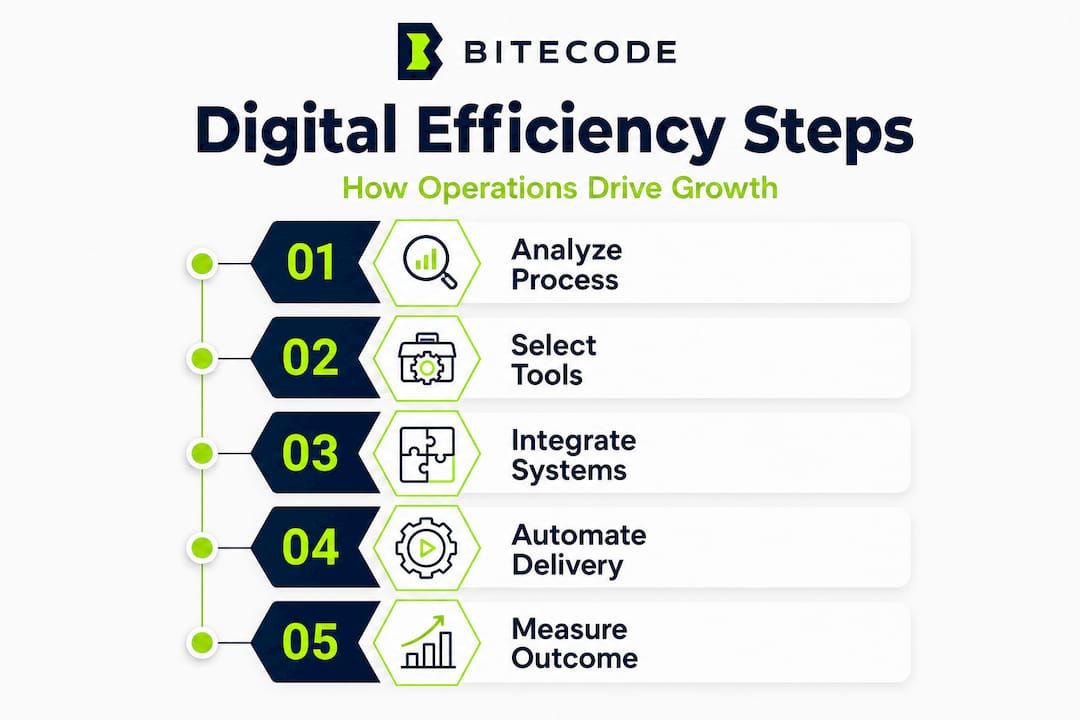
This distinction is why many technology investments disappoint. When teams acquire a new platform to solve a specific pain point without considering how it connects to existing systems, they relocate complexity rather than eliminate it. A new project management tool that requires manual updates from a separate ERP system, for example, does not create efficiency. It creates more touchpoints for error. Leaders focused on digital discipline in leadership increasingly recognize that restraint and integration quality matter as much as innovation speed.
True digital efficiency produces specific, measurable outcomes:
- Reduced operational costs through fewer manual steps and lower error rates
- Less unplanned downtime through proactive monitoring and resilient architecture
- Faster, higher-quality decisions through consolidated data and clear workflow ownership
- Adaptive processes that respond to changing conditions without requiring full re-engineering
“Digital efficiency is not a technology project. It is an operational discipline that uses technology as its medium. Without that clarity, tool adoption accelerates spending without accelerating results.”
Following software efficiency best practices means starting with process analysis before platform selection, not the other way around. Organizations that do this correctly avoid the trap of building digital complexity in place of analog complexity.
How disciplined delivery makes or breaks efficiency gains
Knowing what digital efficiency means is necessary, but not sufficient. The mechanisms that convert strategic intent into operational reality require their own discipline. Specifically, the way software is built, validated, deployed, and monitored determines whether efficiency gains are realized or lost in translation.
Digital efficiency depends on disciplined delivery mechanisms such as CI/CD pipelines, automated testing, and continuous monitoring. Without them, the benefits of release velocity, system stability, and reduced downtime simply do not materialize. Teams can have excellent intentions and still ship unreliable software if the underlying delivery process is manual, inconsistent, or poorly instrumented.

Consider the contrast between manual and automated delivery workflows:
| Dimension | Manual workflows | Automated workflows |
|---|---|---|
| Deployment frequency | Low, infrequent, risky | High, predictable, low risk |
| Error detection | Post-deployment, costly | Pre-deployment, cheap to fix |
| Release stability | Variable | Consistent |
| Team cognitive load | High, context-dependent | Reduced, process-driven |
| Recovery time | Slow, often manual | Fast, scripted rollback |
The table is not theoretical. Enterprise teams running manual release processes typically deal with longer change-failure cycles, higher incident rates, and more reactive firefighting. The cognitive cost alone, where engineers spend hours reconstructing what changed and why, is a significant drag on organizational velocity.
Implementing layered automation helps in a predictable sequence:
- Standardize the codebase using version control and branch policies so all changes are traceable.
- Introduce automated testing at unit, integration, and end-to-end levels to catch regressions before they reach production.
- Implement CI/CD pipelines that trigger on every merge, ensuring code is always in a deployable state.
- Add observability tooling (logs, metrics, distributed tracing) so teams detect anomalies in real time rather than after customer impact.
- Establish feedback loops from monitoring back into the development process, so recurring issues become prioritized fixes rather than repeat incidents.
Pro Tip: Pair Git-driven CI/CD with automated validation gates at each pipeline stage. A gate that fails a build when test coverage drops below a threshold, or when a security scan finds a critical vulnerability, turns human discipline into system-enforced policy. That shift is what allows teams to automate complex workflows without sacrificing safety.
These enterprise automation strategies do not just accelerate delivery. They create the structural conditions under which predictable software quality becomes a repeatable outcome rather than a lucky streak.
Recognizing the limits: When efficiency gains backfire
Digital efficiency is genuinely valuable, but pursuing it without attending to verification and governance can produce results worse than the status quo. This is one of the more uncomfortable truths in enterprise technology leadership, and it deserves direct attention.
Efficiency gains can be offset by verification and governance burdens for high-stakes or complex tasks. Research suggests that developers working with AI assistance on complex problems can actually be 19% slower than those working without it, precisely because the review, certification, and compliance overhead required to validate AI-generated output consumes the time saved in generation. This does not mean AI or automation is counterproductive. It means governance cost must be factored into efficiency calculations from the start.
The following table illustrates how verification overhead affects productivity in high-stakes deployments:
| Environment type | Automation benefit | Verification overhead | Net efficiency gain |
|---|---|---|---|
| Low-complexity internal tools | High | Low | Strongly positive |
| Mid-complexity business apps | Moderate | Moderate | Positive with discipline |
| High-stakes regulated systems | High potential | Very high | Marginal without governance design |
| AI-assisted complex development | Moderate | High (review cycles) | Can be negative without process design |
The takeaway is not to avoid automation in regulated environments. It is to design the governance process alongside the automation process, not as an afterthought. Organizations managing financial systems, healthcare data, or compliance-critical workflows must treat oversight architecture as a first-class deliverable.
Red flags that signal efficiency efforts may be undermining reliability:
- Release frequency increases but incident rates also increase, suggesting validation is not keeping pace with velocity.
- Teams struggle to explain system behavior in post-incident reviews, indicating observability is insufficient.
- Compliance audits reveal undocumented changes, pointing to gaps between automated pipelines and audit trail requirements.
- Bottlenecks migrate rather than disappear, appearing in review queues or approval workflows when the core process accelerates.
- Metrics improve on paper while operational frustration grows, often a sign that measurements are not capturing the real cost of governance friction.
“Complexity without clarity blunts the benefits of digital investment. When organizations automate quickly but govern loosely, they trade one class of problems for another.”
Decision-makers navigating these trade-offs benefit from structured decision governance frameworks that explicitly address how automated systems are reviewed, who holds accountability, and what escalation paths exist when automated decisions produce anomalous results. Managing integration complexity with security and clear ownership is not optional in these environments. It is foundational.
Turning efficiency into competitive advantage: Practical steps
Understanding the theory and recognizing the risks creates the conditions for disciplined action. Organizations that convert digital efficiency from a concept into a competitive differentiator tend to follow a recognizable framework, applied consistently across business units rather than in isolated pockets.
AI can improve leader decision speed through real-time data synthesis, predictive modeling, and rapid scenario testing. But realizing that benefit requires frameworks for transparency, healthy questioning of outputs, and governance to convert insight into operational action. Technology accelerates the process. Leadership disciplines determine whether the output is reliable.
A practical action framework for teams ready to move from theory to execution:
- Map existing workflows end to end before touching any tooling. Identify where manual effort concentrates, where delays accumulate, and where error rates are highest. This baseline is the honest starting point.
- Prioritize automation candidates based on frequency, error cost, and strategic impact. High-frequency, low-complexity tasks offer the cleanest early wins. Avoid automating broken processes before fixing them.
- Embed monitoring and feedback loops from day one of any automation initiative. Efficiency gains that are not measured cannot be defended, and unmeasured systems cannot be improved.
- Reinforce decision governance by assigning ownership to every automated output that has downstream business consequence. Automation without accountable human review creates accountability gaps that surface at the worst possible moments.
For workflow optimization at the CIO level, the framework above needs organizational backing. Without executive commitment to the discipline, individual teams optimize locally while systemic friction persists.
Leadership habits that genuinely support sustainable digital efficiency:
- Transparency over optics. Share real metrics including error rates and incident counts, not just velocity numbers. Teams that see honest performance data make better prioritization decisions.
- Reduce noise before adding tools. Every new platform introduces integration surface. Retire underused tools before adding new ones to keep the technology footprint manageable.
- Healthy skepticism of metrics. A metric that improves while the underlying problem persists is a measurement problem, not a performance gain. Challenge numbers that seem suspiciously positive.
Pro Tip: Use structured pilot programs before scaling any automation initiative. A pilot with defined success criteria, a realistic timeline, and an explicit review point surfaces the governance and verification costs before they become enterprise-scale problems. It is far easier to course-correct in a pilot than to reverse an organization-wide rollout that has already embedded new dependencies.
Resources on AI innovation in operations consistently reinforce this pattern: the organizations extracting durable value from digital investment are those that treat governance and measurement as core capabilities, not administrative overhead.
Why most digital efficiency efforts stall, and how to do better
After working across enterprise software contexts, a clear pattern emerges. Most digital efficiency initiatives do not fail because organizations chose the wrong tools. They fail because the human and leadership disciplines that sustain efficiency are underestimated, underinvested in, or simply absent.
Tool selection gets the majority of attention in most digital transformation discussions. But a best-in-class automation platform in the hands of teams without clear process ownership, shared performance standards, or leadership that models disciplined decision-making produces chaos at higher speed. The tools accelerate whatever is already present in the organization. If what is present is fragmented accountability and unclear priorities, automation amplifies exactly those problems.
What actually works versus what sounds good in theory:
- Works: Defining clear process ownership before automating. Automation without ownership creates systems nobody defends when things break.
- Sounds good but fails: Automating everything simultaneously. Broad automation initiatives without sequencing overwhelm teams and obscure which changes are producing which outcomes.
- Works: Building feedback loops into every automated process. Organizations that measure, review, and act on operational data consistently outperform those that set up automation and move on.
- Sounds good but fails: Treating digital efficiency as a one-time project. Efficiency is an ongoing operational discipline, not a destination. Organizations that declare success after a major rollout often find gains erode within 18 months.
- Works: Developing advanced workflow management capabilities that are reusable across business units. Shared automation frameworks and common governance models reduce the effort required to scale efficiency initiatives across the organization.
The organizations that pull ahead do so by combining good tooling with consistent leadership disciplines, replicable frameworks, and a genuine commitment to operational learning. That combination is harder to build than a platform subscription, but far more durable as a competitive advantage.
Accelerate your digital efficiency journey with Bitecode
The principles outlined here point toward a clear conclusion: sustainable digital efficiency requires both the right technical foundation and the disciplined architecture to support it. For teams ready to act on that understanding, the practical challenge is compressing the time between strategic intent and working, reliable systems.
Bitecode builds exactly that kind of foundation. By starting projects with up to 60% of the baseline system pre-built through modular components, including AI assistant capabilities for workflow automation and intelligent decision support, and blockchain-based payment solutions for organizations managing complex financial transactions, Bitecode helps medium to large organizations reach production-ready systems in a fraction of the time traditional development requires. The result is less time spent on boilerplate, more time spent on the business-domain complexity that actually differentiates your operations. If your team is ready to move from planning to execution, Bitecode is a practical starting point for that conversation.
Frequently asked questions
What are the top measurable benefits of digital efficiency?
The main benefits are cost reduction, minimized downtime, reduced manual labor, and faster high-quality decision-making, as digital efficiency integrates and optimizes digital tools toward all four outcomes simultaneously.
How can organizations measure their digital efficiency progress?
Teams should track release velocity, error rates, unplanned downtime, cost per workflow, and employee effort reduction, since disciplined delivery mechanisms such as CI/CD and automated monitoring make these metrics visible and actionable.
What are common reasons digital efficiency initiatives fail?
Failure typically stems from poor tool integration, lack of disciplined delivery processes, and neglected verification or governance controls, all of which allow efficiency gains to be offset by accumulated compliance and review overhead.
How can AI help decision-makers become more efficient?
AI accelerates decision speed through real-time data synthesis and rapid scenario modeling, but requires clear governance and transparency frameworks to convert insight into reliable operational action, as AI leadership research consistently confirms.
What’s the risk of pursuing efficiency without proper oversight?
Without proper oversight, organizations increase their exposure to errors, compliance violations, and cascading failures, particularly in complex environments where verification overhead grows proportionally with system complexity and regulatory requirements.