Core banking integration is the work of connecting a bank’s system of record to everything around it: payment networks, digital channels, KYC and fraud tools, CRM, accounting and fintech partners. The approach that holds up is a thin, well-governed integration layer in front of the core, built from proven modular components, not a custom point-to-point connection for every new product. That is how we build it at Bitecode, and the rest of this article explains why, and how to plan it.
The core itself rarely changes quickly. The systems around it change constantly. Integration is where a bank or fintech either accelerates work without accelerating chaos, or relocates complexity into a tangle of interfaces nobody fully owns.
TL;DR
- Core banking integration connects the ledger and account system to channels, payments, compliance tools and partners, usually through APIs, middleware, event streams and batch jobs together.
- Many U.S. cores were not designed for open banking or instant payments, so an integration layer in front of the core is often the practical route to new services.
- Every added connection widens the attack surface. Encryption, provider oversight and monitoring belong in the design from the first sprint.
- A phased plan (inventory, pattern choice, pilot, test, monitor) lowers risk more than any single technology choice.
- Starting from a modular foundation, with a large share of the baseline system already built, shortens the path to a working integration layer.
What core banking integration actually covers
Each U.S. depository institution runs a back-end core system that processes daily transactions and manages financial accounts. The Federal Reserve Bank of Kansas City notes that many of these systems are outdated and cannot fully support modern services such as open banking and instant payments. That gap is the reason integration is a project in its own right.
The same Kansas City Fed briefing splits the landscape in two. Primary core services are account management, customer management, deposit and withdrawal processing, loan processing, and finance and accounting. Ancillary services include payments, bank product interfaces, customer support, fraud and risk management, compliance and audit, reporting and analytics, and supporting third-party apps. Integration is mostly about the second list: getting those ancillary systems to read from and write to the primary one reliably.
In practice, the data that moves falls into a few families:
- Customer and account data: profiles, balances, account status, KYC results.
- Transactions: postings, holds, reversals, settlement confirmations.
- Reference and risk data: limits, sanctions and fraud signals, product rules.
- Reporting data: ledgers and events feeding analytics, audit trails and regulatory reports.
A useful test of any integration design: for each data family, can you say which system owns it, how a change travels, and how you would prove it arrived once and only once?
The four integration patterns, and when each fits
Most real projects combine patterns. The skill is assigning each flow to the right one.
APIs for synchronous requests
APIs suit questions that need an immediate answer: a balance check, an account lookup, a payment authorization. Speed matters here. AWS’s reference guidance for a core banking build states that real-time transactions must be written to the database and answered within about 200 ms, which it achieves with a dedicated network link to the bank’s data center and as few hops as possible to the ledger. The lesson applies beyond AWS: every extra hop in a synchronous path costs latency and adds a failure point.
Middleware for translation and control
When the core has no native way to talk to channels and apps, or its APIs are not enough, a middleware layer closes the gap. The ABA’s 2022 report says middleware is needed in exactly those cases, and that a typical layer contains four modules: an API gateway, an API manager, data integration and transformation tools, and a developer portal.
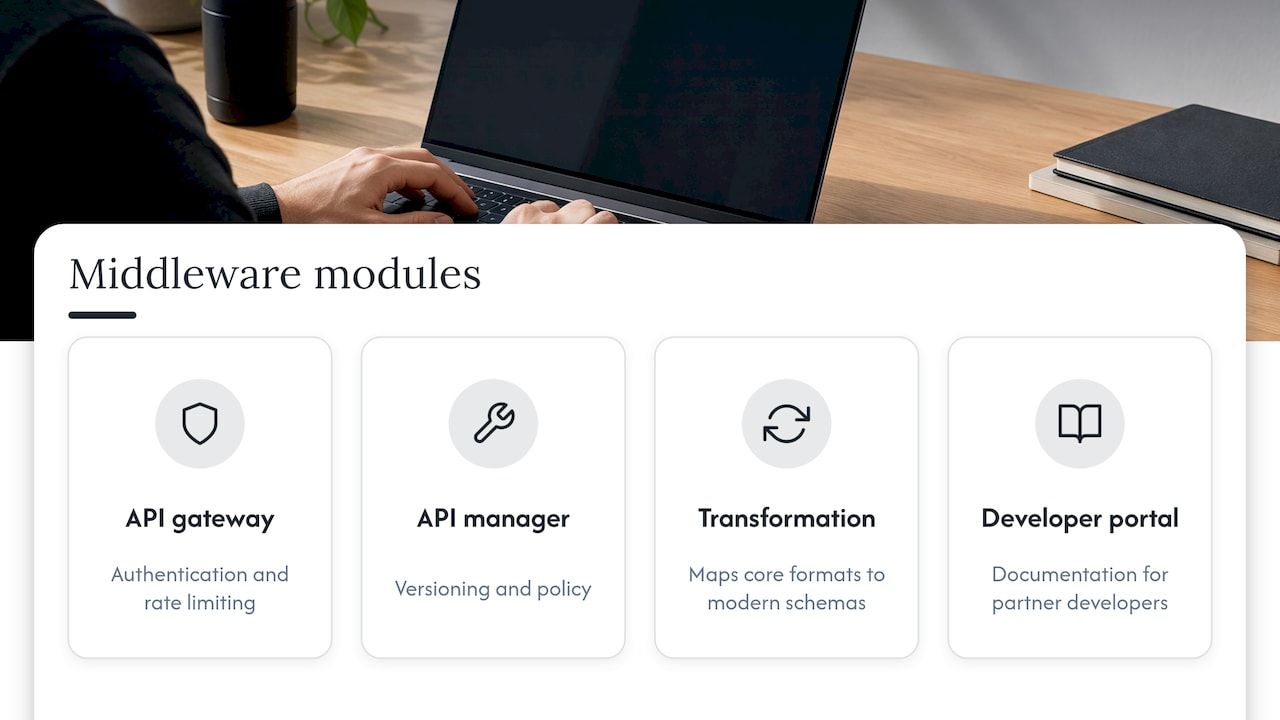
That list is a good checklist for scoping. If your design lacks a place for authentication and rate limiting (the gateway), for versioning and policy (the manager), for mapping between core formats and modern schemas (transformation), or for documentation that partner developers can use, the missing piece will show up later as support tickets.
Event-driven messaging for real-time propagation
Instant payments and live notifications do not fit a request-and-wait model. EY advises banks to adopt event-driven architectures with real-time messaging so newer products, such as instant payment connectivity, can rely on modern ledgers that give immediate transaction visibility and settlement. In AWS’s reference design, the same idea appears as data replicated from the ledger database to a secondary database, with downstream applications consuming from a streaming service.
The benefit is decoupling. The ledger publishes what happened, and fraud, notifications, analytics and CRM each subscribe, without the core needing to know they exist.
Batch for volume and reconciliation
Batch processing has not gone away. End-of-day files, statement runs, regulatory extracts and reconciliations still move in scheduled bulk. A hybrid approach is usually most practical: synchronous calls for simple, fast queries, events for propagation, and batch where completeness matters more than latency. Treat batch as a deliberate choice with its own monitoring, not as legacy residue.
| Pattern | Best for | Main risk | What to design in |
|---|---|---|---|
| Synchronous API | Balance checks, authorizations | Latency, cascading failure | Timeouts, circuit breakers, caching |
| Middleware layer | Translating core formats, policy | New entry point, vendor dependence | Gateway security, ownership of mappings |
| Event stream | Notifications, analytics, fraud | Duplicate or out-of-order events | Idempotency keys, replay tooling |
| Batch | Reconciliation, reporting | Late detection of errors | Control totals, exception queues |
Choosing an architecture for a legacy or modern core
The right layout depends on what the core can already do. Three questions settle most decisions.
What does the core expose today? If it offers stable, documented APIs with adequate throughput, a lighter gateway may be enough. If it exposes only files or proprietary protocols, middleware with strong transformation tooling carries more of the load.
Which flows are real time? Isolate them. Instant payment connectivity and card authorization justify event-driven design and tight latency budgets. Reporting does not, and forcing it onto the same path adds cost without benefit.
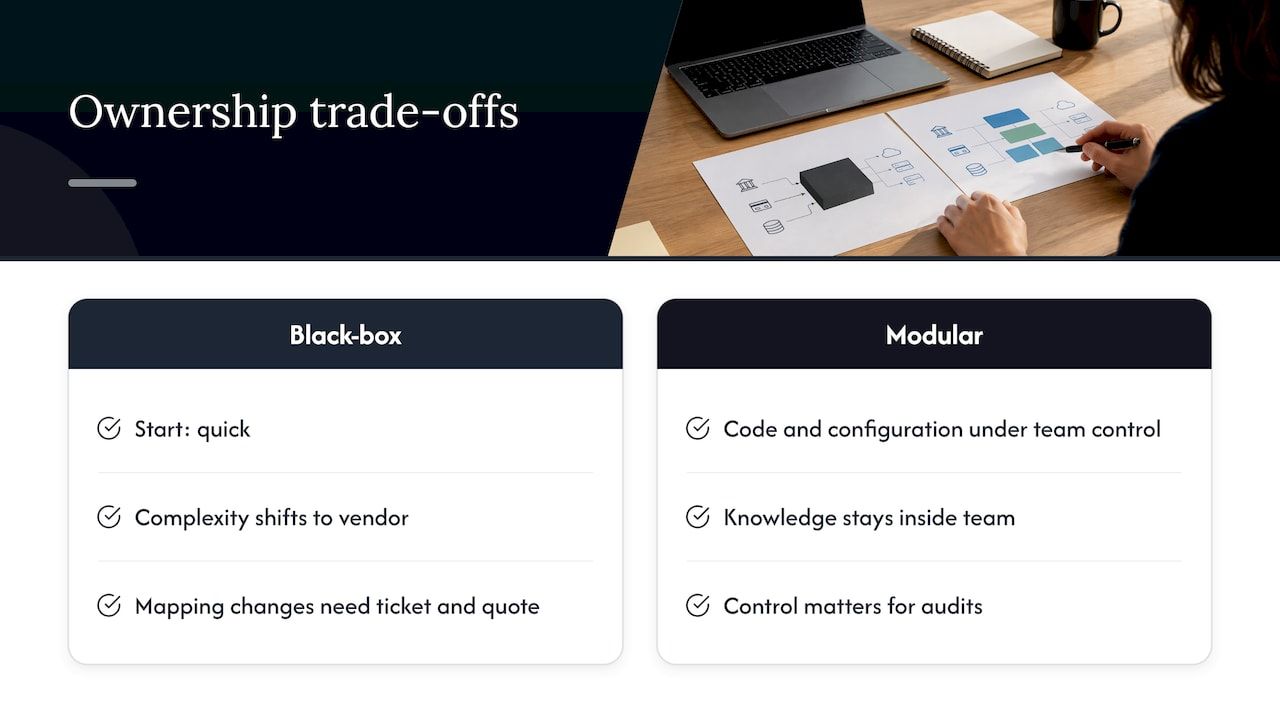
Who will own the layer in five years? This is where the trade-off appears. A black-box platform can be quick to start, but it can also relocate complexity into the vendor relationship, leaving you unable to change a mapping without a ticket and a quote. A modular foundation whose code and configuration you control keeps that knowledge inside your team. For regulated institutions, that control also matters for audits.
AWS’s nine-step reference architecture illustrates a clean separation worth copying even if you never use that cloud: an API layer between the core platform and upstream applications, payment-network transactions entering through defined interfaces, replicated data for downstream consumers, and consumers reading from a stream, not from the ledger itself. Protecting the ledger from direct reads is a design principle, not a vendor feature.
For more on connecting external financial data safely, see our guide to financial data integration challenges, and for consent-based access to customer accounts, our US guide to open banking integration.
Security and compliance: the integration layer is the new perimeter
A new integration layer is also a new place to be attacked. The ABA report warns that adding a technology layer, especially one supplied by a third party, increases the number of entry points in the stack and so the probability of a breach. The answer is to design for that from the start.
Practical controls:
- Encrypt everywhere. The FTC’s GLBA Safeguards Rule requires financial institutions to encrypt customer information in transit over external networks and at rest, with appropriate protection for the cryptographic keys.
- Authenticate services, not just users. EY recommends protecting partner data exchanges with API-based encryption, mutual TLS and immutable ledger technologies, alongside embedded controls and automated governance.
- Govern your providers. The same Safeguards Rule requires reasonable steps to select service providers able to maintain safeguards, contracts that require them, and periodic risk-based assessments. The obligation stays with the institution.
- Understand data use. The ABA notes that traditional core providers have deep compliance experience that newer technology vendors may lack, so for critical functions such as KYC or loan origination, banks need to understand how a middleware provider uses and manages customer data to satisfy regulators.
When you assess a build partner, ask where the code runs, who holds the keys, and whether the layer can be self-hosted inside your own environment. Those answers shape your audit story more than any feature list does. Our fintech compliance requirements checklist, financial data security guide and secure software integration guide go deeper on each control.
Security and regulatory questions specific to your charter belong with your compliance officer and counsel, who should sign off on provider contracts before go-live.
A phased plan for implementation
Integration projects fail less from technology than from unclear scope and late testing. A sequence that works:
1. Inventory systems and data owners
List every system that touches the core today, including spreadsheets and file drops. For each, record the data it reads and writes, the protocol, and the person accountable. This usually surfaces undocumented interfaces, which are the ones that break during cutover.
2. Assign a pattern to each flow
Use the table above. Resist the urge to put everything on one pattern. Mark which flows are real time, which need guaranteed delivery, and which are bulk.
3. Define the integration layer’s boundaries
Decide what the layer owns: authentication, schema mapping, rate limits, audit logging. Decide what it does not own: business rules that belong in the core or in the product.
4. Pilot with one product or channel
Pick a flow with contained risk and visible value, such as a customer notification feed or a CRM sync, and run it end to end. A narrow MVP exposes mapping errors and permission gaps while they are still cheap.
5. Test beyond the happy path
Test duplicate messages, timeouts, partial failures, out-of-order events, and core downtime windows. Reconcile balances between the core and each downstream system with control totals, not spot checks.
6. Monitor from day one
EY advises establishing governed cloud data platforms with embedded telemetry, so teams can observe the whole stack, monitor data flows and system health and get real-time insight into compliance and resilience. In practice that means dashboards for latency, error rates, queue depth and reconciliation breaks, with alerts routed to a named owner.
7. Scale in increments
Add flows one at a time, reusing the gateway, mappings and monitoring you already have. The second integration should cost noticeably less than the first. If it does not, the layer is not reusable and needs rework.
Fintech partnerships and banking-as-a-service
Integration is also the commercial engine behind banking-as-a-service. In EY’s framing, BaaS modernization means upgrading core technology, data governance, integration architecture and security controls to support scalable, compliant and AI-ready partner ecosystems. EY recommends an API-first design, multi-tenant architecture, real-time processing, and a modular integration framework for secure interoperability across partners.
The American Banker has described how one community bank built a subledger integrated with its core operating system so fintech partners could transact while the bank monitored that the books balanced and activity complied with regulations. That structure is instructive: partners get a controlled surface, and the bank keeps the ledger and the oversight.
For a fintech or SaaS company, the practical point is that you rarely need to touch the core directly. You need a well-designed API surface and an integration layer that handles accounts, payments and reporting with the controls the sponsoring institution expects. For payment rails beyond cards and ACH, see our overview of enterprise blockchain payment integration for U.S. compliance.
Where Bitecode fits
If you are building the layer between your core and everything else, we start projects with up to 60% of the baseline system already built, using modular, ready-made components rather than a blank repository. Our Financial Module, Automation Module, CRM Module and AI Assistant are designed for multi-currency, audit-ready, self-hosted deployments, so your team keeps control of where the integration layer runs and how it is customized.
For a bespoke integration layer or internal banking tooling, our custom business software service covers the build, and our AI business process automation handles workflow steps such as exception routing and reconciliation follow-up. If you want to prove the approach on one flow first, a small MVP is the natural entry point.
Tell us which core you run and which flow hurts most. We will scope it from there at bitecode.tech.
Our perspective
Most integration pain comes from treating each new connection as a one-off. Teams wire a channel to the core, then a fraud tool, then a CRM, and a year later nobody can say which interface owns which field.
We argue for a modular foundation: a shared gateway, shared mappings, shared audit logging, and components that already behave correctly for multi-currency and financial processing. Starting with a large share of the baseline system built lets a team spend its effort on the business-domain complexity that is unique to the institution, not on boilerplate.
Control matters as much as speed. Self-hosted modules and client-controlled customization mean the integration layer is something your engineers and auditors can inspect and evolve, not a black box that relocates complexity into a vendor relationship.
Our approach is to pilot one flow, prove reconciliation and monitoring, then extend the same foundation to the next. That is how we accelerate work without accelerating chaos.
Bitecode
FAQ
What is core banking integration?
It is the connection of a bank’s core system of record to channels, payment networks, compliance tools, CRM, accounting and partner applications. It typically combines APIs, middleware, event streams and batch files, so data stays consistent across every system that depends on the ledger.
Do I need middleware to integrate with a core banking system?
Often, yes. The ABA’s middleware report says it is needed when the core has no native way to talk to channel systems or when its APIs fall short of the bank’s needs. If the core exposes rich, stable APIs, a lighter gateway can be enough.
How long does a core banking integration take?
It depends on what the core exposes, how many flows you connect and how much compliance review each needs. A single-flow pilot is far quicker than a full program. Starting from pre-built modular components removes a large part of the baseline work, so scoping a narrow first phase is the best way to get a real estimate.
What are the biggest security risks?
Each new connection adds an entry point, so the main risks are weak service authentication, unencrypted data in transit or at rest, and insufficient oversight of third-party providers. Mutual TLS, encryption with sound key management, and documented provider assessments address them directly.
Can a fintech integrate without touching the core directly?
Yes. Many fintechs work through APIs exposed by a sponsoring bank or an integration layer, so they never connect to the core itself. The bank keeps the ledger and compliance oversight, and the fintech builds on a controlled interface.
Sources
- Core Banking Systems and Options for Modernization, Federal Reserve Bank of Kansas City
- Guidance for Building a Core Banking System on AWS
- Exploring Banking Middleware Solutions, ABA 2022 Middleware Report
- BaaS modernization for scalable banking platforms, EY US
- GLBA Safeguards Rule: Protecting NPI After You Share It
- Two small banks aim to turbocharge growth by serving fintechs, American Banker