Open banking integration connects your software to customers’ bank accounts through APIs, so you can retrieve account data or initiate payments once the customer consents. In the United States there is no single national gateway. You connect through data aggregators, directly to individual banks, or both, and the rules that govern this are still being settled.
This guide covers how the integration works, which US rules apply today, the steps to implement it, and how to test coverage and reliability before you commit engineering time.
TL;DR
- Open banking lets consumers share bank data with third parties through APIs, usually facilitated by data aggregators.
- A typical integration redirects the customer to the bank to authenticate and consent, then exchanges an authorization code for tokens that unlock permitted APIs.
- The CFPB finalized its personal financial data rights rule in 2024, but its compliance dates were stayed by a court in October 2025, so design for the standard while watching the official page.
- Plan for consent management, token security, institution coverage testing and API maintenance before production, not after.
What open banking integration means in the US
Open banking is the practice of letting consumers share bank-account data with third-party service providers through APIs. According to the Kansas City Fed, aggregators usually sit in the middle: the consumer authorizes, the third party asks an aggregator, the aggregator asks the bank, and the data flows back along the same path.
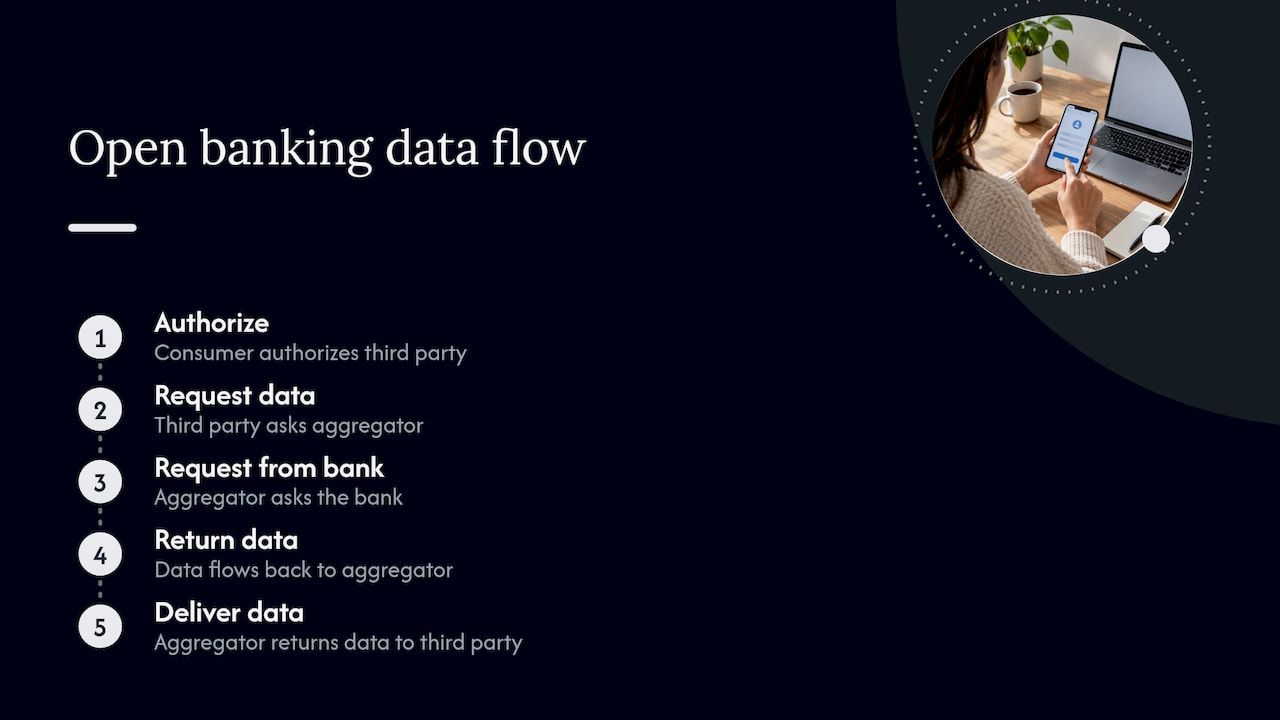
An integration is the engineering work that makes your product a participant in that chain. It includes the authorization flow, token storage, the data model you map bank responses into, consent records, monitoring and the operational process for when a bank endpoint misbehaves.
The US market differs from Europe and the UK. It grew through private agreements and industry standards rather than a single regulatory mandate. Consumers already share data through aggregators, APIs or screen scraping, and the Congressional Research Service notes that the Gramm-Leach-Bliley Act permits disclosure when consumers consent to or direct it.
What you can build with it
The Kansas City Fed lists use cases that map directly to business products: Pay-by-Bank, instant bill payments, cash-flow lending, account verification, balance checks and fraud mitigation. For a B2B team, the most common patterns are:
- Account verification during onboarding, replacing manual micro-deposit checks.
- Balance and transaction retrieval for underwriting, cash-flow forecasting or accounting sync.
- Payment initiation for account-to-account payments and collections.
- Treasury and reconciliation feeds that bring bank activity into internal systems.
How an open banking API integration works
The mechanics are less exotic than the vocabulary suggests. Most implementations rely on the OAuth 2.0 authorization-code pattern.
- The customer starts in your application. They choose their bank and the data or payment you are asking for.
- You redirect them to the bank. The customer authenticates with the bank directly, so your system never sees their bank credentials, and grants consent.
- The bank redirects back with an authorization code. U.S. Bank’s developer security guide describes this step, after which your server exchanges the code for tokens.
- You call permitted APIs with the tokens. Scopes define what you may access. That guide, for example, requires the openid and accounts scopes and identifies the third-party application through a dedicated parameter in the authorization request.
- You refresh, monitor and revoke. Tokens expire, customers revoke, and banks change endpoints.
For higher-assurance profiles, the Ozone technical guide describes the FDX and FAPI sequence: a pushed authorization request, customer redirection to the bank for OAuth authentication, and token issuance for data retrieval. When an aggregator is involved, your application talks to the aggregator’s API and the aggregator manages the bank-specific connections.
Why APIs beat screen scraping
The Kansas City Fed identifies three advantages of APIs over scraping: credentials are shared with fewer parties, banks can control the amount and type of data, and access can be more efficient and timely. A January 2025 Georgetown Center on Financial Markets paper reports one cited study that found connectivity issues in 0.5% of open banking attempts against 22% for screen scraping, while noting that API maintenance still carries costs.
The practical conclusion for a build team: APIs reduce a class of failures, but they do not eliminate operations work. Budget for it.
US rules: what governs access to financial data
The legal picture is the part most likely to change during the life of this article, so it helps to separate what is stable from what is in motion.
What is stable
Section 1033 of the Dodd-Frank Act requires covered institutions, subject to CFPB rules, to make certain account data available on request. Alongside it, GLBA permits disclosure when a consumer consents to or directs it. Both points come from the CRS overview of consumer financial data access.
What the 2024 CFPB rule says
The CFPB’s rule published in the Federal Register on November 18, 2024 requires covered data providers to make covered financial data available to consumers and authorized third parties in secure, reliable, standardized, machine-readable form. It also prohibits satisfying access obligations through screen scraping and prohibits fees for consumer or third-party access.
The CFPB’s October 2024 announcement adds the detail that matters to builders:
- Covered data includes transaction information, account balances, payment-initiation information, upcoming bills and basic account-verification information.
- Access must end immediately after a customer revokes it, and deletion is the default.
- Access may continue for no more than one year without express reauthorization.
What is in motion
The CFPB states that the rule’s compliance dates were stayed by court order on October 29, 2025 in Forcht Bank v. CFPB, and the CRS notes the rule is subject to litigation and reconsideration. Check the CFPB’s page for the current status before you finalize a compliance plan.
Our recommendation is to build to the rule’s principles anyway: standardized data, consent that can be revoked and expires, and no dependence on credential sharing. Those requirements are good engineering regardless of the timeline, and retrofitting consent and deletion later is more expensive than designing them in. Your legal counsel should confirm which obligations apply to your institution type.
Steps to implement an open banking integration
The Financial Data Exchange (FDX) publishes US implementation guidance that is written mainly for financial institutions, yet its sequence is useful for any team. Adapted for a business building a connected product:
- Define business requirements. Which data fields, which account types, which payment capabilities, and for which customers? Vague scope is the main source of rework.
- Decide how much of the data model to implement. FDX advises deciding which portions of its data model you will support rather than adopting everything.
- Choose your connectivity route. Aggregator, direct bank connections or a mix. Banks, in the FDX framing, evaluate building versus buying an API. Third parties face a mirror-image decision.
- Plan migration from screen-scraped fields. If you already pull data by scraping, map each scraped field to its API equivalent.
- Design consent management before production. Store what was consented to, when, by whom, for how long, and how revocation propagates.
- Pick an initial testing partner. Start with one institution, establish issue-response processes, then widen.
- Run in parallel. FDX recommends running the API in production alongside scraping before retiring scraping.
Where integrations stall
The American Banker research from January 2026 found that third-party risk management was the challenge surveyed banking respondents cited most, followed by data-access agreements, API maintenance and upgrades, and third-party support. For you as the third party, that translates into longer security reviews, contract negotiation and a need to show disciplined operations. Prepare documentation early. Our guide to financial data integration challenges covers the data-mapping side of this in more depth.
Security requirements for open banking APIs
Financial APIs are an attractive target, and the standards reflect that. The OpenID Foundation’s reference architecture identifies FAPI as a high-security open banking profile. FAPI 2 uses the OAuth 2 authorization-code flow with pushed authorization requests, token binding through mutual TLS or DPoP, and client authentication through private_key_jwt or mutual TLS.
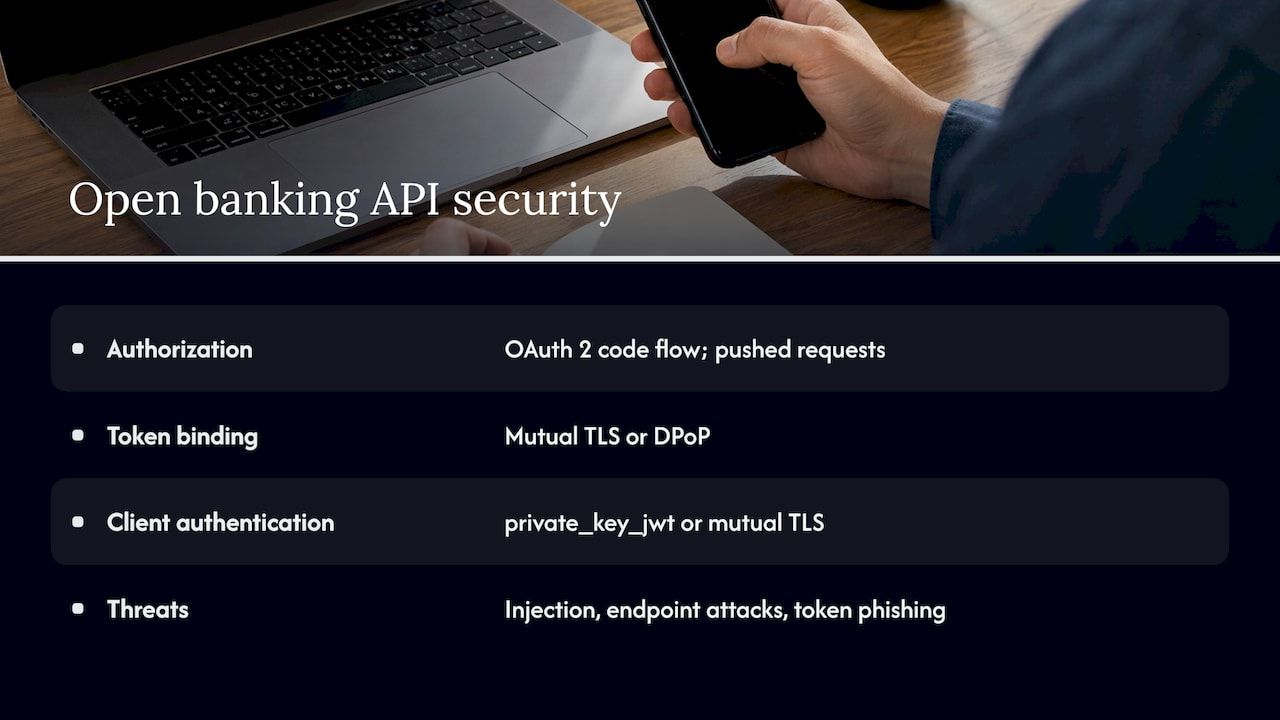
The FAPI 1.0 Advanced specification explains why: it addresses authorization-request and response tampering, code injection, state injection, endpoint attacks and token-request phishing. U.S. Bank’s developer guide, mentioned above, similarly documents registered redirect URIs, required scopes and mutual TLS with exchanged certificates.
A practical security checklist
- Register exact redirect URIs and reject anything else.
- Use the authorization-code flow with PKCE or pushed requests, never implicit flows.
- Bind tokens to the client with mutual TLS or DPoP where the bank supports it.
- Keep tokens and certificates in a managed secret store with rotation and audit logging.
- Log every consent event and every data access in a form an auditor can read.
- Honor revocation immediately and apply your retention and deletion schedule.
If your product also moves money, layered payment security and fraud controls belong in the same design review as your API security. For broader guidance on protecting data in transit and at rest, see our financial data security best practices and the fintech security guide for IT leaders.
Testing coverage and reliability
Coverage in the US is uneven by institution, account type and capability, so treat it as a measurement problem, not a marketing claim. The FDX guidance supports a disciplined approach:
- Build a target-institution matrix. Rows are the banks your customers use. Columns are account types, endpoints, data fields, payment capabilities, authentication methods and expected availability.
- Test representative institutions. Include a large national bank, a regional bank and a credit union if your customers use them.
- Measure what matters. Track response rates, latency, data freshness, error rates, consent completion and payment-status accuracy.
- Monitor in production. Set alerts per institution, because a healthy average hides one broken bank.
- Coordinate incident handling. Know who to contact at the aggregator or bank and what your customer sees while it is down.
Consent completion deserves special attention. A technically perfect integration still fails commercially if customers abandon the bank redirect. Instrument each step of the flow and review drop-off by institution.
Once data lands, the next problem is usually matching it to internal records. Our examples of financial reconciliation automation show how teams close that loop, and our NACHA file format checklist is relevant if payments also settle over ACH.
Build, buy or assemble from a modular foundation
Teams usually face three options. A pure aggregator integration is quickest to start, but your product inherits its data model and roadmap. A fully custom build gives control, but it puts months of effort into authentication, consent storage, ledgers and audit trails that look nearly identical across companies. A modular foundation sits between them: proven components for the repetitive parts, custom code where your business differs.
| Approach | Speed to first release | Control over data model | Main risk |
|---|---|---|---|
| Aggregator only | Fast | Limited to what the aggregator exposes | Dependence on one vendor’s coverage and roadmap |
| Fully custom build | Slow | Complete | Engineering time spent on commodity plumbing |
| Modular foundation plus custom layer | Moderate to fast | High | Requires a clear scope for what is custom |
Our perspective
Most open banking projects we see do not fail at the API call. They fail around it: consent records that cannot answer an auditor, token handling bolted on late, and bank data that never reconciles with the internal ledger.
That is why we start from a modular foundation rather than a blank repository. Our approach is designed to let a project begin with up to 60% of the baseline system already in place, including financial processing, workflow automation and audit-ready structure, so engineering time goes to the integration logic that is specific to your business.
We also favor client-controlled, self-hosted deployment where data sensitivity demands it. A system you can host, extend and maintain yourself keeps complexity inside your own architecture instead of relocating it into a vendor relationship.
Our advice to teams is to treat the 2024 CFPB rule as a design direction even while its timeline is contested: standardized data, revocable and expiring consent, and no reliance on shared credentials. Build those properties once, and the system holds up whichever rule set finally applies.
Bitecode
Build your integration with Bitecode
If you are planning an open banking integration, we can scope it as a small MVP to validate one use case, or as a larger program covering several institutions and payment flows. Our Financial Module provides accounting, audit and subscription building blocks, workflow automation can handle reconciliation and exception routing, and our custom business software service covers the product layer around them.
To discuss your requirements, start from the Bitecode homepage and describe the institutions, data and payment flows you need.
FAQ
Is open banking legal in the US?
Yes. Consumers already share bank data through aggregators, APIs and screen scraping, and GLBA permits disclosure when consumers consent or direct it. Section 1033 requires covered institutions to provide certain data on request, subject to CFPB rules. The CFPB’s 2024 rule is stayed and under reconsideration, so check the CFPB’s official page for current status.
What is the difference between an open banking API and screen scraping?
An API gives a third party permissioned access through tokens, so customers never hand over their bank credentials. Screen scraping uses the customer’s login to read web pages. The Kansas City Fed notes that APIs involve fewer parties holding credentials and give banks control over the type and amount of data shared.
What are the downsides of open banking?
The main challenges are technical and operational: uneven standardization across institutions, API maintenance costs and third-party risk reviews. They are manageable with a coverage matrix, production monitoring and clear data-access agreements, as described above.
Which data can a US open banking integration retrieve?
Under the CFPB’s 2024 rule, covered data includes transaction information, account balances, payment-initiation information, upcoming bills and basic account-verification information. What you actually receive depends on the institution and the connectivity route you use.
Sources
- Open Banking: A Critical Piece in the Future of Financial Services, Kansas City Fed
- Security guide, U.S. Bank Developer Portal
- Technical Guide to CFPB Section 1033, Ozone API
- Getting Started with Open Banking, Financial Data Exchange
- Required Rulemaking on Personal Financial Data Rights, Federal Register
- CFPB Finalizes Personal Financial Data Rights Rule
- Personal financial data rights, CFPB
- Access to Consumer Financial Data: Open Banking and the CFPB, Congressional Research Service
- Open Banking: Lessons, Challenges, and Opportunities, Georgetown Center on Financial Markets
- Open Banking Reference Technical Architecture, OpenID Foundation
- Financial-grade API Security Profile 1.0 Part 2: Advanced, OpenID Foundation
- Exclusive research: Banks approach an open finance shift, American Banker