Yes: selective, risk-based automation combined with strong governance is the prudent path for U.S. BSA/AML programs. Institutions should prioritize transaction monitoring triage, KYC/CDD workflows, and SAR drafting first. Federal banking agencies have signaled support for responsible innovation, provided programs remain effective and well documented under model risk management principles.
TL;DR:
- Automation should be prioritized where false positives waste analyst time, manual processes delay reviews, and tasks are rules-based and repeatable.
- Poor data quality, weak governance structures, or limited validation capacity should delay automation initiatives to prevent relocating risk.
- Automation can significantly reduce false-positive rates and shorten detection-to-filing times, with NLP and ML tools enhancing detection quality and speed.
- Successful implementation relies on clear governance, documentation, phased pilot testing, and ongoing metrics like false positive rates and SAR timeliness.
- Modular, tailored automation systems are preferable for complex or legacy environments, as they can be built faster and better aligned with specific institutional workflows.
When should a bank automate BSA/AML tasks?
The decision to automate should flow from the institution’s own risk assessment, not from vendor pressure or industry trend-chasing. A bank with concentrated exposure to higher-risk customer segments or correspondent banking relationships has a different automation calculus than a community institution with a narrow deposit base. The starting point is always the same question: where does risk concentrate, and where does manual process fail to keep pace with it?
Several practical signals suggest automation is worth pursuing:
- Alert volumes generate a high proportion of false positives that consume analyst hours without producing quality SARs.
- Manual bottlenecks delay KYC refresh cycles or transaction monitoring review beyond acceptable timeframes.
- Tasks are repeatable and rules-based, such as data entry, screening list matching, or narrative drafting.
- Leadership can commit to documenting pilot design, success metrics, and governance before deployment.
Regulators have made clear that the FFIEC BSA/AML Examination Manual evaluates automated programs based on the institution’s risk profile and the quality of its risk management processes, not the specific technology deployed. That framing removes any excuse for skipping governance work in the name of speed.
Red flags that should delay automation include poor data quality across core systems, immature governance structures, and a compliance function that lacks the capacity to validate model outputs independently. Automating on top of bad data or thin oversight relocates risk rather than reducing it.
Benefits and measurable impacts of BSA/AML automation
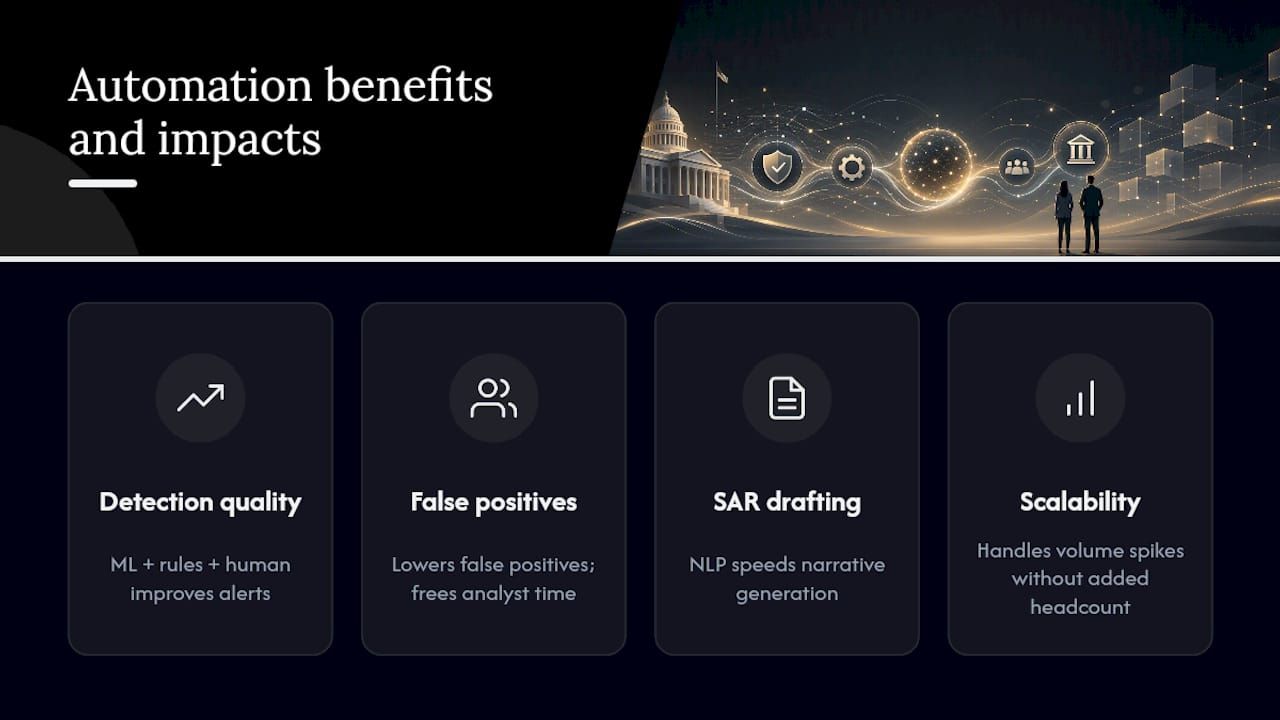
The case for automation rests on quality gains as much as cost. Reduced false-positive rates free analysts to spend more time on genuinely suspicious activity, and faster investigations shorten the window between detection and filing. NLP-assisted narrative generation can speed SAR drafting, while ML-based scoring layered onto rule-based alerts tends to improve detection quality when paired with analyst review rather than replacing it.
Industry analysis from KPMG reports that automation initiatives can meaningfully reduce analyst workload on repetitive tasks and lower false-positive volumes, with use cases spanning false-positive hibernation, ML-based transaction scoring, and automated narrative drafting. That combination, rules plus machine learning plus a human in the loop, appears repeatedly as the configuration that balances detection quality against alert volume.
Automation also builds resilience during volume spikes, such as periods of elevated transaction activity or sudden regulatory scrutiny that demands rapid look-backs. A system that can scale alert processing without proportionally scaling headcount gives compliance leaders room to absorb surges that would otherwise require emergency staffing.
The staffing impact is often reallocation rather than reduction. Analysts freed from low-value alert triage can move into complex investigations, typology research, and quality assurance, work that requires judgment automation cannot replicate. Framing automation as a capacity multiplier, rather than a headcount cut, tends to align better with both examiner expectations and staff morale.
Core technologies and how they map to BSA/AML use cases
Different automation technologies solve different problems, and matching the right tool to the right task matters more than adopting the newest one. Transaction monitoring benefits from ML scoring and anomaly detection layered onto traditional rules, with graph analytics adding the ability to trace relationships across accounts and entities that linear rules miss. Bitecode’s analysis of AI in transaction monitoring covers how these scoring approaches work in practice.
KYC and CDD processes are natural automation candidates because they involve document review, sanctions screening, and periodic refresh cycles that follow predictable patterns. Perpetual KYC models replace fixed-interval reviews with continuous monitoring triggered by risk events, reducing the lag between a customer’s changed risk profile and the institution’s response.
Alert triage benefits from NLP for narrative generation and from false-positive hibernation patterns that suppress recurring low-risk alerts without eliminating the underlying rule. RPA handles the repetitive glue work: pulling data from core systems, populating screening queries, and routing cases between platforms.
Key technology-to-use-case mappings include:
- ML scoring and anomaly detection strengthen transaction monitoring beyond static thresholds.
- Graph analytics reveal relationship patterns across accounts that rule-based systems miss.
- NLP supports SAR narrative drafting and speeds analyst documentation.
- RPA automates data pulls, screening list checks, and case routing between systems.
Integration requirements matter as much as the technology choice: institutions need reliable APIs into core banking platforms, screening vendors, and case management tools, along with data pipelines clean enough to support model scoring. A technical breakdown of transaction monitoring system design walks through the integration decisions engineers face when building these pipelines.
Governance, model risk management, and exam readiness
Automated BSA/AML systems that materially affect alerting or decision outcomes should be treated as models for governance purposes, which means documentation, conceptual soundness testing, and independent validation apply. The OCC’s statement on model risk management makes clear that this guidance should be applied proportionally to BSA/AML systems, with validation frequency and rigor scaled to materiality, rather than applied uniformly.
Examiners generally look for four things when reviewing automated systems:
- The institution can explain how the system produces its outputs, including which variables drive alerts.
- Independent testing has occurred outside the team that built or implements the system.
- The design reflects the institution’s own risk assessment rather than a generic template.
- Data lineage and change control processes are documented, so any model update can be traced and justified.
Third-party risk management deserves particular attention when vendors supply the underlying technology, since examiners will ask how the institution validates vendor claims and monitors ongoing performance rather than accepting them on faith.
Pro Tip: Document pilot design and results before scaling, and share that documentation with examiners early rather than waiting for the next exam cycle to surface it.
The FinCEN and federal banking agencies’ joint statement confirms that agencies will not penalize institutions piloting innovative approaches, provided the underlying BSA/AML program remains effective throughout. That commitment only holds value when institutions actually document their pilots well enough to demonstrate it.
A practical roadmap from pilot to scale
Moving from concept to production requires a sequence that resists the temptation to skip steps under deadline pressure.
- Define a narrow pilot scope with specific success metrics, such as false-positive reduction or SAR timeliness, and identify exactly which data inputs the pilot requires.
- Run hold-out testing and back-testing against historical alert populations to see how the new approach would have performed without disrupting live operations.
- Conduct sensitivity analysis to understand how the system behaves as thresholds or input data shift.
- Build an integration checklist covering data remediation needs, API connections to core and screening systems, orchestration logic, and the analyst-facing interface.
- Update SOPs, train staff on new workflows, and establish escalation paths for cases the system flags as uncertain.
- Set a periodic review cadence for revisiting thresholds and model performance rather than treating deployment as a one-time event.
- Plan capacity for scaling, including infrastructure performance and the operations support needed to keep the system running reliably.
The FFIEC manual’s guidance on assessing compliance notes that BSA/AML systems often lack definitive outcome labels like confirmed law enforcement action, which means tuning has to rely on proxy metrics such as SAR yield and analyst agreement rates rather than a clean accuracy score. Bitecode’s step-by-step guide to fintech AI automation covers similar sequencing for teams building automation projects outside the BSA/AML context specifically.
Metrics that prove the system is working
Ongoing measurement is what separates a monitored automation program from one running on autopilot. Core metrics include false positive rate, true positive yield, SAR filing timeliness, analyst throughput per alert, and model drift over time.
- Track false positive rate and true positive yield together to see whether tuning is improving detection quality or just suppressing volume.
- Measure analyst time saved per alert to quantify capacity freed for higher-value investigation work.
- Monitor SAR filing timeliness as a direct indicator of whether automation is reducing the detection-to-filing window.
- Run periodic outcomes analysis and independent sampling to catch drift before it becomes a compliance gap.
KPMG’s analysis identifies analyst time saved per alert and the percentage reduction in level-one reviews as practical KPIs that justify expanding automation and inform threshold rebalancing. These figures also feed capacity forecasting, giving compliance leaders a defensible basis for staffing and budget decisions rather than relying on anecdote.
When bespoke modular automation makes more sense than off-the-shelf tools
Standard AML platforms work well for institutions with conventional transaction types and clean legacy environments. They struggle when a bank runs unusual transaction structures, layers multiple legacy cores after a merger, or needs automation logic that a generic vendor configuration cannot express. In those cases, a modular, purpose-built system often outperforms a black-box platform that forces the institution’s processes to fit the vendor’s assumptions.
Bitecode’s approach starts projects with up to 60% of the baseline system pre-built from modular components, which shortens delivery timelines compared with building from a blank codebase. That speed comes with a trade-off familiar to any build-versus-buy decision: a bespoke system demands more upfront governance work, since the institution, not a vendor’s compliance team, owns the validation and documentation burden.
— Bitecode
How Bitecode approaches compliance automation projects
Institutions with legacy environments or transaction types that do not fit standard platforms often need automation built around their own data and workflows rather than reshaped to fit someone else’s. Bitecode’s modular components, including the AI Assistant, Financial Module, and Automation Module, let compliance and technology teams assemble a system tailored to their alert logic and case management needs without starting development from scratch.
Because the baseline components arrive largely pre-built, projects move faster than traditional custom development while still leaving room for the documentation, data lineage tracking, and validation hooks examiners expect. Bitecode supports this through:
- Modular AI and financial processing components that integrate with existing core banking and screening systems.
- Audit-ready, self-hosted deployment options for institutions with strict data control requirements.
- Direct engagement on automation workflow design tailored to a specific compliance program rather than a generic template.
Institutions exploring a bespoke path can review Bitecode’s project options and request a scoped consultation before committing to a build.
Sources
Compliance teams building automation programs should consult the FFIEC BSA/AML Examination Manual, FinCEN’s proposed rule to modernize AML/CFT programs, and the OCC’s model risk management statement before designing any pilot, alongside industry analyses such as KPMG’s automation research.
- Joint Statement on Innovative Efforts to Combat Money Laundering and Terrorist Financing (FinCEN and federal agencies)
- FFIEC BSA/AML Examination Manual — Assessing compliance
- OCC statement on model risk management and BSA/AML systems
- Automating Anti‑Money Laundering (KPMG)
FAQ
What are the top AML software options for banks?
There is no single official ranking of AML software providers, and capability needs vary widely by institution size and risk profile. Compliance teams typically evaluate platforms against their own risk assessment and the FFIEC manual’s criteria rather than a generic vendor list, and institutions with unusual transaction types often find bespoke modular systems fit better than off-the-shelf platforms.
What is the $3,000 rule for banks?
This question refers to a Bank Secrecy Act recordkeeping threshold tied to funds transfers and monetary instrument sales, distinct from the currency transaction reporting requirement. Institutions should confirm current thresholds directly with FinCEN guidance rather than relying on secondhand summaries, since recordkeeping rules are periodically updated.
Will AI replace AML analysts?
No credible regulatory or industry source suggests AI will replace AML analysts entirely. The pattern that consistently works the best combines automated scoring and triage with analyst review, freeing analysts from repetitive tasks so they can focus on complex investigations that require judgment.
What are the pillars of a BSA/AML compliance program?
A BSA/AML program is generally built around a risk assessment, internal controls, designated compliance oversight, ongoing training, and independent testing. FinCEN’s proposed rule emphasizes a mandatory risk assessment process as the foundation these other components build on.
Does automating BSA/AML processes create examiner risk?
Federal banking agencies have stated they will not penalize institutions that pilot innovative technology while maintaining an effective, risk-based BSA/AML program, according to the joint statement on innovation. Documenting pilot design, testing, and independent validation is what actually reduces examiner risk, not the automation itself.