Most enterprises should start blockchain payment integration with a stablecoin settlement flow routed through a payments platform, not a custom direct-API build from day one. That path gets a pilot live in weeks, not quarters, while preserving a clear upgrade path to direct API integration and MPC self-custody once volume justifies the engineering cost. The real trade-off is speed-to-market versus long-term control: hosted and SDK paths ship faster but cede some custody and compliance ownership, while direct API and self-custody demand more engineering and a dedicated compliance owner. Bring in a systems integrator once you need custom ledger logic, multi-chain treasury, or bank-partner-grade audit trails.
TL;DR:
- Using a stablecoin settlement flow through a payments platform offers a quick pilot launch within weeks, with a clear long-term upgrade path to direct API and self-custody.
- Blockchain settlement is peer-to-peer and often irreversible, reducing chargeback risk but demanding rigorous error and fraud handling protocols.
- Integration involves multiple layers, including order orchestration, ledger reconciliation, chain adapters, and security controls like MPC signing and multisig, requiring thorough testing before production.
- The fastest deployment paths are hosted checkout for testing demand, embedded SDKs for control, and direct API for full customization, each with different setup times and control levels.
- Compliance demands documented governance, KYC/KYB procedures, AML/KYT monitoring, and plans for handling chain reorganizations and recovery drills before full-scale deployment.
What Is Blockchain Payment Integration, and How Does It Differ From Card or ACH Rails?
Blockchain payment integration means connecting your checkout, order system, and treasury to a distributed ledger network instead of (or alongside) card networks and ACH. The mechanics diverge sharply from what most finance and engineering teams already know.
Card and ACH rails settle through intermediaries: banks, processors, and clearinghouses that can reverse a transaction, hold funds, and reconcile disputes over days. Blockchain transaction processing settles peer-to-peer on a shared ledger, usually within seconds to minutes, and settlement is generally irreversible once a transaction reaches finality. That irreversibility cuts chargeback risk to nearly zero, but it also means a coding error or fraud loss cannot be clawed back the way a card dispute can.
Settlement choice matters as much as the rail itself:
- Stablecoin on-chain settlement keeps value denominated in dollars while moving on a blockchain rail, minimizing treasury volatility exposure.
- Native crypto settlement exposes the business to price swings unless converted immediately, which adds an operational step.
- Fiat off-ramp settlement converts crypto back to bank deposits automatically, trading some speed for treasury simplicity.
Three use cases show where blockchain for online payments earns its complexity: cross-border payouts to contractors or suppliers where correspondent banking is slow and expensive, marketplace payouts to sellers in regions with limited banking access, and programmable payouts that release funds automatically when a contract condition is met.
Integration Architecture and Technical Components
A production-grade blockchain payment system is a stack of distinct layers, and skipping one of them is where most projects run into trouble later. A working reference architecture, drawn from how modern payment infrastructure providers structure these systems, breaks into seven components.
- Merchant access layer — the checkout page, widget, or API endpoint customers or partners actually touch.
- Order orchestration — the service that creates a payment order, tracks its state, and coordinates everything downstream.
- Internal ledger — the system of record reconciling on-chain events against business transactions.
- Wallet and address management — generating, rotating, and monitoring deposit addresses across chains.
- Chain adapters — the integration layer talking to nodes or indexers per blockchain network you support.
- Risk and compliance layer — screening, monitoring, and travel rule handling wired into the order lifecycle.
- Treasury orchestration — sweeping, rebalancing, and off-ramp logic that moves funds into custody.
Several operational details separate a resilient system from a fragile one. Idempotency keys prevent duplicate fulfillment when a webhook fires twice. Webhook signature verification stops spoofed payment confirmations. Confirmation and finality thresholds determine how many blocks to wait before treating a payment as settled, and reorg handling accounts for the rare case where a chain rewrites recent history. Address pool management keeps you from running out of clean deposit addresses during volume spikes.
Security controls tie the architecture together: MPC signing distributes private key control across parties so no single point of failure can move funds, automated sweeping moves balances into cold storage on a schedule, multisig adds a second approval layer for larger transfers, and separation of duties keeps the person who approves a payout from also holding the signing key.
Pro Tip: Build your reorg handling and key recovery drill before your first production transaction, not after your first incident. Teams that skip this step usually discover the gap during an outage, when it is far more expensive to fix.
Hosted Checkout, Embedded SDK, or Direct API: Which Integration Path Fits?
Three integration paths cover almost every enterprise scenario, and the right one depends less on company size than on how much control over custody and user experience you actually need.
Hosted checkout redirects the customer to a provider-hosted payment page. It is the fastest path to accepting cryptocurrency payments because the provider handles wallet generation, monitoring, and much of the compliance burden. The trade-off is limited branding control and less flexibility over settlement logic. It fits companies that want to test demand before investing engineering time, typically live in sandbox within days and production within two to four weeks.
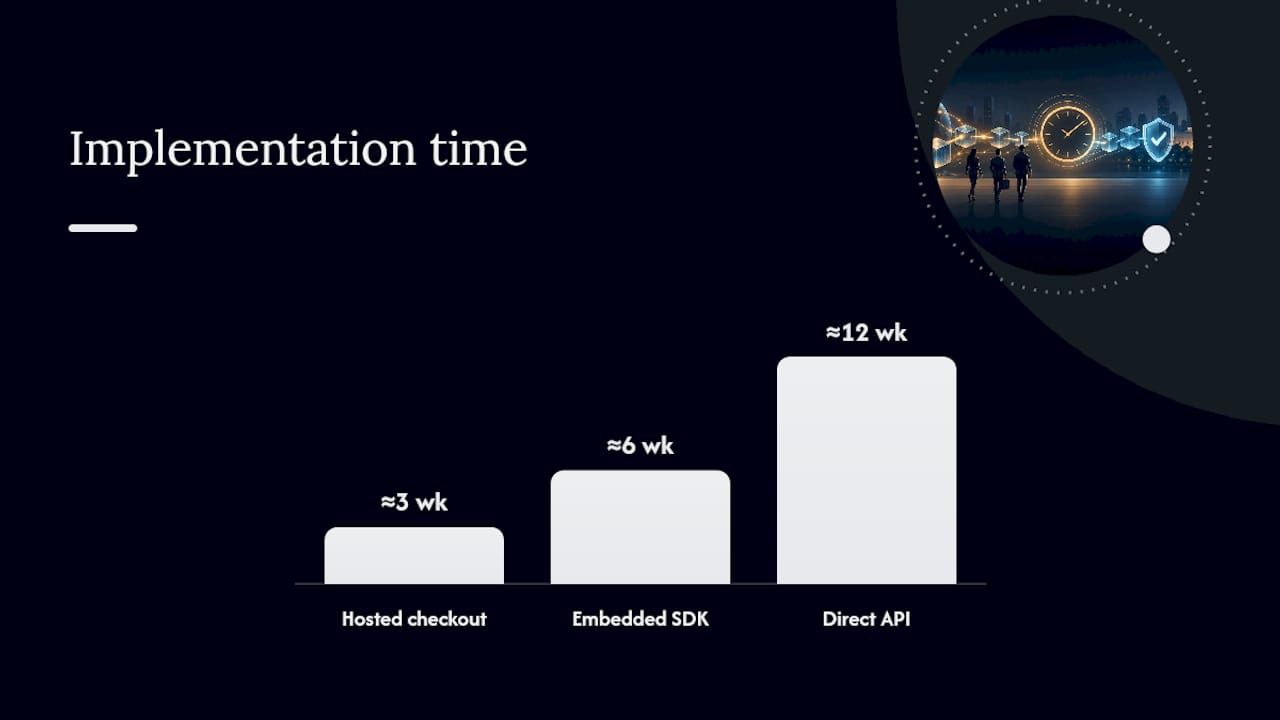
Embedded SDK or widget integration keeps the customer on your site while a provider’s component handles the payment flow underneath. This preserves your checkout branding and conversion funnel while still outsourcing wallet and chain complexity. Front-end teams need to budget for state handling, error states, and mobile wallet deep-linking. Expect four to eight weeks from sandbox to production, depending on how much custom UX your team wants.
Direct API integration means your backend talks directly to a payment gateway blockchain provider or to chain nodes and indexers yourself. This path gives full control over the order lifecycle, ledger design, and treasury rules, but it requires a backend team comfortable with webhook infrastructure, idempotent processing, and reconciliation logic. Expect a few months minimum from sandbox through pilot to production, longer if you are also standing up MPC custody.
- Hosted checkout: fastest, least control, best for validating demand.
- Embedded SDK: balanced control and speed, best for consumer-facing brands.
- Direct API: most control, most effort, best for high-volume or highly regulated flows.
What Compliance and Regulatory Steps Do U.S. Deployments Need?
Federal Reserve Governor Miran said in a November 2025 speech that stablecoins are genuinely useful where conventional dollar access is constrained, and urged businesses to validate the specific settlement corridor or customer problem before assuming a blockchain rail is automatically the better choice. That is a useful gut check before any procurement decision: crypto payment integration is a means, not an end.
For bank partners and supervisors, the Federal Reserve’s supervisory materials on dollar token activities lay out what state member banks must demonstrate to receive a nonobjection: governance structure, operational and cybersecurity risk controls, liquidity management, and illicit-finance monitoring. Any enterprise building on top of a bank partner should expect to answer the same questions the bank itself must answer to its supervisor.
Separately, FinCEN’s proposed rulemaking implementing the GENIUS Act would treat permitted payment stablecoin issuers as financial institutions under the Bank Secrecy Act, requiring effective customer identification programs and related AML obligations. If your integration touches issuance or redemption of a payment stablecoin rather than pure pass-through settlement, this rulemaking applies directly to your compliance scope.
Practical controls to have documented before you approach a bank partner or auditor:
- Governance policy naming who owns compliance decisions.
- KYC/KYB onboarding for merchants and counterparties.
- AML and know-your-transaction (KYT) monitoring on-chain.
- Sanctions screening against OFAC and related lists.
- Travel rule handling for qualifying transfers.
- Documented custody and liquidity controls with a recovery plan.
Build a fintech compliance checklist before your first bank conversation, not after a rejection.
How Do You Build and Test a Blockchain Payment Pilot?
A disciplined pilot separates enterprises that scale smoothly from those that discover expensive gaps mid-launch. Follow this order.
- Assign owners before writing code. Name a product owner for the integration path decision, a backend lead for custody architecture, a compliance owner for KYC/AML scope, and a treasury owner for settlement asset choice.
- Scope the pilot narrowly. Limit to one chain and one asset in a sandbox environment. StableOps guidance on accepting USDT recommends persisting a business order before generating a payment order, then testing duplicate delivery and replay scenarios explicitly.
- Simulate failure before you need to survive it. Run reorg handling drills, webhook replay attacks, and reconciliation mismatches on purpose, in sandbox, before any real funds move.
- Build the launch checklist. Address rotation policy, webhook signature verification, automated reconciliation between ledger and chain state, uptime monitoring, a documented disaster recovery runbook, and a support policy for failed or stuck payments.
- Fulfill only on finalized status. The payment order lifecycle. detected, confirmed, finalized, exists precisely so irreversible business actions (shipping goods, granting access) only trigger on a verified finalized webhook, never on a transaction hash alone or a frontend signal.
Pro Tip: Treat the pilot’s reconciliation report as your real acceptance test. If every on-chain movement cannot be traced to a matching ledger event, a sweep, a fee, or an authorized adjustment, the system is not ready for production volume no matter how clean the checkout demo looks.
Expect several weeks for a disciplined pilot covering these five steps, with product, backend, and compliance roles running in parallel rather than sequentially.
Why Work With a Modular Integrator Like Bitecode for Blockchain Payments?
Building this stack from scratch, custody, ledger, chain adapters, compliance wiring, routinely stretches procurement timelines past six months before a single transaction clears in production.
What that looks like in practice includes an audit-ready internal ledger, custody integration wired for MPC signing, AML and KYT screening built into the order lifecycle rather than bolted on afterward, and monitoring dashboards for treasury and compliance teams. The Token Module pairs with the Financial Module to handle both the chain layer and the accounting layer in one engagement.
When scoping a call with any integrator, ask for a concrete milestone plan: sandbox environment, pilot scope, and a production date, plus which compliance artifacts they will hand you for your bank partner conversation.
What Does Blockchain Payment Integration Actually Cost Over Time?
The sticker price of a payment gateway or SDK license is rarely the number that matters most. Total cost of ownership for blockchain payment integration breaks into three buckets: build cost, transaction cost, and operational cost, and the third one is where budgets usually go wrong.
Build cost covers integration engineering, whether that is a few weeks of front-end work for an embedded widget or several months for a direct API build with custom custody. Transaction cost includes network fees, which vary by chain and congestion, plus any provider markup on settlement or conversion. Neither of those tends to surprise finance teams.
Operational cost is the quiet budget killer. It includes compliance monitoring tooling and staff time for KYC/KYT review, key management infrastructure and the personnel trained to run recovery drills, reconciliation tooling to keep the ledger and chain state in sync, and incident response capacity for the rare but expensive reorg or stuck-transaction event. Add to that ongoing audits required by bank partners once you move real volume, and ongoing chain adapter maintenance whenever a network you support changes its client software or fee structure.
Enterprises that budget only for the initial build routinely underfund the compliance and monitoring layer, then discover the gap during their first bank partner review. A realistic total cost of ownership model treats compliance staffing and reconciliation automation as recurring line items from month one, not as a post-launch addition.
How Does Blockchain Payment Integration Affect Existing Systems?
Blockchain transaction processing rarely replaces your existing payment stack outright. It sits alongside card and ACH rails as an additional settlement option, which means your existing order management, accounting, and customer support systems all need updates to recognize a new payment state.
Your order management system needs a new payment status path that accounts for the detected, confirmed, finalized lifecycle rather than the single “paid” flag card processors typically return. Your accounting and ERP integration needs to reconcile crypto and stablecoin transactions against the same general ledger as fiat, which usually means either a connector into your existing finance module or a parallel ledger that syncs on a schedule.
Customer support tooling needs visibility into blockchain transaction status so agents can answer “where is my payment” questions without escalating to engineering. And your existing fraud and risk tooling, built for card-network chargebacks, needs a different rule set for a rail where reversals are not possible and the fraud signal shifts toward wallet screening and transaction monitoring instead.
Transition planning works best in phases: run the new rail alongside existing ones for a defined pilot window, keep card and ACH as the default while blockchain payments are opt-in, and only flip the default once reconciliation, support, and fraud tooling have all been tested against real volume. Teams that skip the phased rollout tend to discover integration gaps in production rather than in the sandbox.
How Should Checkout and Support Change for Crypto Payment Customers?
Customers rarely care which rail moves their money, but they notice friction immediately if a blockchain-based option feels like a second-class experience. Presenting it as one more payment method next to card and bank transfer, rather than a separate flow, keeps conversion steady.
A few UX details matter more than teams expect. Wallet connection and QR-code payment flows need clear, plain-language instructions, since a meaningful share of customers have never sent a stablecoin payment before. Confirmation timing needs honest messaging. telling a customer their payment is “detected” or “finalized” avoids confusion if there is any lag before an order actually ships. And a fallback payment method always needs to be visible: if a customer’s wallet fails, their network is congested, or they simply change their mind mid-transaction, dropping back to card or ACH without losing their cart is the difference between a completed sale and an abandoned one.
Support teams need a script for the most common questions: why a payment shows as pending, what finality means in plain terms, and what happens if funds are sent to the wrong address. That last scenario deserves particular attention, since blockchain’s irreversibility cuts both ways. it eliminates chargeback fraud, but it also means a customer error cannot be reversed the way a card dispute can. Setting that expectation clearly at checkout, not after a support ticket, prevents most of the friction.
Practical Perspective: What Actually Sinks a Blockchain Payment Pilot
Most failed pilots don’t fail on the blockchain part. They fail on reorg handling nobody tested, KYC scope that quietly excluded an entire customer segment, or an address pool that ran dry during a traffic spike. Vendor red flags cluster the same way: no clear governance model, a custody structure nobody can explain in one sentence, and no audit trail to show a bank partner. Run a failure drill before you sign anything.
— Bitecode
How Bitecode Helps: Modular Integrations, Compliance-Ready Deployment
Some providers offer faster blockchain payment infrastructure deployment by using pre-built system components to reduce build time compared to a from-scratch integration.
That modular baseline covers the parts of the stack that rarely differ across enterprises: custom business software foundations, the Token Module for blockchain integration, and the Financial Module for audit-ready ledgers and reconciliation. A typical engagement moves from MVP scoping to a scoped pilot to production deployment, with compliance wiring, AML/KYT screening, and monitoring built in rather than retrofitted after a bank partner asks for it.
If you are evaluating vendors for a blockchain payment build, start with a scoping conversation and bring your integration path decision, custody preference, and target settlement asset. That single call typically clarifies whether a modular build or a fully custom engagement fits your timeline better.
Sources
- Speech by Federal Reserve Governor Miran (November 2025)
- FinCEN and agencies proposed rulemaking implementing GENIUS Act directives (2026)
- Payment Orders · StableOps
FAQ
What Is a Blockchain Payment?
A blockchain payment is a transfer of value, usually a stablecoin or native cryptocurrency, recorded on a distributed ledger instead of routed through a bank or card network. It settles when the network confirms the transaction has reached finality, often within seconds to minutes, and that settlement is generally irreversible.
Can I Transfer Money From Blockchain to My Bank Account?
Yes. Most blockchain payment platforms include a fiat off-ramp that converts crypto or stablecoin balances into a bank deposit, typically through a licensed exchange or payment processor partner. The transfer speed and fees depend on the off-ramp provider and the destination bank’s processing window.
Is Blockchain Real or Fake?
Blockchain is a real, functioning technology used today by major financial institutions, payment processors, and enterprises for settlement and record-keeping. The Federal Reserve’s own supervisory framework for dollar token activities at state member banks confirms it is treated as a legitimate financial infrastructure, not a novelty.
What Should I Look For in a Blockchain Payment Gateway?
Look for documented support for the payment order lifecycle (detected, confirmed, finalized), verified webhook handling, and clear custody options including MPC or multisig. Beyond the technical fit, confirm the provider can supply the compliance documentation, KYC/KYB, AML/KYT, governance policy, that your bank partner will eventually request.
How Long Does Blockchain Payment Integration Take?
A hosted checkout can reach production in two to four weeks, an embedded SDK typically takes four to eight weeks, and a direct API integration with custom custody usually runs a few months or longer. Bitecode’s modular baseline is built to compress these timelines by starting from pre-built components; current project scoping and estimates are available through a direct consultation.