TL;DR:
- Successful blockchain integration depends primarily on stakeholder alignment, governance, and disciplined execution.
- Proper planning involves defining clear use cases, assessing existing systems, and securing early smart contract audits to avoid costly failures.
Blockchain integration is one of the most consequential technical decisions an organization can make, and it rarely goes smoothly without a plan. The blockchain integration process touches your financial systems, your governance model, your security posture, and your vendors — all at once. Companies that approach it without a clear methodology tend to stall mid-project, burn resources, and produce systems that technically work but deliver no measurable business value. This guide covers the full arc from preparation through deployment, giving business leaders and IT specialists a concrete framework for executing blockchain integration that holds up under real enterprise conditions.
Key takeaways
| Point | Details |
|---|---|
| Define use cases first | Vague business cases are the leading cause of stalled blockchain projects before a single line of code is written. |
| Expect a multi-month timeline | Enterprise integration phases typically span 4 to 12-plus months from strategy to full deployment. |
| Keep ERP as system of record | Blockchain records hashes and proofs, not full transactional data, to protect privacy and performance. |
| Audit smart contracts early | Security audits cost between $8K and $150K and should be scoped before the pilot phase, not after. |
| Governance determines success | Execution discipline and stakeholder alignment matter more than protocol selection for long-term outcomes. |
Prerequisites before starting blockchain integration
The most common reason enterprise blockchain projects fail before they even reach a proof of concept is that teams skip the groundwork. Starting with a technical spike before the business case is solid is putting risk in the wrong place.
Defining the right use cases
Not every workflow needs a blockchain. The right blockchain integration use cases share a few characteristics: multiple parties with limited trust in each other, a need for an immutable audit trail, or financial settlement logic that currently requires manual reconciliation. Trade finance, cross-border payments, pharmaceutical supply chains, and tokenized asset management are proven categories. An internal document approval system is not.
Before any architecture discussion, leadership and IT must agree on a single sentence: What specific problem does blockchain solve here that a conventional database cannot? If the answer requires more than one sentence, the use case needs more definition.
System readiness and integration touchpoints
Once the use case is locked, teams need an honest inventory of the existing systems that blockchain will need to talk to. The primary touchpoints in most enterprise contexts are ERP systems (SAP, Oracle), identity and access management platforms, financial processing modules, and data warehouses. Each integration point carries its own data format, authentication protocol, and latency expectation.
The table below summarizes the key areas to assess before any build begins:
| Readiness Area | What to Evaluate |
|---|---|
| Business use case | Documented, approved, and tied to measurable outcomes |
| Integration touchpoints | ERP, IAM, finance systems identified with data formats mapped |
| Compliance and legal | GDPR, AML, and sector-specific rules reviewed |
| Team competencies | Blockchain developers, security engineers, and compliance officers available |
| Governance model | Decision rights, upgrade policies, and escalation paths defined |
Pro Tip: Set up a governance model before the PoC begins, not after. Defining who owns upgrade decisions, incident response, and audit scheduling retroactively is significantly harder once systems are live.
Stakeholder alignment is the other piece teams chronically underestimate. Execution discipline and governance are the primary determinants of blockchain project success, well ahead of protocol selection or tooling choices.
Step-by-step execution phases
The blockchain integration process does not compress well. Organizations that try to skip phases to accelerate delivery typically create technical debt that surfaces at the worst possible moment — during a production incident or a compliance audit. Understanding the sequence matters.
-
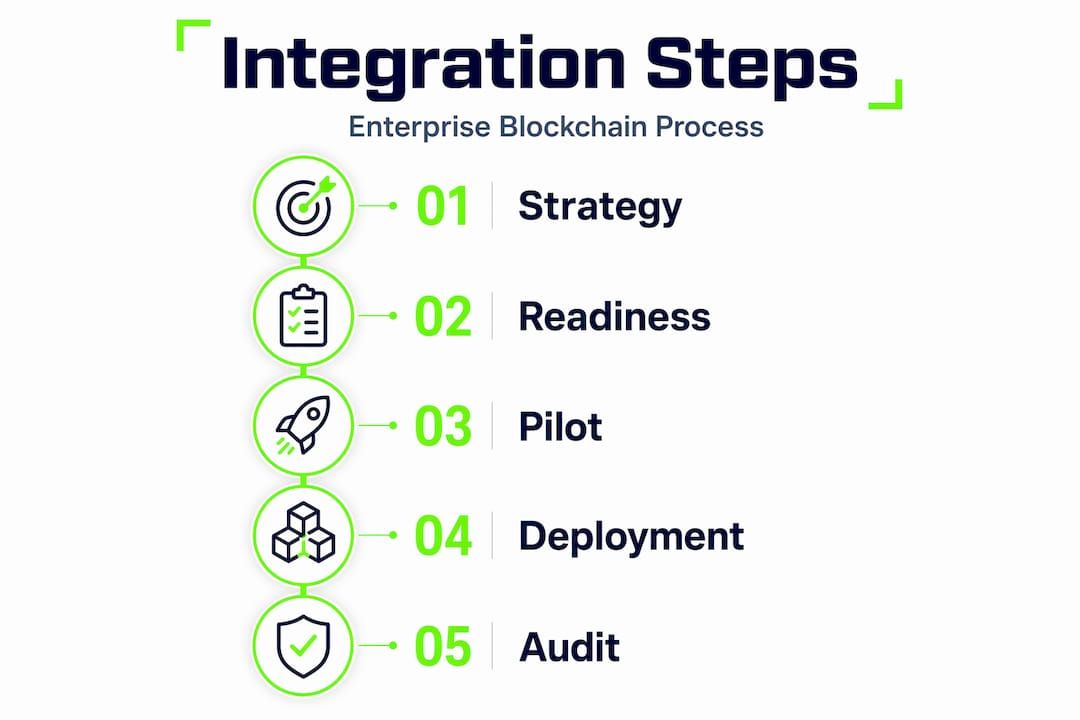
Feasibility and strategy (1 to 2 weeks). Define the use case formally, identify the appropriate blockchain network (public, private, or consortium), and produce an initial cost and risk estimate. This phase ends with a signed-off business case document.
-
Proof of concept (4 to 8 weeks). Build a minimal working prototype that validates the core technical assumptions. The goal is not a production system. It is evidence that the integration pattern is viable. Enterprise blockchain timelines consistently show this phase ranges from four to eight weeks when scoped correctly.
-
Pilot and testing (2 to 4 months). Expand the PoC into a full pilot with real data, real integration points, and a subset of actual users. Smart contract auditing should happen here. Performance testing, load simulation, and reconciliation verification are non-negotiable deliverables.
-
Deployment and scaling. Production release with full monitoring, alerting, and a documented rollback procedure. After deployment, ongoing governance, compliance planning, and operational monitoring take over as the primary operational activities.
The integration engineering itself relies on three key patterns: middleware adapter services, REST or GraphQL APIs, and event-driven synchronization. Adapter services translate legacy data formats into canonical blockchain payloads and handle replay logic when transactions fail. This is architecturally different from a conventional database rollback because blockchain transactions are immutable once committed.
| Phase | Typical Duration | Key Deliverable |
|---|---|---|
| Feasibility and strategy | 1 to 2 weeks | Approved business case |
| Proof of concept | 4 to 8 weeks | Validated integration prototype |
| Pilot and testing | 2 to 4 months | Audited smart contracts, load test results |
| Full deployment and scaling | Ongoing | Production system with governance model |
Pro Tip: Scope your smart contract audit vendor during the pilot phase, not at the end of it. Audit slots fill quickly and audit costs range from $8K to $150K depending on contract complexity. Budget surprises here derail timelines more often than any technical issue.
Technical integration with ERP, finance, and wallet systems
This is where the architecture decisions become consequential. Getting the integration patterns wrong at this layer is expensive to fix post-deployment.

ERP integration patterns
The cardinal rule of ERP integration is that the ERP stays the system of record. Blockchain does not replace it. ERP integration uses an integration layer that translates ERP events into blockchain transactions and vice versa. Selected data — transaction hashes, document identifiers, and settlement confirmations — gets written to the chain. Blockchain events then trigger workflow updates back in the ERP.
This matters for teams connecting to ERP and blockchain platforms because any architecture that attempts to use blockchain as the primary data store for operational records will produce performance problems and compliance headaches simultaneously.
Off-chain and on-chain data strategy
A common misconception is that blockchain integration means moving all data on-chain. In practice, enterprise integrations store hashes or proofs on-chain while keeping full transactional records in the ERP or financial system. This balances auditability with data privacy and performance.
Hybrid off-chain/on-chain architectures use KMS-signed minimal instruction payloads on-chain to provide separation of duties and idempotency. The detailed financial message stays off-chain. The chain records only the canonical settlement instruction, signed and verifiable.
The performance and privacy case for hybrid architectures is not a compromise. It is the correct design for any system that handles regulated financial data at scale.
Wallet integration flows
Wallet integration introduces a security pattern that many teams conflate to their detriment. There are two distinct steps: wallet connection and ownership proof via cryptographic signing. Separating these steps ensures that a connected wallet does not equal authorization to act. Apps request actions, wallets prompt user approval via signing, and apps receive verified on-chain results for reconciliation.
For teams building secure transaction workflows, the practical implication is that the application layer must never assume connection equals control. Every sensitive operation requires an explicit signing step, and the result must be reconciled against the on-chain state before the workflow proceeds.
Key security practices across all integration types include multi-party approvals for high-value transactions, key rotation schedules, and smart contract audit focus on access control and trust boundary management. Centralized admin privileges represent the highest risk category in most enterprise smart contracts.
Common mistakes and how to verify success
Even well-planned integrations encounter problems. Knowing where they typically originate saves significant remediation time.
The most frequent pitfalls across enterprise blockchain projects include:
- Unclear ownership at integration boundaries. When neither the blockchain team nor the ERP team owns an adapter service, incidents go unresolved longer than they should.
- Weak reconciliation logic. Blockchain transactions do not roll back like database transactions. Teams need explicit reconciliation jobs that detect and flag discrepancies between on-chain state and ERP records.
- Skipping the security audit. Smart contract audits must cover access control, trust boundaries, and upgrade mechanisms to prevent severe exploits. Treating audit as optional until something goes wrong is a costly posture.
- No event monitoring in production. Blockchain events that trigger ERP workflows can fail silently. Production systems need real-time alerting on missed events and transaction reversion.
Pro Tip: Build a reconciliation job that runs on a scheduled interval and compares on-chain transaction hashes against ERP records. This is your ground-truth verification layer, and it should exist from day one of production operation, not as a future enhancement.
Use the following checklist to verify integration readiness before go-live:
- Smart contract audit completed and findings resolved
- Event-driven synchronization tested under failure conditions with replay verified
- Key management procedures documented and tested
- Wallet connection and signing flows validated end to end
- Load and performance benchmarks met under expected peak volumes
- Governance model documented: who approves upgrades, who handles incidents
- Compliance review signed off by legal or compliance function
My take on where blockchain integration actually breaks down
I’ve worked with enough enterprise blockchain projects to see a consistent pattern, and it rarely matches what teams expect going in. The technical protocol choice — Ethereum, Hyperledger, a consortium chain — almost never determines whether a project succeeds. What determines it is execution discipline.
Most blockchain projects stall not because of protocol limitations but because of underinvestment in stakeholder alignment, governance, and integration planning. In my experience, the uncomfortable truth is that the hardest part of blockchain integration is not the chain itself. It is the integration boundary: the adapter layer, the reconciliation logic, the event handling. That is where complexity concentrates, and it is where teams typically understaff and under-test.
What actually works is treating the integration layer as a first-class engineering concern, not a connector you wire up in the last sprint. It means scoping the governance model before the PoC, not after. It means running your reconciliation logic against failure scenarios before you call the pilot a success.
One more thing I’d flag: security auditing is not a box-checking exercise. The teams that treat it as such tend to discover that reality in production. Access control flaws in smart contracts have resulted in losses that dwarf the cost of a thorough pre-deployment audit.
— Bitecode
How Bitecode accelerates enterprise blockchain projects
Bitecode’s blockchain payment system module gives enterprise teams a pre-built foundation for blockchain-based financial processing, with security patterns, key management, and audit trail capabilities already structured into the architecture. Rather than building the integration layer from scratch, teams start with up to 60% of the baseline system already in place, which meaningfully compresses the proof of concept and pilot phases.
For organizations that also want to automate the workflows connected to blockchain events, Bitecode’s AI automation module provides an integrated layer for orchestrating approvals, notifications, and exception handling without custom development overhead. Bitecode works with medium to large organizations that need systems built to enterprise security and compliance standards, with the speed that modular development makes possible. Reach out to discuss your integration requirements.
FAQ
What is the blockchain integration process?
The blockchain integration process is the structured sequence of steps an organization follows to connect blockchain technology to its existing enterprise systems, including ERP, financial platforms, and identity management. It typically spans from use case definition and feasibility through proof of concept, pilot testing, and full production deployment.
How long does enterprise blockchain integration take?
Enterprise blockchain integration timelines generally range from 4 to over 12 months. The feasibility phase takes one to two weeks, the PoC runs four to eight weeks, and the pilot and testing phase adds two to four months before full deployment begins.
What are the most common blockchain integration use cases?
The most proven blockchain integration use cases in enterprise contexts include cross-border payment settlement, supply chain provenance tracking, trade finance documentation, and tokenized asset management. These use cases share the characteristics of multi-party trust requirements and audit trail obligations.
Should all data be stored on the blockchain?
No. Enterprise best practice stores only hashes, proofs, or settlement identifiers on-chain while keeping full transactional records in the ERP or financial system. This approach preserves auditability without creating privacy, performance, or compliance problems.
Why do blockchain integration projects fail?
The leading cause of blockchain project failure is not technical. Most projects stall because of unclear ownership, insufficient governance planning, and weak integration design at the boundary between blockchain and legacy systems. Stakeholder alignment and disciplined execution matter more than protocol selection.