TL;DR:
- Smart contracts hold massive value on immutable blockchains, making security flaws both permanent and costly.
- Organizations must prioritize comprehensive security practices, including audits, formal verification, and layered defenses before deployment.
Smart contracts control large amounts of value on immutable blockchains, making vulnerabilities irreversible and highly attractive to attackers. The dangerous misconception held by many organizations is that deploying code on a blockchain automatically confers security. It does not. The blockchain guarantees that what is written stays written, which means a flawed contract is a permanently flawed contract. For decision-makers and IT managers evaluating blockchain adoption, understanding exactly where smart contract security breaks down, and what to do about it, is not optional background knowledge. It is a core strategic responsibility.
Key Takeaways
| Point | Details |
|---|---|
| Immutability amplifies risk | Mistakes in smart contracts are irreversible, so prevention and pre-deployment review are critical. |
| Major losses continue | Billions are lost to smart contract exploits, with new high-profile vulnerabilities each year. |
| Layered defense is essential | Combining secure coding practices, audits, and advanced tools reliably reduces risks. |
| AI tools bring new dangers | AI-generated code is error-prone and must always be reviewed for security flaws. |
| Smart contract security needs ownership | Making contract security a board-level concern protects value and reputation. |
The high stakes of smart contract vulnerabilities
The history of smart contract exploits reads less like a cautionary tale and more like a recurring financial catastrophe. The 2016 DAO hack resulted in over $60 million in stolen funds, effectively splitting the Ethereum network. The Parity wallet incidents froze over $300 million in ETH due to a single access control oversight. These are not ancient history. Tracking blockchain security outcomes through recent years shows the problem is not shrinking.
$2.4 billion was lost across 303 incidents between 2024 and 2025, with Q1 2026 alone accounting for $169 million stolen across 55 exploits. These numbers represent real organizational losses, many of them irreversible.
The attack surface is broad and well-documented. Understanding which vulnerability classes appear most often helps teams prioritize security investments:
- Access control failures: Unauthorized callers gaining privileged functions
- Reentrancy attacks: External calls triggering recursive loops that drain funds
- Business logic flaws: Contracts functioning correctly at the code level but incorrectly at the intent level
- Oracle manipulation: Exploiting price feeds to extract value from DeFi protocols
- Proxy and upgradeability bugs: Flawed upgrade mechanisms that introduce new vulnerabilities
- Integer arithmetic errors: Rounding and overflow errors, especially critical in automated market makers (AMMs)
The following table illustrates the scale of losses by year and dominant exploit type, based on publicly available incident data:
| Year | Estimated losses | Dominant exploit type |
|---|---|---|
| 2022 | ~$3.8 billion | Bridge vulnerabilities, access control |
| 2023 | ~$1.7 billion | Private key compromise, logic flaws |
| 2024 | ~$2.2 billion | Reentrancy, oracle manipulation |
| 2025 | ~$1.4 billion | Proxy flaws, business logic |
| Q1 2026 | ~$169 million | Infrastructure, access control |
Understanding enterprise blockchain workflow automation in this context means recognizing that every automated financial workflow is a potential target if smart contract security is treated as an afterthought. The attack data is not an abstract industry statistic. It maps directly onto financial exposure that boards and risk committees should be tracking.
Why blockchains amplify risk: Immutability and attack surface
Traditional enterprise software carries risk, but most of that risk is manageable through patching, rollbacks, and configuration updates. Smart contracts operate under fundamentally different constraints. Immutability demands pre-deployment perfection: once a contract is deployed, the logic is locked. There are no patches post-deployment without sophisticated and risky upgrade mechanisms.
The following comparison clarifies why conventional IT security frameworks do not transfer cleanly to smart contract environments:
| Security dimension | Traditional software | Smart contracts |
|---|---|---|
| Patch cycle | Days to weeks | Not possible without upgrade pattern |
| Attack window | Limited by update speed | Permanent until replaced |
| Error recovery | Rollback, hotfix | None without prior circuit breaker design |
| Code transparency | Often closed-source | Publicly readable on-chain |
| Financial exposure | Indirect, reversible | Direct, often irreversible |
| Regulatory recourse | Legal remedies exist | Limited, jurisdiction-dependent |
The two most common root causes, which access control vulnerabilities (OWASP SC01) and business logic flaws (OWASP SC02), account for the majority of actual fund losses. Access control failures let unauthorized callers trigger privileged state changes. Business logic flaws are subtler: the code runs exactly as written, but the logic itself was wrong, allowing value extraction that no low-level check would catch.
Security automation for workflows needs to account for both categories. An organization can have perfect cryptographic hygiene and still lose everything to a logic flaw that an attacker mapped from the public bytecode. This is why secure software integration best practices must extend into the smart contract layer, not stop at the API boundary.
Pro Tip: Adopt a defense-in-depth approach before shipping any contract. This means layering audits, formal verification for critical paths, comprehensive test suites, and on-chain monitoring. No single control is sufficient. Redundancy is not waste; it is the architecture of resilience in an environment where you cannot call support after the fact.
Given these unique risks, the natural next question is how organizations can make smart contracts truly secure before deployment.
Foundations of smart contract security: Prevention, detection, and mitigation
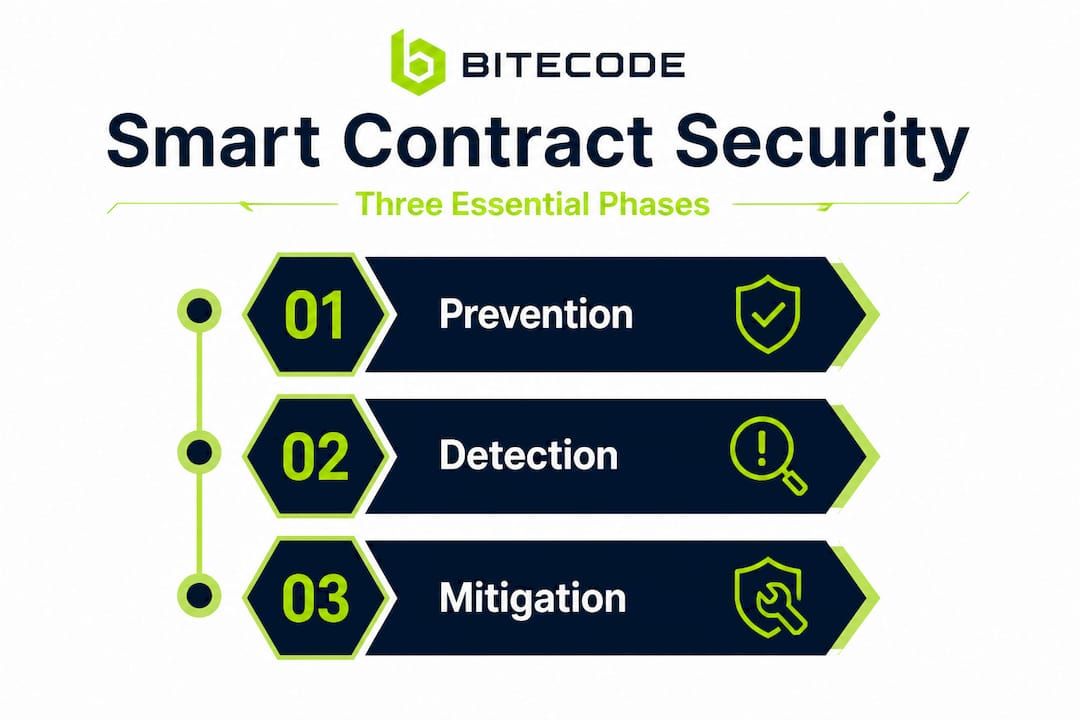
Security engineering for smart contracts operates across three distinct phases: prevention before deployment, detection during testing, and mitigation by design. Teams that treat security as a pre-launch checklist rather than a continuous practice are the ones that appear in exploit databases.
Prevention: Writing secure contracts from the start
The core prevention methodologies are well-established, though not universally practiced. The Checks-Effects-Interactions (CEI) pattern is the primary defense against reentrancy attacks: perform all state changes before calling external contracts. Role-based access control (RBAC) restricts which addresses can call sensitive functions. Multisig requirements on admin functions ensure no single compromised key can drain a treasury.
Using audited libraries such as OpenZeppelin rather than rolling custom implementations for standard functions eliminates a large class of known vulnerabilities. Formal verification applies mathematical proof techniques to critical logic paths, confirming that contract behavior matches specification. It is expensive and limited by complexity, but for high-value custody contracts it is difficult to justify skipping.
Detection: Static analysis, fuzzing, and audits
Research benchmarks show 192 documented vulnerability types across 13 categories, with 219 available detection tools. Tools like Slither can detect over 40 distinct issue types through static analysis alone. Fuzzing tools such as Echidna and Foundry’s built-in fuzzer generate adversarial inputs automatically, surfacing edge cases that manual review misses.
Independent audits from specialized firms remain the gold standard. A single audit is necessary but not sufficient. Multiple auditors with different methodologies catch different issues, and the combination of automated tools with human expert review produces meaningfully better outcomes than either alone. Bug bounty programs extend detection into production, incentivizing white-hat researchers to find issues before malicious actors do.
Smart contract deployment checklist
- Use OpenZeppelin or comparable audited libraries for all standard logic
- Apply the CEI pattern consistently across all functions involving external calls
- Implement RBAC and multisig controls for all admin and treasury functions
- Run Slither or Crytic static analysis and resolve all high-severity findings
- Execute fuzz testing with property-based tools before final audit
- Commission at least two independent audits from firms with on-chain track records
- Verify formal correctness for high-value custody or settlement logic
- Deploy a monitoring solution with alerting for anomalous transaction patterns
- Establish an incident response plan including circuit breaker functions
- Document all upgrade paths and ensure proxy logic is separately audited
A secure transaction workflow guide is only as strong as its weakest contract. Teams should treat the checklist above not as bureaucratic overhead but as the minimum viable security posture for any contract controlling meaningful value. For broader strategic framing, the smart contract automation guide for leaders addresses how these security requirements fit within organizational governance structures.
Pro Tip: Never rely on a single tool or audit. Each analyzer has blind spots, and each auditor brings different domain expertise. Stacking controls is not redundancy; it is standard practice in any environment where failure is both likely to be exploited and difficult to recover from. The blockchain application development challenges that teams underestimate most often are not technical, they are organizational: the discipline to run the full security process before the launch pressure hits.
Solid security begins with secure foundations, but there are advanced threats that specifically target smart contracts in ways that even careful teams overlook.
Modern threats and emerging risks in 2026
The threat landscape has shifted in notable ways. While overall hack losses dropped roughly 80% from 2022 to 2024 largely due to improved auditing practices and bug bounties, tail risks have grown more sophisticated. Organizations should not interpret the declining average as a signal that the problem is solved.

Proxy and upgradeability flaws
The OWASP Top 10 for 2026 introduced SC10 specifically to address proxy and upgradeability design flaws, recognizing that the mechanisms teams use to make contracts patchable introduce their own attack surface. Storage collision, uninitialized proxies, and improper access control on upgrade functions have all led to real losses. The irony is that upgrade mechanisms, which exist to improve security, become a primary vulnerability if poorly implemented.
AI-generated smart contracts
AI-assisted code generation has entered the smart contract space, and the risk profile is alarming. In 2026, 72 to 83% of AI-generated contracts that were functionally correct nonetheless contained security flaws. Teams using AI tools to accelerate contract development must treat AI output as a first draft requiring full audit, not a finished product. Functional correctness does not imply security correctness in smart contract engineering.
Infrastructure and key management
The attack vector that has grown most significantly is off-chain infrastructure. Private key compromise, insecure admin access, and social engineering against contract administrators now account for 43% of Q1 2026 losses despite being relatively rare in absolute frequency. This means that technically flawless contracts can still be drained through the humans and systems managing them.
Additional modern threats worth tracking include:
- Flash loan and oracle combination attacks: Borrowing massive capital within a single transaction to manipulate price oracles and extract value
- Arithmetic rounding exploits: Especially critical in AMMs where small per-transaction errors accumulate into exploitable patterns
- Cross-chain bridge vulnerabilities: Bridge contracts carry complex cross-chain state assumptions that are difficult to audit completely
For organizations with financial compliance and trust requirements, these emerging risks translate directly into regulatory and reputational exposure. The threat surface is expanding even as baseline security practices improve.
Action checklist: How organizations can build and maintain secure smart contracts
The following numbered checklist maps security responsibilities to organizational roles, recognizing that smart contract security is not solely a developer concern. It is a strategic asset requiring governance, budget, and oversight at multiple levels.
- Establish secure coding standards using OpenZeppelin libraries, CEI, and RBAC as organizational defaults for all medium to large scale contracts
- Build internal expertise or retain specialist partners with verifiable smart contract audit track records
- Schedule regular independent audits at every major update, not just initial deployment
- Deploy on-chain monitoring with real-time alerting for abnormal transaction patterns and value flows
- Create and test incident response procedures including circuit breaker activation, multisig freeze capabilities, and communication protocols
- Review and restrict admin key management using hardware security modules, multisig wallets, and access logging
- Track emerging vulnerability classes through OWASP Smart Contract Top 10 updates and ecosystem-specific threat intelligence
- Assign ownership at the leadership level so contract security receives budget and review cycles equivalent to other high-risk IT systems
The following table maps key security tasks to the organizational roles best positioned to own them:
| Security task | Primary owner | Supporting roles |
|---|---|---|
| Secure coding standards | Engineering lead | Security architect |
| Audit commissioning | IT or risk manager | Legal, compliance |
| On-chain monitoring | DevOps/SecOps | Engineering |
| Incident response planning | CISO or risk lead | Engineering, legal |
| Key management policy | IT security | Finance, operations |
| Vendor security review | Procurement | IT, legal |
| Board-level risk reporting | CTO or CISO | Risk committee |
A step-by-step smart contract workflow embedded in organizational practice prevents the common failure mode where security is treated as a pre-launch gate rather than an ongoing discipline. The automation strategy for leaders should include explicit milestones for security review at every stage of the contract lifecycle.
Perspective: Why most organizations still underestimate smart contract risk
Most organizations still mentally categorize smart contracts as software. That categorization is technically correct and strategically misleading. Traditional software bugs are embarrassing and expensive. Smart contract bugs are often both catastrophic and permanent, with no customer service line to call afterward.
The conventional wisdom in many IT departments holds that blockchain adoption is primarily a procurement and integration challenge. Get the right platform, connect the right APIs, and the security follows from the technology. This view has proven wrong repeatedly and expensively. The immutability and public readability of smart contracts mean that any error in logic is simultaneously permanent and openly visible to every potential attacker on earth.
What organizations that have survived breaches consistently report is that they treated contract security as a developer responsibility rather than a board-level risk category. The secure business workflows insight that actually matters is this: the firms that avoided catastrophic losses were not necessarily the ones with the best developers. They were the ones where leadership understood the exposure, budgeted appropriately for audits and monitoring, and treated contract upgrades with the same governance rigor as major financial system changes.
The uncomfortable truth is that many organizations will only internalize this lesson after a loss event. The data shows it clearly. Audit spending and bug bounty adoption both increased sharply after the major 2022 losses, not before. Getting ahead of that curve requires treating smart contract security as a strategic and financial risk, not a technical detail.
Next steps: Secure your organization’s smart contracts with the right partner
Smart contract security demands both technical precision and organizational discipline, and finding partners who understand both dimensions is genuinely difficult. Most development shops can write contracts. Far fewer can architect, audit, and maintain them with the rigor that high-value production environments require.

Bitecode combines blockchain payment system modules with pre-built, security-reviewed components that give teams up to 60% of their baseline system already built and tested. The AI assistant automation module integrates with contract workflows to provide real-time monitoring and anomaly detection without lengthy custom development cycles. For organizations that need to move fast without accelerating risk, Bitecode’s modular approach means security is baked into the foundation rather than bolted on at the end. Visit Bitecode.tech to explore how these components can anchor your smart contract strategy.
Frequently asked questions
What are the top risks in smart contracts for 2026?
The top risks are access control flaws (OWASP SC01), business logic errors (SC02), and newly classified proxy and upgradeability design issues (SC10), all of which can result in irreversible financial losses.
How can organizations quickly assess the security of smart contracts?
Run static analysis tools like Slither, which detect 40+ issue types automatically, review all access control logic manually, and commission an independent audit before any contract handles significant value.
Why is pre-deployment security so important for smart contracts?
Because immutability means no patches exist post-deployment, every flaw discovered after launch is a permanent vulnerability that attackers can exploit indefinitely until the contract is replaced.
What practical steps reduce the risk of losses from smart contracts?
Implement the CEI pattern and RBAC from the start, use OpenZeppelin audited libraries, conduct multiple independent audits, and deploy real-time monitoring on all contracts controlling significant assets.
Are AI-generated smart contracts safe to use without audits?
No. In 2026, 72 to 83% of AI-generated contracts that passed functional testing still contained exploitable security flaws, meaning independent security review is mandatory regardless of how the code was produced.
Recommended
- Build secure transaction workflows: step-by-step guide
- Secure financial processing guide: compliance and trust
- Blockchain in finance: Secure, efficient, scalable results
- Why security in automation is critical for complex workflows
- Before You Ape In: A Deep Dive on DeFi Protocol Risks | Crypto Watchdog
- Contract Management Insights | Simplif-i Blog