TL;DR:
- Enterprise blockchain is a permissioned ledger designed for multi-party business processes that require trust and regulatory compliance. It uses consensus mechanisms like RAFT, emphasizes identity management, and offers immutable transaction records for industries such as supply chain, finance, and healthcare. Successful deployment depends on prior governance planning, seamless system integration, and understanding that it is not a substitute for traditional databases.
Enterprise blockchain is defined as a permissioned distributed ledger tailored for business environments, where a defined group of organizations maintains a shared, immutable transaction history with fine-grained access control. Unlike public blockchains such as Ethereum or Bitcoin, enterprise blockchain frameworks prioritize governance, privacy, and regulatory compliance over open participation. Platforms like Hyperledger Fabric, R3 Corda, and IBM Blockchain Platform are the dominant frameworks in this space. Understanding enterprise blockchain basics means recognizing that the technology is not a general-purpose database replacement. It is infrastructure designed for multi-party business processes where trust, auditability, and controlled access are non-negotiable requirements.
What are the key components of enterprise blockchain?
Enterprise blockchain architecture differs from public chains at every layer. The foundational difference is the permissioning model: participants must be explicitly authorized before they can read or write to the ledger. Two common models exist. Private blockchains restrict access to a single organization, while consortium blockchains distribute governance among a group of known organizations, enabling shared rule enforcement without open participation.

Consensus mechanisms built for business
Public blockchains use energy-intensive proof-of-work or proof-of-stake to reach agreement among anonymous participants. Enterprise networks favor RAFT consensus, which provides leader election and transaction ordering suited to permissioned environments. RAFT is faster and more predictable than public chain consensus methods. That predictability matters in financial services and supply chain contexts where transaction finality must be guaranteed within seconds, not minutes.
Smart contracts and identity management
Smart contracts in enterprise blockchain encode business rules directly into the ledger. In Hyperledger Fabric, these are called chaincode; in R3 Corda, they are called CorDapps. Both automate multi-party agreements without requiring a central intermediary. Identity management is equally critical. Certificate authorities issue cryptographic credentials to every participant, which means every transaction is tied to a verified identity. This is the compliance backbone that regulated industries require.
| Feature | Enterprise Blockchain | Public Blockchain |
|---|---|---|
| Access control | Permissioned, identity-verified | Open, pseudonymous |
| Consensus method | RAFT, PBFT, or similar | Proof-of-work, proof-of-stake |
| Privacy | Configurable, channel-based | Transparent by default |
| Governance | Defined by consortium rules | Protocol-level, community-driven |
| Transaction speed | High, sub-second finality | Variable, often slow |
| Regulatory fit | Designed for compliance | Requires additional layers |
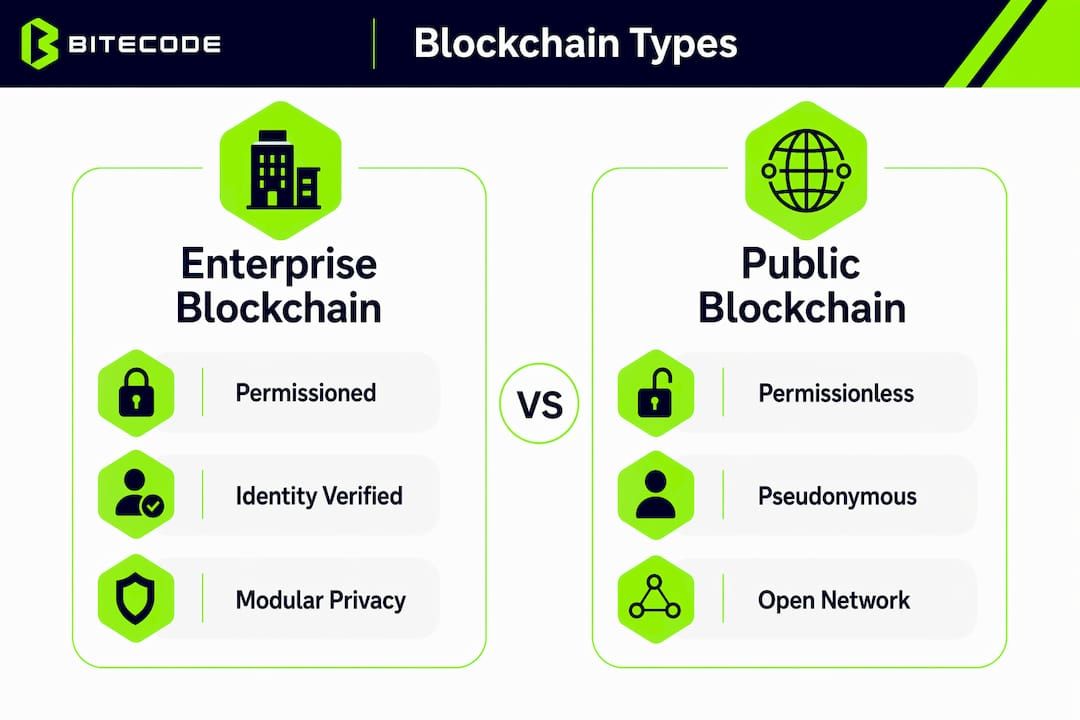
Pro Tip: Define governance rules before writing a single line of chaincode. Failure to predefine governance is the leading cause of stalled production rollouts, not technical limitations.
What are the most valuable enterprise blockchain applications?
Enterprise blockchain applications cluster around industries where multiple parties must share data but cannot fully trust each other or a single central authority. Supply chain tracking is the most widely deployed use case. IBM Blockchain Platform enables permissioned network access and immutable transaction records to prevent fraud across global supplier networks. That immutability means a retailer can trace a product from raw material to shelf without relying on any single supplier’s self-reported data.
Trade finance and financial services are equally active. R3 Corda was built specifically for financial contract automation, allowing banks to settle transactions privately between counterparties without broadcasting details to the entire network. Healthcare organizations use enterprise blockchain for patient record sharing across hospital systems, where auditability and access control are regulatory requirements. Asset tokenization, where physical assets like real estate or commodities are represented as digital tokens on a ledger, is an emerging application with significant implications for financial sector efficiency.
Core business benefits vs. traditional systems
The benefits of enterprise blockchain are most visible when compared directly to what they replace:
- Auditability: Every transaction is timestamped and cryptographically signed, creating a tamper-evident audit trail that satisfies regulatory requirements without manual reconciliation.
- Reduced reconciliation costs: Organizations that previously maintained separate internal ledgers and reconciled them periodically can replace that process with a single shared ledger, cutting operational overhead.
- Automated contract execution: Smart contracts execute automatically when predefined conditions are met, removing the need for manual approval steps and reducing settlement time from days to seconds.
- Fraud prevention: Because records cannot be altered retroactively, the attack surface for data manipulation is significantly reduced compared to centralized databases.
- Cross-organization trust: Participants who compete in the market can share process data on a neutral ledger without exposing proprietary information, a capability no traditional database architecture provides.
For a structured view of when blockchain adds value versus when a conventional database suffices, the decision criteria matter as much as the technology itself.
How does enterprise blockchain setup and integration work?
Deploying enterprise blockchain is a multi-disciplinary engineering effort. Deploying Hyperledger Fabric on Kubernetes involves complex network configuration, certificate management, and consensus node operation. That complexity means teams need expertise across distributed systems, cryptography, DevOps, and cloud-native infrastructure simultaneously. Organizations that underestimate this tend to treat blockchain deployment like a standard software release. It is not.
Platform selection and network configuration
The first decision is platform choice. Hyperledger Fabric suits organizations that need modular, channel-based privacy and have the engineering capacity to manage certificate authorities. R3 Corda suits financial services firms that need bilateral contract privacy. IBM Blockchain Platform provides a managed layer on top of Hyperledger Fabric, reducing operational burden at the cost of vendor dependency. Each choice relocates complexity rather than eliminating it.
Network configuration follows platform selection. Organizations must define the number of peer nodes, ordering nodes, and channel structures before any application code is written. These decisions are difficult to reverse once the network is live, which is why a greenfield deployment requires careful upfront architecture work.
Integration with existing enterprise systems
The biggest risk in enterprise blockchain deployment is creating an isolated data silo. Integration with ERP, CRM, and KYC systems is the step that determines whether blockchain delivers business value or simply adds infrastructure cost. A blockchain ledger that does not connect to the systems where business decisions are made produces no measurable return. Teams must build API layers that synchronize on-chain state with operational databases in near real time.
For a detailed look at the technical integration challenges enterprises face during deployment, the architecture decisions made early in the process have long-term cost implications.
Pro Tip: Keep sensitive data off-chain. Store only hashed references on the ledger to meet data retention, deletion, and privacy compliance requirements. Putting raw personal data on an immutable ledger creates regulatory exposure that is extremely difficult to remediate.
Enterprise blockchain vs. traditional databases: key differences
Enterprise blockchain is not simply a decentralized database. Misusing blockchain as a database increases cost and complexity without delivering the trust or auditability benefits the technology is designed to provide. The decision to use blockchain should rest on one question: does this process involve multiple organizations that need a shared, tamper-evident record they cannot achieve through a trusted central authority?
| Dimension | Enterprise Blockchain | Traditional Database | Public Blockchain |
|---|---|---|---|
| Control model | Consortium-governed | Single organization | Fully decentralized |
| Data immutability | Cryptographic, append-only | Mutable, deletable | Cryptographic, append-only |
| Privacy | Configurable per channel | Full control | Transparent by default |
| Performance | Moderate, improving | Very high | Low to moderate |
| Operational cost | High, multi-party | Low to moderate | Variable, gas fees |
| Best fit | Multi-party trust processes | Single-org data storage | Censorship-resistant apps |
Traditional databases are the right tool when a single organization controls all participants and data. Enterprise blockchain earns its complexity premium only when the process spans organizational boundaries and requires a neutral record that no single party can alter. The development costs and hard parts of blockchain projects are real, and organizations should evaluate them honestly before committing to a full deployment.
Key takeaways
Enterprise blockchain delivers measurable value only when governance, integration, and privacy boundaries are defined before deployment begins.
| Point | Details |
|---|---|
| Permissioned access is foundational | Enterprise blockchain restricts participation to verified identities, separating it from public chains. |
| Governance precedes technology | Define node operators, upgrade processes, and dispute resolution before writing any chaincode. |
| Integration determines ROI | Connecting the ledger to ERP, CRM, and KYC systems is what converts infrastructure into business value. |
| Off-chain data is the rule | Store only hashed references on-chain to maintain privacy compliance and regulatory flexibility. |
| Blockchain is not a database substitute | Use it only when multiple organizations need a shared, tamper-evident record no central party can control. |
Bitecode’s view on enterprise blockchain adoption
The most consistent mistake Bitecode observes in enterprise blockchain projects is treating governance as a post-deployment problem. Organizations spend months selecting platforms, configuring Kubernetes clusters, and writing chaincode, then stall when they realize no one has agreed on who approves smart contract upgrades or how disputes get resolved. The technology is ready. The organizational alignment is not.
A second pattern worth naming: blockchain as a second island of complexity. Teams deploy a ledger, integrate it with nothing, and then maintain two parallel data systems indefinitely. The blockchain becomes a compliance artifact rather than an operational asset. True value comes from connecting the ledger to the systems where decisions are made, not from running it in parallel.
The organizations that succeed with enterprise blockchain share one trait. They run a pilot with defined success criteria, a specific process, a measurable baseline, and a clear exit condition if the technology does not deliver. They do not treat blockchain as a platform to grow into. They treat it as a tool to prove out. That discipline, more than any technical choice, separates production deployments from perpetual proof-of-concept projects.
For teams evaluating whether their workflows are ready for scalable enterprise deployment, the maturity of the surrounding systems matters as much as the blockchain layer itself.
— Bitecode
Ready to deploy enterprise blockchain without starting from scratch?
Bitecode builds enterprise blockchain systems on a modular foundation, with up to 60% of the baseline infrastructure pre-built before your team writes the first line of business logic. That means organizations can move from architecture decision to working pilot in weeks, not quarters.
The blockchain payment module handles secure, permissioned transaction processing out of the box, while the AI assistant module automates the workflow steps that surround those transactions. Together, they address the two most common enterprise pain points: secure multi-party payments and the manual approval processes that slow them down. If your organization is evaluating a blockchain deployment, Bitecode provides the modular foundation that accelerates work without accelerating chaos.
FAQ
What is enterprise blockchain in simple terms?
Enterprise blockchain is a permissioned ledger shared among a defined group of organizations, where every transaction is cryptographically recorded and no single party can alter the history. It differs from public blockchains by restricting participation to verified identities.
How does enterprise blockchain differ from a regular database?
A traditional database is controlled by a single organization and can be modified or deleted by administrators. Enterprise blockchain distributes control across multiple organizations and makes records append-only, which is the property that makes it valuable for multi-party trust processes.
Which platforms are most common for enterprise blockchain?
Hyperledger Fabric and R3 Corda are the two most widely deployed enterprise blockchain frameworks. IBM Blockchain Platform provides a managed deployment layer built on Hyperledger Fabric for organizations that prefer reduced operational overhead.
How long does an enterprise blockchain deployment take?
A well-scoped pilot with a single use case and two to three participating organizations typically takes three to six months to reach a working state. Full production deployments with ERP integration and multi-party governance take considerably longer, often twelve months or more.
When should a company not use enterprise blockchain?
Organizations should avoid blockchain when a single entity controls all participants and data, when transaction volumes require database-level performance, or when the cost of multi-party governance outweighs the trust benefit. A centralized database is the correct tool for single-organization data management.