TL;DR:
- Blockchain transforms workflow automation by replacing centralized control and human checkpoints with self-executing smart contracts that operate on shared, verifiable rules. Enterprises report 30-70% cost savings across industries through immediate execution, enhanced transparency, and reduced manual intervention. However, organizations must carefully address technical, security, and governance challenges to fully realize its benefits.
Most enterprises have automated something. Invoice routing, approval queues, compliance checklists. But traditional automation tools still depend on human checkpoints, centralized databases, and institutional trust to function correctly. Blockchain changes that equation. Smart contracts reduce business costs 30-70% across industries by replacing manual intervention with self-executing code that operates on verifiable, shared rules. This article walks through the core mechanics, measurable ROI, key technical enablers, security implications, and the practical challenges every enterprise technology leader needs to understand before committing to a blockchain automation strategy.
Key Takeaways
| Point | Details |
|---|---|
| Smart contracts drive automation | Blockchain-based smart contracts eliminate manual steps for faster, more reliable workflows. |
| Tangible cost savings | Automation with blockchain can save enterprises 30-70% in operational costs and shorten settlement times by 90%. |
| Enhanced security and compliance | Cryptographic proofs and audit trails provide verifiable security and simplify audits. |
| Proper integration is crucial | Using oracles, hybrid storage, and human oversight ensures resilient, compliant automation. |
| Organizational readiness matters | Shifting trust from people to code means new skills and processes are needed for successful blockchain automation. |
How blockchain transforms workflow automation
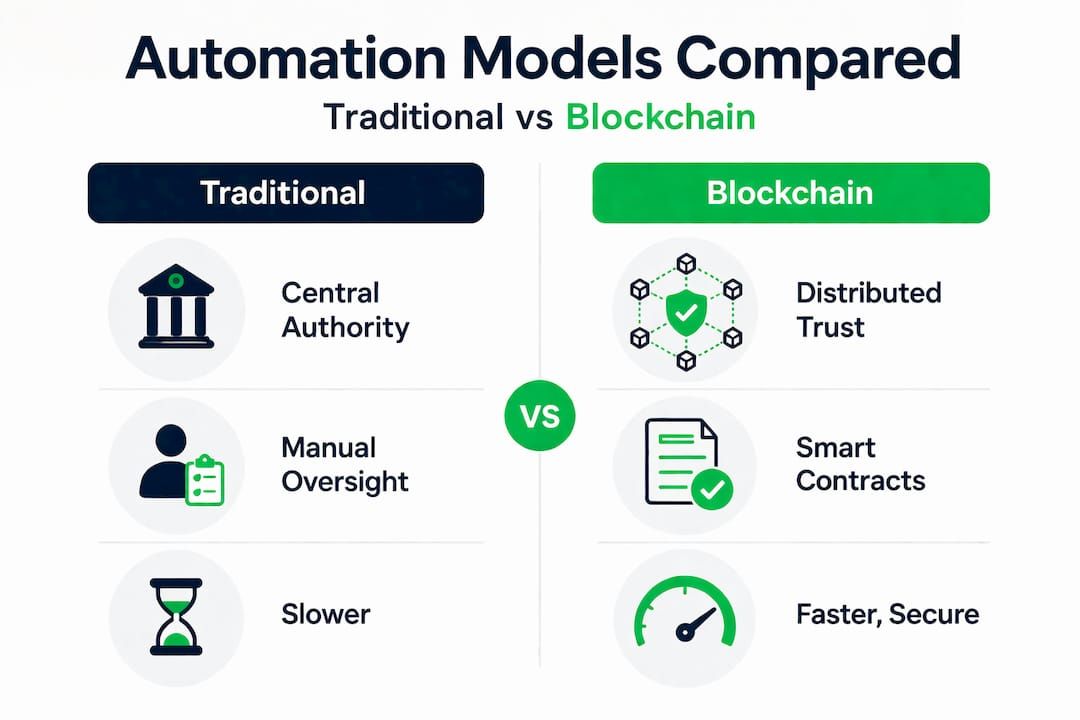
Traditional automation tools, whether robotic process automation (RPA) or workflow orchestration platforms, move data between systems and trigger actions based on predefined rules. They are effective. But they still rely on centralized control points, human approvals, and trust in a single system of record. When that system fails or is compromised, the workflow breaks.
Blockchain introduces a fundamentally different model. Smart contracts automate business processes by encoding business rules directly into self-executing code deployed on a distributed ledger. Once conditions are met, the contract executes automatically. No intermediary required. No manual sign-off. The logic is transparent, auditable, and enforced by the network itself.
Consider a procurement workflow. In a traditional setup, a purchase order triggers a series of email approvals, database updates, and manual reconciliation steps. With smart contract automation, the same workflow executes the moment predefined conditions are satisfied: delivery confirmed, quality check passed, invoice matched. Payment releases automatically. Every step is recorded on-chain.
“Smart contracts eliminate intermediaries and manual interventions, enabling business processes to execute with greater speed, transparency, and trust than any centralized system can provide.”
This shift matters because it removes the bottleneck of human coordination from processes that don’t actually require human judgment. Payments, compliance checks, inventory updates, and contract milestones are all candidates for this kind of automation.
Blockchain automation vs. traditional automation
| Feature | Traditional automation | Blockchain automation |
|---|---|---|
| Trust model | Centralized authority | Distributed consensus |
| Auditability | Log files, often mutable | Immutable on-chain records |
| Intermediary dependency | High | Minimal |
| Execution trigger | System or human | Code condition |
| Transparency | Internal only | Configurable, often shared |
| Failure mode | Single point of failure | Distributed resilience |
Pro Tip: Before writing a single line of smart contract code, map your business rules exhaustively. Ambiguous logic in the design phase becomes a costly bug in production. Codifying rules correctly from the start prevents bottlenecks and rework later.
The practical entry point for most enterprises is smart contract automation in high-volume, rule-based processes where the cost of manual intervention is measurable and the conditions for execution are clearly defined.
Real-world impact: Business benefits, savings, and ROI
Now that we’ve seen the mechanics, what tangible benefits are enterprises realizing? Let’s look at the numbers.
The headline figures are significant. Enterprises report 30-70% cost savings from blockchain automation across industries, with Walmart and Maersk cutting supply chain tracking costs by 35-40% after deploying distributed ledger solutions. Cross-border payment settlement time has dropped by as much as 90% in pilot programs, replacing multi-day bank clearing processes with near-instant on-chain settlement.

These aren’t edge cases. Insurance companies automating claims adjudication have reduced processing time from weeks to hours. Contract management platforms using smart contracts have eliminated entire categories of legal overhead. Financial institutions running tokenized asset settlement have cut reconciliation costs dramatically.
Industry ROI benchmarks
| Industry | Use case | Reported reduction |
|---|---|---|
| Supply chain | Tracking and provenance | 35-40% cost reduction |
| Insurance | Claims processing | 60-70% time reduction |
| Finance | Cross-border settlement | Up to 90% time reduction |
| Contract management | Legal overhead | 30-50% cost reduction |
| Healthcare | Record reconciliation | 40-60% error reduction |
The workflow automation ROI case becomes clearest when teams quantify the current cost of manual steps. Here’s a practical framework for estimating it:
- Identify the process scope. Map every manual touchpoint: approvals, data entry, reconciliation, dispute resolution.
- Measure current cost per transaction. Include labor hours, error rates, delay penalties, and third-party fees.
- Model the automated baseline. Estimate execution cost on-chain, oracle fees, and integration overhead.
- Calculate the delta. The difference between current cost and automated cost, annualized, is your ROI numerator.
- Estimate time to value. Most blockchain automation deployments reach breakeven within 6-12 months for high-volume processes.
The math is compelling for processes that run at scale. A procurement workflow processing 10,000 transactions per month at $15 of manual overhead each represents $1.8 million annually in addressable cost. Even a 40% reduction delivers substantial savings within the first year.
Key enablers: Smart contracts, oracles, and BPMN models
Knowing the business results, let’s look under the hood at the main technical enablers.
Three components form the core of any serious enterprise blockchain automation architecture: smart contracts, oracles, and Business Process Model and Notation (BPMN) modeling. Each plays a distinct role, and understanding how they interact is essential for designing systems that are both scalable and maintainable.
Smart contracts are the execution engine. They encode the business rules, hold state, and trigger downstream actions when conditions are satisfied. In an enterprise context, a smart contract might release payment when a shipment is confirmed, update inventory records when a threshold is crossed, or flag a compliance exception when a transaction falls outside defined parameters.
Oracles are the bridge between on-chain logic and off-chain reality. A smart contract cannot natively access external data. It cannot check a weather API, pull a commodity price, or verify a shipping status from a third-party logistics provider. Oracles solve this by importing trusted external data into the blockchain environment. Model-driven BPMN approaches generate smart contract code for blockchain orchestration, while oracles pull in off-chain data to keep automated workflows connected to real-world conditions.
BPMN modeling bridges the gap between process design and code generation. Business analysts can map workflows in standard BPMN notation, and tooling can translate those models into smart contract logic. This dramatically reduces the translation loss between what a process owner intends and what the code actually does.
Key technical enablers at a glance:
- Smart contracts: Self-executing code that enforces business rules without intermediaries
- Oracles: Trusted data feeds connecting on-chain logic to off-chain systems
- BPMN models: Visual process maps that generate or guide smart contract development
- Hybrid storage: On-chain hashes with off-chain document storage for compliance and scalability
- Event listeners: Off-chain services that monitor blockchain state and trigger external system updates
You can explore practical enterprise blockchain automation examples to see how these components work together in production environments, and review how organizations are streamlining crypto operations through structured workflow automation.
Pro Tip: Don’t store large documents or sensitive data directly on-chain. Use a hybrid storage model where the blockchain holds a cryptographic hash of the document and the actual file lives in a compliant, encrypted off-chain store. This keeps your architecture scalable and your compliance posture intact.
Security and compliance: Blockchain’s role in verifiable automation
With automation increasingly touching critical business processes, security and compliance are top-of-mind. Blockchain brings unique strengths here, but they need to be understood precisely.
“When AI agent actions are recorded as signed transactions on a blockchain, the result is a verifiable execution layer that reduces fraud by 25% in insurance pilots and provides regulators with auditable proof of every automated decision.”
The core security advantage of blockchain automation is immutability. Once a transaction is recorded, it cannot be altered without consensus from the network. This creates an audit trail that is not just logged but cryptographically verified. For regulated industries, this distinction matters enormously. A log file can be edited. An on-chain record cannot.
Blockchain enhances security through immutable audit trails and has demonstrated a 25% reduction in fraud in insurance pilot programs. The mechanism is straightforward: every automated action is a signed transaction, every state change is recorded, and every participant in the network can verify the history independently.
Security benefits for enterprise automation:
- Immutable audit trails: Every transaction is permanently recorded and verifiable
- Cryptographic proof of execution: Actions are signed and cannot be repudiated
- Decentralized verification: No single party controls the record of truth
- Tamper-resistant logic: Smart contract code, once deployed, executes as written
- Role-based access control: Permissioned blockchains support fine-grained access policies
Real-world compliance applications are already demonstrating value. In financial services, smart contracts automate Know Your Customer (KYC) and Anti-Money Laundering (AML) checks, triggering alerts when transaction patterns fall outside defined risk thresholds. In supply chain, provenance tracking on-chain gives regulators and auditors instant access to a complete chain of custody without requesting records from multiple parties.
For teams building secure AI and blockchain workflows, the combination of AI-driven anomaly detection and blockchain’s immutable record creates a powerful compliance layer. AI flags suspicious patterns; blockchain preserves the evidence. This pairing is also increasingly relevant for AI-enhanced fraud prevention, where speed and auditability are equally critical.
Challenges and best practices: Nuances every enterprise must address
Finally, a responsible roadmap means getting clear about the limitations and pitfalls of blockchain-based automation. The technology is powerful, but it is not without meaningful constraints.
Blockchain automation requires oracles for off-chain data, and smart contract bugs combined with front-running attacks create real operational risks. Front-running, also called Miner Extractable Value (MEV), occurs when actors exploit the visibility of pending transactions in public mempools to execute competing transactions first. This is a structural risk on public blockchains and requires architectural mitigation on enterprise deployments.
Common pitfalls and practical remedies:
- Underdefined business rules: Leads to contract logic that doesn’t match real-world intent. Remedy: extensive process mapping before development.
- Oracle dependency failures: If an oracle goes down, the smart contract stalls. Remedy: use redundant oracle networks and fallback logic.
- Smart contract bugs: Immutable code means bugs are permanent unless upgrade patterns are built in. Remedy: formal verification, extensive testing, and proxy upgrade patterns.
- MEV and adversarial attacks: Public mempool visibility enables front-running. Remedy: use private transaction relays or permissioned networks for sensitive workflows.
- Scalability constraints: High transaction volumes can congest public chains. Remedy: evaluate Layer 2 solutions or permissioned enterprise blockchains like Hyperledger Fabric.
- Governance gaps: Smart contracts don’t self-govern. Remedy: establish clear upgrade and dispute resolution protocols before deployment.
The security considerations in automation extend beyond code quality. Organizational processes for monitoring, incident response, and contract upgrades are just as critical as the technical architecture. Teams that treat smart contracts as fire-and-forget deployments consistently encounter problems that proper governance would have prevented.
Understanding the full scope of blockchain application development challenges is essential before scoping a project. The development and audit costs for smart contracts are meaningfully higher than for equivalent traditional software, and that investment must be factored into the ROI model from the start.
Pro Tip: Test smart contract logic against adversarial scenarios, not just happy paths. Simulate oracle failures, edge-case inputs, and high-load conditions before deployment. Post-deployment, implement continuous monitoring for anomalous transaction patterns that could indicate an active exploit.
What most blockchain automation guides miss: Trust shifts, human oversight, and the real change
Most technical guides on blockchain automation focus on what the code does. They explain smart contract mechanics, show impressive cost reduction figures, and outline integration patterns. What they consistently underemphasize is what changes organizationally when you shift trust from people and processes to software and data.
This is the harder conversation. When a smart contract executes a payment, no human approved that specific transaction. The approval happened when the contract was written, tested, and deployed. The trust that previously lived in a person’s judgment now lives in code. That is a profound governance shift, and organizations that don’t prepare for it operationally will struggle regardless of how well their contracts are written.
Automation shifts trust from humans to code and data, but human oversight remains essential for managing upgrades, responding to failures, and monitoring AI agent behavior on-chain. This isn’t a weakness of the technology. It’s a design reality that mature implementations account for explicitly.
The organizations that deploy blockchain automation most successfully treat it as an ongoing operational discipline, not a one-time deployment. They build monitoring dashboards. They establish upgrade governance committees. They run regular audits of contract logic against evolving business rules. They maintain critical automation oversight as a standing function, not an afterthought.
The practical implication: before automating a workflow on-chain, ask who owns the contract when something goes wrong. If the answer is unclear, the governance model isn’t ready. The technology can be perfect and the project can still fail if the organizational processes around it aren’t designed with the same rigor as the code itself.
Blockchain automation doesn’t eliminate the need for human expertise. It relocates it. The judgment moves from transaction-level decisions to system-level design, monitoring, and governance. Teams that understand this transition early build more resilient systems and avoid the most common failure modes.
Begin your automation journey with advanced blockchain solutions
If your organization is evaluating blockchain automation seriously, the path from assessment to production doesn’t have to be a multi-year greenfield build. The right modular foundation can accelerate work without accelerating chaos.
Bitecode.tech provides pre-built modules for AI workflow automation and blockchain-based payment solutions that give enterprise teams a significant head start. With up to 60% of the baseline system pre-built, organizations can focus engineering effort on business-domain complexity rather than boilerplate infrastructure. Whether you’re building a custom procurement automation system, a compliant financial processing layer, or a supply chain provenance platform, the modular approach reduces time-to-value and keeps the architecture flexible as requirements evolve. Explore the platform to see how pre-built blockchain and AI components can support your specific automation goals.
Frequently asked questions
How do smart contracts eliminate manual steps in business workflows?
Smart contracts automate compliance checks, inventory updates, and payments upon delivery confirmation by executing code the moment predefined conditions are met, removing the need for human sign-off on individual transactions.
What kind of ROI can enterprises expect from automating with blockchain?
Businesses typically see cost reductions of 30-70% and reach ROI breakeven within 6-12 months for high-volume processes like supply chain management and contract execution.
What are the biggest risks with blockchain-based automation?
Public mempools enable front-running attacks, and smart contract bugs combined with insecure oracle dependencies represent the most significant operational risks for enterprise deployments.
How does blockchain improve compliance monitoring?
Blockchain enables immutable audit trails, reducing fraud by 25% in insurance pilots and giving regulators cryptographically verifiable proof of every automated action without relying on mutable log files.
Is human oversight still needed after automating with blockchain?
Yes. Automation shifts trust to code, but human oversight remains essential for managing contract upgrades, responding to failures, and governing the behavioral boundaries of AI agents operating on-chain.