TL;DR:
- Rapid software deployment involves releasing frequent code updates through automated pipelines. It helps organizations patch vulnerabilities faster, validate products with real users, and compete effectively. Implementing it safely requires months of investment in automation, testing, and cultural change to ensure stability and security.
Rapid software deployment is the practice of releasing code updates frequently and reliably through automated pipelines, compressing release cycles from months to days or hours. Understanding why rapid software deployment matters is no longer optional for IT decision-makers. Organizations that deploy slowly cannot patch vulnerabilities fast enough, cannot validate product decisions with real users, and cannot match the pace of competitors who ship multiple times per day. The industry benchmark for this practice is continuous deployment, built on CI/CD pipelines, automated testing, and feature flags. These are not aspirational tools. They are the operational foundation of modern software delivery.
What measurable benefits does rapid software deployment offer?
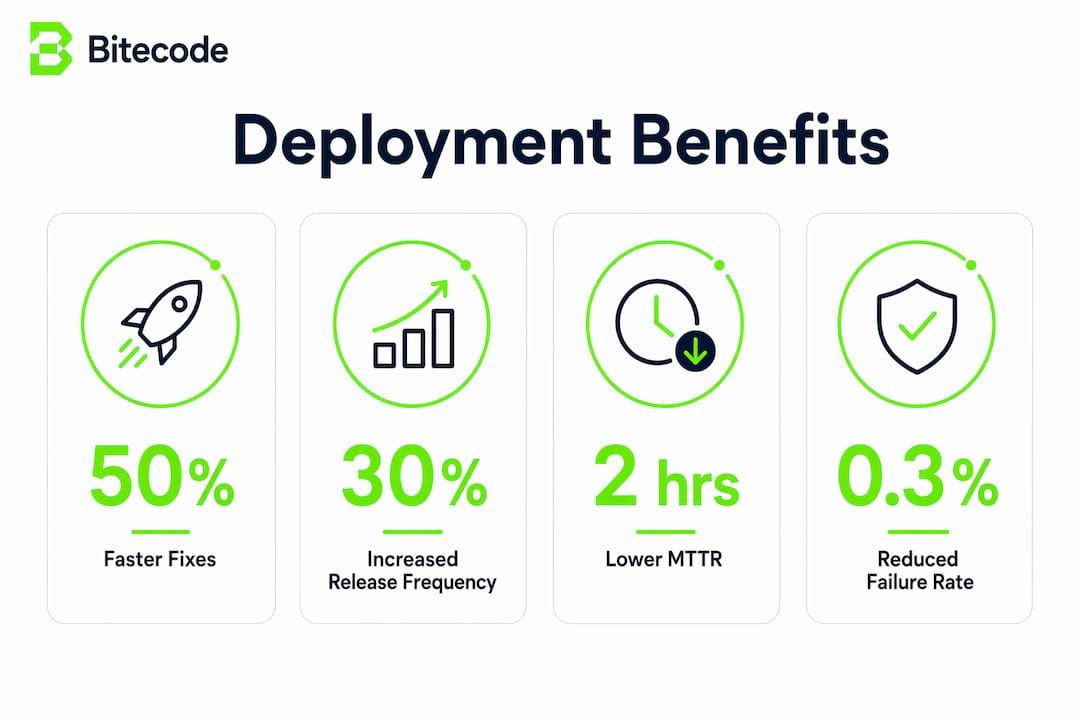
The business case for fast software delivery is concrete and well-documented. Enterprises implementing continuous deployment achieve up to 12 daily releases with failure rates below 5%, delivering updates 45% faster than traditional methods. That velocity translates directly into revenue: case studies report 367% sales growth and 18% click-through rate improvement tied to faster release cycles.
The performance gap between elite and average teams is even more striking. Elite DevOps performers achieve 2,083 times faster lead times for changes and recover from incidents 2,555 times faster than low-performing teams, with change failure rates under 0.3%. These numbers are not outliers from a single vendor study. They reflect a consistent pattern across thousands of organizations tracked in annual DevOps research.
Three additional benefits deserve attention from IT leaders:
- Security posture improves. Faster deployment means security patches reach production in hours, not weeks. Shrinking the window between vulnerability discovery and remediation directly reduces exposure.
- Technical debt decreases. Teams that ship frequently are forced to keep codebases clean. Large, infrequent releases accumulate hidden complexity that compounds over time.
- User feedback loops tighten. Rapid deployment transforms how teams validate product decisions, replacing assumption-based planning with real user data.
Pro Tip: Track mean time to restore (MTTR) alongside deployment frequency. A team deploying 10 times per day with a 2-hour MTTR is far more resilient than one deploying monthly with a 48-hour MTTR.
How do organizations implement rapid deployment safely?
Moving from monthly releases to daily or continuous deployment is a multi-month organizational effort, not a tooling switch. Building the foundation requires 4–6 months of investment in automated testing, CI/CD pipeline maturity, and feature flags that decouple deployment from feature release. Teams that skip this groundwork and simply push code faster create more instability, not less.

The technical enablers are well understood. The cultural shift is harder. Cross-team collaboration, shared ownership of pipeline health, and continuous monitoring must become defaults, not exceptions. Without these, deployment speed creates chaos rather than capability.
Key practices for safe, fast delivery include:
- Automated test coverage at every layer. Unit tests, integration tests, and end-to-end tests must run automatically on every commit. Manual testing gates kill velocity.
- Feature flags as a release control mechanism. Deploying code and releasing features are separate decisions. Feature flags let teams ship code to production while controlling who sees new functionality.
- Small batch sizes. Frequent smaller deployments limit blast radius. When something breaks, the failure affects a narrow code change, making diagnosis and rollback faster.
- Rollback procedures tested in advance. A rollback plan that has never been rehearsed is not a plan. Teams should practice rollbacks regularly.
- Observability built into the pipeline. Logs, metrics, and distributed tracing must be in place before deployment frequency increases.
Pro Tip: Accelerate work without accelerating chaos by setting a deployment readiness checklist that every release must pass before it touches production. Automate the checklist enforcement so it cannot be bypassed under deadline pressure.
Bitecode’s secure deployment practices align with this foundation. Starting projects with up to 60% of the baseline system pre-built means teams inherit a modular foundation that already supports CI/CD integration, reducing the ramp-up time significantly.
What strategic role does deployment speed play in high-stakes industries?
Deployment speed is an operational survival mechanism in industries where threats and regulations evolve faster than annual release cycles can accommodate. Fintech companies have compressed release cycles from six months to two weeks to meet cybersecurity, regulatory, and customer demands. Slow deployment in fintech is now classified as an operational liability, not merely an inefficiency.
The defense sector offers the most dramatic example of deployment speed as competitive advantage. AI defense initiatives reduced deployment time from six months to days, a 97% reduction that shifted operational advantage by enabling continuous adaptation. That is not an efficiency story. It is a resilience story.
Security integration into deployment pipelines is a design requirement in these environments, not an afterthought. Organizations that treat fintech security practices as a separate workstream from deployment velocity create dangerous gaps. The two must be designed together.
| Deployment model | Release cycle | Patch delivery time | Incident recovery |
|---|---|---|---|
| Traditional (monthly) | 4–6 weeks | Days to weeks | 24–48 hours |
| Continuous deployment | Multiple per day | Hours | Under 1 hour |
| Elite DevOps teams | Multiple per hour | Minutes | Under 15 minutes |
The table above illustrates why organizations in regulated industries cannot afford to treat deployment speed as a secondary concern. Every row represents a different risk profile.
What are common misconceptions about rapid deployment?
The most persistent misconception is that deploying more frequently increases failure rates. The evidence runs in the opposite direction. Elite teams show the lowest change failure rates in the industry, under 0.3%, while deploying far more often than average teams. Frequency and stability are not in tension. They reinforce each other when the underlying practices are sound.
A second misconception is that vendor marketing claims about deployment speed reflect real-world performance. Buyers should seek service-level agreements that guarantee deployment performance rather than relying on marketing language. The gap between a vendor’s claimed deployment speed and actual production behavior can be significant. Contractual guarantees close that gap.
Cultural resistance and accumulated technical debt are the most common practical barriers. Teams accustomed to large, infrequent releases often resist smaller batches because the process feels unfamiliar and the tooling is not yet in place. The path forward is incremental:
- Start by automating one manual testing step per sprint.
- Add a feature flag system before increasing deployment frequency.
- Measure MTTR and deployment frequency as team-level metrics, not just infrastructure metrics.
- Build psychological safety so engineers report failures quickly rather than hiding them.
Pro Tip: Prioritize pipeline observability before increasing deployment frequency. You cannot improve what you cannot see. Instrument your pipeline to surface failures within minutes of a bad deploy.
Secure software integration guides teams through the coordination layer that makes speed safe. The goal is not to rush releases. It is to build a system where releasing frequently is the lowest-risk option available.
Key takeaways
Rapid software deployment is the single most effective way to reduce release risk, accelerate feedback, and maintain security posture simultaneously.
| Point | Details |
|---|---|
| Speed reduces risk | Smaller, frequent deploys limit blast radius and cut mean time to restore. |
| Elite teams prove the model | Change failure rates under 0.3% show that frequency and stability reinforce each other. |
| Foundation takes 4–6 months | CI/CD maturity, automated testing, and feature flags must precede increased frequency. |
| Regulated industries face survival pressure | Fintech and defense sectors treat slow deployment as an operational liability, not a preference. |
| Vendor claims need contractual backing | Service-level agreements on deployment performance protect organizations from marketing gaps. |
Bitecode’s perspective on deploying faster without breaking things
The organizations that struggle most with deployment speed are not the ones with the worst tooling. They are the ones that treat deployment as a technical problem when it is actually an organizational one. Tooling is the easy part. Getting a product team, a security team, and an infrastructure team to agree on a shared definition of “ready to deploy” is where most acceleration efforts stall.
What I have observed consistently is that teams deploying small changes frequently develop a fundamentally different relationship with failure. Failure becomes a signal, not a crisis. When a bad deploy affects 200 lines of code rather than 20,000, the team can diagnose and fix it in minutes. That experience, repeated dozens of times, builds confidence that larger batch deployments never can.
The warning I give every organization considering rapid deployment is this: do not rush the foundation. The 4–6 month investment in automated testing and CI/CD maturity is not a delay. It is the work. Teams that skip it and simply push code faster are not deploying rapidly. They are deploying recklessly.
The future of deployment speed runs through AI and automation. AI automation implementation is already reducing manual pipeline steps that previously required human judgment. The organizations building those capabilities now will have a compounding advantage over the next three years. The ones waiting for the technology to mature will find themselves in the same position as fintech firms that held onto six-month release cycles until regulatory pressure forced their hand.
— Bitecode
How Bitecode supports faster, safer software delivery
Teams that understand the importance of quick software delivery still face a practical gap between knowing what to build and having the infrastructure to build it quickly.

Bitecode’s AI Assistant Module is built for organizations that need to automate deployment workflows without building the automation layer from scratch. The module handles workflow automation, integrates with existing pipelines, and reduces the manual coordination that slows release cycles. Because Bitecode starts projects with up to 60% of the baseline system pre-built, teams inherit a modular foundation that already supports rapid iteration. The result is a shorter path from decision to production, with security and governance built into the structure rather than bolted on afterward.
FAQ
What is rapid software deployment?
Rapid software deployment is the practice of releasing code updates frequently and reliably through automated CI/CD pipelines, compressing release cycles from months to hours or days.
Does deploying more often increase the risk of failures?
No. Elite DevOps teams deploy most frequently and show the lowest change failure rates, under 0.3%, because smaller batch sizes make failures easier to diagnose and reverse.
How long does it take to build a rapid deployment capability?
Moving from monthly to daily deployment typically requires 4–6 months of investment in automated testing, CI/CD pipeline maturity, and feature flag infrastructure.
Why does deployment speed matter in fintech and regulated industries?
Fintech companies that cannot deploy quickly cannot patch vulnerabilities fast enough to meet regulatory and cybersecurity demands. Slow deployment is now classified as an operational liability in these sectors.
How can teams verify vendor claims about deployment speed?
Teams should negotiate service-level agreements that contractually guarantee deployment performance rather than relying on marketing claims, which often overstate real-world delivery speed.