TL;DR:
- Digital partners are embedded collaborators who align digital systems with business goals and are accountable for measurable outcomes. They enhance growth through specialized expertise, cross-industry insights, and continuous optimization while reducing operational complexity and dependency risks. Success depends on strategic selection, clear metrics, cultural fit, and building internal capability alongside the partnership.
Digital partners are strategic collaborators that align digital systems with commercial goals, taking accountability for outcomes rather than just delivering outputs. Unlike traditional agencies or vendors, they integrate across marketing, sales, CRM, and operational workflows to drive measurable results continuously. The role of digital partners in business has shifted from tactical execution to cross-functional coordination, making them central to how medium and large organizations compete in 2026. Firms like Spyrosoft and Mars Digital represent this model well: embedded, commercially accountable, and oriented toward long-term outcomes rather than project milestones.
What strategic advantages do digital partners bring to businesses?
The core advantage of a digital partner over a conventional supplier is integration. Partners act as part of the team, contributing context-aware solutions rather than isolated deliverables. This distinction matters because most operational failures in digital transformation trace back to handoff gaps, not technical incompetence. A partner who understands your commercial context can make faster, better-calibrated decisions than a vendor who only sees their own workstream.
Digital partners reduce operational load by serving as a central strategic accountability point, enabling faster decision-making and coordination across functions. This is particularly valuable for organizations managing multiple technology vendors, where coordination overhead can consume as much internal capacity as the actual work. A well-structured digital partnership consolidates that complexity into a single relationship with shared accountability.
The strategic advantages compound over time through continuous optimization. One-off projects deliver a fixed output and close. Digital partnerships generate a feedback loop: data from one initiative informs the next, and the partner’s institutional knowledge of your business grows with each cycle. Long-term digital growth depends on exactly this kind of collaborative relationship focused on outcomes, not short-term delivery.
Key operational advantages include:
- Commercial accountability: Partners are measured against business metrics, not just delivery timelines or scope completion.
- Cross-functional coordination: Effective partners connect marketing, sales, product, and operations rather than optimizing a single channel in isolation.
- Speed and scalability: Access to pre-built expertise and processes means organizations can scale digital capabilities faster than internal hiring allows.
- Data-driven iteration: Partners with cross-industry exposure bring pattern recognition that internal teams, focused on a single domain, rarely develop.
Pro Tip: Before signing any digital partnership agreement, define two or three specific business metrics the partner will be held accountable for. If a prospective partner resists this conversation, that tells you everything you need to know about their orientation.
What types of digital partners exist and when should you use each?
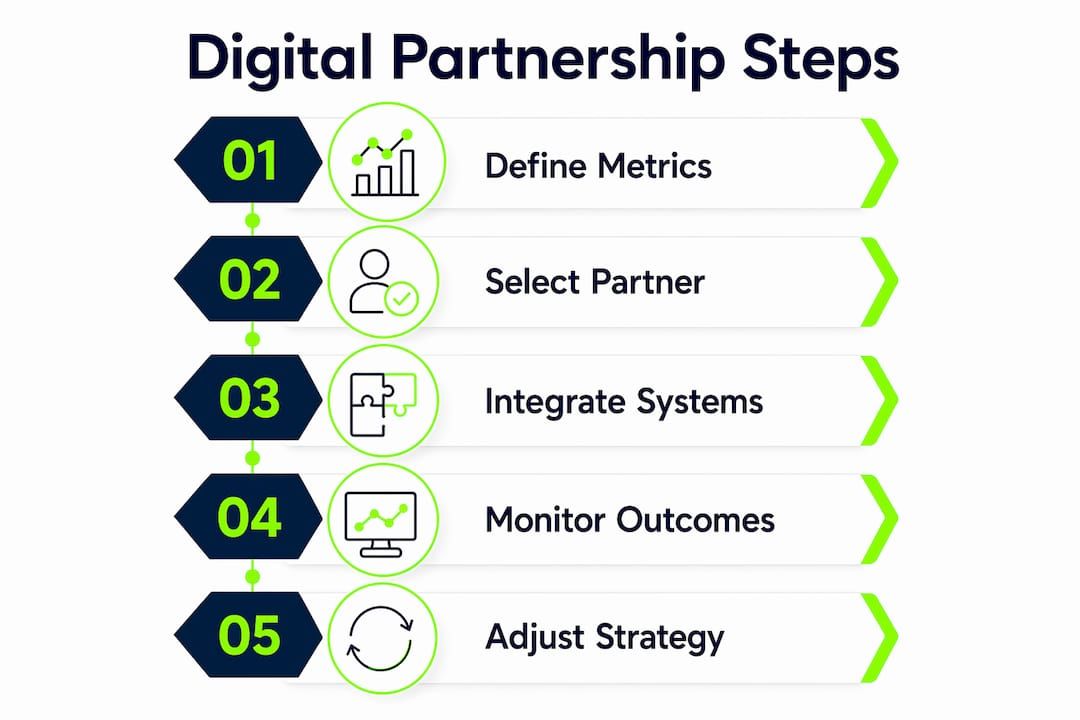
Not all digital partners serve the same function, and choosing the wrong archetype for your organizational context is one of the most common and costly mistakes in digital transformation. Three broad categories cover most of the market.

Large consulting firms such as Accenture, Deloitte Digital, and McKinsey Digital operate at the strategy and governance layer. They excel at cross-functional alignment, executive stakeholder management, and designing transformation programs that span multiple business units. Their limitation is execution velocity. Large consulting engagements often relocate complexity into the vendor relationship itself, producing frameworks and roadmaps that require significant internal capacity to act on.
Vertical and domain specialists bring focused expertise in a specific industry or technology stack. A firm specializing in financial services workflow automation, for example, arrives with realistic operational insights that a generalist partner would need months to develop. The trade-off is breadth: domain specialists may lack the cross-functional reach to connect their work to adjacent business systems.
Execution-focused engineering partners prioritize delivery velocity and project stabilization. These are the firms organizations turn to when a greenfield build has stalled, a legacy migration is behind schedule, or a product needs to ship. They are less suited to strategy definition but invaluable when the path is clear and speed is the constraint.
| Partner type | Best context | Primary benefit | Key risk |
|---|---|---|---|
| Large consulting firm | Enterprise-wide transformation | Governance and alignment | Slow execution, high cost |
| Domain specialist | Industry-specific workflows | Deep operational insight | Limited cross-functional reach |
| Engineering partner | Delivery-critical projects | Speed and technical depth | Weak strategic input |
| Digital marketing partner | Growth and acquisition | Specialist channel expertise | Narrow business context |
Pro Tip: Most organizations need more than one partner archetype at different stages. Map your current transformation phase before evaluating partners, not after. Bringing in a strategy firm when you need execution, or an engineering partner when you need governance, adds months to your timeline.
How do digital partners impact business growth and innovation?
The tangible impact of digital partnerships on growth operates across four distinct dimensions. Understanding each helps leadership teams set realistic expectations and structure partnerships to capture the full value available.
-
Elastic access to specialized capability. Organizations scale expertise elastically through partnerships, particularly in fields like predictive analytics and technical SEO, bypassing traditional hiring constraints entirely. Building an in-house team with equivalent depth in five or six specialized domains is a multi-year, multi-million-dollar commitment. A well-chosen partner provides that capability on demand, sized to current need.
-
Cross-industry innovation transfer. Partners who work across multiple clients and industries carry pattern recognition that internal teams cannot develop. A digital partner who has solved a customer retention problem in financial services may bring a structural insight directly applicable to a retail or logistics context. This cross-pollination is one of the least-discussed but most concrete benefits of digital collaboration.
-
Customer acquisition and lifetime value improvement. Digital marketing partnerships provide immediate access to high-level specialists, closing the gap between what an organization needs and what its internal team can deliver. The downstream effect on customer acquisition cost and retention rates is measurable within one to two quarters when the partnership is structured around those outcomes.
-
Sustained alignment with leadership strategy. Successful digital transformation requires leadership support beyond IT and connection to clear business outcomes. Digital partners who engage at the leadership level, not just the project level, keep digital initiatives anchored to strategic priorities as those priorities evolve. This prevents the common failure mode where a technically successful project delivers no measurable business impact.
One challenge that deserves direct attention is the continuity deficit: talent rotation and knowledge loss within partner organizations that erode institutional memory over time. Organizations that treat this as an inevitable cost of partnership rather than a solvable design problem consistently underperform those that build explicit knowledge transfer protocols into their partnership agreements from day one. Explore enterprise digital transformation tips for practical frameworks on managing this across departments.
How do you choose and sustain the right digital partnership?
Selecting a digital partner is a governance decision, not a procurement exercise. The criteria that matter most are not the ones that appear in standard RFP scoring matrices.
- Industry expertise with honest limitations. The best partners are candid about what they do not know. A partner who presents universal competence across every domain is either overstating their capability or understaffing your account with generalists.
- Cultural fit and communication style. Misaligned communication patterns create friction that compounds over time. Assess how a prospective partner handles disagreement, delivers bad news, and responds to scope changes before the contract is signed.
- Commercial accountability structures. Modern businesses prioritize digital partnerships over transactional vendors to focus on long-term outcomes. This means structuring agreements around business metrics, not just deliverables. Shared risk and shared reward create the alignment that makes partnerships durable.
- Transparency in reporting and decision-making. Partners who operate as black-box platforms, delivering results without explaining methodology, create dependency without building organizational capability. Transparency is not just an ethical preference; it is a practical requirement for internal learning.
Building internal capability alongside the partnership is equally important. Organizations must maintain strong internal cores that preserve knowledge and capability, preventing over-dependence on external partners. The goal is not to replace internal expertise but to extend it. Teams that treat their digital partner as a substitute for internal capability eventually find themselves unable to evaluate, direct, or replace that partner effectively.
Regular performance reviews tied to business outcomes, not just project milestones, keep partnerships calibrated to current priorities. Shared intent, honest conversations, and commitment to outcomes larger than the contract itself are the structural foundations of stable, high-performing digital partnerships. Use a software selection checklist to formalize evaluation criteria before any partnership decision is finalized.
Key takeaways
The role of digital partners in business is defined by strategic integration, commercial accountability, and continuous optimization across the full operational lifecycle, not by project delivery alone.
| Point | Details |
|---|---|
| Partners vs. vendors | Digital partners take accountability for business outcomes; vendors deliver scoped outputs and disengage. |
| Partner type selection | Match the partner archetype to your transformation phase: strategy, domain expertise, or execution. |
| Growth impact | Elastic access to specialized capability and cross-industry insight drives measurable gains in acquisition and retention. |
| Continuity planning | Build explicit knowledge transfer protocols into partnership agreements to prevent institutional memory loss. |
| Internal capability | Maintain a strong internal core alongside any partnership to preserve strategic direction and reduce dependency risk. |
What Bitecode has learned about digital partnerships that actually hold
The most persistent misconception Bitecode encounters is that partnership stability is a function of contract length. Organizations sign three-year agreements expecting continuity, then discover that the team who sold the engagement has rotated out by month six. Stability is a design choice, not a contractual guarantee. It is built through shared intent, honest communication, and a commitment to outcomes that extends beyond any individual statement of work.
From Bitecode’s experience working with medium and large organizations on complex digital builds, the partnerships that deliver the most value share one structural characteristic: the client maintains a strong internal product owner who can challenge, direct, and absorb knowledge from the external team. Organizations that outsource both execution and judgment consistently underperform those that retain strategic ownership internally while extending technical capacity externally.
The market in 2026 is also demanding more from digital partners on the technical side. Workflow automation, AI-assisted decision-making, and blockchain-based transaction systems are no longer experimental. They are production requirements for organizations competing in financial services, logistics, and enterprise SaaS. Partners who cannot deliver at this technical layer are not positioned to support the next phase of digital transformation, regardless of their strategic credentials.
The mindset shift that matters most is moving from “we hired a partner to build X” to “we are building X together, and both parties are accountable for whether it works.” That shift changes how teams communicate, how risk is allocated, and ultimately how much value the partnership generates. It is also, in Bitecode’s experience, the clearest predictor of whether a digital partnership survives its first major setback.
— Bitecode
How Bitecode supports digital partnerships at the technical layer
Bitecode is built for organizations that need to move fast without accumulating technical debt. The AI Assistant Module automates complex workflows and integrates directly with existing business systems, giving digital partnerships a production-ready automation layer without a greenfield build. For organizations managing financial transactions at scale, the blockchain payment system provides a secure, auditable foundation that supports both internal operations and partner-facing integrations. Both modules ship with up to 60% of the baseline system pre-built, which means teams spend their time on business-domain complexity rather than boilerplate infrastructure. For organizations evaluating how to migrate to digital systems as part of a broader partnership strategy, Bitecode provides the technical foundation that makes that transition faster and more predictable.
FAQ
What is the role of digital partners in business?
Digital partners align digital systems with commercial goals, taking accountability for outcomes across marketing, operations, and technology rather than delivering isolated project outputs. They function as embedded collaborators, not transactional suppliers.
How do digital partners differ from traditional agencies?
Traditional agencies deliver scoped work and disengage at project completion. Digital partners maintain continuous involvement, optimize based on performance data, and are measured against business metrics rather than delivery milestones.
What are the main benefits of digital collaboration for growth?
The primary benefits include elastic access to specialized expertise, cross-industry innovation transfer, improved customer acquisition and retention, and sustained alignment between digital initiatives and leadership strategy.
How do you evaluate a digital partner before committing?
Assess industry expertise, communication transparency, commercial accountability structures, and cultural fit. Require that any prospective partner define specific business metrics they will be held accountable for before the agreement is signed.
What is the biggest risk in digital partnerships?
The continuity deficit, where talent rotation and knowledge loss within the partner organization erode institutional memory, is the most underestimated risk. Mitigate it by building explicit knowledge transfer protocols into the partnership agreement from the start.