For U.S. enterprises evaluating custom software development partners, Bitecode is the strongest qarbon.it alternative for organizations that need rapid delivery, modular architecture, and AI-ready integration without greenfield build cycles. Where Qarbon IT brings solid JavaScript depth and a track record across fintech and logistics, Bitecode’s pre-built modular foundation cuts baseline delivery time significantly, making it the recommended first call for teams under schedule pressure.
The shortlist of vetted qarbon.it alternatives worth evaluating:
- Bitecode — Best for rapid enterprise deployment with AI automation, blockchain, and financial processing modules; starts with a substantial portion of the baseline system pre-built.
- Staff augmentation providers — Best for teams that want to extend an existing internal engineering group without transferring full delivery ownership.
- Nearshore dedicated-team firms — Best for mid-market organizations that need timezone-compatible engineering capacity and Agile sprint cadence.
- Full-cycle custom development agencies — Best for greenfield SaaS products where the scope is well-defined and the team can absorb a longer discovery phase.
- Low-code platform integrators — Best for workflow automation and CRM customization when the business-domain complexity is moderate and speed to first release is the primary constraint.
Key Takeaways
The strongest qarbon.it alternatives for U.S. enterprises are those that combine delivery-metric transparency, documented QA frameworks, and integration-ready architecture, with Bitecode leading on modular speed and AI-ready deployment.
| Point | Details |
|---|---|
| Benchmark on three axes | Evaluate every alternative by quality, schedule, and cost sub-scores, not overall rating alone. |
| QA framework is non-negotiable | Request documented automated testing coverage and release validation steps before shortlisting any vendor. |
| Match contract model to scope stability | Use fixed-scope when integration points are mapped; use time-and-materials with milestone gates when requirements are still evolving. |
| Bitecode’s modular advantage | A significant portion of the baseline system arrives pre-built, compressing discovery-to-first-release cycles for fintech, blockchain, and automation projects. |
| First action in procurement | Ask every finalist for two named vertical references and a sample integration architecture document from a comparable engagement. |
How do qarbon.it alternatives compare side by side?
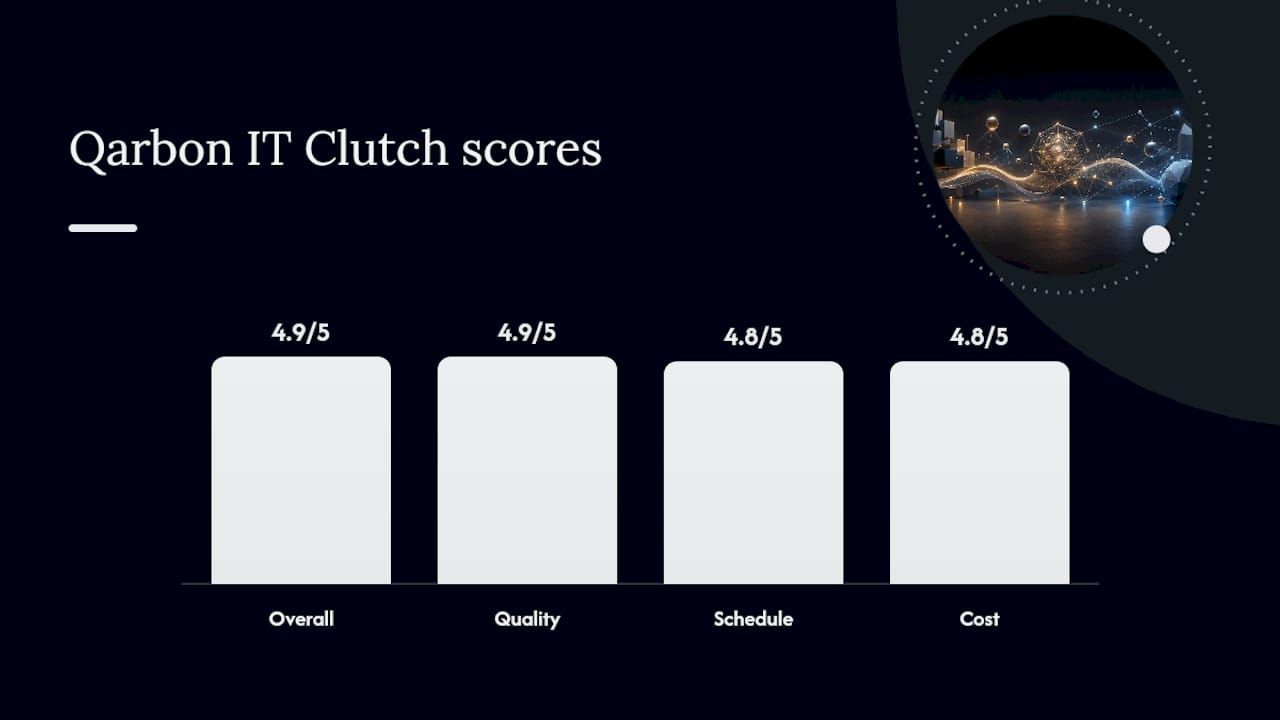
Clutch benchmarks Qarbon IT at 4.9 overall across 25 reviews, with sub-scores of 4.9 for quality, 4.8 for schedule, and 4.8 for cost. That is a high bar. Any alternative shortlist should be held to the same three-axis standard before a contract is signed.
| Vendor type | Best for | Services offered | Delivery model | Engagement size & pricing | Vertical strengths | Tech stack strengths | Security & compliance | Time-to-market baseline | Client ratings / references |
|---|---|---|---|---|---|---|---|---|---|
| Bitecode | Rapid modular enterprise systems, AI/blockchain integration | End-to-end product development, AI automation, financial processing, blockchain, CRM, workflow | Dedicated team or fixed-scope modular deployment | Mid-to-large; fixed or scoped fees per module | Fintech, SaaS, enterprise operations | Low-code modular, AI assistants, blockchain, multi-currency | Audit-ready, self-hosted option, multi-currency compliance | Fast; substantial baseline pre-built | Vendor-published; request case studies |
| Staff augmentation provider | Extending internal teams without full delivery transfer | Staff augmentation, embedded engineers | Embedded / time-and-materials | Small-to-mid; hourly or monthly retainer | Varies by provider | Varies; match to internal stack | Depends on provider vetting | Slow ramp; onboarding overhead | Clutch / G2 ratings; request references |
| Nearshore dedicated-team firm | Timezone-compatible Agile delivery for mid-market | Dedicated teams, QA, DevOps | Dedicated team, sprint-based | Mid-market; monthly team rate | Fintech, logistics, e-commerce | JavaScript, Java, .NET common | Varies; ask for SOC2 or ISO evidence | Moderate; 4 weeks to first sprint | Clutch ratings; case study depth |
| Full-cycle custom agency | Greenfield SaaS with well-defined scope | End-to-end development, UX/UI, QA | Fixed-scope or T&M | Mid-to-large; project-based | E-commerce, logistics, SaaS | Broad; depends on agency | Varies; request documented framework | Slower; discovery adds multiple weeks | DesignRush, Clutch portfolios |
| Low-code platform integrator | Workflow automation, CRM customization | Workflow automation, integrations, CRM | Managed service or fixed-scope | Small-to-mid; lower entry cost | Operations, HR, sales automation | Low-code platforms, API integrations | Platform-dependent; limited self-hosting | Fast for standard use cases | G2 ratings; platform-specific reviews |
G2’s alternatives listing for Qarbon Technologies is a useful starting point for building this kind of shortlist, though market directories alone do not reveal delivery-metric depth. Supplement any directory list with verified case studies and Clutch sub-scores before narrowing to two or three finalists.
How do these alternatives actually differ in practice?
The surface-level differences between qarbon.it competitors are easy to spot. The ones that change a buying decision are buried in delivery model, PM maturity, and QA discipline.
Delivery model and team structure
Dedicated-team models give you a stable, named engineering group that builds context over time. Fixed-scope engagements transfer risk to the vendor but require well-mapped requirements upfront. Staff augmentation, as explained in detail for HR and procurement teams, relocates complexity into the vendor relationship rather than eliminating it. The right model depends on how much of the requirements are locked versus evolving.
Bitecode’s modular foundation sits between these poles. Because a significant portion of the baseline system arrives pre-built, the discovery phase is shorter and the fixed-scope risk is lower. Teams are not starting from a blank canvas.
Project management maturity
Proactive, transparent project management reduces schedule slippage and scope surprise more reliably than raw engineering headcount. When evaluating any alternative, ask for sprint cadence documentation, escalation protocols, and a named project manager. Vendors that describe PM in vague terms during a proposal are unlikely to improve once the contract is signed.
QA and automated testing
QA maturity is the single strongest differentiator for long-term technical health and maintenance cost. Smaller shops often prioritize delivery velocity over comprehensive automated testing, which increases technical debt. Ask every vendor for a documented QA framework, not a verbal assurance. Specifically request: automated test coverage targets, regression suite documentation, and release validation steps.
Geographic and timezone fit
Nearshore scaling options offer timezone overlap with U.S. East Coast hours and lower rate premiums than fully onshore teams. For fintech and logistics integrations where daily standups and rapid iteration matter, timezone compatibility is a scheduling variable, not a soft preference. Remote-only providers with a 7–9 hour gap require deliberate async discipline to avoid bottlenecks.
Industry vertical fit
Techreviewer’s profile of Qarbon IT notes 15+ years of experience across fintech, e-commerce, and logistics, with mid-market project budgets. That profile is a useful benchmark. When evaluating similar sites to qarbon.it, map each vendor’s stated verticals against their portfolio evidence, not just their marketing copy.
Pro Tip: Ask every vendor to name two clients in your specific vertical and describe the integration complexity they handled. A vendor that defaults to generic case studies when asked for vertical-specific references is signaling shallow domain depth.
How to choose the right qarbon.it alternative for your organization
The evaluation process for top alternatives to qarbon.it should be structured around four buyer priorities: speed to market, security and compliance, integration complexity, and advisory capacity.
Decision checklist
- Speed to market — Does the vendor have a pre-built baseline or modular foundation that reduces time to first release? Or does every engagement start greenfield?
- Security and compliance — Can the vendor provide SOC2 or ISO certification evidence? Is self-hosted deployment available for sensitive data environments?
- Integration complexity — Has the vendor documented ERP, payment gateway, or blockchain integration experience with named client references?
- Advisory capacity — Does the vendor act as a strategic advisor during scoping, or do they wait for a requirements document before engaging?
- PM maturity — Is there a named project manager, a documented sprint cadence, and a defined escalation path?
- QA framework — Is automated testing coverage documented? What does the release validation process look like?
Questions to ask vendors
- “Walk me through your QA automation framework and what coverage targets you set for a project of this scope.”
- “Who is the named project manager for this engagement, and how do you handle scope change requests?”
- “Can you name two clients in our vertical and describe the integration points you handled?”
- “What are your warranty and post-launch support terms, and are they written into the contract?”
- “Do you offer fixed-scope, time-and-materials, or both? Under what conditions do you recommend each?”
Contracting guidance
Fixed-scope contracts work best when integration points are well-mapped and requirements are stable. Time-and-materials with milestone gates is more appropriate for evolving requirements, but it requires disciplined change-order management to avoid cost creep. Always request explicit warranty terms covering defect remediation post-launch, and confirm that escalation paths are named in the contract, not left to informal agreement.
Red flags to watch for
- QA described only as “manual testing” with no mention of automation or coverage targets.
- No named references, only anonymized case studies.
- A discovery phase that produces no written integration map or architecture decision record.
- Vague staffing language (“a team of engineers”) with no named lead or PM.
- Pricing that changes materially between proposal and contract without a documented scope change.
How we evaluated and shortlisted these alternatives
The shortlist above was built around three primary metrics: delivery quality, schedule reliability, and project management maturity. Those three axes reflect what enterprise clients consistently cite as the difference between a successful integration and a costly remediation.
Data sources used
- Third-party review platforms: Clutch for verified delivery sub-scores (quality, schedule, cost); G2 for market positioning and peer alternatives.
- Agency directories: DesignRush for service coverage and portfolio mapping; iTRate for technical stack depth and team size verification.
- Organizational profiles: The Org for company composition cross-checks against stated verticals.
Trust signals to request from any vendor
- Clutch or G2 profile with verified reviews and delivery sub-scores.
- Two named client references in your vertical, available for a call.
- A documented QA and automated testing framework.
- SOC2 or ISO certification, or a written explanation of the compliance posture.
- A sample project roadmap or integration architecture document from a comparable engagement.
Market directories like G2 are a fast way to assemble an initial shortlist, but they must be supplemented with delivery-metric checks and case-study validation before any vendor reaches the finalist stage.
Why Bitecode is a strong qarbon.it alternative for U.S. enterprises
Bitecode’s core differentiator is not a service category. It is a delivery architecture. That matters most for organizations that have already spent time in a lengthy greenfield build and need to accelerate without accelerating chaos.
Key capability areas where Bitecode is especially strong:
- AI automation modules — Pre-integrated AI assistant and workflow automation components that can be configured for specific business-domain logic rather than built from scratch.
- Financial processing and multi-currency support — Audit-ready financial workflows with multi-currency handling, relevant for fintech clients and enterprises operating across multiple markets. See how fintech workflow optimization applies in practice.
- Blockchain integration — Native blockchain module support for organizations that need on-chain transaction records or smart-contract-driven workflows.
- Self-hosted deployment — For enterprises with strict data residency or security requirements, self-hosted deployment keeps sensitive data within the organization’s own infrastructure.
- CRM and workflow automation — Modular CRM and process automation components that connect to existing ERP and payment systems without a full platform replacement.
On the comparison dimensions that matter: Bitecode supports both dedicated-team and fixed-scope engagement models, with QA integrated into the modular delivery process. Onboarding begins with a scoping session that maps integration points before any development starts, reducing the risk of scope surprise mid-project.
Pro Tip: When evaluating Bitecode against other qarbon.it replacements, ask specifically about the pre-built module inventory relevant to your use case. The faster a vendor can show you working baseline components, the shorter your path to a production-ready system.
For a broader view of how enterprise software integration should be structured before you engage any vendor, the enterprise software integration guide covers the technical and organizational considerations that shape vendor selection.
What post-selection support and maintenance should you expect?
Post-launch support is where many vendor relationships either solidify or deteriorate. The contract terms that govern maintenance, defect remediation, and feature iteration after go-live deserve as much scrutiny as the delivery terms.
A well-structured post-selection support arrangement covers three distinct layers. First, a warranty period with defined defect categories and response SLAs, typically 30–90 days post-launch for critical and major defects. Second, an ongoing maintenance retainer or a documented process for submitting and prioritizing enhancement requests. Third, a named technical contact who carries context from the original build, not a generic support queue staffed by engineers unfamiliar with the system’s architecture.
For modular systems like those Bitecode delivers, maintenance is structurally simpler because individual modules can be updated or replaced without touching the full codebase. That modularity also makes it easier to add new capabilities, an AI module, a new payment gateway, a blockchain connector, without a full re-engagement cycle. Verify that any vendor you select can articulate how their architecture supports incremental enhancement, not just initial delivery.
What does client onboarding look like, and how flexible are contract terms?
The onboarding process signals how a vendor manages ambiguity, which is the dominant risk in any complex enterprise integration. A structured onboarding typically includes a discovery session to map integration points, a requirements workshop to align on scope and acceptance criteria, and a written architecture decision record before development begins. Vendors that skip the architecture documentation phase tend to accumulate technical debt faster.
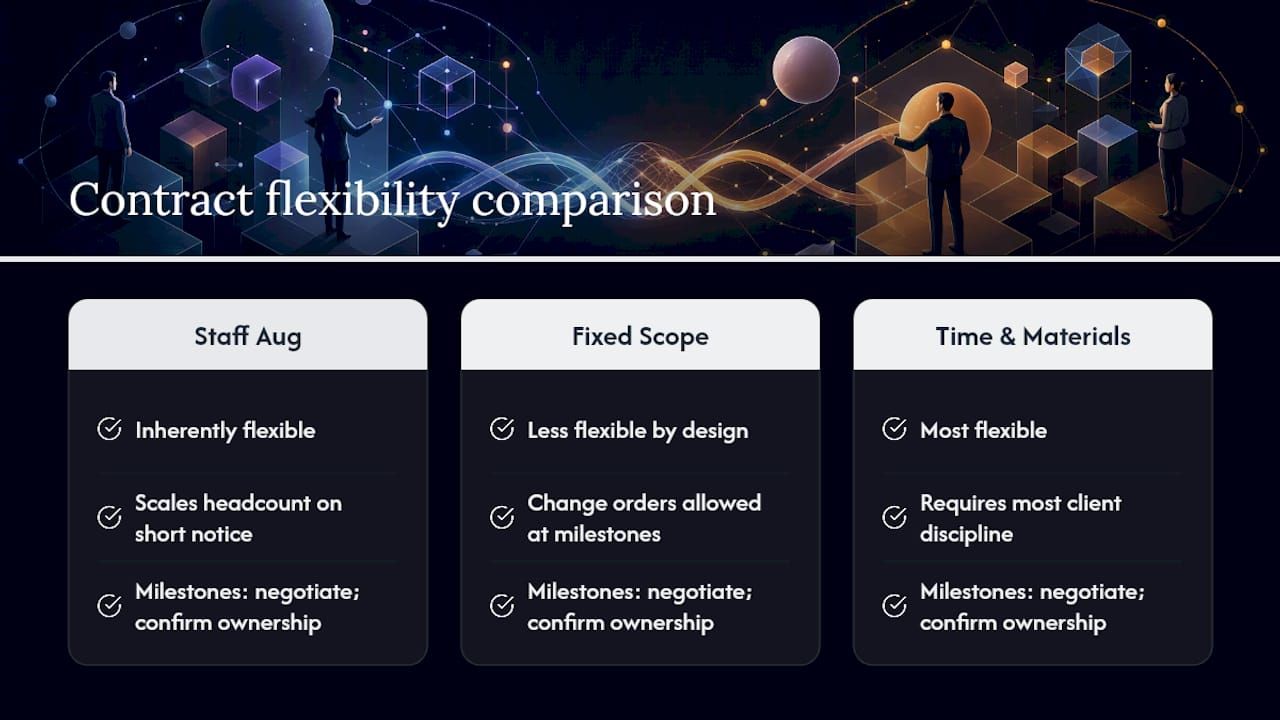
Contract flexibility varies significantly across the vendor types in this shortlist. Staff augmentation arrangements are inherently flexible because you can scale headcount up or down with relatively short notice. Fixed-scope project contracts are less flexible by design, but they can include change-order provisions that allow scope adjustments at defined milestones without renegotiating the entire agreement. Time-and-materials contracts offer the most flexibility but require the most discipline from the client side to avoid scope expansion.
For organizations evaluating alternatives for qarbon.it, the practical recommendation is to negotiate milestone-based payment schedules regardless of the contract type. Milestone payments align vendor incentives with delivery outcomes and give the client a structured exit point if the engagement is not tracking to plan. Always confirm that the contract specifies who owns the source code, the documentation, and the integration credentials at each milestone, not just at final delivery.
What Bitecode actually sees in enterprise vendor transitions
The pattern Bitecode observes most often in enterprise vendor transitions is not a failure of technical skill. It is a failure of integration planning. Organizations switch providers because the previous vendor delivered working code that did not connect cleanly to the existing ERP, payment stack, or compliance layer. The system works in isolation and breaks at the boundary.
That is why the modular foundation approach matters beyond speed. When integration points are mapped at the architecture level before development starts, the boundary failures that cause expensive post-launch remediation are caught in design, not in production. The vendors worth shortlisting are the ones that can show you an integration architecture document from a comparable engagement before you sign anything.
If your team is mid-evaluation and needs a second opinion on a vendor’s proposed architecture or integration approach, Bitecode offers discovery sessions specifically for that purpose.
Bitecode delivers what qarbon.it alternatives often promise
Organizations that need a custom enterprise system built around AI automation, financial processing, or blockchain integration can reach production faster with Bitecode’s modular delivery model than with a greenfield build from any provider.
Bitecode supports custom enterprise software development across fixed-scope and dedicated-team engagement models, with flexible contracting that includes milestone-based payment schedules and post-launch warranty terms. For teams prioritizing process automation, the AI automation service covers workflow, financial processing, and AI assistant integration as modular components. Request a scoping session to see which baseline modules apply to your use case and get a delivery estimate grounded in your actual integration requirements.
Sources
The sources below are the most useful references for vetting qarbon.it competitors during procurement. Each reveals a different layer of vendor evidence.
- Qarbon IT Reviews (25), Pricing, Services & Verified Ratings
- Top 10 Qarbon Technologies Alternatives & Competitors in …
- Qarbon IT Profile & Reviews - Techreviewer
- Qarbon IT Reviews | View Portfolios | DesignRush
- Qarbon IT - JavaScript Masters Reviews, Rate, Contact at iTRate
- Qarbon IT | The Org
How to use these sources in procurement: Pull Clutch sub-scores for every finalist and request that vendors explain any gap between their Clutch rating and the benchmark. Use G2 to identify peer alternatives you may have missed. Use DesignRush and iTRate to verify that the stack and service categories in a vendor’s proposal match their actual delivery history. Cross-reference The Org and Techreviewer profiles against the case studies a vendor provides during discovery.