For a new custom product with evolving data, PostgreSQL is usually the safer default. For predictable, read-heavy or straightforward CRUD systems, and for teams that already run MySQL well, MySQL remains a sound and often better choice. The decision should follow your workload, your team’s skills and the way your data model is likely to grow, not popularity rankings.
This guide compares the two engines on the criteria that matter when a company is paying for a system it will operate for years: data integrity, query complexity, concurrency, operations, extensibility and migration risk.
TL;DR
- Choose PostgreSQL when business logic, reporting and data relationships are expected to grow more complex, or when you need rich types, JSONB, extensions or strict integrity rules.
- Choose MySQL for predictable, read-heavy web workloads and simple CRUD systems, particularly when your team already knows it well.
- Existing team expertise is the strongest tiebreaker. A fluent MySQL team will usually ship a safer system on MySQL than an unproven team will on PostgreSQL.
- Neither engine is free of operational work: PostgreSQL demands vacuum literacy and connection pooling, MySQL demands attention to storage engines and upgrade paths.
- If you already run a MySQL fleet, an in-place upgrade is typically a smaller risk than a cross-engine migration.
What the two engines have in common
Both are mature, open-source relational databases that store data in tables, speak SQL and run on every major cloud. CrowdStrike’s overview lists the shared ground: open-source licensing, relational structure and wide platform support. For a large share of applications, either will work, and the deciding factors are subtler than a feature checklist suggests.
The SQL itself is where teams often underestimate the gap. Both use standard SQL, but each speaks its own dialect, and LearnSQL’s comparison shows that moving between them is not just a connection-string change. Dialect differences surface in functions, data types and procedural code, which matters later when we discuss migration.
Architecture: where the real differences start
PostgreSQL is an object-relational database. According to AWS’s comparison, it offers more flexibility in data types and is favored for complex queries, data integrity and enterprise applications with frequent writes. MySQL is a read-performant relational database that suits prototypes, web applications and internal tools, thanks to simpler operational requirements and a lower barrier to entry.
Two architectural facts shape day-to-day behavior.
Connections. PostgreSQL spawns a new system process per client connection, so any production application with significant concurrent traffic needs a connection pooler such as PgBouncer. MySQL handles concurrency with threads, which is generally more memory-efficient out of the box for read-heavy workloads. Both points come from the same AWS comparison.
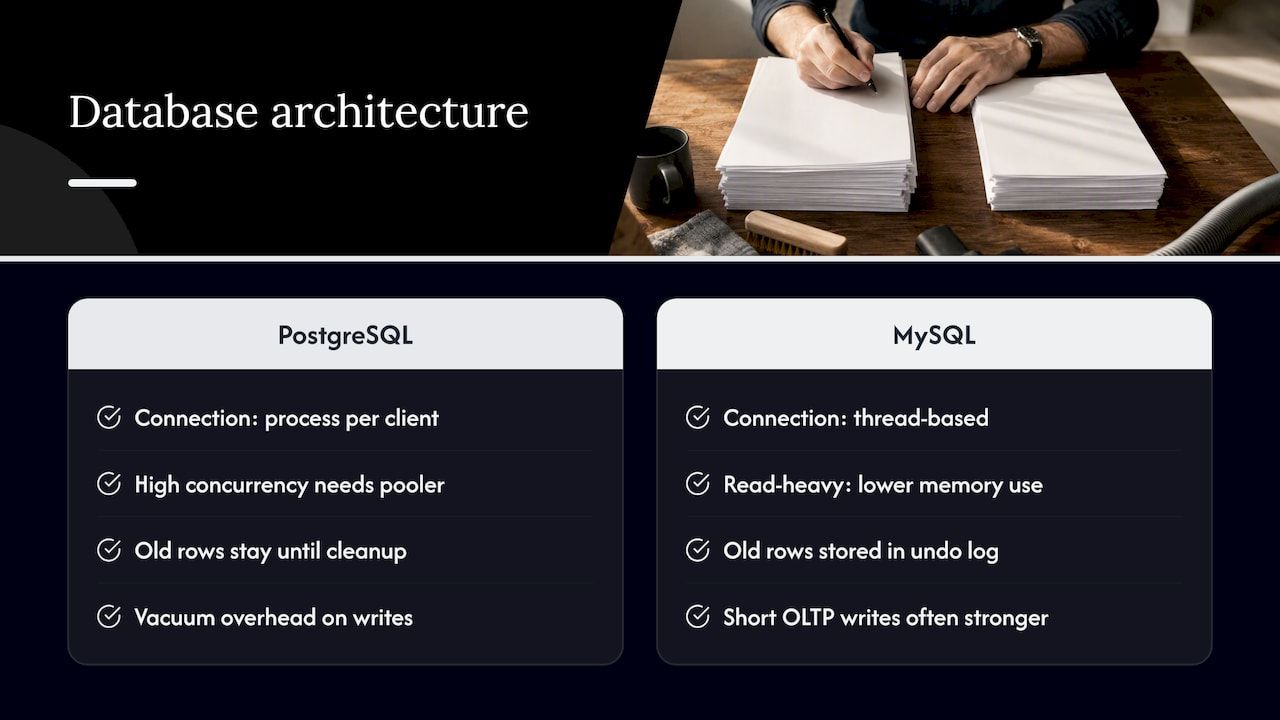
Old row versions. MySQL’s InnoDB engine keeps previous row versions in an undo log, not in the main table storage. That design often makes MySQL stronger for write-heavy OLTP workloads with short transactions, where PostgreSQL can struggle with vacuum-related overhead, as the AWS source explains. PostgreSQL, by contrast, leaves dead row versions in the table until a cleanup process removes them.
This is why the debate is often misframed as absolute superiority. Each design trades something for something else.
Data integrity and ACID behavior
PostgreSQL supports ACID compliance across all configurations. MySQL requires a specific storage engine, such as InnoDB, to provide it (AWS). In practice, almost every modern MySQL deployment runs InnoDB, so the gap is smaller than the sentence suggests. It still matters in one situation: when a system handles money, ledgers or audit trails, you want the database to enforce rules rather than rely on application code and good discipline.
PostgreSQL’s stricter data rules, richer constraints and mature transactional behavior make it a natural fit for that class of system. Refact’s guide summarizes the case for a new product with evolving data: stronger tools for complex SQL, stricter data rules, richer types, JSONB and full-text search.
Features and extensibility
PostgreSQL supports a wider set of data types, including arrays, JSON and geometric types, while MySQL concentrates on efficient handling of standard types. The more important difference is extensibility. In PostgreSQL you can define your own data types and build custom functions, and the extension ecosystem lets one engine absorb jobs that would otherwise need a separate system.
The clearest current example is AI. Extensions such as pgvector let teams store and query embeddings next to transactional data, a point the Roaming Pigs analysis makes when explaining how high-scale users keep system complexity manageable. If vector search is on your roadmap, our piece on enterprise vector database use cases and checklists covers the latency and design questions in more depth.
Security controls are another place where depth matters. PostgreSQL’s row-level security lets you enforce tenant or role isolation inside the database itself, which we walk through in our practical guide to row level security. That is a significant advantage for multi-tenant SaaS products.
MySQL is not standing still. InfoQ reports that Oracle released MySQL 9.7 as the first major LTS series since 8.4, adding the Hypergraph optimizer, dynamic data masking in the Enterprise Edition and OpenID authentication. The same report notes community concern about declining MySQL development activity and Oracle’s long-term commitment, a factor worth weighing for a ten-year system.
PostgreSQL keeps moving as well. PostgreSQL 18 introduced a new I/O subsystem with up to 3x faster reads from storage in the project’s tests, less disruptive major-version upgrades, virtual generated columns, uuidv7() and OAuth 2.0 authentication.
Performance: workload decides
Generic benchmark claims should be treated cautiously. The pattern that most comparisons agree on is this:
| Workload | Typically stronger | Why |
|---|---|---|
| Simple, read-heavy web traffic | MySQL | Lightweight threaded connections, simple query paths |
| Complex queries with many joins, analytics, reporting | PostgreSQL | Richer planner features and SQL capabilities |
| Short-transaction, write-heavy OLTP | Often MySQL | Undo-log design avoids vacuum overhead |
| Mixed workloads with evolving schemas | PostgreSQL | Flexibility in types, JSONB and indexing |
| Many concurrent connections without pooling | MySQL | Threads instead of processes |
Read the table as a tendency, not a verdict. Schema design, indexing and query discipline move performance far more than the engine label. A poorly indexed PostgreSQL database will lose to a well-tuned MySQL one, and the reverse is equally true.
Operations: what you actually have to run
This is where selection decisions quietly turn into cost.
PostgreSQL is not set-and-forget. Teams need what the Bytebase guide calls vacuum literacy: understanding how PostgreSQL reclaims space from deleted and updated rows. That guide identifies neglect here as the leading cause of performance degradation in maturing PostgreSQL instances. Add connection pooling, and the operational surface is real, though managed cloud services absorb part of it.
MySQL’s burden is different. It is lighter to start, but you must make deliberate choices about storage engines, replication topology and version lifecycle. Upgrades also deserve planning, which brings us to the question many established companies actually face.
Existing MySQL fleets: upgrade or migrate?
For a team already managing MySQL in production, the question is often operational rather than technical. Bytebase argues that stacking a cross-engine migration onto a mandatory upgrade deadline doubles the risk, which makes staying on MySQL and targeting an LTS release such as 9.7 the safer organizational choice. We agree with that logic. A migration should be justified by a concrete capability you need, not by a ranking.
Adoption and ecosystem
Popularity is a weak decision criterion, but it affects hiring and tooling, so it is worth knowing. The 2024 Stack Overflow Developer Survey, as summarized by Refact, put PostgreSQL at 51.9% among professional developers and MySQL at 39.4%, a reversal from 2018, when MySQL held 59% and PostgreSQL 33%.
The trend shows in the rankings too. Bytebase notes that in the September 2026 DB-Engines ranking MySQL still sits at #2 and Postgres at #4, but MySQL lost 47 points year over year while Postgres gained 26, so the gap of 161 points narrows every year.
On the question readers often ask: yes, large companies use PostgreSQL. The Roaming Pigs piece lists Instagram, Spotify and Twitch among high-scale users with PostgreSQL in diverse production workloads, and notes that Netflix runs many storage technologies, with Cassandra central to its core cloud infrastructure. The same source says NASA uses PostgreSQL on the International Space Station to manage Nagios data. Use these as signals of maturity, not as proof that your workload resembles theirs.
A decision framework for business teams
Work through these questions in order.
- What does your team already run well? Expertise is the most important tiebreaker. A fluent MySQL team will ship a more stable system on MySQL than an untested team on PostgreSQL, even if PostgreSQL is technically more capable (Bytebase).
- How will your data evolve? If business rules, reporting needs and relationships are likely to grow in complexity, favor PostgreSQL. If the model is stable and mostly reads, MySQL’s simplicity is a feature. Refact describes MySQL here as boring in the best way.
- Does the system carry financial or audit weight? Strict constraints, transactional guarantees and in-database security controls point toward PostgreSQL.
- Is AI, search or semi-structured data on the roadmap? JSONB, full-text search and vector extensions let one engine do more.
- Are you migrating or starting fresh? Greenfield projects have freedom. Existing fleets should price the migration honestly before committing.
- Who operates it? A managed service lowers the operational cost of either engine. Self-hosting raises it, though it may be required for data-control reasons.
Our perspective
We build custom business systems from modular, ready-made components, so the database question arrives in almost every engagement. Our view is simple and, we hope, candid about its trade-offs.
For products where financial processing, workflow automation, audit trails or AI features will accumulate over time, we lean toward PostgreSQL as the foundation. The reason is not fashion. Complexity in these systems tends to arrive in the data layer first: new reporting demands, tenant isolation, flexible attributes, embeddings. An engine with strict rules and rich types absorbs that growth without forcing a second system into the architecture.
We also push back on the idea that the engine is the main risk. In our experience the larger risks are an undisciplined schema, a black-box platform that hides how data is stored, and a vendor relationship that relocates complexity instead of removing it. A modular foundation that the client controls, including self-hosted deployment, keeps those risks visible. That is why we prefer starting from a tested base over a blank repository, a trade-off we examine in our comparison of boilerplate and black-box builds.
And where a client has a healthy MySQL estate and a team that knows it, we say so plainly: stay, upgrade on schedule, and spend the budget on features. A database switch is a project, and it should earn its place.
— Bitecode
Where a modular foundation fits
Choosing an engine is one decision among many in a custom system. If you are planning internal software, a SaaS product or a financial workflow, our custom business software service starts projects with up to 60% of the baseline system pre-built, which shortens the path to a working product while keeping the data layer and customization under your control. Teams building products for market can also read how rapid SaaS development with audit-ready modules works in practice, and those weighing release safety can look at database-safe blue-green deployments.
Switching later: what it really costs
Neither choice is permanent, but moving is not trivial. Because each engine has its own SQL dialect, a migration touches queries, stored procedures, data types and sometimes application logic, as LearnSQL explains. Plan for schema conversion, data validation, performance retesting and a rollback path.
To keep the option open, a few habits help regardless of engine:
- Keep business logic in the application layer where practical, and use database-specific features deliberately and documented.
- Use an ORM or query layer for routine access, but test the generated SQL.
- Version every schema change.
- Avoid proprietary shortcuts unless they deliver a clear, measurable benefit.
FAQ
Is PostgreSQL better than MySQL?
Not universally. PostgreSQL is stronger for complex queries, strict integrity and evolving data models, while MySQL is often at least as good for simple, read-heavy or short-transaction write workloads. Choose by workload and team skills.
Which is easier to learn, MySQL or PostgreSQL?
MySQL generally has the lower barrier to entry and simpler operational requirements, according to AWS. PostgreSQL asks more of you over time, especially around vacuum behavior and connection pooling, but its feature depth rewards that investment.
What are the disadvantages of PostgreSQL?
It uses a process per connection, so busy applications need a pooler, and it requires routine attention to cleanup (vacuum) to avoid degraded performance. Write-heavy workloads with short transactions can also expose vacuum overhead.
Should we migrate from MySQL to PostgreSQL?
Only for a specific capability you need, such as richer types, extensions or stricter controls. If you also face an upgrade deadline, combining the two doubles the risk, so an in-place upgrade to a supported LTS release is often the safer path.
Does Netflix use Postgres?
Netflix uses many storage technologies, with Cassandra prominent in its core cloud infrastructure. Other high-scale companies such as Instagram, Spotify and Twitch use PostgreSQL in production.
Sources
- AWS: Difference between MySQL and PostgreSQL
- Bytebase: PostgreSQL vs MySQL
- Refact: PostgreSQL vs MySQL guide
- Roaming Pigs: Why PostgreSQL Keeps Winning
- CrowdStrike: PostgreSQL vs MySQL
- LearnSQL: Is it difficult to switch?
- LearnSQL: Major companies using PostgreSQL
- InfoQ: MySQL 9.7 LTS
- PostgreSQL 18 release announcement