Vector databases have become the default infrastructure for retrieval augmented generation, semantic search, recommendation systems, anomaly detection, and AI agent memory because they retrieve by meaning, not by matching text strings. That single capability, similarity search over embeddings, unlocks a fast, scalable read path for any workload where the query and the answer share intent but not exact words. Teams should evaluate a vector database once queries turn semantic, results need hybrid filtering, or read latency has to stay well under 100 milliseconds at scale.
TL;DR:
- Vector databases are essential for workloads that require semantic retrieval, hybrid filtering, or sub-100 millisecond latency at scale.
- They rely on approximate nearest neighbor algorithms like HNSW and IVF, which trade off some recall for significantly faster search times on billions of vectors.
- Key use cases include retrieval-augmented generation, semantic search, recommendation systems, AI agent memory, and multimedia similarity search.
- Smaller datasets or straightforward keyword searches do not benefit from a dedicated vector database, and existing SQL solutions can be prototyped with extensions like pgvector.
- To operationalize effectively, focus on embedding pipeline quality, schema design for hybrid queries, continuous monitoring of recall and latency, and leveraging pre-built automation workflows.
What Is a Vector Database, and How Is It Different From SQL?
A vector database is a storage and indexing system built around embedding vectors, the numeric fingerprints that machine learning models generate from text, images, audio, or mixed inputs. Each vector sits alongside a payload, the original content plus metadata like timestamps, category tags, user IDs, or access permissions. The database’s job is to find the nearest vectors to a query vector fast, even across billions of records.
That is a fundamentally different job than a relational database performs. SQL engines match on exact values and predicates: WHERE status = 'active'. A vector store answers a fuzzier question: “what is conceptually closest to this?” Semantic search retrieves information by meaning rather than literal keyword overlap, so a search for “affordable family car” can surface a listing that says “budget-friendly minivan” even though no words match.
Is SQL a vector database? No, not natively. Standard relational engines have no concept of approximate nearest neighbor search or high-dimensional similarity scoring. Extensions like pgvector bridge that gap by adding vector columns and distance operators to Postgres, which works well for moderate-scale workloads already living in a relational schema, according to one pgvector implementation demo. Purpose-built vector databases exist for the cases where scale, latency, or multimodal complexity outgrow that bridge.
Embeddings can come from text encoders, image models, audio transcription pipelines, or multimodal models that map several data types into one shared vector space. The payload structure matters more than most teams expect. Good schema design keeps metadata queryable (category, tenant ID, permission level, freshness timestamp) so the database can filter before or after the similarity search runs, not just perform a raw nearest neighbor scan, enabling efficient hybrid queries without scanning everything.
How Vector Search Actually Works: Indexes, ANN, and Hybrid Queries
Exact nearest neighbor search does not scale. Comparing a query vector against every stored vector in a billion row dataset is computationally prohibitive at any reasonable latency budget, so nearly every production vector database relies on approximate nearest neighbor (ANN) search instead. ANN trades a small amount of recall for a dramatic gain in speed, and for most retrieval tasks, a match with very high accuracy returned in a few tens of milliseconds beats a perfectly accurate match returned in several seconds.
Three index families dominate. HNSW (Hierarchical Navigable Small World) builds a multi-layer graph that lets queries hop toward the nearest neighbors quickly; it delivers strong recall and low latency but comes with higher memory use and slower index builds, especially under heavy write load, per research on vector database management systems. IVF (Inverted File Index) partitions the vector space into clusters and searches only the most promising ones, which scales better to very large corpora at the cost of some recall. Flat indexes skip approximation entirely and scan everything, a reasonable choice only for small datasets or offline testing.
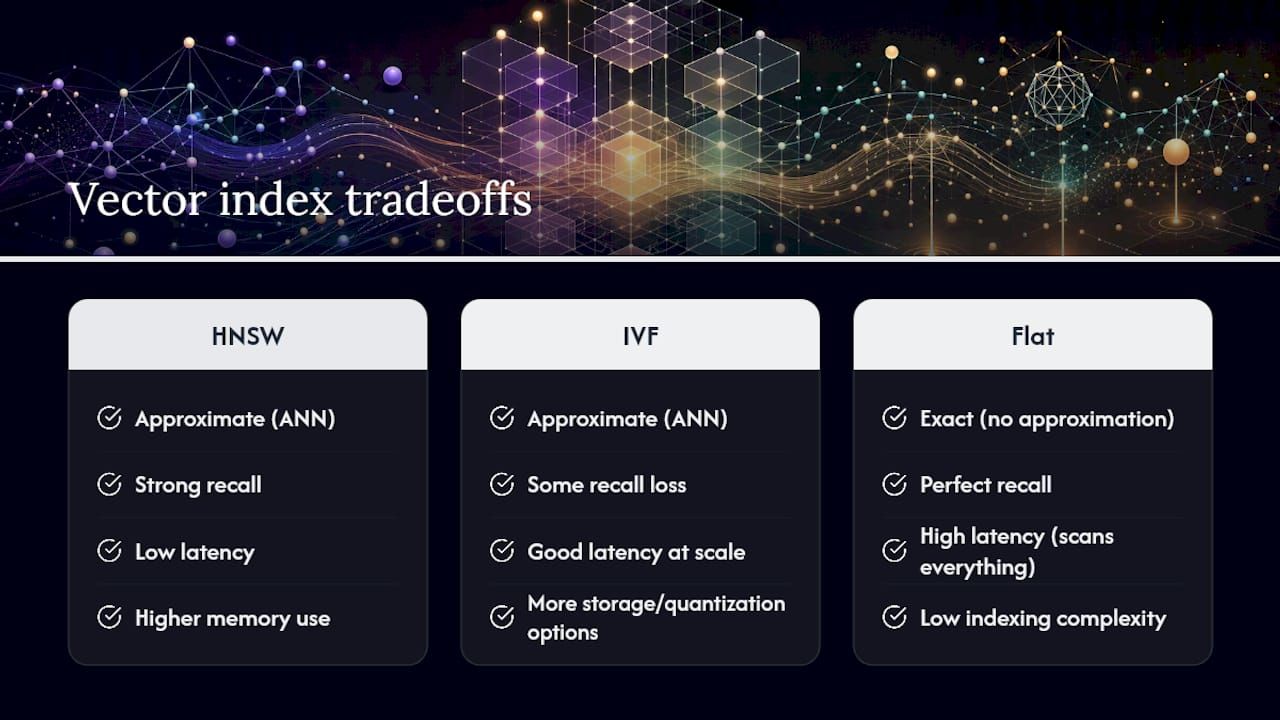
Index choice should follow workload shape: HNSW suits read-heavy, low-latency applications; IVF and quantized variants suit massive corpora where a bit of rerank cost is acceptable, according to the VectorDB survey on indexing and query processing. Many systems layer a filter-and-refine architecture on top: narrow the candidate set with compressed or quantized vectors, then rerank the survivors against full-precision vectors for accuracy. Hybrid queries combine vector similarity with metadata or keyword predicates, either filtering metadata first to shrink the search space or running vector search first and filtering results afterward. The right choice depends on how selective the metadata filter is.
Track four metrics before shipping anything: P95 latency, throughput under concurrent load, recall against a labeled ground truth set, and the cost of index builds or incremental updates.
Core Vector Database Use Cases and Real Examples
Some of these patterns show up in nearly every enterprise stack; others solve a narrower, higher-stakes problem. Here is what each looks like in production.
- Retrieval-augmented generation (RAG): A vector retriever fetches the top-k most relevant chunks from a knowledge base and hands them to an LLM as context, which substantially reduces hallucinated answers and improves factual grounding. Retrieval quality is the bottleneck here, not model size. Weak chunking or a mismatched embedding model will sink an otherwise well-tuned pipeline before the LLM ever gets a chance.
- Semantic search: Enterprise knowledge bases, support portals, and internal documentation search all benefit from paraphrase-tolerant matching. A user typing “how do I reset my password” should find an article titled “Account Recovery Steps” without needing exact keyword overlap. Chunk documents into coherent passages, not arbitrary character counts, and retrieval quality improves noticeably.
- Recommendation systems: User, item, and session embeddings let a platform find “things like this” in real time. E-commerce sites use nearest-neighbor retrieval on product embeddings to power “customers also viewed,” while streaming platforms do the same with viewing session vectors.
- Semantic caching: Instead of hitting the LLM API for every request, a semantic cache matches incoming prompts against previously answered ones by similarity, not exact string match, and serves the cached response when the match clears a similarity threshold. This can meaningfully cut both LLM API cost and response latency, though the payback depends heavily on query redundancy in the actual workload.
- AI agent memory: Autonomous agents need persistent memory that survives beyond a single context window. Storing conversation history, tool outputs, and learned facts as searchable embeddings lets an agent retrieve relevant past interactions instead of re-deriving them, which is what makes multi-session agent continuity possible at all.
- Image and video similarity search: Reverse image search, digital asset management, and video frame indexing all rely on multimodal embeddings that place visually similar content near each other in vector space, regardless of file name or tags.
- Anomaly and fraud detection: Financial institutions encode normal transaction behavior as vectors and flag outliers in real time, an approach also used in industrial predictive maintenance to catch abnormal sensor readings before equipment fails. Bitecode’s own work on transaction monitoring and fraud prevention shows how this pattern plays out in fintech pipelines specifically.
- Deduplication and clustering: Near-duplicate detection across large content sets, whether product catalogs, support tickets, or scraped documents, is a natural fit for similarity thresholds rather than exact-match hashing.
- Domain-specific applications: Drug discovery pipelines use molecular embeddings to find structurally similar compounds, and voice biometric systems match speaker embeddings for authentication. Both demand careful evaluation of false-positive rates given the stakes involved; a general course on building applications with vector databases walks through several of these patterns with working code.
When Should You Actually Adopt a Vector Database?
Three signals justify the investment: your queries are semantic rather than exact-match, you need multimodal search across text and images, or you need hybrid filtering combined with sub-100ms latency at meaningful scale. If any of those describe your workload, a dedicated vector store earns its operational overhead.
Counter-signals matter just as much. A corpus of a few thousand documents, a purely transactional workload with structured lookups, or a search experience that genuinely only needs exact keyword matching does not need this infrastructure. Adding a vector database to a problem that SQL already solves just adds a system to maintain. For smaller datasets already living in Postgres, pgvector can prototype the same retrieval pattern without standing up a separate service, and teams can migrate later if scale or latency demands grow.
Workload shape also drives the decision. RAG systems tend to be read-heavy with infrequent updates, which favors HNSW-style indexes tuned for query speed. E-commerce catalogs and session-based recommenders are write-heavy, with constant embedding updates, which pushes toward architectures that tolerate write contention gracefully. Weigh the operational complexity of running and tuning a vector database yourself against a managed service that absorbs index tuning and scaling, especially if the team lacks dedicated infrastructure engineers.
Building It Right: Pipelines, Schema, and Monitoring
Embedding model choice sets a ceiling on retrieval quality that no amount of index tuning can fix later. Chunking strategy matters nearly as much: chunks too small lose context, chunks too large dilute relevance, and most teams land somewhere between 200 and 500 tokens with meaningful overlap. Run semantic QA regularly, spot-check retrieved results against expected answers, not just uptime metrics.
Metadata schema design determines whether hybrid filtering stays fast as data grows. Fields like tenant ID, category, and access level should be indexed for efficient pre-filtering, following the pattern of filtering metadata first to narrow shards before running vector search when filters are highly selective.
Index maintenance is where many pilots stumble in production. HNSW graphs handle incremental updates but degrade under heavy concurrent writes, so plan reindex windows and monitor write contention before it surfaces as latency spikes. Track recall against a benchmark set continuously, not just at launch, since embedding drift from model updates or shifting content can silently erode retrieval quality.
Set a semantic cache similarity threshold deliberately. Too loose, and it serves wrong answers; too strict, and it never triggers. Deduplication rules should run on ingest, not after the corpus balloons. On security, enforce access controls and encryption at the metadata and vector store level, and keep audit logs of query and retrieval activity for compliance review.
How Enterprises Operationalize This Without a Year-Long Build
Most of the friction in shipping RAG, recommendation, or anomaly detection features is not the vector database itself. It is everything around it: embedding generation pipelines, orchestration between the vector store and the LLM serving layer, authentication, and the automation workflows that connect retrieval to a downstream action. Modular, pre-built components shorten that path considerably, since embedding connectors, retrieval APIs, and workflow triggers rarely need to be built from scratch for every project, a point covered in more depth in this guide to pre-built software components.
An enterprise checklist for this kind of integration should cover multi-tenant data isolation, role-based access to sensitive vector payloads, audit logging on retrieval calls, and a scaling plan for both index size and query throughput. Teams weighing where embeddings and models get hosted should also consider the tradeoffs in running a private LLM versus a hosted API, since that decision affects latency, cost, and data residency all at once.
Real-Time Personalization: Where Vector Search Earns Its Keep
Personalization is one of the clearest wins for vector databases because user intent shifts faster than batch pipelines can track. A session embedding built from the last few clicks or searches can be compared against item embeddings in milliseconds, surfacing recommendations that reflect what someone wants right now rather than what they wanted last week.
This differs sharply from older collaborative filtering approaches that rebatch overnight. A vector-based system updates the user’s session vector incrementally as behavior comes in, then reruns nearest-neighbor retrieval on every request. Retailers use this to reorder search results based on mid-session intent signals; media platforms use it to adjust a “continue watching” row after a single new view. The tradeoff is operational: real-time personalization means the index has to tolerate frequent writes without a latency penalty on reads, which is exactly the write-contention problem HNSW-based systems need tuning to handle well.
Latency budgets tend to be stricter here than in RAG or search. A recommendation panel that takes 400 milliseconds to render feels broken to a user, even if the same latency would be unremarkable for a chatbot response. That pushes personalization workloads toward aggressive caching of frequent queries and pre-computed candidate sets, with the vector search narrowing a shortlist rather than scanning the full catalog on every request.
Fitting Vector Search Into Pipelines You Already Have
A vector database rarely stands alone. It sits inside a pipeline: source data gets ingested, transformed, chunked, embedded, and written into the store, and that flow has to survive the same versioning, monitoring, and rollback discipline as any other data pipeline.

The cleanest integrations treat embedding generation as its own stage with its own retry logic and dead-letter handling, not a side effect of the main application. When source content updates, a change-data-capture process should trigger re-embedding and re-indexing for just the affected records, not a full corpus rebuild. Teams that skip this step often find their vector store quietly drifting out of sync with the system of record, returning confident but stale results.
Orchestration tools that already run ETL or ELT jobs can usually add an embedding step without much friction, since the vector write is just another sink alongside the data warehouse. The harder integration work is usually on the query side: routing a user request through metadata filters, vector search, and possibly a reranking model, then back into whatever application or automation workflow consumes the result. Workflow automation platforms increasingly treat vector retrieval as one more callable step, which is worth planning for from day one rather than retrofitting later.
Author Perspective: Pragmatic Staging and Common Pitfalls
Pilot small. Measure retrieval quality and cost before committing to a specific embedding model or index, and expect to iterate on both. Prioritize monitoring and hybrid filters early, not after a demo succeeds, because the gap between a working prototype and a production system is almost entirely about what you can measure. Watch for index rebuild timing and write contention catching teams off guard mid-scale. The most common organizational failure is not technical: it is product and engineering disagreeing on what “good enough” recall actually means before the SLO gets written down.
— Bitecode
Getting From Pilot to Production Without the Year-Long Build
Bitecode gets enterprises to a working RAG, recommendation, or fraud-detection feature faster because up to 60% of the baseline system, the embedding pipeline scaffolding, workflow automation, and data connectors, arrives pre-built instead of custom-coded from zero.
This approach suits buyers who know their use case—whether RAG for internal knowledge search, real-time anomaly detection on transaction data, or agent memory for a customer-facing assistant—but want to avoid a year-long engineering commitment. Bitecode’s AI automation workflows connect embedding generation, retrieval, and downstream actions into one modular system, while the AI Assistant and Financial Module components handle the domain-specific logic that usually eats the most engineering time. If your team is scoping a vector-powered feature and wants a faster path to production than a from-scratch build, start a project with Bitecode and get a scoped plan back before committing to a full build cycle.
Sources
- Vector Database Use Cases: RAG, Search & More (Redis blog)
- VectorDB survey — design, indexing, and query processing (VLDB paper)
FAQ
Is the Vector Database Still Relevant in 2026?
Yes. Adoption is driven by production workloads in RAG, semantic search, recommendations, semantic caching, and fraud detection, all of which depend on retrieving information by meaning rather than exact match, per Redis’s use-case research. If anything, agent memory and multimodal search have expanded the relevant use cases rather than shrinking them.
What Are the Top Use Cases for a Vector Database?
The most common production applications are retrieval-augmented generation, semantic search, recommendation systems, semantic caching for LLM cost control, AI agent memory, and anomaly or fraud detection. Image and video similarity search and near-duplicate detection round out the list for multimodal and content-heavy workloads.
What Are Some Real-Life Applications of Vector Embeddings?
Embeddings power reverse image search, voice biometric authentication, drug discovery compound matching, fraud detection in financial transactions, and personalized product recommendations in e-commerce. Each of these relies on placing similar items close together in vector space so nearest-neighbor search can find matches a keyword system would miss.
Is SQL a Vector Database?
No. Standard SQL databases match exact values and lack native approximate nearest neighbor search, though extensions like pgvector add vector columns and similarity operators to Postgres for smaller-scale semantic search workloads. Teams needing high scale, low latency, or multimodal embeddings typically move to a purpose-built vector database instead.
How Much Does It Cost to Build a Vector-Powered Feature With Bitecode?
Pricing depends on project scope, since Bitecode structures engagements around modular components rather than flat packages. Current details on service scope are available directly through Bitecode’s project pages.