TL;DR:
- Pre-built software components offer high returns by reducing development time, costs, and defect rates.
- They enable organizations to focus on core differentiators while improving quality and maintaining systems efficiently.
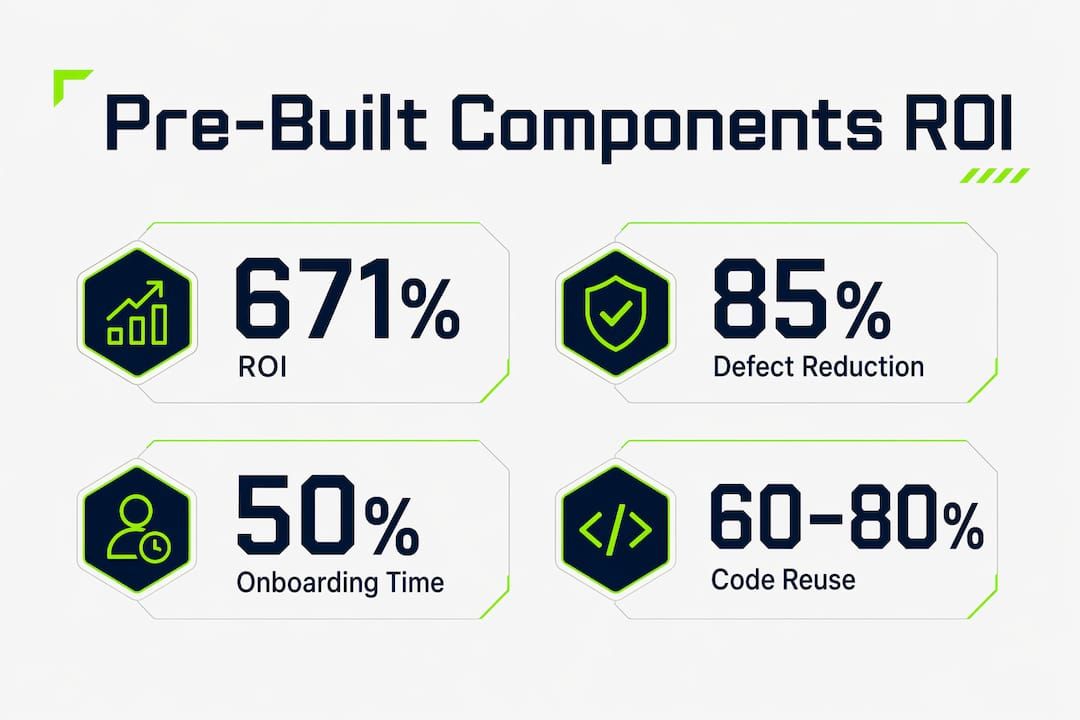
Pre-built software components are standardized, tested building blocks that teams integrate directly into applications instead of writing equivalent code from scratch. The case for using them is quantified: 671% ROI, 40% fewer UI defects, and 30% of developer time freed for work that actually differentiates a product. Frameworks like React component libraries and Ruby on Rails have made this approach the default in professional engineering, not an optional shortcut. The industry term for this practice is software component reuse, and it sits at the foundation of every modern modular software design.
Why use pre-built software components instead of building from scratch?
The direct answer is time and money. Building basic UI components from scratch typically costs $4,000 to $12,000 in labor and consumes 2–3 weeks of development time per component. Pre-built libraries recapture that cost entirely. Teams that switched to component libraries during modernization projects compressed what would have been multi-year builds into weeks.

The productivity gains extend beyond the initial build. Standardized UI libraries cut developer onboarding time by 50% and decrease UI defect tickets by 85%. That means new engineers contribute faster, and support queues shrink. Both outcomes directly affect engineering capacity and budget.
The benefits of pre-built components also show up in authentication. Implementing authentication frameworks reduces that feature’s development time from two weeks to two hours. Authentication is boilerplate. No organization gains competitive advantage by writing its own login system. Pre-built components redirect that effort toward business-domain complexity where differentiation actually lives.
Key reasons teams adopt pre-built components:
- Speed: Proven components ship in hours, not weeks.
- Cost reduction: Labor savings of $4,000–$12,000 per component are recoverable immediately.
- Lower defect rates: Vetted libraries carry far fewer bugs than greenfield code.
- Faster onboarding: New developers work with familiar, documented patterns from day one.
- Security maintenance: Framework maintainers handle patches, not your team.
Pro Tip: Track the hours your team spends on boilerplate UI work for one sprint. That number, multiplied by your average hourly rate, is the direct cost of not using a component library.
How do pre-built components improve quality and maintainability?
Quality in software is not just about fewer bugs at launch. It is about how defects behave over time. Standardizing UI components reduces annual developer overhead significantly and drops UI bug tickets by 85%. That reduction compounds: fewer bugs mean fewer interruptions, which means more time for planned work.
The mechanism behind this is what engineers call maintenance compounding. When a bug is fixed in a centralized component, that patch propagates automatically to every place the component is used. Teams that write the same button, modal, or form field in five different places fix the same bug five separate times. Teams using a shared library fix it once.
Accessibility and compliance also benefit from vetted components. Well-maintained libraries like those in the Material Design or Ant Design ecosystems ship with WCAG compliance built in. Teams that build custom components from scratch must audit and maintain accessibility themselves, which adds overhead most organizations underestimate.
The quality advantages of ready-made components include:
- Centralized bug fixes that propagate across the entire application automatically.
- Accessibility compliance maintained by library authors, not individual developers.
- Consistent visual language that prevents UI sprawl across teams.
- Reduced surface area of failure by limiting the number of unique implementations.
Pro Tip: Audit your codebase for duplicate implementations of the same UI pattern. Each duplicate is a separate maintenance liability. A component library collapses those into one.
What is the architectural rationale for component-based design?
Component-based design has become the industry standard because it manages complexity through clear boundaries. Each component has defined inputs and outputs. That structure lets multiple teams work in parallel without stepping on each other’s code. It also makes the system easier to reason about, test, and replace.
Modern enterprise applications use 60–80% pre-built or third-party components, with only 20–40% custom business logic. That ratio reflects a deliberate architectural choice. Writing universal infrastructure from scratch, such as data grids, authentication, or file upload handlers, is not a competitive activity. It consumes engineering capacity without producing differentiation.
Modular architectures also allow teams to update individual layers independently. A security patch to an authentication module does not require touching the payment layer. A UI library upgrade does not break backend logic. This separation is what lets organizations accelerate work without accelerating chaos as systems grow.
The table below shows how component reuse compares to full custom development across key dimensions:
| Dimension | Pre-built components | Full custom build |
|---|---|---|
| Initial development time | Hours to days | Weeks to months |
| Bug density at launch | Low (vetted code) | Higher (greenfield risk) |
| Security maintenance | Handled by maintainers | Owned entirely by your team |
| Onboarding speed | Fast (documented patterns) | Slow (tribal knowledge) |
| Long-term maintenance cost | Lower (centralized fixes) | Higher (duplicated effort) |
The architectural argument for modular software design is not theoretical. It is the reason React, Spring Boot, and Django exist and dominate production systems at scale.
What are the trade-offs and how should teams approach adoption?
Pre-built components are not a universal answer. The real risk is treating them as a default without evaluating fit. A component library that does not match your design system creates more friction than it removes. Version drift, where different teams use incompatible versions of the same library, produces duplicated bugs and inconsistent user experience. UI sprawl caused by fragmented component use drains resources and erodes product quality over time.
Top enterprise teams use a hybrid approach: pre-built components cover 80–90% of standard UI, while custom development handles the 10–20% that genuinely differentiates the product. That allocation is a portfolio decision, not a technical one. It requires teams to identify which parts of their product create competitive advantage and protect engineering time for those areas.
The comparison below shows when each approach makes sense:
| Scenario | Recommended approach |
|---|---|
| Authentication, data tables, modals | Pre-built component library |
| Core product differentiator UI | Custom build |
| Compliance-sensitive workflows | Vetted, audited library |
| Rapid MVP or prototype | Pre-built first, refine later |
| Highly branded, unique interaction | Custom with library base |
Choosing a component library is a strategic architectural decision, not a convenience. Teams that treat it casually end up with fragmented stacks and inconsistent products. Teams that evaluate libraries against their design system, accessibility requirements, and long-term maintenance model get the full benefit.
Pro Tip: Before adopting a component library, check its release cadence, open issue count, and community size. A library with infrequent releases and thousands of unresolved issues relocates complexity into the vendor relationship rather than eliminating it.
Key Takeaways
Pre-built software components deliver measurable ROI through faster development, lower defect rates, and reduced maintenance overhead, making them the default choice for 80–90% of standard application UI.
| Point | Details |
|---|---|
| Quantified ROI | Component libraries deliver 671% ROI and cut UI defect tickets by 85%. |
| Time and cost savings | Building from scratch costs $4,000–$12,000 per component; libraries eliminate that spend. |
| Maintenance compounding | Centralized fixes propagate automatically, reducing repeated bug work across the codebase. |
| Hybrid allocation | Build custom only for the 10–20% of UI that differentiates your product. |
| Strategic selection | Evaluate libraries on release cadence, community health, and design system fit before committing. |
Bitecode’s take on component reuse in enterprise development
The teams that get the most from pre-built components are not the ones who adopt the most libraries. They are the ones who adopt the fewest, chosen deliberately. Bitecode has seen organizations import six different component libraries across three product teams, each chosen independently, each solving the same problem differently. The result is not efficiency. It is a fragmented UI, a bloated bundle, and a maintenance burden that grows with every release cycle.
The insight that changes how teams think about this is simple: component selection is a product decision, not a developer preference. When engineering leadership treats it that way, the outcomes shift. Onboarding accelerates. Defect rates drop. Engineers spend their time on the problems that actually require original thinking.
The future of software development moves further in this direction, not away from it. AI-assisted code generation, low-code platforms, and modular deployment architectures all assume a foundation of reusable components. Organizations that build that foundation now will compound the advantage over time. Those that continue writing boilerplate from scratch will spend their engineering budget on work that produces no differentiation.
The right question is not whether to use pre-built components. It is which ones, governed how, and for which parts of the system.
— Bitecode
How Bitecode accelerates development with pre-built modules
Bitecode starts every project with up to 60% of the baseline system already built, using a modular library of production-ready components covering AI automation, financial processing, blockchain integration, and workflow automation.
Teams that need an AI-powered interface without a multi-month build can deploy the Bitecode AI Assistant Module directly into their workflow. The module ships with pre-built conversational UI, backend integration hooks, and configurable automation logic. For organizations evaluating secure component integration practices before committing to a modular architecture, Bitecode’s technical team provides architecture review as part of the engagement. The result is a faster path from requirement to production without sacrificing control over the parts of the system that matter most.
FAQ
What are pre-built software components?
Pre-built software components are tested, reusable code modules that developers integrate into applications instead of writing equivalent functionality from scratch. Common examples include UI libraries like React component sets, authentication frameworks, and data grid modules.
How much time do pre-built components actually save?
Building a single UI component from scratch typically takes 2–3 weeks and costs $4,000–$12,000 in labor. Authentication alone drops from two weeks to two hours when using a framework, according to industry benchmarks.
What is the biggest risk of using pre-built components?
The main risk is version drift and inconsistent adoption across teams. When different teams use incompatible versions of the same library, duplicated bugs and fragmented UI result, which can cost organizations over $500,000 annually in maintenance overhead.
How do pre-built components affect software quality?
Standardized component libraries reduce UI defect tickets by 85% and cut developer onboarding time by 50%. Centralized bug fixes propagate automatically to every instance of the component, which eliminates repeated manual patching.
Should teams build any components from scratch?
Yes. The optimal allocation is 80–90% pre-built for standard UI and infrastructure, with custom development reserved for the 10–20% of functionality that directly differentiates the product in the market.