TL;DR:
- Custom enterprise software is specifically designed to match an organization’s unique workflows, data structures, and security needs. It offers control over features and integrations, especially in regulated industries, enabling better compliance and efficiency. Building on a modular foundation accelerates development, reduces costs, and focuses efforts on differentiating business processes.
Custom enterprise software is defined as purpose-built software engineered to match a specific organization’s workflows, data models, and security requirements rather than serving a broad market. Unlike off-the-shelf products such as generic HR platforms or standard project management tools, tailored software applications are designed from the ground up to fit how a business actually operates. This distinction matters most in regulated industries like healthcare and finance, where compliance requirements exceed what packaged software can handle without costly workarounds. For decision-makers evaluating enterprise software development, understanding this difference is the starting point for every build-versus-buy decision.
What is custom enterprise software and how does it differ from off-the-shelf products?
Custom enterprise software is designed and engineered specifically for a company’s workflows, data models, and security needs rather than as a generic product. That specificity is the defining characteristic. A healthcare network running patient intake, billing, and compliance reporting through a single system needs logic that no packaged product ships with by default.

Off-the-shelf software, by contrast, is built for the widest possible audience. Products like generic CRM platforms or standard ERP suites cover common use cases well. They fall short when a business has non-standard processes, proprietary data structures, or integration requirements that the vendor never anticipated.
The core difference is control. Organizations gain control over features, design, and integrations that help them avoid inefficiencies from forcing processes to fit one-size-fits-all tools. That control is not just a technical preference. It translates directly into reduced manual workarounds, fewer data silos, and faster decision-making at the operational level.
What features distinguish custom enterprise software?
Custom enterprise software carries a specific set of characteristics that separate it from configurable off-the-shelf products. These features are worth understanding before committing to any development path.
- Workflow alignment. The software mirrors the actual sequence of tasks your teams perform, not a generalized approximation. A logistics company’s dispatch workflow differs from a financial firm’s trade approval chain. Custom software encodes those differences precisely.
- Deep system integration. Custom software integration is designed from day one, avoiding the fragile connectors and middleware workarounds that off-the-shelf tools require. This means direct connections to existing ERP systems, CRM databases, payment processors, and data warehouses.
- Governance and compliance controls. In regulated sectors, custom applications meet exact compliance needs where generic software falls short. Role-based access, audit trails, and data residency rules can be built in rather than bolted on.
- User experience ownership. Teams are not constrained by a vendor’s interface decisions. The UI can reflect actual user roles, terminology, and task frequency, which reduces training time and adoption friction.
- Feature control. You ship only what the business needs. There is no unused feature bloat that creates security surface area or confuses end users.
Pro Tip: Before scoping a custom build, map every system your new software must exchange data with. Integration complexity is the most common source of budget overruns in enterprise software development.
What are the main types of custom enterprise software?
Enterprise applications cover internal productivity, customer-facing platforms, data and analytics, and middleware, each with distinct architecture and compliance needs. Understanding the categories helps teams scope the right solution.
The most common types built as custom solutions include the following:
- Custom ERP systems. Enterprise resource planning software ties together finance, procurement, inventory, and operations. A custom ERP is built around the specific reporting hierarchies and approval workflows of one organization, rather than forcing the business to adapt to a vendor’s data model.
- Custom CRM platforms. Customer relationship management software tracks sales pipelines, service interactions, and account history. Custom CRM solutions serve industries with non-standard sales cycles, such as commercial real estate or government contracting, where off-the-shelf products like Salesforce require heavy configuration that still leaves gaps.
- Customer and partner portals. These are web or mobile interfaces that give external users controlled access to internal data. A manufacturer might build a portal for distributors to check inventory and place orders directly, with logic tied to their specific pricing agreements.
- Supply chain management systems. Custom supply chain software handles procurement, vendor management, and logistics tracking aligned to a company’s specific supplier network and delivery commitments.
- Workflow automation platforms. These systems replace manual approval chains, document routing, and notification processes with automated logic. They are common in legal, compliance, and financial operations teams.
The table below compares these types across key dimensions.
| Software Type | Primary Business Function | Typical Integration Points |
|---|---|---|
| Custom ERP | Finance, operations, procurement | Payroll, inventory, reporting tools |
| Custom CRM | Sales pipeline, customer service | Email, billing, marketing platforms |
| Customer portal | External user access and transactions | ERP, inventory, pricing databases |
| Supply chain system | Vendor and logistics management | Procurement, shipping APIs, ERP |
| Workflow automation | Approval chains, document routing | CRM, ERP, compliance systems |
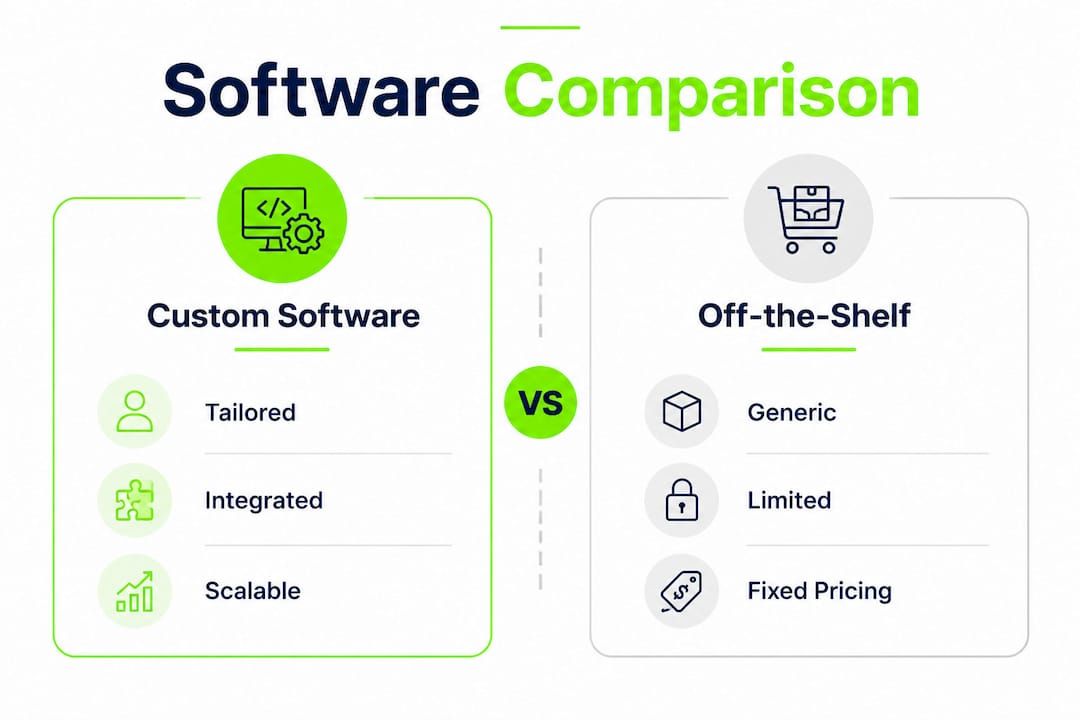
Each type serves a different layer of the business. Many organizations build more than one, then integrate them through a shared data layer or middleware service. You can explore the full range of business software categories to see where custom solutions fit within a broader technology stack.
How does custom enterprise software development work?
Enterprise app development encompasses building software that supports large-scale workforce operations, supply chain, financial reporting, regulatory compliance, and integrates with multiple internal systems. Projects at this scale typically involve more than 1,000 users, more than 10 external integrations, and extensive governance requirements. That complexity shapes every phase of the development process.
The development lifecycle for a custom enterprise system generally follows these stages:
- Discovery and requirements mapping. Teams document existing workflows, identify integration points, and define compliance constraints before writing a line of code. Skipping this phase is the leading cause of scope creep.
- Architecture design. Engineers define the data model, API structure, and security framework. Decisions made here determine how well the system scales and how easily it integrates with future tools.
- Agile delivery in phases. Most enterprise builds use iterative sprints rather than a single waterfall release. This allows business stakeholders to validate functionality against real workflows before the system goes live.
- Integration and testing. Connecting to existing ERP, CRM, and payment systems requires dedicated testing cycles. Data integrity and performance under load are the two most common failure points.
- Deployment and change management. Going live is not the end. User adoption, training, and process adjustment take weeks or months after launch.
The central strategic decision is whether to build greenfield custom code or configure an existing commercial platform. Custom builds provide full control but carry maintenance liability. Platform configurations deliver faster time-to-value but relocate complexity into the vendor relationship. Neither path is universally correct. The right choice depends on how much of the business logic is proprietary and how quickly the organization needs to move.
In-house development preserves institutional knowledge but requires sustained engineering capacity. Outsourced development reduces fixed costs but demands rigorous specification and governance. A modular foundation approach, where a significant portion of the boilerplate infrastructure is pre-built and teams customize from there, reduces both timelines and risk without sacrificing control.
Pro Tip: Treat the first production release as a validated prototype, not a finished product. Plan a structured feedback cycle within 90 days of launch to capture workflow gaps before they become embedded problems.
What are the benefits and ROI of custom enterprise software?
The business case for custom software solutions rests on four measurable advantages: integration quality, compliance coverage, scalability, and total cost of ownership over time.
“Custom applications enable organizations to design workflows and integrations aligned exactly to business goals, providing competitive advantages beyond feature counts.” — Salesforce Custom Application Development Guide
Custom software scales with growth models rather than being restricted by vendor pricing tiers as SaaS products are. Scaling in a custom system is limited by technical infrastructure, not license costs. For organizations growing headcount or transaction volume rapidly, this distinction has direct budget implications.
The table below outlines the ROI dimensions most relevant to enterprise decision-makers.
| ROI Dimension | Custom Software | Off-the-Shelf Software |
|---|---|---|
| Integration quality | Native, designed from day one | Connector-dependent, often fragile |
| Compliance coverage | Built to exact regulatory requirements | Requires workarounds or add-ons |
| Scalability | Tied to infrastructure, not license tiers | Vendor pricing increases with scale |
| Feature control | Full ownership, no unused modules | Bundled features, limited removal |
| Long-term cost | Higher upfront, lower per-user cost at scale | Lower upfront, higher recurring fees |
The upfront investment in custom enterprise software development is real. A greenfield build for a mid-sized organization can run from several hundred thousand to several million dollars depending on scope. The long-term case is built on eliminating per-seat licensing fees, reducing integration maintenance costs, and avoiding the productivity losses that come from forcing teams to work around a black-box platform’s limitations. For a deeper look at enterprise customization ROI, the financial case becomes clearer when total cost of ownership is modeled over a five-year horizon rather than a single budget cycle.
Key takeaways
Custom enterprise software delivers its greatest value when it is built around the specific workflows, integrations, and compliance requirements that off-the-shelf products cannot address without costly workarounds.
| Point | Details |
|---|---|
| Definition clarity | Custom enterprise software is engineered for one organization’s workflows, not a broad market. |
| Integration advantage | Native integration with ERP, CRM, and payment systems eliminates fragile connector workarounds. |
| Compliance fit | Regulated industries require compliance controls that generic software cannot provide without add-ons. |
| Scalability without licensing | Growth scales with infrastructure costs, not vendor pricing tiers. |
| Build vs. configure trade-off | Full custom builds offer control; platform configurations offer speed. Choose based on proprietary logic requirements. |
The case for starting with a modular foundation
Most organizations underestimate how much of an enterprise system is undifferentiated boilerplate. Authentication, role management, audit logging, notification systems, and API scaffolding are not competitive advantages. They are table stakes. Building them from scratch on every project puts time and budget into infrastructure that does not move the business forward.
The projects that deliver the fastest time-to-value are the ones where teams start with a modular foundation and focus engineering effort on the business-domain complexity that actually differentiates the product. At Bitecode, the pattern we see consistently is that organizations which spend the first three months building authentication and user management are the same ones that run out of budget before they reach the workflows that matter.
There is also a common misconception that custom software means greenfield development. It does not. A well-designed modular foundation can cover 60% of the baseline system before a single line of business logic is written. That is not a shortcut. It is a way to accelerate work without accelerating chaos. The remaining 40% is where the real differentiation lives, and that is where engineering attention should be concentrated.
The future of enterprise software development is not a choice between full custom builds and rigid SaaS platforms. It is a spectrum, and the organizations that navigate it well are the ones that know exactly which parts of their system need to be proprietary and which parts can be standardized without consequence.
— Bitecode
Build your custom enterprise system faster with Bitecode
Bitecode builds tailored enterprise systems with up to 60% of the baseline infrastructure pre-built, so your team focuses on the workflows that differentiate your business rather than rebuilding boilerplate from scratch.
The Bitecode platform includes an AI workflow automation module that handles intelligent task routing and process automation without custom AI development cycles. For organizations handling financial transactions, the blockchain payment system module delivers secure, auditable payment processing built for enterprise compliance requirements. Teams that need customer relationship management can deploy custom CRM solutions configured to their specific sales processes and data structures. Each module integrates with your existing systems and scales with your organization.
FAQ
What is custom enterprise software in simple terms?
Custom enterprise software is purpose-built software designed to match one organization’s specific workflows, data requirements, and integrations. It differs from off-the-shelf products by fitting the business rather than requiring the business to adapt to the software.
How long does custom enterprise software development take?
Development timelines vary by scope, but most enterprise projects run from six months to over two years. Starting with a modular foundation with pre-built infrastructure components can reduce initial timelines significantly.
Is custom software more expensive than off-the-shelf solutions?
Upfront costs for custom builds are higher, but total cost of ownership over five or more years is often lower. Custom software eliminates per-seat licensing fees and reduces the integration maintenance costs that accumulate with packaged products.
What industries benefit most from custom enterprise software?
Healthcare, finance, logistics, and manufacturing gain the most from custom solutions because their compliance requirements, proprietary workflows, and integration complexity exceed what generic software handles without costly workarounds.
What is the difference between custom software and configuring a platform like salesforce?
Custom builds provide full control over the data model, logic, and integrations but carry ongoing maintenance responsibility. Configuring a platform like Salesforce delivers faster deployment but relocates complexity into the vendor relationship and limits what the system can do at its boundaries.