TL;DR:
- Enterprise customization, when governed through structured extension frameworks, delivers measurable ROI and system agility. Establishing cross-functional governance before development reduces technical debt and streamlines upgrades, as shown by industry examples like SAP’s Clean Core. Applying disciplined customization principles to AI and enterprise processes enhances operational efficiency, cost savings, and competitive advantage.
Enterprise customization is defined as the deliberate tailoring of technology, workflows, and processes to match the specific operational needs of a large organization. It drives competitive differentiation, reduces friction in complex workflows, and directly affects profitability. Generic, off-the-shelf systems force organizations to adapt their operations to the software rather than the reverse. That misalignment compounds over time, producing inefficiency, missed customer insights, and slower response to market shifts. The case for why enterprise customization matters is not philosophical. It is measurable, and the evidence from SAP, Azul Prime, and JFrog deployments makes the financial argument clear.
Why enterprise customization matters: governance is the real differentiator
The industry term for disciplined enterprise customization is governed extensibility. It refers to a structured approach where organizations extend their core platforms through defined APIs, decoupled modules, and extension frameworks rather than modifying vendor-maintained code directly.
SAP’s Clean Core concept is the most widely cited governance model in ERP modernization. The principle is straightforward: keep the standard system untouched and push all business-specific logic into extensions that sit outside the core. According to SAP’s own learning framework, Clean Core is 10% technology and 90% discipline. That ratio is counterintuitive to most IT leaders who assume the challenge is technical. The real challenge is organizational: getting business units to accept standard processes, and getting IT to enforce extension boundaries.
The consequences of ignoring this discipline are well documented. Organizations that modify core ERP code directly face upgrade cycles that require months of regression testing, because every vendor patch must be reconciled against custom modifications. This is what the industry calls “upgrade hell,” and it is the primary reason large SAP implementations stall during cloud migration. Governance boards that review and approve every customization request before development begins are the structural solution. They function as gatekeepers, evaluating whether a proposed change delivers enough business value to justify the extension overhead.
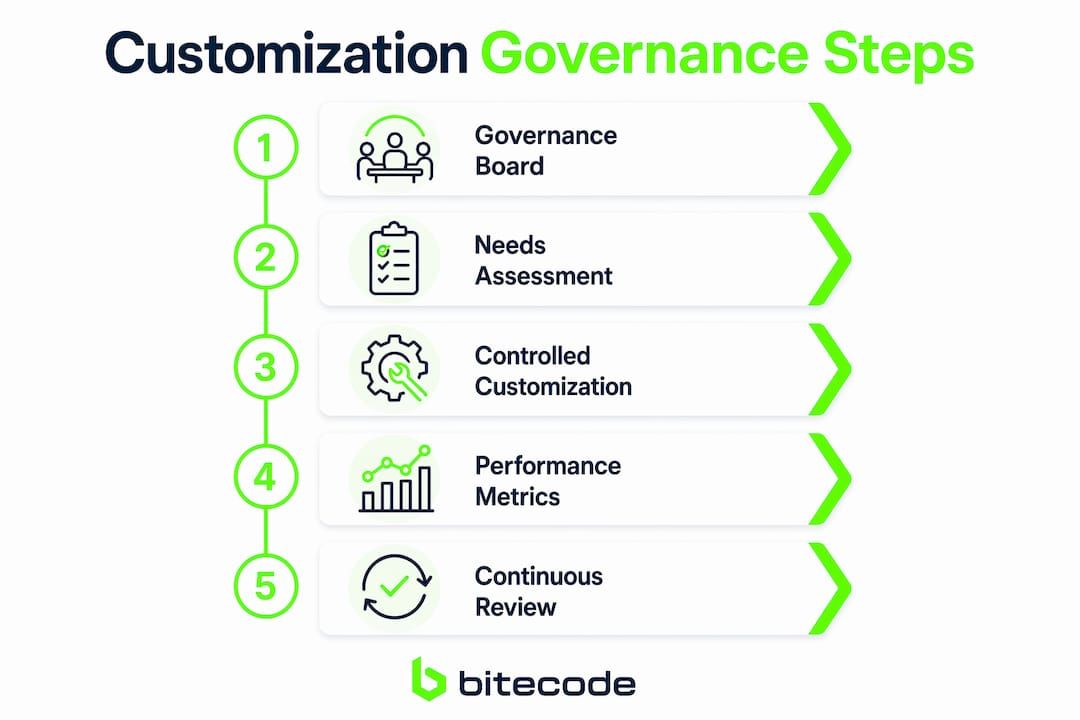
The practical steps for establishing this governance structure follow a clear sequence:
- Form a cross-functional governance board with both business unit leaders and IT architects as permanent members.
- Define a customization classification system: core modifications (prohibited), decoupled extensions (permitted with review), and configuration changes (self-service).
- Require a business case for every extension request, including estimated ROI and integration impact.
- Establish a quarterly review cycle to retire extensions that no longer serve their original purpose.
Pro Tip: Start the governance board before any customization work begins, not after. Organizations that defer governance setup until mid-implementation consistently face cascade rework in testing and training phases.
How customization improves operational efficiency and ROI
The financial case for tailored solutions is no longer theoretical. Organizations that apply disciplined customization to their platforms report measurable returns across cloud costs, developer productivity, and security posture.

Azul Prime’s deployment data is instructive. An independent study found that organizations using Azul Prime achieved a 129% ROI over three years, with nearly $4 million in cloud compute savings and $5.7 million in productivity gains. Those numbers reflect what happens when runtime optimization is matched precisely to workload characteristics rather than applied generically. The customization was not cosmetic. It changed how compute resources were allocated at the infrastructure level.
JFrog’s platform standardization tells a parallel story from the software supply chain side. By consolidating tooling and applying consistent security policies across the development pipeline, JFrog customers reduced software tool spend by 71% and cut critical vulnerabilities by 65%. Remediation time improved by 80%, and the total ROI reached 282% with payback under six months. That is the impact of replacing fragmented, ad-hoc tooling with a standardized, customized platform built around the organization’s actual security and delivery requirements.
The benefits of customized solutions extend beyond cost reduction. Consider what tailored systems enable on the customer intelligence side:
- Precise behavioral segmentation. Custom data models capture buying patterns specific to your product catalog, not generic e-commerce archetypes.
- Workflow-specific automation. Approval chains, exception handling, and escalation paths can be built around actual business rules rather than vendor defaults.
- Competitive differentiation. When your operational processes are encoded in software that competitors cannot replicate from a shared platform, the system itself becomes a strategic asset.
- Faster response to market changes. Decoupled extensions can be updated independently without touching the core, reducing change cycle times from months to weeks.
The importance of enterprise customization becomes most visible when organizations compare their pre- and post-customization operational metrics. The gap is rarely marginal.
Customization approaches: extension frameworks vs. ad-hoc core changes
Not all customization strategies produce the same outcomes. The method matters as much as the intent.
The three primary approaches differ significantly in their long-term cost profile and upgrade compatibility:
| Approach | Upgrade compatibility | Maintenance cost | Business agility |
|---|---|---|---|
| Clean Core extensions (API-first, decoupled) | High. Vendor updates do not break extensions. | Low. Extensions are maintained independently. | High. Changes deploy without core regression testing. |
| Classical core modification | Low. Every vendor patch requires reconciliation. | High. Grows with each additional modification. | Low. Changes require full regression cycles. |
| No customization (pure standard) | Maximum. Zero custom code to maintain. | Minimal. Vendor handles all updates. | Low. Business processes must conform to vendor defaults. |
The Clean Core extension model is the clear winner for organizations that need both stability and adaptability. Decoupled extensions and API-first design separate differentiated business logic from vendor-maintained code, which means the organization retains its competitive customizations without paying the upgrade tax associated with core modifications.
Classical customization relocates complexity into the vendor relationship. Every upgrade negotiation becomes a rework exercise. Organizations that built heavily customized SAP R/3 systems in the 2000s are still paying that debt today during S/4HANA migrations. The technical debt is real, and it compounds.
Pro Tip: When evaluating a new customization request, ask one question first: can this be achieved through configuration or a decoupled extension? If yes, core modification is off the table. That single rule eliminates the majority of future upgrade problems.
How AI customization fits into enterprise strategy
The same governance logic that applies to ERP extensions applies directly to enterprise AI deployments. A one-model-fits-all approach to AI is as problematic as a monolithic ERP with thousands of core modifications.
Multi-model AI customization allows organizations to match AI capabilities to specific task requirements, balancing performance against cost. A large language model appropriate for contract analysis is not the right tool for real-time inventory classification. Using the same model for both tasks overpays on one and underperforms on the other. Model routing, where requests are directed to the most cost-effective capable model, is the AI equivalent of extension-based architecture.
The governance mechanisms that make AI customization work at scale include:
- Model routing rules that direct tasks to the appropriate model tier based on complexity and latency requirements.
- Usage quotas and chargebacks that assign AI costs to the business units consuming them, creating accountability for consumption.
- Model transparency requirements that document which model produced which output, supporting audit and compliance needs.
Governance controls like quotas and model transparency build the organizational trust necessary for AI to operate at scale. Without them, AI spend grows unchecked and outputs become difficult to audit. Matching AI to task-specific needs through a governed multi-model strategy yields superior ROI compared to deploying a single flagship model across all use cases.
Implementing enterprise customization: practical steps and metrics
Governance intent without measurement produces drift. Organizations that sustain customization discipline over time do so by tracking a defined set of KPIs and running periodic maturity assessments.
SAP’s Clean Core Measurement Framework provides a practical template. The core metrics track the share of fit-to-standard processes (processes running on vendor defaults without modification), the percentage of extensions that are fully decoupled from the core, and the ratio of API-based integrations to point-to-point connections. These three numbers tell a leadership team whether their customization posture is improving or degrading over time.
The implementation sequence for organizations starting this process follows a logical progression:
- Baseline assessment. Map every existing customization, classify it by type (core modification, extension, configuration), and estimate its maintenance cost.
- Prioritization. Rank customizations by business value and strategic differentiation. Retire those that no longer serve a clear purpose.
- Governance activation. Stand up the review board and enforce the classification system for all new requests.
- KPI definition. Set targets for fit-to-standard share and decoupled extension percentage, and report against them quarterly.
- Continuous improvement. Run annual maturity assessments to identify regression and recalibrate targets.
Delaying customization governance cascades into delayed testing, training, and integration rework, increasing the operational burden on every subsequent project phase. Early governance is not overhead. It is the mechanism that keeps customization from becoming technical debt.
Pro Tip: Treat your fit-to-standard percentage as a financial metric, not just a technical one. Every point below your target represents deferred upgrade cost and increased vendor dependency. Present it to the CFO alongside capital expenditure figures.
For teams looking to connect customization governance with broader enterprise software efficiency practices, the integration of KPI tracking into existing performance management cycles is the fastest path to organizational adoption.
Key takeaways
Enterprise customization delivers measurable ROI only when governed through structured extension frameworks, defined KPIs, and cross-functional oversight.
| Point | Details |
|---|---|
| Governance precedes technology | Customization is 90% discipline. Establish review boards before any development begins. |
| Extension frameworks outperform core changes | Decoupled, API-first extensions preserve upgrade compatibility and reduce long-term maintenance cost. |
| Financial evidence is concrete | Azul Prime delivered 129% ROI; JFrog achieved 282% ROI with 71% tool spend reduction through disciplined platform customization. |
| AI customization follows the same rules | Multi-model routing with usage quotas aligns AI cost to business value and prevents unchecked spend. |
| Measurement sustains discipline | KPIs like fit-to-standard share and decoupled extension percentage must be tracked quarterly and reported to leadership. |
Bitecode’s perspective on the real challenge
The organizations that struggle most with enterprise customization are rarely the ones that lack technical talent. They are the ones that treat customization as a development decision rather than a governance decision. The technical work is the easy part. Getting a business unit to accept a standard process when they have operated a custom one for a decade is where the real friction lives.
What we observe consistently is that late customization decisions are the most expensive ones. When a team defers the question of whether to customize until implementation is underway, the answer almost always becomes “yes” by default, because the standard process no longer fits the timeline for retraining. That default yes cascades into integration rework, delayed testing, and scope creep that the original project budget never anticipated.
The organizations that get this right treat their digital transformation strategy as a continuous program, not a project. They bring finance and IT into customization decisions from the start, not as reviewers at the end. They measure their customization posture the same way they measure financial performance: with targets, variance analysis, and accountability. That cultural shift is harder than any technical migration. It is also the only thing that makes the technical migration sustainable.
— Bitecode
Accelerate your enterprise customization with Bitecode
Bitecode’s modular platform is built for organizations that need to move fast without accumulating technical debt. The AI Assistant Module delivers workflow automation capabilities aligned with governed customization principles, allowing teams to deploy AI-driven processes as decoupled extensions rather than core modifications. For organizations managing complex financial integrations, Bitecode’s blockchain payment system provides secure, customizable transaction infrastructure that integrates cleanly with existing enterprise architectures.
Bitecode starts projects with up to 60% of the baseline system pre-built, which means governance frameworks, integration layers, and automation modules are ready to configure rather than build from scratch. That approach accelerates work without accelerating chaos, giving decision-makers a faster path from customization strategy to production deployment.
FAQ
Why does enterprise customization matter for large organizations?
Enterprise customization aligns technology with specific business processes, enabling operational efficiency and competitive differentiation that generic platforms cannot deliver. Governed customization, as demonstrated by SAP’s Clean Core model, produces measurable ROI while maintaining system stability.
What is the difference between Clean Core extensions and classical customization?
Clean Core extensions are decoupled from vendor-maintained code and deployed via APIs, preserving upgrade compatibility. Classical customization modifies the core directly, creating technical debt that compounds with every vendor update cycle.
How do organizations measure customization success?
SAP’s Clean Core Measurement Framework tracks fit-to-standard process share, decoupled extension percentage, and API-based integration ratios. These KPIs should be reported quarterly to leadership alongside financial performance metrics.
What role does AI play in enterprise customization strategy?
Multi-model AI customization matches specific AI capabilities to task requirements, using model routing and usage quotas to control cost. This governance-first approach mirrors the same discipline applied to ERP extensions and produces superior ROI compared to single-model deployments.
When should governance boards be established in a customization program?
Governance boards must be established before any customization development begins. Deferring this decision until implementation is underway consistently produces cascade rework in testing, training, and integration phases, increasing total program cost.