The ISO 20022 migration is no longer a future project. Cross-border coexistence on Swift ended in November 2025, Fedwire went live in July 2025, and U.S. companies now work in a world where payment instructions are expected as structured XML messages. If your systems still depend on MT-style flat fields, you are probably relying on a bank-side translation service to stay connected. This guide explains what changed, what still lies ahead, and how to plan the mapping, integration and testing work so that translation becomes a choice rather than a dependency.
TL;DR
- Swift’s coexistence period for cross-border payment instructions ended on 22 November 2025. Limited, chargeable contingency conversion remains.
- In the U.S., CHIPS has been live on ISO 20022 since April 2024 and Fedwire Funds since July 2025, according to BNY’s May 2026 FAQ.
- The hard work is data, not syntax: capturing richer fields, mapping legacy formats such as MT103 and MT940, and updating storage, reconciliation and reporting.
- Teams relying on translation should plan to move to native messages in 2026 and beyond, because contingency services carry extra charges.
- A phased approach (inventory, mapping, an integration layer, parallel testing, cutover) keeps risk contained.
What ISO 20022 is and why it matters for payments
Swift describes ISO 20022 as an open global standard for financial information that provides consistent, rich and structured data for every kind of financial business transaction. For payments, the practical meaning is simple. The older MT messages carry short, fixed-format text fields. ISO 20022 messages carry richer, more granular, end-to-end data in XML, so names, addresses, purposes and references travel in discrete, labeled elements instead of being squeezed into free-text lines.
That structure is what makes the benefits possible. Swift lists improved analytics, less manual intervention, more accurate compliance, higher resilience, better fraud prevention and end-to-end automation among the outcomes the standard supports. None of these arrive automatically. They arrive when a company’s own systems capture, preserve and use the extra data instead of flattening it back into a legacy shape.
An example of an ISO 20022 payment message
Two message families cover most corporate and bank-to-bank scenarios. The pacs.008 is the customer credit transfer between financial institutions, the successor to the MT103. The pacs.009 is the institution-level credit transfer, the successor to the MT202. Returns use pacs.004. BNY lists exactly these as the payment messages it now receives, and describes multi-format options in which a pacs.008 carries an embedded translation of an MT103, and a pacs.009 an embedded translation of an MT202.
On the reporting side, the mapping runs from MT940 and MT950 statements to camt.053, as shown in Wells Fargo’s quick reference guide to ISO 20022 XML. The practical lesson: a statement is not a lightly reformatted statement. It is a differently structured document that your reconciliation logic has to read.
The migration timeline, and where things stand now
The sequence matters because it explains why some teams feel pressure now and others do not.
| Milestone | What happened | Source |
|---|---|---|
| March 2023 | Swift cross-border coexistence period began | Swift |
| April 2024 | CHIPS live on ISO 20022 for USD | BNY |
| July 2025 | Fedwire Funds Service live on ISO 20022 | BNY |
| 22 November 2025 | Coexistence ended for cross-border payment instructions | Swift |
| 1 January 2026 | Automatic extra charges for contingency processing and in-flow translation | Swift |
| November 2027 | Planned address enforcement, per one U.S. bank’s guidance | U.S. Bank |
Wells Fargo’s FAQ states that after the coexistence period ended, support for MT 1xx and 2xx messages on SwiftNet FIN was discontinued outside limited contingency scenarios and closed user groups. Swift adds that selective, chargeable short-term contingency measures provide limited conversion so that receivers only receive ISO 20022.
The takeaway for a corporate treasury or a fintech: the standard is live, and the safety net is narrow, temporary and priced.
What the Swift migration means in practice
A search for “Swift ISO 20022 migration” usually comes from one of two situations. Either a bank or financial institution needs to send native messages over the network, or a corporate wants to know how its payment files reach that network. For the first group, Swift recommends full adoption of ISO 20022 payment instruction messages to minimize operational, business and financial impacts, and says institutions relying on contingency processing or in-flow translation should start planning their move in 2026. For the second group, the change shows up as bank requirements: what format the bank accepts, which fields are mandatory, and how rejected data is reported back.
What applies to U.S. institutions and businesses
U.S. Bank describes the transition as an industry-wide shift that began in 2025 and will eventually replace Fedwire Funds, Swift and proprietary payment formats with one standardized message format. The same page notes that important Swift and Fedwire message types were implemented in 2026, with address enforcement planned for November 2027. Wells Fargo’s FAQ says payment instructions are now expected in ISO 20022, with CHIPS and Fedwire among the major high-value systems already aligned.
Three practical consequences follow for a U.S. company:
- Your bank sets the format. There is no single corporate deadline. Each bank decides which formats it accepts from clients and when it retires older ones, so your integration calendar is set by your banking partners.
- Address data is the next pressure point. If your vendor, customer or beneficiary records store addresses as a single free-text block, structuring them takes data cleanup before it takes code.
- Returns and reporting count too. Return messages and camt-style statements flow back into your ERP and treasury tools. A migration that fixes outbound payments but leaves inbound reporting on legacy assumptions creates reconciliation gaps.
Where migrations get hard: data, not XML
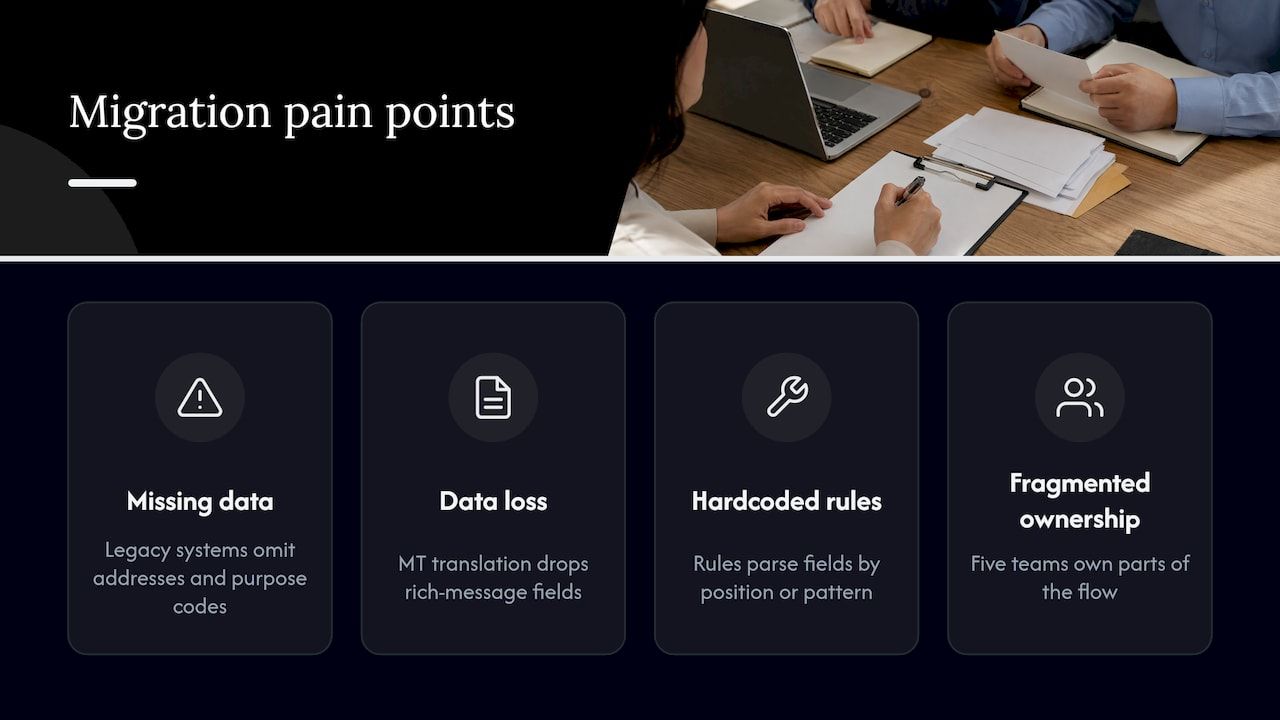
Swift notes that ISO 20022 uses modern, mainstream XML technology that is well supported and eases integration. Parsing and producing XML is rarely what delays a project. The delays come from four places.
Missing source data. Legacy systems often never captured what the new messages ask for: structured postal addresses, ultimate debtor or creditor, purpose codes, remittance details. Deloitte frames migration as an operational-risk program, and highlights that additional data capture, message restructuring, integration updates and data storage updates are all required.
Truncation and lossy round trips. Translating a rich message down to an MT shape drops information. Translating an MT up to ISO 20022 cannot invent the missing fields. Either direction leaves you with messages that look valid and carry less than they should.
Hardcoded downstream logic. Reconciliation rules, sanctions screening feeds, general ledger postings and reporting often parse legacy fields by position or by pattern. Those assumptions break quietly.
Fragmented ownership. Payments, treasury, IT, compliance and finance operations each own part of the flow. Without a single owner for the data model, the same field gets mapped three different ways.
A mapping approach that survives audits
A mapping guide is only useful if people can review it. Use a structure that a payments analyst, a developer and an auditor can all read.
Build a field-level mapping register
For each message type you send or receive, create one row per element: source system field, source format, target ISO 20022 element, data type and length, transformation rule, default or fallback, and an owner. Wells Fargo’s guide, which maps MT940 and MT950 to camt.053 and describes amount and code data types, is a good model for the level of detail to aim for. Start from your banks’ own implementation guides, because the bank’s usage rules decide what is actually accepted.
Separate three kinds of mapping rules
- Direct moves: the value goes across unchanged (an amount, a currency code).
- Derived values: the target needs logic (splitting a free-text address into structured elements, choosing a purpose code from a transaction category).
- New data: nothing exists in the source, so a collection step or a business decision is needed before the mapping can be completed.
The third category is where schedules slip. Count those rows early. They tell you how much of the project is data capture rather than integration.
Validate in layers
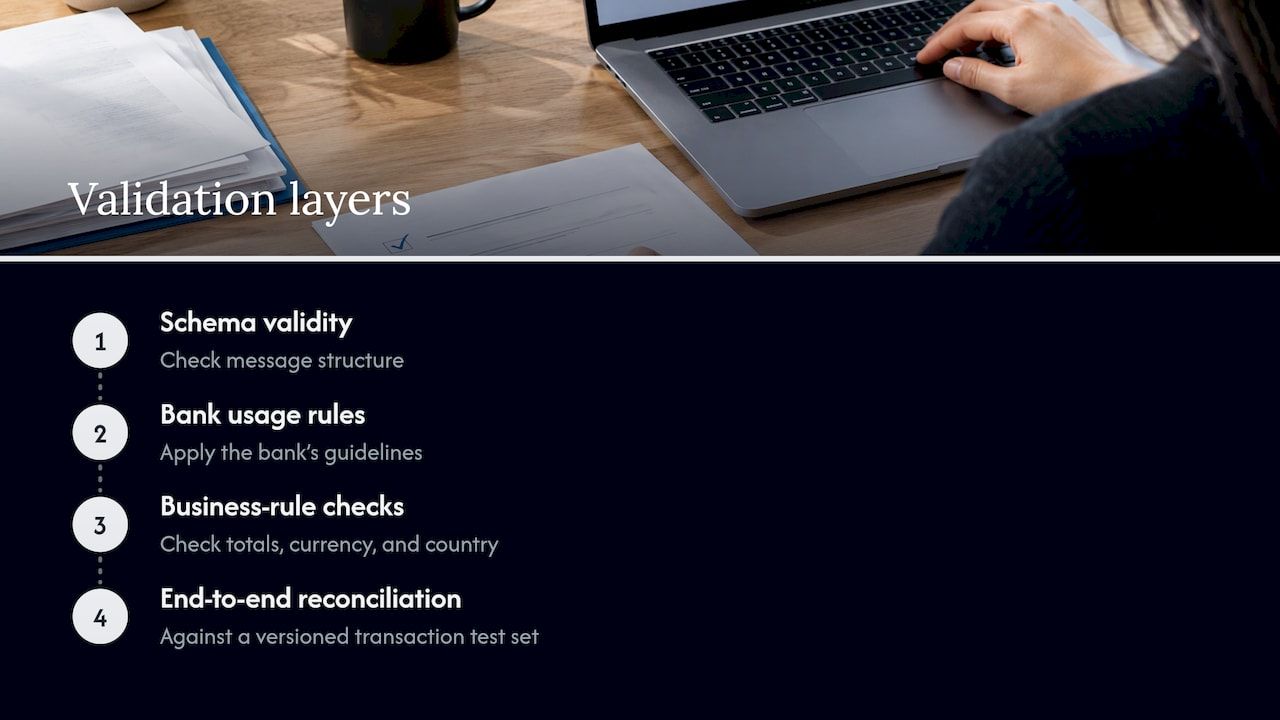
Validate in this order: schema validity, then the bank’s usage-guideline rules, then business-rule checks (for example, totals match, currency and country combinations make sense), then end-to-end reconciliation against a known set of transactions. Keep the test set as a versioned asset, with real-world edge cases: long names, non-Latin characters, missing addresses, partial returns, multi-currency batches.
Integration options and the ISO 20022 API question
Deloitte lays out three routes: upgrade internal systems, upgrade or replace third-party solutions, or deploy translation tools outside the payment infrastructure to reduce the effect on legacy technology and processes. Each has a place.
| Approach | Best when | Watch for |
|---|---|---|
| Upgrade internal systems | You own the payment engine and have a long runway | Longest timeline; touches storage and reporting |
| Replace or upgrade packaged software | Vendor roadmap already supports the standard | Dependence on vendor release dates and configuration |
| External translation layer | Legacy core cannot change soon | Data richness limited by what the source holds; a permanent layer can become permanent debt |
Many teams end up with a hybrid: a translation and validation layer in front of legacy systems now, with a planned path to native data capture behind it. The layer should be designed to be removed, not to be admired.
Integration and APIs
When readers ask about an ISO 20022 API, they usually mean one of two things: an API that accepts business data and emits ISO 20022 messages to a bank channel, or an API that receives status reports and statements and converts them into the data model your ERP understands. The design principle is the same for both. Keep the canonical internal payment model richer than any single external format, and treat ISO 20022 as one adapter on the edge. That way a bank-specific usage variation changes one adapter, not the whole system.
For ERP integration, expect three touchpoints: payment initiation (from accounts payable or treasury), status feedback (acceptance, rejection, reasons), and statements for reconciliation. Build each as an observable pipeline with logging at every transformation, so an investigator can see the original, the mapped message and the bank response side by side.
Planning, testing and operating the migration
Deloitte warns that delay risks payment disruption, reconciliation and reporting gaps, insufficient bank resources, and too little time to upgrade, test and configure affected systems. A phased plan counters those risks.
- Inventory. List every payment flow, format, bank connection, and downstream consumer. Include the unglamorous ones: payroll files, refunds, supplier portals, and manual uploads.
- Confirm bank requirements. Get each bank’s supported formats, mandatory fields and cutover dates in writing, and map them to your own calendar.
- Close the data gaps. Decide who owns structured addresses, purpose codes and identifiers, and fix master data at the source.
- Build the mapping register and the integration layer. Version both.
- Test in parallel. Run legacy and ISO 20022 flows side by side where banks allow it, and compare outcomes, not just message validity.
- Cut over by flow, not all at once. Start with a lower-risk corridor or entity, and keep a rollback path.
- Operate and monitor. Track rejection rates by reason code, repair time, and reconciliation breaks for several cycles after go-live.
The cost of staying on contingency
Swift states that contingency processing and in-flow translation exist to enable business continuity as the community exits the coexistence period, and that from 1 January 2026 additional charges apply automatically to these services for MT senders. Even before cost, a translated message carries less data than a native one, so downstream screening and analytics work with less. That makes moving to native messages an operational improvement and not only a compliance task.
Why compliance and monitoring belong in the same project
Richer payment data changes what compliance teams can do with it. Structured party and address data supports cleaner screening, and better-labeled purposes give transaction monitoring more to work with. If you are modernizing monitoring alongside the format change, our overview of AI in transaction monitoring and fraud prevention shows how that data feeds detection, and our guide to secure financial processing, compliance and trust covers the controls that should surround any payment pipeline. IT leaders choosing architecture can also use our guide to financial processing systems.
Perspective
Most ISO 20022 programs we see framed as a message-format upgrade are really a data-model and integration problem. The format is documented and the schemas are public. What is hard is deciding where richer data is captured, who owns it, and how it moves through the systems that already run your finance operations.
Our view is that companies should avoid two extremes. Replacing a working core system just to change a message format puts risk into the part of the stack that is least broken. Leaving a permanent translation layer in place relocates complexity into a dependency nobody owns. A modular foundation sits between them: a canonical payment model, adapters for each bank format, validation and audit logging at every step, and the freedom to retire the adapter when the core catches up.
That is how we approach financial software at Bitecode. We start projects with up to 60% of the baseline system pre-built from modular components, including financial processing, workflow automation and AI assistance, then customize the remainder to the client’s business-domain complexity. Our modules are designed to be multi-currency and audit-ready, with self-hosted options, so a team keeps control of its payment data instead of handing it to a black-box platform. For an ISO 20022 effort, that means more of the schedule goes to mapping and testing and less to rebuilding scaffolding.
The goal is to accelerate work without accelerating chaos: a documented mapping register, parallel testing, and a cutover plan that a finance controller can sign off.
Bitecode
Building the integration layer with Bitecode
If your team has finished the inventory and needs an integration layer, a validation workflow or a modernized finance application, this is where we work. We deliver custom business software built from modular components, from a small MVP to larger programs, and our Financial Module covers accounting, audit trails and subscriptions that payment data feeds into. For approval flows, exception handling and reconciliation routing, our AI business process automation workflows are designed to reduce manual repair work.
To discuss scope for your payment flows, start from our custom business software page and tell us which systems and banks are involved. Engagements are scoped per project.
Questions to settle before you start
These are the decisions that most often determine whether a migration stays on schedule:
- Which banks and channels will send and receive ISO 20022 messages for us, and in what usage variants?
- Are we capturing structured address and party data at the source, or reconstructing it afterward?
- Is the translation layer temporary by design, and who is accountable for removing it?
- How will reconciliation consume camt-style statements, and who signs off on the results?
- What is our rollback path if a corridor fails after cutover?
When these have named owners and dates, the technical work becomes predictable. When they do not, the project drifts, regardless of how good the code is.
FAQ
What is the timeline for the Swift ISO 20022 migration?
The cross-border coexistence period began in March 2023 and ended on 22 November 2025, after which MT payment instructions are no longer supported by the FIN service for institution-to-institution cross-border flows. Limited, chargeable contingency measures remain. Swift recommends that institutions still relying on them plan their move to full adoption.
Does ISO 20022 apply to U.S. payments such as Fedwire and CHIPS?
Yes. CHIPS went live for USD on April 8, 2024, and the Fedwire Funds Service went live on July 14, 2025, per BNY’s published timeline. U.S. Bank adds that the industry transition will eventually replace Fedwire Funds, Swift and proprietary formats, with address enforcement planned for November 2027.
How do I map MT messages to ISO 20022?
Build a field-level register that links each legacy field to a target element, with data type, transformation rule and owner. Common pairings include MT103 to pacs.008 and MT202 to pacs.009, while MT940 and MT950 statements map to camt.053. Flag every field that has no source data, because those rows need a business decision, not just code.
Do we have to replace our core systems?
Not necessarily. Deloitte describes options that include upgrading internal systems, replacing third-party solutions, or deploying translation tools outside the payment infrastructure. The right choice depends on your runway, your banks’ requirements and how much of the richer data you want to use.
Which message is an example of an ISO 20022 payment?
The pacs.008 is the standard example: a customer credit transfer between financial institutions that replaces the MT103. Its institution-level counterpart is the pacs.009, and returns use pacs.004, as BNY’s FAQ lists.
Sources
- About ISO 20022, Swift
- ISO 20022: MT to ISO 20022 Conversion, Swift
- ISO 20022: Implementation, Swift
- ISO 20022: A new era for global payments, Swift
- FAQs: ISO 20022, Wells Fargo
- Quick reference guide: ISO 20022 XML, Wells Fargo
- ISO 20022 FAQ, May 2026, BNY
- ISO 20022 Migration, U.S. Bank
- ISO 20022: Preparing for US adoption, Deloitte