Smart payment routing is the automated choice of the best processor, acquirer or payment rail for each individual transaction, made in real time against rules, live performance data or a learning model. Instead of sending every payment down one fixed pipe, the system compares the available paths and picks the one most likely to approve the payment at the lowest sensible cost. This guide explains how that decision is made, what results businesses can realistically expect, where the approach goes wrong, and what a U.S. team should settle before building or buying it.
TL;DR
- Smart payment routing (also called intelligent or dynamic routing) selects a processor or rail per transaction, rather than using one fixed route for everything.
- The decision draws on transaction attributes such as amount, currency, card type and region, plus live data on provider health and approval history.
- The benefits are higher approval rates, lower fees, redundancy and steadier performance at peak volume, but they depend on your mix of payments and on the quality of your routing logic.
- Retries and failover need discipline: recoverable failures can go to a second route, true declines should not.
- Routing is one decision inside the wider payment orchestration layer, and it adds integration, reconciliation and compliance work you need to plan for.
What smart payment routing actually means
The terms overlap, and vendors use them loosely. In practice, “smart,” “intelligent” and “dynamic” routing all describe the same shift: the route is no longer hard-coded, it is decided per payment. A processor’s 2026 guide describes intelligent routing as choosing a payment path in real time based on accessibility, speed and cost, rather than pushing every transaction through one route.
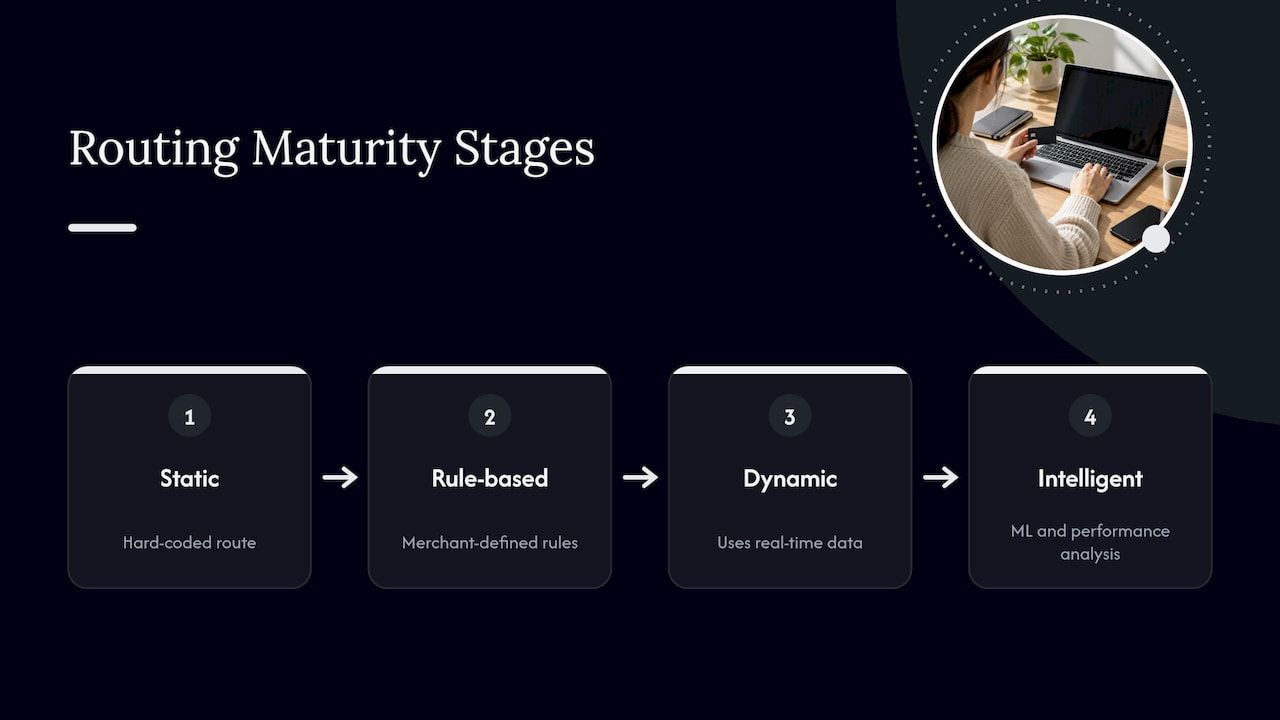
There is a real spectrum underneath the vocabulary. One industry guide from 2025 separates four stages: static routing, rule-based routing, dynamic routing that uses real-time data, and intelligent routing that adds machine learning and performance analysis. Another view cautions that “dynamic” often means only that merchant-defined rules are applied automatically, which is not the same as AI making the decision. When a vendor says “smart,” ask which of those four stages it actually means.
The term also stretches beyond cards. A July 2025 Federal Reserve Bank of Cleveland brief uses intelligent routing for payment hubs, where participants specify the attributes they want and the hub chooses the mechanism, potentially across ACH, instant payments, wire and card rails. For an enterprise with payouts, collections and card acceptance, that wider meaning is often the more useful one.
Static, rule-based and intelligent routing compared
Static routing sends every transaction through a predetermined processor. Dynamic routing evaluates each payment against current conditions and can stop sending traffic to a provider that is down or underperforming. Intelligent routing goes one step further and learns from outcomes.
| Approach | How the route is chosen | Strength | Limitation |
|---|---|---|---|
| Static | One fixed processor for everything | Simple to run and reconcile | No resilience, no optimization |
| Rule-based | Human-written conditions (currency, amount, card type) | Predictable, easy to audit | Rules go stale as provider performance shifts |
| Dynamic | Rules plus real-time health and performance data | Avoids outages and degraded providers | Still depends on how well the rules are set |
| Intelligent | Models learn from transaction outcomes and update logic | Adapts as conditions change | Needs enough volume and clear logging to trust |
Most teams should not jump straight to the bottom row. A well-built rule-based layer with good logging is often the right first release, and it produces the data an adaptive model would later need.
How the engine picks a route
The sequence is similar across implementations. According to the processor guide, the engine gathers transaction details and compares them with rules, performance data and provider health. It weighs processing fees, currency-conversion costs and approval probability, sends the payment down the selected route, and records the result so future routing improves.
A developer guide to one smart-routing engine adds a useful detail on order of operations. Providers are first filtered out for downtime, inactivity or incompatibility with the transaction. Only then do the applicable rules choose among the survivors, by best performance, a preferred provider or load balancing.
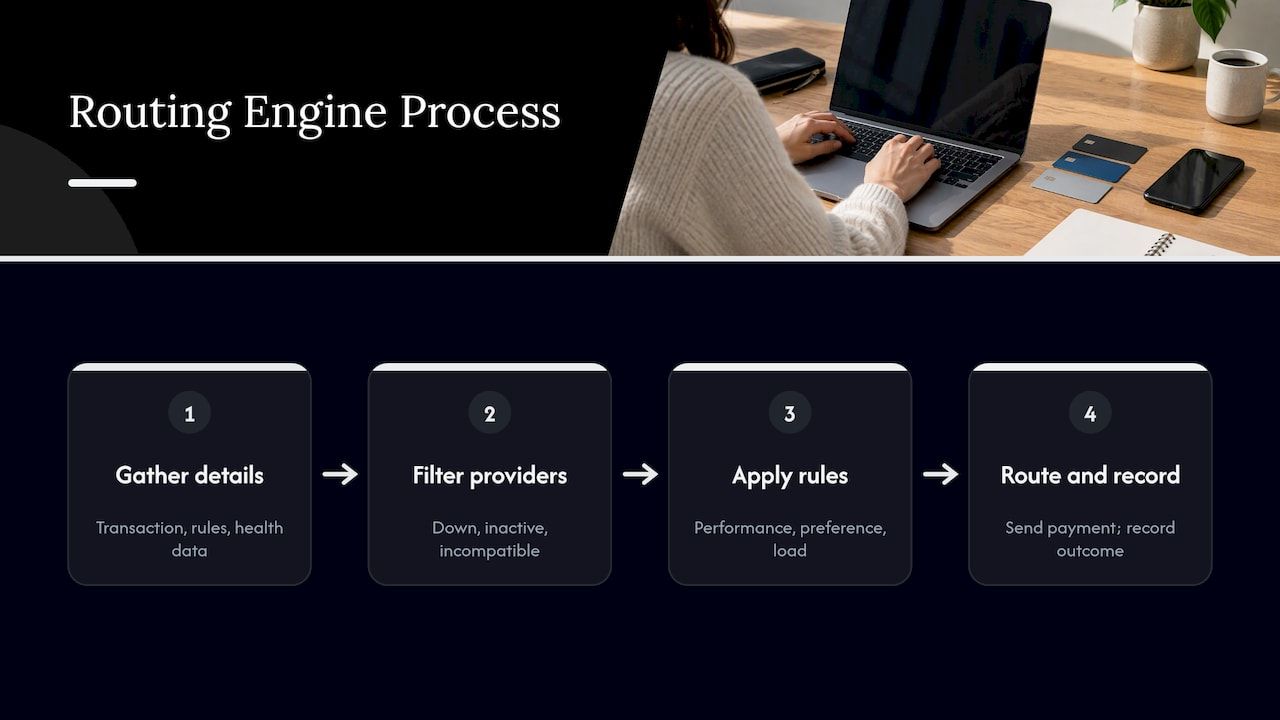
That two-stage structure, eligibility first and optimization second, is worth copying in any design. It keeps the logic explainable: you can always answer why a provider was excluded, and separately why another was chosen.
Which signals feed the decision
The inputs fall into a few groups:
- Transaction attributes. Customer region, currency, amount, card type and merchant details can all shape the choice of provider.
- Card data. Routing engines commonly evaluate card type or BIN range, merchant category and geographic origin against configured rules before dispatch.
- History. Approval-rate history by route, issuer and card brand shows which path tends to succeed under which conditions.
- Cost. Interchange-adjacent fees, processor fees and conversion costs for each candidate path.
- Live health. Latency, error rates and outages at each gateway, processor or bank.
What smart routing can deliver, and what it cannot promise
The plausible gains are higher authorization rates, recovery of false declines, lower cross-border fees, provider redundancy and steadier performance during traffic spikes. The same guide is explicit that results move with approval patterns, costs, provider reliability, network conditions, markets and the routing logic itself.
One published data point shows the scale of savings in a specific setting. In a 2024 pilot with more than 20 enterprise merchants, average cost savings reached 26% and authorization rates on U.S. debit transactions rose by 0.22%. Note the context: U.S. debit, enterprise volumes, one provider’s pilot. It is evidence that routing can matter, not a benchmark for your own payment mix.
A second caution is about what to optimize. A processor-side analysis argues that routing should balance acceptance, reliability and efficiency together rather than chase the lowest fee alone. A cheap route that declines more good customers loses money. Technical documentation for one open routing engine makes the same point from the engineering side: routing can serve several objectives, among them authorization rate, cost, volume distribution, eligibility and fallback resilience, and there is no single universal metric.
The benefit is also felt unevenly. Merchants in sectors where acquirer choice is narrow and declines are frequent, such as those that rely on high-risk payment processing, have more to gain from having several paths and a clear policy for choosing among them.
Failover and retries without making things worse
Failover shifts traffic when a gateway, processor or bank shows latency or downtime. Retries are a related but separate tool. The processor guide says technical errors or nonfinal issuer responses may be retried through an alternate route, and that businesses should distinguish recoverable failures from true declines and watch for higher costs and issuer fatigue.
A workable policy looks like this:
- Classify the failure. A timeout or processor error is recoverable. A hard decline for a stolen card is not.
- Retry only the recoverable class. Recoverable declines or errors can go to an alternative acquirer, while non-recoverable failures should not be retried at all.
- Cap the attempts. Retries should end once the configured attempts are exhausted, and the cap should be low enough to protect issuer relationships.
- Price the retry. A second route may cost more, so the saved sale has to outweigh the extra fee.
Every one of these steps depends on having reliable failure codes and an audit trail. For related design work on scoring and monitoring at transaction speed, see our engineering notes on transaction monitoring system design and on how AI enhances transaction monitoring and fraud prevention.
Routing and payment orchestration are not the same thing
Routing is the decision about which eligible path handles a particular transaction. Payment orchestration is broader: the layer that integrates and coordinates multiple providers. PXP’s explanation puts provider connectivity, transaction lifecycle management, retry logic and reporting on the orchestration side. A PYMNTS analysis from 2023 frames orchestration as the foundation, with optimization applied on top and dynamic routing as one of its principal tools.
The practical consequence: you cannot route among providers you have not connected. Before routing logic, you need the integrations, a normalized data model and consistent reporting. Our practical guide to payment orchestration covers that foundation in more detail.
What a U.S. business should evaluate before implementing
Total cost, not only the headline fee
Orchestration platforms can add platform and per-transaction fees on top of processor costs. Model the savings net of those fees, using your own volumes by card type, ticket size and geography.
Compliance responsibilities stay with you
The same U.S. business guide notes that orchestration does not remove your PCI DSS or other compliance responsibilities. Adding providers can widen the surface you must document, so involve your security and compliance leads early.
Logging and explainability
Each routing decision should be logged with the selected processor, the routing approach and the outcome so teams can review performance. Without that, finance cannot reconcile and engineering cannot debug. This is also where audit-readiness is won or lost.
Scope: cards only, or more rails?
The Cleveland Fed’s review of the FedNow Service Provider Showcase found that 20% of payment hub, platform and gateway providers appeared to reference cross-rail routing, and 24% appeared to reference routing among competing providers of a payment solution. Those figures describe that showcase, not the whole market, but they suggest cross-rail routing is still less common than card-processor routing. Decide whether your roadmap includes ACH, instant payments or wires, since that changes the architecture.
A sensible rollout order
- Connect at least two providers and normalize their responses and error codes.
- Start with simple, auditable rules: eligibility, currency, amount thresholds, and a default fallback.
- Add health-based failover.
- Compare approval rate, cost and error rate per route on dashboards.
- Introduce adaptive logic only when you have the volume and logging to judge it.
Our perspective
We see the same pattern in projects with finance and payments teams: routing is rarely the hard part. The hard part is the foundation around it, meaning provider connectors, a ledger that reconciles across routes, audit trails and a rules layer that operations staff can change without a release. Teams that treat routing as a bolt-on to a black-box platform often find that it relocates complexity into the vendor relationship rather than removing it.
Our view is that a modular foundation is the more durable path. Starting from pre-built financial, automation and AI components, with up to 60% of the baseline system already in place, lets a team spend its time on the business-domain complexity that is actually unique: its routing policy, its risk tolerance, its settlement flows. It also keeps customization and hosting under the client’s control, including self-hosted modules where security requirements demand it.
We would also say plainly that smart routing does not suit every company. If you run a single processor, modest volume and few currencies, a well-negotiated contract may beat any engine. Routing earns its place when volume, geography or decline patterns make a single path expensive or fragile.
— Bitecode
Building routing into your own system
If you need payment routing inside an internal platform or a SaaS product, with multi-currency handling, audit-ready logs and your own rules, we build it from modular components rather than from a blank repository. Our Financial Module and Automation Module cover the transaction and workflow layers, and our custom business software service covers the surrounding product.
If you are scoping a project, tell us your providers, volumes and the rails you want to cover, and we will propose an approach. Start from our main page or look at related reading on financial processing systems for IT leaders and payout automation.
FAQ
Is smart payment routing the same as intelligent or dynamic routing?
Mostly, yes. The labels are used interchangeably in marketing, but they can mean different depth. Dynamic routing often means automatically applied rules, while intelligent routing usually implies a model that learns from transaction outcomes. Ask what actually drives the decision.
Do I need multiple processors to use smart routing?
Yes, in the card context. Routing chooses among eligible paths, so you need at least two connected providers for the decision to mean anything. That connectivity is the job of the orchestration layer beneath the routing logic.
Will smart routing always lower my fees?
No. Published results, such as a 26% average saving in one U.S. debit pilot, depend on the payment mix and provider. Platform fees can also offset gains, so model the net result on your own volumes before committing.
Should every failed payment be retried on another route?
No. Only recoverable failures, such as technical errors or nonfinal issuer responses, should be retried. True declines should not, and attempts should be capped to avoid higher costs and issuer fatigue.
Sources
- A Guide to Intelligent Payment Routing (Stripe)
- Intelligent Payment Routing: Increase Your Approval Rate (Yuno)
- Dynamic transaction routing (Primer)
- Intelligent Routing via Payment Hubs (Federal Reserve Bank of Cleveland)
- Payment Routing: How It Works, Types and Use Cases (Akurateco)
- How it works (PXP developer guide)
- Smart Routing: Definition, How It Works (PXP)
- Intelligent payment routing explained (Checkout.com)
- Intelligent Routing (Hyperswitch documentation)
- Adyen’s Intelligent Payment Routing achieves 26% cost savings
- Dynamic Routing Can Boost eCommerce Payments (PYMNTS)
- What is Payment Orchestration? US Business Guide (Wise)
- Intelligent routing and smart routing (Spreedly glossary)