Payout automation lets finance teams run thousands of vendor and partner disbursements a month with the same headcount, while cutting payment exceptions and keeping every transaction auditable. Teams already on modern rails should pilot an API-based mass payout flow; teams still running spreadsheets or manual bank uploads should start with CSV-batch automation and graduate to API once volume justifies it. Automated payment processing reduces errors and speeds collections when legacy systems and compliance requirements are mapped out early, and Bitecode has seen internal automation projects boost transaction efficiency by roughly 40%.
Three impacts show up almost immediately once a payout run moves off manual processing:
- Manual reconciliation hours drop because settlement files feed the ledger automatically.
- Payment errors fall because payee data gets validated once, at onboarding, instead of every run.
- Audit prep shortens because every disbursement carries a timestamped, traceable record.
Pro Tip: Don’t automate a broken process. Fix payee data quality and approval rules first, or you’ll just run bad data faster.
Key Takeaways
Payout automation succeeds when payee data quality, idempotent API design, and ERP reconciliation are solved before scaling transaction volume.
| Point | Details |
|---|---|
| Pick the right model early | Use API orchestration for high-frequency runs; reserve CSV batches for lower-volume, less time-sensitive payouts. |
| Fix data before automating | Audit payee records, bank validation, and tax IDs before connecting any orchestration layer. |
| Require multi-rail coverage | Insist on ACH, same-day ACH, RTP/FedNow, wires, and card push, not just a single default rail. |
| Pilot with a representative cohort | Test 20 to 50 payees across every rail before a parallel run or full cutover. |
| Bitecode builds the custom layer | Bitecode assembles modular, audit-ready orchestration, rail adapters, and ERP sync for enterprise payout programs. |
What Is Payout Automation?
Payout automation is the practice of routing outbound vendor, partner, or marketplace payments through a rules-based system instead of manual bank transfers or check runs. It replaces spreadsheet approvals and one-off wire requests with a repeatable pipeline: payee onboarding, payment orchestration, rail selection, and settlement reconciliation. The scope covers vendor payouts, partner commission splits, marketplace seller disbursements, and gig or claims payments, anywhere a business pays many recipients on a recurring basis.
Two delivery models dominate the market. API-first orchestration pushes payments programmatically through a payout API, ideal for real-time or high-frequency runs where volume regularly tops a few hundred transactions. CSV-batch automation uploads a formatted file on a schedule, which works well for lower-volume, less time-sensitive runs but strains once error handling and retries become manual again.
Payout automation typically sits at four points in the payment stack:
- Payee onboarding and identity verification
- An orchestration layer that applies business rules and routing logic
- Rail adapters (ACH, wire, card push, RTP)
- Accounting sync that posts settled transactions to the general ledger
Why Does Automating Payouts Matter For Finance Teams?
The primary payoff is speed without added exceptions: automated runs finish faster, generate fewer failed transactions, and give finance a clearer, near real-time view of committed cash. That combination changes the calculus for headcount planning and month-end close.
The metrics that matter most to a CFO or controller:
- Fewer reconciliation exceptions because rules engines flag mismatches before settlement, not after.
- Shorter close cycles since settlement data flows into the ledger automatically rather than through manual journal entries.
- Reduced manual processing hours, freeing accounts payable staff for exception handling instead of data entry.
- Potential rebate or fee capture through smarter rail selection and payment method mix.
Statistic Callout: Bitecode’s own automation work shows financial transaction efficiency gains of roughly 40% once manual approval and reconciliation steps are replaced with rules-based processing. Separately, Corpay reports that clients capture an average of $43,000 in annual rebates by optimizing payment method mix across ACH, virtual card, and check.
How Does Payout Automation Work Technically?
The core architecture runs in a straight line: payee onboarding feeds an orchestration layer, which routes transactions through rail adapters, which report back through webhooks into reconciliation and accounting sync. Each stage needs to be built as a discrete, testable component, not a monolithic script.
The components that matter most to engineering teams briefing this build:
- Payee data and verification: bank account validation, tax ID collection, and KYC checks run once at onboarding and get refreshed periodically.
- Orchestration rules engine: decides which payees get paid on which schedule, through which rail, based on amount, geography, and payee preference.
- Rail adapter layer: abstracts ACH, same-day ACH, wire, and card push behind a common interface so adding a new rail doesn’t mean rewriting the core system. Dwolla’s payout API is a good reference point for what mass-disbursement, multi-rail routing looks like in practice.
- Idempotent API design: every payout request carries a unique key so a retried call never double-pays a vendor.
- Webhooks and eventing: settlement status, failures, and returns get pushed back in real time instead of polled.
- Settlement ingestion: bank or processor settlement files get parsed and matched against the original payout batch automatically.
An internal architecture diagram should show these six stages as separate boxes with explicit data contracts between them, not a single “payment engine” blob. That level of detail is what lets a team swap a rail adapter or add a new verification step without touching orchestration logic. Bitecode’s guide on payment orchestration walks through connector design in more depth.
Pro Tip: Build idempotency and structured error codes before you build volume. A batch re-run without idempotent keys is how a single retry becomes a duplicate-payment incident.
Which Payment Rails Should You Require From A Provider?
A provider needs to support ACH (standard and same-day), RTP or FedNow where the payee’s bank supports it, wires for large or international payments, and card push or virtual card for speed when bank details aren’t available. Coverage across all four, not just ACH, is what separates a payout platform built for scale from one built for a single use case.
- ACH is the lowest-cost default for domestic vendor payouts but settles in one to two business days.
- Same-day ACH and RTP/FedNow cost more per transaction but matter when a partner or gig payee needs funds within hours, not days. Xendit’s automated payout routing illustrates how dynamic rail selection can push eligible transfers through in under fifteen minutes.
- Wires remain the standard for large one-off or international disbursements where speed and finality matter more than cost.
- Card push and e-wallets cover payees without a linked bank account, common in gig and marketplace payouts.
Ask any provider for rail-specific success and failure rates, plus what happens when a payment fails, whether it retries automatically or falls back to a secondary rail.
How Do You Implement High-Volume Payout Automation?
The safest rollout moves through four phases: sandbox, pilot, parallel run, and cutover. Skipping straight to production is the single most common cause of failed payout automation projects.
- Sandbox integration (one to two weeks): engineering connects to the provider’s test environment, validates API calls, and confirms webhook delivery. Stakeholders: engineering, integration lead.
- Pilot (two to four weeks): a small, representative payee cohort, ideally 20 to 50 payees, receives live payments through the new system while the legacy process continues for everyone else. Stakeholders: finance, ops, security.
- Parallel run (two to four weeks): the full payee population runs through both systems simultaneously, with results reconciled line by line before the legacy system is retired. Stakeholders: finance, ops, legal, engineering.
- Cutover: legacy processes are decommissioned once parallel-run results match within an agreed error tolerance.
Pro Tip: Choose your pilot cohort for diversity, not convenience. Include at least one payee on each rail you plan to support so failures surface before full rollout, not after.
Bitecode’s financial process automation guide walks through a similar phased rollout with deliverables mapped to each stage.
How Do You Sync Payouts With Your Accounting System?
ERP and general ledger sync needs to be designed alongside the payout system, not bolted on afterward, because reconciliation speed at month-end depends entirely on how cleanly settlement data maps to GL accounts.
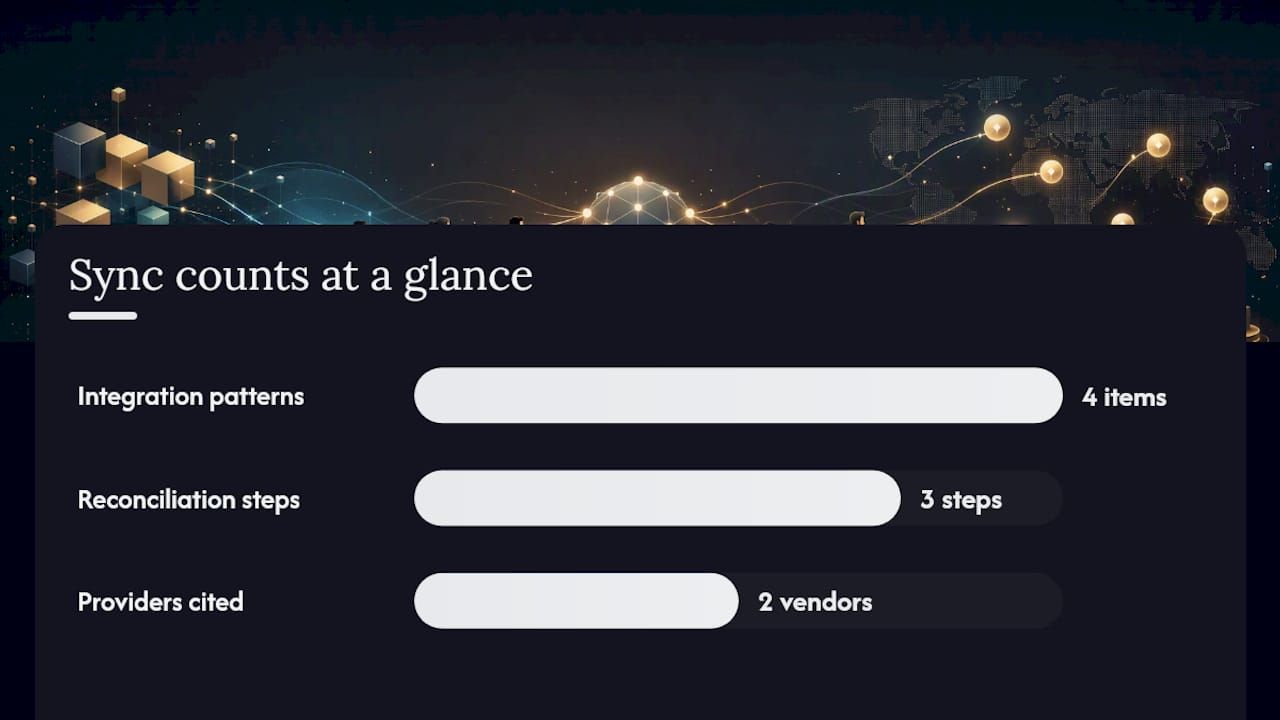
Four integration patterns cover most enterprise setups:
- A native connector between the payout platform and the ERP, when one exists for your stack.
- SFTP-based settlement file ingestion, parsed on a schedule into staging tables.
- Webhook-driven journal posting, where each settled transaction triggers a GL entry in near real time.
- A middleware transformation layer that normalizes settlement data before it reaches the ERP, useful when multiple rails produce different file formats.
For reconciliation itself, build these steps into the pipeline:
- Auto-match settlement records against the original payout batch by transaction ID.
- Route unmatched or partial-amount records to an exception worklist for manual review.
- Map fees, rebates, and returns to their own GL accounts rather than netting them against the payout total.
HighRadius reports that integrated B2B payment sync can shave up to ten days off days sales outstanding when reconciliation runs automatically instead of manually. Bitecode’s reconciliation automation examples show how the exception-worklist pattern plays out for finance teams.
What Security And Compliance Controls Should You Require?
Security and audit controls aren’t optional add-ons for a high-volume payout program; they’re the reason auditors and finance leadership will sign off on the system at all.
At minimum, validate that a provider or your internal build includes:
- SOC 2 Type II or ISO 27001 attestation.
- Encryption at rest and in transit for all payee banking data.
- Immutable audit logs covering every payout initiated, approved, and settled.
- Role-based access controls separating who can add payees from who can approve payment batches.
- Payee onboarding with KYC and bank account validation before the first payment goes out.
- Transaction-level audit trails that tie every disbursement to an approval record.
Before signing with any vendor, request their sandbox environment, API documentation, webhook specification, rail coverage map, and a sample settlement file. A provider that hesitates on any of these five is not built for enterprise scale. Bitecode’s compliance workflow guide covers the governance patterns that pair with these controls.
How Do You Choose A Payout Automation Vendor?
Score every vendor on three axes: scale and throughput, integration and ERP sync, and operational controls with support responsiveness. A platform that excels at one and fails at another will eventually become the bottleneck it was meant to fix.
- Confirm published throughput limits and whether they scale with your projected volume, not just current volume.
- Ask for the provider’s SLA on payout processing time, by rail.
- Test retry behavior: does a failed transaction retry automatically, and how many times before it flags for manual review?
- Verify webhook reliability with a documented delivery guarantee, not just “best effort.”
- Request sample error codes and confirm they’re specific enough to route programmatically, not generic failure messages.
During the RFP or demo, ask directly: What settlement file format do you provide? Which rails do you support natively versus through a partner? How are disputes and returned payments handled? Will you support a live pilot before signing?
Treat any of the following as a disqualifying red flag: no sandbox environment, no published API documentation, unclear rail coverage outside major banks, or an unwillingness to share reference architecture for a payout volume similar to yours.
How Should You Pilot And Test A Payout Automation Program?
Run a time-boxed pilot against a small but representative payee cohort and measure it against concrete KPIs before expanding, rather than judging the system on gut feel after a handful of successful runs.
- Complete sandbox integration and confirm API authentication and webhook delivery.
- Send test disbursements across every rail you plan to support in production.
- Verify settlement files ingest correctly and match the original batch without manual correction.
- Monitor exceptions for at least two full payout cycles.
- Run a parallel test with live payee data before full cutover.
Track five KPIs throughout: payout success rate, mean time to resolve exceptions, reconciliation auto-match rate, end-to-end latency from initiation to settlement, and cost per payout across rails.
Pro Tip: Require the provider to supply a sandbox webhook replay and simulated settlement files. Without them, you’re testing blind and won’t catch failure modes until they hit production.
When Do Manual Payout Processes Actually Break Down?
Manual processes tend to break once monthly payout counts move past a few hundred recipients or reconciliation starts consuming more than a few hours a week of a finance analyst’s time; past that point, the error rate from manual entry grows faster than headcount can absorb.
Common use cases that hit this threshold early include:
- Marketplaces disbursing to hundreds of sellers on a rolling schedule.
- Gig platforms paying thousands of workers weekly or daily.
- Rebate and commission programs with variable, rules-based payout amounts.
- Partner revenue-split arrangements across multiple parties per transaction.
- Insurance claims payouts where speed directly affects customer satisfaction.
Statistic Callout: In specialized high-throughput payout programs like proprietary trading firm payouts, where split structures and payout cycles vary by trader tier, manual processing becomes unworkable almost immediately given the frequency and volume of disbursements involved.
What Do Finance Teams Consistently Get Wrong About Payout Automation?
The most common pitfall is treating payout automation as a technology purchase instead of a data-quality project. Teams buy a platform, connect the API, and only then discover their payee records have duplicate entries, stale bank details, and inconsistent tax IDs. The fastest corrective action is auditing payee data before the first integration test, not after the first failed batch.

Three quick wins consistently pay off: starting with a small, well-understood payee cohort instead of a full-population cutover; automating reconciliation matching rules before automating payment initiation, since exceptions caught early cost far less to fix; and requiring settlement webhooks from day one rather than polling for status manually.
Pro Tip: Maintain a single source of truth for payee data. Every duplicate record across systems is a future duplicate payment waiting to happen.
Build A Custom Payout System That Fits Your Stack
Bitecode builds custom, audit-ready payout automation systems using modular, pre-built components, which means an enterprise-grade orchestration layer, rail adapters, and ERP sync can go from scoping to production in a fraction of the time a from-scratch build takes.
That matters most for teams that have outgrown CSV batches but don’t want to spend a year building orchestration logic, retry handling, and reconciliation rules from zero. Bitecode’s automation services cover the rules engine and webhook infrastructure described earlier in this guide, while the custom software development team handles ERP integration, security controls, and audit logging tailored to your existing GL structure. Every engagement starts with a technical discovery call to map your current payout volume, rail requirements, and compliance obligations against a pre-built modular foundation. If your team is evaluating whether to build, buy, or hybrid this, that discovery conversation costs nothing and gives you a concrete architecture proposal to compare against any vendor demo. Reach out to scope a pilot.
Frequently Asked Questions
What is the difference between payout automation and payment automation? Payout automation specifically covers outbound disbursements to vendors, partners, or payees. Payment automation is the broader category that also includes inbound collections and invoicing.
Do I need an API integration, or is CSV batch automation enough? CSV batch automation works for lower-volume, less time-sensitive runs. Once monthly payout counts move into the hundreds or you need same-day settlement, API orchestration handles error handling and retries far more reliably.
How long does a payout automation pilot typically take? Most pilots run two to four weeks with a small payee cohort, followed by a similar-length parallel run before full cutover.
What compliance certifications should a payout provider have? Look for SOC 2 Type II or ISO 27001 attestation, encryption at rest and in transit, and documented KYC processes for payee onboarding.
Can payout automation reduce fees, not just labor costs? Yes. Smarter rail selection and payment method mix can capture rebates and lower per-transaction fees, alongside the labor savings from reduced manual processing.
Sources
- Automated Payment Processing: How It Works & Top Tools
- Prop Firm Payouts: Splits, Cycles & Timing (2026) · FundedAxe