TL;DR:
- Efficient crypto settlements depend on choosing the right stablecoin and blockchain network to maximize speed and minimize costs.
- Unified infrastructure, proper custody solutions, and workflow automation are essential to reduce delays and operational risks effectively.
Crypto settlement is defined as the process of finalizing a digital asset transfer between two parties, confirming ownership and moving funds to their destination. The core challenge for finance teams is that traditional settlement infrastructure, built around SWIFT wire transfers requiring 1–3 business days, cannot match the speed that blockchain networks now deliver. Stablecoins like USDC and USDT, running on networks such as Solana or Ethereum Layer-2s, achieve near-instant finality measured in seconds rather than days. Knowing how to streamline crypto settlements means combining the right stablecoin infrastructure, blockchain selection, and workflow automation into a single, coherent operational model. This guide covers each layer of that model with specifics your team can act on.
What are the essential prerequisites for efficient crypto settlements?
The foundation of any efficient crypto payment process is choosing the right stablecoin and the right network. USDC and USDT dominate institutional use because they maintain dollar parity and are accepted across most custodians, exchanges, and payment processors. The network choice determines your cost floor and speed ceiling.
| Blockchain | Typical settlement time | Approximate transfer fee |
|---|---|---|
| Solana | Under 1 second | Under $0.01 |
| Ethereum Layer-2 (Arbitrum, Base) | 1–10 seconds | $0.01–$0.10 |
| Ethereum mainnet | 15 seconds–5 minutes | $1–$50+ |
| SWIFT (traditional) | 1–3 business days | $15–$50+ |
The table above shows why teams migrating from SWIFT to Solana or an Ethereum Layer-2 see the sharpest operational gains. Speed and cost move together when you pick the right chain.
Beyond network selection, a complete technology stack requires four components:
- Custody solution: A regulated custodian or MPC-based self-custody wallet that controls private keys and enforces access policies.
- API automation layer: Programmatic interfaces that trigger payments, query balances, and push transaction data to your ERP or treasury system.
- On-ramp and off-ramp integration: Fiat-to-crypto and crypto-to-fiat conversion services embedded in the same workflow, not bolted on separately.
- Risk orchestration: Policy-based approval controls that flag anomalous transactions before they settle.
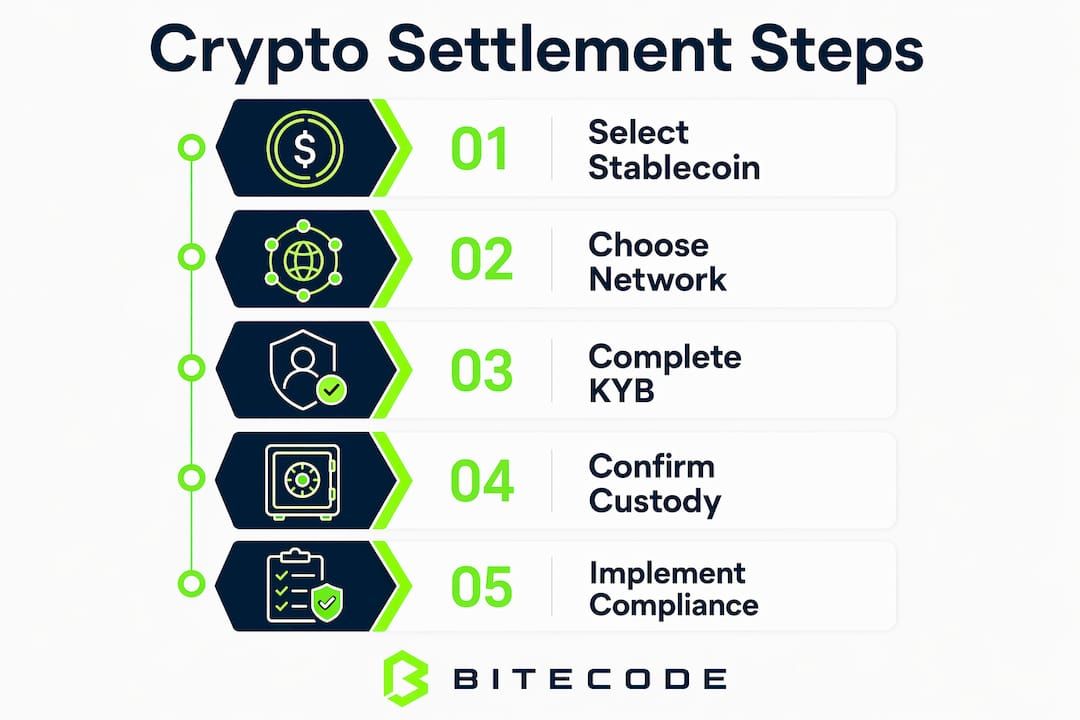
Regulatory compliance is not optional infrastructure. KYB (Know Your Business) onboarding must be completed before your first live transaction. Regulators in the U.S., EU, and Singapore have all issued guidance requiring financial institutions to verify counterparty identity before processing stablecoin payments. Skipping this step does not save time. It creates liability that surfaces during audits.
Pro Tip: Before selecting a custody provider, confirm it supports the specific stablecoin and blockchain you plan to use. Not every custodian supports Solana-based USDC, and discovering that gap after onboarding wastes weeks.
How do you reduce crypto settlement time through network and fee optimization?
Choosing a low-fee chain is the single highest-leverage decision in optimizing crypto transactions. Businesses that migrate stablecoin transfers from Ethereum mainnet to Layer-2 networks or low-fee chains report 90–99% gas fee savings. That is not a marginal improvement. It changes the unit economics of high-volume payment operations.
The tactics that deliver consistent results are:
- Select low-fee chains by default. Route routine B2B payments through Solana or an Ethereum Layer-2 unless a counterparty requires mainnet.
- Time transactions to avoid peak congestion. On Ethereum mainnet, gas prices drop significantly during off-peak hours (late night UTC). Use a gas tracker to identify low-cost windows before submitting large batches.
- Set gas limits accurately. Setting gas limits too low to save money causes failed transactions where spent fees are non-refundable. The fee is burned even when the transaction fails. Always set limits at or slightly above the network’s current recommended value.
- Use reliable RPC endpoints. Unstable RPC connections cause transaction timeouts and duplicate submission errors. Enterprise-grade RPC providers reduce this risk materially.
- Batch payments where possible. Combining multiple transfers into a single transaction reduces per-payment overhead on networks that support batching.
Pro Tip: Run a gas simulation on your target network before scheduling large payment batches. Most blockchain explorers and developer tools offer gas estimation APIs that show expected cost and confirmation time at current network conditions.
Improving crypto transaction speed is not only about the blockchain layer. Custody signing latency, API response times, and approval workflow delays all add seconds or minutes to the end-to-end settlement clock. Teams that focus only on gas fees while ignoring these upstream delays capture only part of the available gain.

What workflow best practices make the entire settlement process reliable?
Effective crypto settlement depends on decomposing risk across the full payment loop, not just the blockchain fee layer. Institutions that map all six stages of stablecoin settlement, from initiation through custody signing, network broadcast, confirmation, FX conversion, and reconciliation, identify where time and cost actually accumulate. The blockchain broadcast step is often the fastest. Custody signing and FX conversion are frequently the slowest.
The contrast between fragmented and unified workflows is stark:
| Workflow element | Fragmented approach | Unified managed approach |
|---|---|---|
| Compliance checks | Manual, per-transaction | Automated, policy-driven |
| Liquidity management | Multiple provider portals | Single orchestration layer |
| FX conversion | Separate vendor, manual trigger | Embedded, auto-triggered |
| Reconciliation | Manual spreadsheet export | Automated, audit-ready reports |
| Counterparty risk | Siloed per relationship | Centralized dashboard |
Unified managed infrastructure integrates liquidity, compliance, and orchestration into one operational layer. This approach reduces the compliance burden that comes from stitching multiple providers together, each with its own reporting format and API contract.
Custody and counterparty management deserve specific attention. Centralized MPC-based security reduces key-management losses and manual interventions. Most catastrophic settlement failures trace back to custody and key management mistakes, not blockchain outages. Rigorous pre-flight checks, including key access verification and counterparty wallet validation, prevent the majority of these events.
Two-way stablecoin payment engines add another layer of efficiency. By netting inbound and outbound flows on-chain, these engines eliminate redundant fiat conversion cycles. A business receiving USDC from customers and paying suppliers in USDC never needs to convert to fiat and back. That eliminates two conversion fees per cycle.
Pro Tip: Map your settlement loop on a whiteboard before selecting any vendor. Identify which stage takes the most calendar time and which stage costs the most in fees. Solve the dominant bottleneck first. Vendors that promise end-to-end solutions often optimize the easy stages and leave the hard ones unchanged.
How to implement and automate crypto settlement processes step by step
Implementation follows a defined sequence. Skipping steps creates gaps that surface as compliance failures or operational errors at scale.
- Complete KYB onboarding. Submit business registration documents, beneficial ownership records, and AML policy documentation to your chosen payment processor or custodian. This step gates everything else.
- Configure your custody environment. Set up MPC wallets or custodian accounts for each stablecoin and network you plan to use. Define signing policies, approval thresholds, and access controls before moving any funds.
- Integrate the stablecoin payment engine via API. Connect your ERP or treasury system to the payment engine using the provider’s REST or webhook APIs. Test with small transactions on a testnet before going live.
- Set up real-time monitoring. Configure dashboards and notifications for transaction status, failed payments, and balance thresholds. Automated alerts reduce the time between a failed transaction and its resolution from hours to minutes.
- Automate reconciliation. Connect transaction data feeds to your accounting system. Automated transaction monitoring with policy-based approval controls improves settlement reliability and reduces audit risk.
- Run a parallel period. Process a subset of real payments through the new system while maintaining the old process. Compare outputs for 2–4 weeks before full cutover.
The parallel period is the step most teams skip under schedule pressure. It is also the step that catches integration errors before they affect the full payment volume. Running both systems simultaneously for a defined period is not redundancy. It is risk management.
Pro Tip: Assign one team member as the settlement operations owner during the first 90 days post-launch. This person monitors dashboards daily, triages failed transactions, and documents edge cases. The institutional knowledge built in that period is worth more than any vendor SLA.
Adopting workflow automation for crypto operations removes the manual touchpoints that introduce errors and delay. Batch payment scheduling, automated FX triggers, and policy-based approvals each reduce the human intervention required per transaction. The goal is a process that runs predictably without daily manual oversight.
Bitecode’s perspective on what actually moves the needle in crypto settlements
The conversation around expediting crypto settlements tends to fixate on blockchain speed. Solana’s sub-second finality is real and impressive. But in practice, the teams that achieve the most consistent settlement performance are the ones that solved their custody and workflow problems first, not their blockchain selection.
Custody key management is where the most serious operational losses occur. Not from hacks. From internal process failures: lost keys, misconfigured signing policies, and approval workflows that create bottlenecks at the worst possible moment. Rigorous custody setup, with MPC architecture and clearly defined access controls, is the prerequisite that makes everything else work.
The second pattern worth noting is the cost of fragmentation. Teams that assemble settlement infrastructure from five or six separate vendors spend a disproportionate amount of time managing integrations, reconciling data formats, and debugging edge cases that only appear at the seams between systems. Unified orchestration layers relocate that complexity into a single vendor relationship. That trade is almost always worth making.
The regulatory direction is also clear. Real-time settlement and regulatory harmonization are converging. The EU’s MiCA framework, the U.S. stablecoin legislation moving through Congress, and Singapore’s MAS guidelines all point toward a world where compliant, automated stablecoin settlement is the baseline expectation, not a competitive differentiator. Teams that build compliant infrastructure now will not need to retrofit it later.
The practical recommendation is to prioritize workflow over technology hype. Pick a network that is stable and well-supported. Build custody and compliance infrastructure that can survive personnel changes. Automate reconciliation before you automate payments. Then, once the foundation is solid, layer in speed and cost optimizations.
— Bitecode
How Bitecode supports crypto settlement automation
Finance teams that have mapped their settlement loop and identified workflow gaps often reach the same conclusion: the bottleneck is not the blockchain. It is the manual coordination between compliance checks, payment triggers, and reconciliation steps.
Bitecode’s AI Assistant Module addresses that coordination layer directly. The module automates approval workflows, flags anomalous transactions before they process, and generates audit-ready reports without manual data extraction. Teams using Bitecode’s modular foundation start with up to 60% of the baseline system pre-built, which means the financial processing architecture is already in place before custom configuration begins. For organizations that need compliant, automated crypto settlement without a multi-year build cycle, Bitecode provides a direct path from current state to operational.
FAQ
What is the fastest way to reduce crypto settlement time?
Migrating stablecoin transfers to Solana or an Ethereum Layer-2 network delivers the largest single reduction in settlement time. Stablecoin finality on these networks ranges from under 1 second to a few minutes, compared to 1–3 business days for SWIFT.
What causes failed crypto transactions and wasted fees?
Setting gas limits too low is the most common cause. When a transaction fails due to insufficient gas, the spent fees are non-refundable. Always set gas limits at or above the network’s current recommended value.
Why is unified infrastructure better than using multiple providers?
Unified managed platforms integrate compliance, liquidity, and orchestration in one layer. Stitching multiple providers together creates data format mismatches, reconciliation gaps, and compounding compliance risk across each vendor boundary.
What is KYB and why does it matter for crypto settlements?
KYB (Know Your Business) is the regulatory process of verifying a business counterparty’s identity and ownership before processing payments. Regulators in the U.S., EU, and Singapore require KYB completion before stablecoin payment operations can begin.
How does MPC-based custody improve settlement security?
MPC (Multi-Party Computation) custody splits private key control across multiple parties, so no single point of failure can expose funds. Centralized MPC security reduces key-management losses and eliminates the manual interventions that cause most custody-related settlement failures.
Key takeaways
Efficient crypto settlement requires unified infrastructure, accurate gas management, and rigorous custody setup before any speed or cost optimization delivers lasting results.
| Point | Details |
|---|---|
| Network selection drives cost | Solana and Ethereum Layer-2s cut fees by 90–99% versus mainnet and eliminate multi-day SWIFT delays. |
| Custody failures cause most losses | MPC-based custody with defined signing policies prevents the key-management errors behind most settlement failures. |
| Map the full settlement loop | Identify which of the six stablecoin settlement stages dominates your time and cost before selecting vendors. |
| Unified platforms reduce friction | Integrated compliance, liquidity, and orchestration remove the reconciliation gaps that fragmented providers create. |
| Automate reconciliation first | Connecting transaction feeds to your accounting system before scaling payment volume prevents audit risk from compounding. |