ETL and ELT move the same data through the same three steps. The difference is where the transformation happens. ETL (extract, transform, load) cleans and reshapes data on a separate processing layer before it reaches the destination. ELT (extract, load, transform) lands raw data in the warehouse or lake first and transforms it there. For most teams on a modern cloud warehouse, ELT is the default. ETL remains the right call when data must be masked, filtered or validated before it is allowed to land. Most production stacks end up using both.
That is the short version. The rest of this article covers what each pattern does, how the architectures differ, the trade-offs that matter to a business owner or an IT lead, and how to decide without turning the choice into an ideology.
TL;DR
- The core difference: ETL transforms before loading, on a separate engine. ELT loads first and transforms inside the target warehouse, lake or lakehouse.
- Default for cloud: ELT fits cloud warehouses with elastic compute, frequently changing business logic and a SQL-literate team.
- Where ETL still wins: regulated data (payment, health, personal) that must be masked or filtered before storage, and sources where extraction is expensive or rate-limited.
- Reality: most mature stacks are hybrid, with ELT for most flows and selective ETL for sensitive sources.
- The decision is architectural: it should follow from your target platform, compliance exposure and how often your transformation rules change.
What ETL and ELT actually mean
Both acronyms describe a data integration process: pulling data out of operational systems, such as databases, CRMs, ERPs, SaaS tools, APIs and logs, and making it usable for reporting, analytics or machine learning.
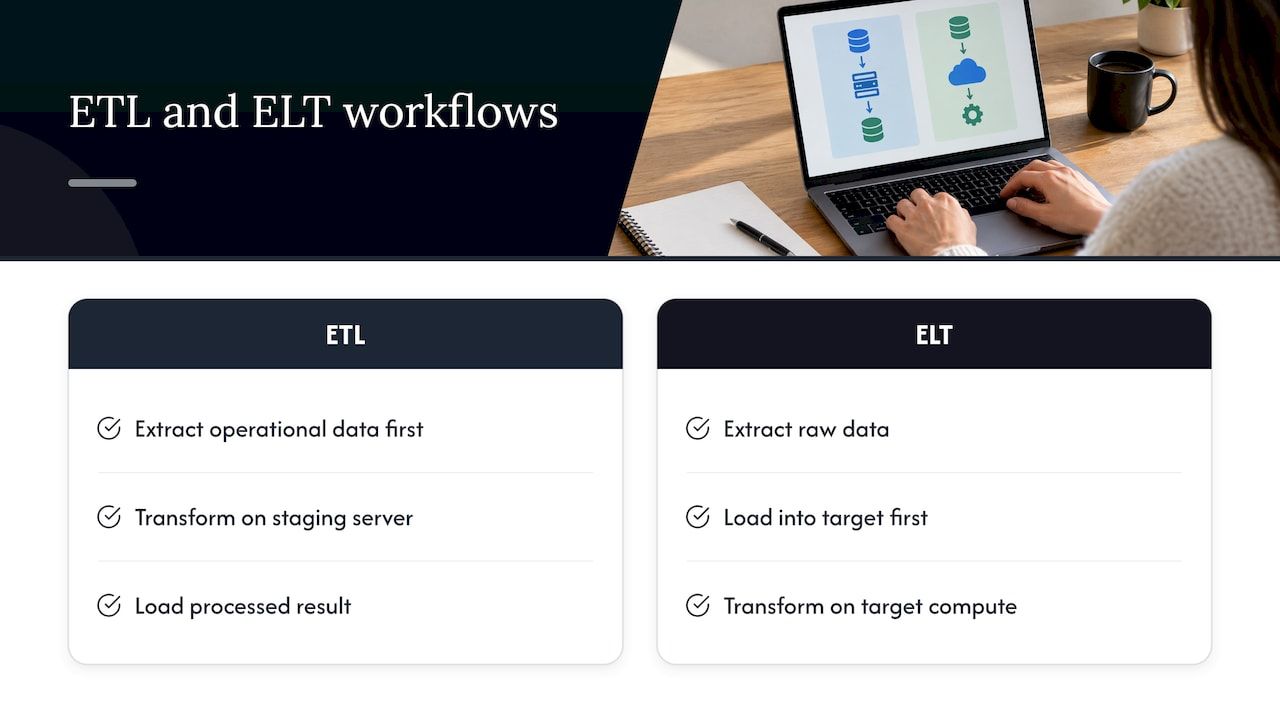
ETL extracts data from sources, transforms it on a secondary processing server or specialized engine using business rules, and then loads the processed result into the target database. AWS describes it as transformation happening before the data reaches the destination, and Microsoft’s Azure Architecture Center adds that staging tables may hold data while it is being processed.
ELT extracts raw data and loads it directly into a data lake or cloud data warehouse, often in its original format or with minimal processing. The transformation then runs on the target system’s own compute. Google Cloud’s overview of ELT lists analytics, reporting and machine learning as the typical uses of that landed data.
The word “transform” covers a lot of work. IBM’s guide lists cleaning, filtering, aggregation, deduplication, validation, calculations, standardization and the protection of sensitive information. Which of those happen before the data lands, and which after, is the whole ETL-versus-ELT question.
The difference that matters: order and location
The defining difference is the order of operations and the place where compute is spent. IBM states it plainly: ETL transforms data in a staging area before the target, while ELT transforms it inside the target after loading. dbt Labs makes the same point and notes that in cloud environments ELT can speed up processing of large datasets, because the warehouse does the heavy lifting.
Everything else people list as a difference follows from that one choice.
| Dimension | ETL | ELT |
|---|---|---|
| Where transformation runs | Separate engine or staging area | Inside the warehouse, lake or lakehouse |
| What lands in the target | Cleaned, modeled data | Raw data, then modeled tables or views |
| Raw data retention | Often lost after transformation | Kept for reprocessing |
| Scaling | Bound by the transformation server | Scales with the target platform |
| Changing business logic | Rework the pipeline | Rewrite a query or model |
| Sensitive data handling | Can be masked before it lands | Needs controls inside the target |
| Typical targets | On-premises warehouses, relational databases | Cloud warehouses, lakes, lakehouses |
| Typical skills | Pipeline-engineering tools | SQL, often with tools such as dbt |
The last two rows are tendencies, not rules. IBM notes that modern cloud repositories can also support ETL, and ELT commonly relies on SQL-based tools such as dbt for target-side transformation.
How each architecture handles the data flow
ETL: a transformation layer between source and destination
In an ETL pipeline, the extract step deals with authentication, pagination, incremental versus full refresh logic and rate limits. Stripe’s pipeline guide then describes the transform step as cleaning (handling nulls, casting types), reshaping (joins, aggregations, column renaming), filtering and enriching. The load step writes the result as a full overwrite, an upsert or an append.
The architectural consequence is an additional component: a transformation engine with its own capacity, its own failure modes and its own deployment. That is a cost, but it is also a control point. Everything that reaches the warehouse has passed through a gate you own.
ELT: the warehouse is the transformation engine
In ELT, the pipeline’s job shrinks to reliable extraction and loading. The Azure Architecture Center explains that ELT relies on scalable storage and target-side processing engines such as Spark, Hive or PolyBase, and that transformed tables or views may be materialized for downstream use. Astronomer’s guide to Airflow 3 pipelines describes ELT as loading raw data first and creating transformed data assets in the destination, and names two common reasons to choose it: keeping full raw datasets and using the target’s parallel compute.
Microsoft also points out that ELT can simplify the architecture by removing a separate transformation engine, and that scaling the target store can scale pipeline performance too, but only if the target has enough transformation capacity. ELT does not remove the transformation work. It moves it onto a platform that you now have to size, govern and pay for.
Is a data lake ETL or ELT?
The destination shapes the answer. Cloud warehouses, lakes and lakehouses are the common ELT targets, because they pair cheap storage with processing power. Databricks’ technical guide notes that ELT suits cloud warehouses and lakes with processing power, while ETL is best suited to structured and some semi-structured data. A lake is therefore usually fed by ELT, but a lake can also receive pre-processed ETL output when a source needs cleaning first.
Trade-offs that decide the choice
Speed to data and flexibility
ELT emerged with elastic cloud platforms. Airbyte’s comparison says ELT lets teams land data within minutes and refine it as questions evolve, whereas ETL ties you to provisioned hardware. When business definitions change often, say a new revenue recognition rule or a redefined customer segment, ELT lets you rerun a transformation over data you already hold. In ETL, you may have to rebuild the pipeline and re-extract.
Reuse of raw data
Snowflake’s whitepaper on moving from on-premises ETL to cloud ELT observes that ETL’s upfront structuring supports fast SQL-based BI but limits reuse, because raw-data artifacts are lost in transformation. Data scientists and machine learning workloads often prefer raw or lightly processed data that can be converted into several formats for different models. If you expect AI and analytics use cases you cannot yet name, retaining raw data is cheap insurance.
Security, privacy and compliance
This is where ETL earns its place. Airbyte notes that keeping transformation outside the warehouse minimizes sensitive data exposure. A practical guide from Dawiso says to choose ETL when data must be masked, anonymized or filtered before it can legally land in storage, citing GDPR personal data, PCI-DSS payment data and HIPAA records. If a raw card number or patient identifier must never reach an analytics store, a transformation step before the load is the simplest way to guarantee it.
Audit history versus storage footprint
An academic paper by Rucco, Saad and Longo formalizes hybrid patterns. In their ETLT pattern, bad records are rejected or quarantined at ingestion and less raw storage is needed. In their ELTL pattern, everything is stored for audit history and time travel, which means a larger raw footprint but a cheaper shared raw layer for compliance, forensic and exploratory work. The choice is between a smaller store with early rejection and a complete record with a bigger bill.
Cost and where it hides
ELT does not make cost disappear. Compute that used to sit on a dedicated server now runs on your warehouse, and poorly designed models can rerun expensive transformations repeatedly. Platform choice, scheduling and workload isolation all affect the bill, and a review of cloud cost optimization is a sensible companion to any move toward warehouse-side transformation.
When to use ETL, ELT or both
Google Cloud frames the decision around four factors in its ETL overview: data volume (ELT suits large volumes processed by a cloud warehouse), data complexity (ETL for complex transformations that need specialized tools), target system (ELT for cloud warehouses and lakes with processing power) and team skills (ETL requires specialized pipeline-building expertise).
Turned into a working rule:
Lean toward ELT when:
- your target is a modern cloud warehouse, lake or lakehouse;
- transformation logic changes frequently;
- your team is comfortable in SQL;
- you want to keep raw data for reprocessing, analytics and machine learning.
Dawiso says these conditions cover the vast majority of enterprise use cases.
Lean toward ETL when:
- regulated data has to be masked, anonymized or filtered before storage;
- extraction from the source is expensive or rate-limited, so you want to pull once and shape the result;
- the destination is an on-premises warehouse or relational database with limited transformation capacity;
- the transformation is complex enough to need a specialized engine.
Go hybrid when both lists describe parts of your business. Dawiso notes that in practice most modern stacks use ELT for most flows with selective ETL for compliance-sensitive sources. A fintech company is a clear example: product usage events can land raw and be modeled in the warehouse, while payment identifiers are tokenized before they leave the transaction system.
A worked example
Take a mid-sized SaaS company with three sources: a billing system, a CRM and application event logs. The events and CRM records have no regulated content and the product team keeps changing its definitions of an active account, so those two flows load raw into the warehouse and are modeled there. The billing feed carries card-related and personal fields, so it passes through a transformation step that masks them before loading. One reporting layer sits on top of all three. Nothing about this design is exotic. It is simply each source treated according to its risk and its rate of change.
Pipeline reliability matters more than the acronym
Teams often spend weeks debating ETL versus ELT and days on the things that cause incidents: duplicate loads, silent schema changes, partial failures and unverified numbers.
Three habits carry across both patterns:
- Partition work sensibly. The Azure Architecture Center recommends designing parallelization around partition boundaries such as date, tenant or shard key to reduce write contention and support idempotent retries. Idempotent means a retried step produces the same result instead of duplicating data. For payment-adjacent systems, see how we think about idempotency keys and duplicate charges.
- Protect the source and the target. Pipelines that read from operational PostgreSQL databases depend on dependable recovery too, and a guide to PostgreSQL incremental backup shows how that layer is handled.
- Monitor data quality, not only job status. A pipeline that finishes successfully and loads wrong numbers is worse than one that fails loudly. Our guide to data quality monitoring checks, metrics and automation covers what to measure.
Finance teams have a stricter bar still. Reports that feed audits need lineage and repeatability, which we cover in four guarantees for audit-ready finance data pipelines.
Where reverse ETL and automation fit
ETL and ELT move data toward the warehouse. Operational teams increasingly need the opposite: modeled data pushed back into the CRM, billing tool or support system. That flow is covered in reverse ETL and when to build it. Once warehouse-side modeling is in place, the next maturity step is usually automating the build, testing and deployment of those models, which we discuss in data warehouse automation for IT teams.
Pipelines are also one part of a wider integration picture. If your sources are a tangle of internal systems, enterprise system integration strategies, ROI and pitfalls is the broader frame, and event-driven designs are a different answer to some of the same problems, as laid out in event-driven architecture patterns and trade-offs.
Choosing in practice: five questions
- Where will the data live? Cloud warehouse or lakehouse points to ELT. An on-premises relational target points to ETL.
- What is the most sensitive field you will move? If it must not land unprotected, put a transformation step ahead of the load for that source.
- How often do the business rules change? Frequent change favors keeping raw data and transforming in the target.
- Who will maintain the pipelines? A SQL-literate analytics team suits ELT. Specialized engineering skills suit ETL.
- What will you need in two years? Machine learning, audit history and new reports all benefit from retained raw data.
Answer those honestly per source, not per company, and the architecture usually draws itself.
Will AI replace ETL?
AI is changing how pipelines are built, for example by generating transformation code and flagging anomalies, but it does not remove the underlying decisions: what to extract, where to transform, which data may be stored and who is accountable for the numbers. Those remain design choices with compliance and cost consequences. The more useful question is how to embed automation into the workflow around the pipeline, where a well-structured system can take over repetitive checks and routing.
Perspective
Our view is that ETL versus ELT is rarely the hard part of a data project. The hard part is that the pipeline sits inside a business system with real rules: currencies, approvals, audit trails, access control. When the pattern is chosen in isolation, complexity relocates into the vendor relationship or into a pile of scripts nobody owns.
We build custom business software from modular, ready-made components, so projects can start with up to 60% of the baseline system already in place. That changes the data question. Instead of designing ingestion, financial logic, workflow automation and reporting from nothing, a team starts from a modular foundation and spends its effort on the domain-specific transformations that make the system theirs.
For financial and audit-sensitive work, our modules are multi-currency and audit-ready, and they can be self-hosted. In practice that means regulated fields can be handled inside infrastructure the client controls, which is the same principle that makes selective ETL attractive, while the rest of the data follows the more flexible warehouse-side pattern.
Our advice is to treat the pipeline as part of the system design, not as a separate tooling purchase. Decide per source, document the reason, and keep raw data wherever the rules allow it.
Bitecode
Building the pipeline into a system that fits your business
If your data movement has to serve a specific workflow, such as financial processing, a CRM, automated approvals or a blockchain settlement flow, the pipeline pattern should be designed together with the application around it. Bitecode’s custom business software starts from pre-built modular components, including a financial module, AI assistant, automation module, CRM module and token module, so your team can spend its time on the rules that are unique to your organization. For the workflow side, see our AI business process automation service, and for a scoped conversation about your own data architecture, start from the Bitecode home page.
For a wider look at planning systems like this, the enterprise system design workflow for IT leaders is a good next read.
FAQ
Is ELT better than ETL?
Neither is better in general. ELT suits cloud warehouses, large volumes, SQL-literate teams and logic that changes often. ETL suits data that must be masked or filtered before landing, and complex transformations that need a specialized engine. Many teams use both.
Is SQL an ETL tool?
SQL is a query language, not a pipeline tool. It is the main language for transformation in ELT, usually run through tools such as dbt inside the warehouse. An ETL or ELT pipeline still needs something to extract, load, schedule and monitor the work.
Is a data lake ETL or ELT?
A data lake is usually fed by ELT, because lakes offer cheap storage and processing power for transformation after loading. Pre-processed ETL output can also land in a lake when a source needs cleaning or masking first.
Can I use ETL and ELT together?
Yes, and most modern stacks do. A common pattern is ELT for most sources and ETL for compliance-sensitive ones, such as payment or health data that must be masked before it reaches storage.
Sources
- ETL vs ELT: Difference Between Data-Processing Approaches (AWS)
- Extract, transform, load (ETL), Azure Architecture Center (Microsoft Learn)
- ELT vs. ETL: Similarities and Differences (IBM)
- What is ELT? (Google Cloud)
- What is ETL? (Google Cloud)
- ETL vs. ELT Pipelines: What to Know About Each Model (Stripe)
- ETL vs ELT: Key differences explained (dbt Labs)
- ETL and ELT Pipelines with Apache Airflow 3 (Astronomer)
- Understanding ETL (Databricks)
- ELT vs ETL for Cloud Data Warehouses (Airbyte)
- Moving from On-Premises ETL to Cloud-Driven ELT (Snowflake)
- ETL vs ELT: What’s the Difference and Which Should You Use? (Dawiso)
- Formalizing ETLT and ELTL Design Patterns (arXiv)