Reverse ETL is the process of moving cleaned, modeled data out of your data warehouse or lakehouse and into the operational systems where people act on it: the CRM, the billing platform, the support desk, the ad network. For companies with complex workflows, financial transactions or audit duties, the sync itself is the easy part. The hard part is the foundation under it: matching keys, rate limits, failure handling and an audit trail. That is why many teams treat reverse ETL as part of a custom, modular system rather than a loose set of scripts.
TL;DR
- Reverse ETL reads from a model or table in the warehouse and writes to records in business applications. ETL and ELT do the opposite: they load data into the warehouse.
- Its value comes from sending already-transformed data, so sales, finance and support see the same definitions of a customer, a lead or an account.
- The engineering risk sits at the destination: API rate limits, matching keys, duplicate records, schema changes and silent sync failures.
- For regulated or finance-heavy workloads, plan monitoring, logging and an audit trail from day one, not as a follow-up ticket.
- A modular foundation shortens the build because the workflow, finance and integration layers do not start from zero.
What reverse ETL means
A warehouse is built to answer questions. Analysts query it, dashboards read from it, and the answers stay there. Meanwhile the people who could use those answers, such as an account manager deciding whom to call or a collections team deciding whom to chase, work inside operational tools that never see the modeled data.
Reverse ETL closes that gap. dbt Labs describes it as getting transformed warehouse data into end business platforms such as sales CRMs and ad platforms, where it can drive actions like building custom ad audiences or supplementing CRM records. The same idea goes by other names: operational analytics and data activation.
The word “transformed” matters. dbt Labs argues that the power of the approach comes from sending modeled data rather than raw data, because raw data usually lacks the structure, aggregation and naming that business users need. A churn-risk score, a lifetime-value tier or a “qualified lead” flag is useful in a CRM. A raw event table is not.
The problem it solves
Without a reverse flow, teams fall back on manual exports, CSV uploads and static segments. Each department then keeps its own version of the customer. Finance sees one balance, sales sees another, support sees a third. Reverse ETL replaces those copies with one governed source: the warehouse model defines the metric once, and every downstream tool receives it.
How reverse ETL works, step by step
Every reverse ETL setup has the same four building blocks: a source, a model, a destination and a mapping. The pipeline around them runs in a repeating cycle.
- Define the model. A SQL query, a dbt model or a view in the warehouse produces the exact rows and columns you want to send. This is where business logic lives, for example what counts as an active account.
- Connect source and destination. The source is a warehouse or lakehouse. The destination is an application reached through its API or a direct database connection.
- Map fields and choose a matching key. Each warehouse column is linked to a field in the destination. Domo’s process guide points out that the matching key decides whether a sync updates the right record or creates a duplicate. Choose it carefully: an email address that changes, or an ID that exists in only one system, is a common source of duplicates.
- Schedule the sync. Execution frequencies in practice range from every 15 minutes to hourly or daily, and should follow the decision cycle of the team that uses the data. A daily sales-territory refresh does not need a streaming pipeline.
- Load, retry and log. The pipeline batches records, calls the destination API to insert or update them, retries failures and records what happened.
- Monitor. Row counts, failure rates and freshness are checked on every run.
If your destination is Microsoft’s stack, Microsoft Learn documents a reference pattern in Fabric: a warehouse or lakehouse as the source, transformation through pipelines or T-SQL, and a SQL database target with separate landing, history, quarantine and serving schemas. The quarantine and history schemas are worth copying in spirit on any platform. They give you a place for rejected records and a record of what changed.
Reverse ETL vs. ETL vs. ELT
The three patterns differ in direction, in where transformation happens and in who uses the result.
| ETL | ELT | Reverse ETL | |
|---|---|---|---|
| Direction | Operational sources to warehouse | Operational sources to warehouse | Warehouse to operational applications |
| Where transformation happens | In the pipeline, before loading | In the warehouse, after loading | Upstream in the warehouse, before the sync |
| Typical timing | Scheduled batches | Scheduled or continuous loads | Scheduled, or triggered by a change |
| Main users | Analysts and BI | Analysts and data engineers | Sales, marketing, support and finance teams in their own tools |
| Hardest part | Source extraction and cleaning | Modeling at scale | Destination APIs, rate limits and matching keys |
The patterns do not compete. In a mature stack you run all of them: ELT brings data in, models in SQL or dbt shape it, and reverse ETL sends the result back out. A company that only does the first two has a good warehouse and a disconnected business.
Why the destination is harder than the source
Loading into a warehouse is forgiving: files in cloud storage can carry millions of rows in one go. Loading into a CRM is not. Each destination API accepts a bounded number of records per call, enforces rate limits and validates field types. A reverse pipeline therefore needs batching, change detection (sending only the rows that changed since the last run), and a clear policy for failed records. Warehouses typically do not track row-level changes in a way that suits this pattern, so many pipelines compare snapshots between runs.
Rate limiting is an engineering topic in its own right. Our article on API rate limits and Redis plus Lua in production covers the decisions involved when your own system sits on either side of a throttled API.
Business use cases worth building for
Microsoft lists the typical payloads as curated, high-value data slices: customer engagement metrics, sales and marketing scores such as propensity to buy, operational data such as stock levels and order status, and AI-derived outputs such as recommendations and churn-risk scores. Databricks adds fraud detection and real-time decisioning to the list, using gold tables, engineered features and model outputs from the lakehouse as the source.
For the readers of this page, four patterns come up most often:
- Revenue operations. Product usage, billing status and risk scores are written to CRM accounts so reps work from the same numbers finance reports. If your CRM choice is still open, this comparison of HubSpot and Salesforce for growing businesses shows how the two platforms handle the customer data you would be sending.
- Finance and settlement. Reconciled balances, invoice status or exposure limits flow from a governed ledger model into billing, ERP or customer-facing portals. Here accuracy and traceability matter more than speed.
- Customer operations. Churn flags and account health reach the support desk, so an agent sees the context before answering. For sales teams that also record calls, automatic logging of sales calls into HubSpot and Salesforce shows how conversation data can land in the same CRM records that the warehouse model enriches.
- AI and automation triggers. A model output, such as a next-best-action score, starts a workflow: create a task, send a message, open a review. This is where reverse ETL meets workflow automation.
What to evaluate before you implement
Whether you buy a sync product, assemble open components or build the flow into a larger system, the same criteria apply.
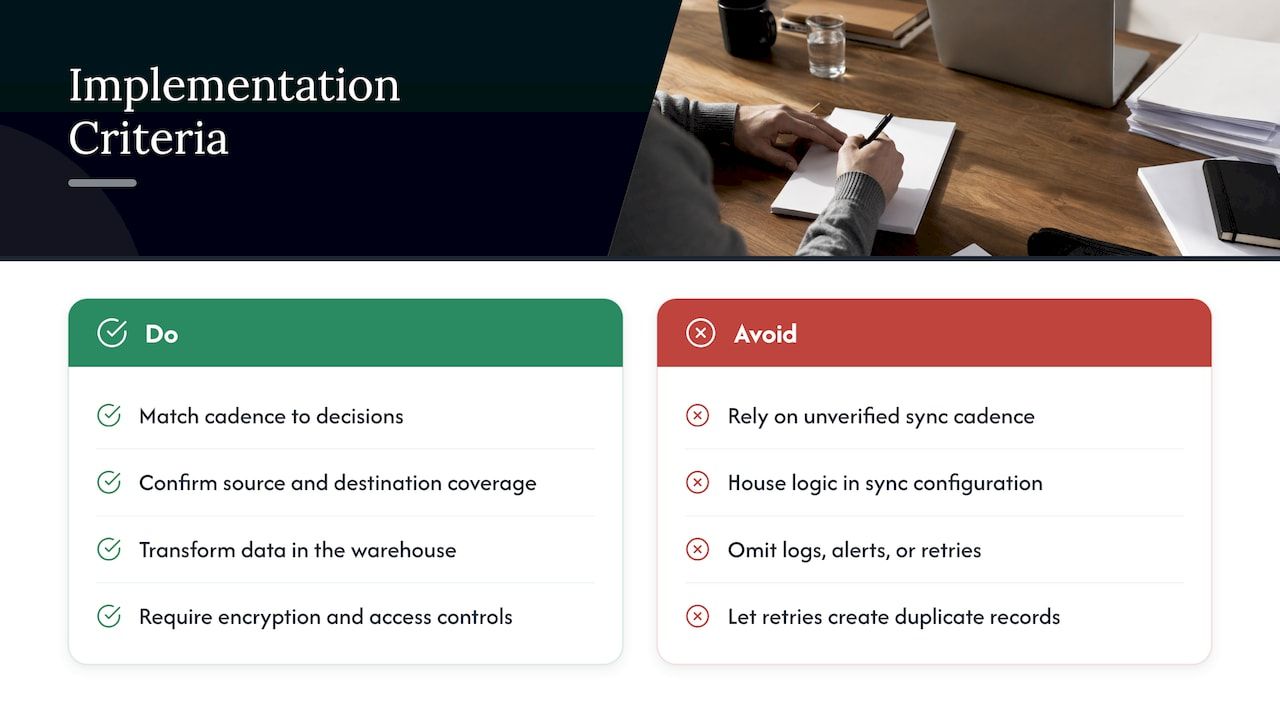
Data freshness and cadence. Match the schedule to the decision. Warehouses are optimized for processing power, not speed, and some sync tools update in batches, so confirm the cadence your teams actually need before you design around it. Many valuable use cases work well on updates every 10 to 20 minutes, hourly or daily.
Source and destination coverage. Confirm support for your warehouse (Snowflake, BigQuery, Redshift, Databricks or a lakehouse format) and every destination you plan to add in the next year, including custom internal systems that have no standard connector.
Business logic location. Finish heavy transformation in the warehouse, not inside the sync configuration. Domo’s guide warns that logic housed in a sync configuration is logic no one can audit. For an audit-ready environment this is the single most important design rule.
Security and compliance. Data leaving the warehouse can contain personal or financial information. Require encryption in transit and at rest, role-based access, audit logging and masking of personal data, and map each flow to the regulations that apply to you, such as CCPA, HIPAA, PCI DSS or SOC 2 controls.
Monitoring and recovery. Track sync success rate, failed versus synced records, latency against an agreed target and freshness. A practical habit is to sample destination records against the warehouse after a run. Treat logging, alerts, retries and version control as part of the first release.
Idempotency. A retried batch must never create a second invoice, a second charge or a second contact. Our guide to background job processing and duplicate charges explains the patterns that make retries safe.
When reverse ETL fits, and when another pattern does
Reverse ETL is the right pattern when the warehouse already holds trusted, modeled data and operational teams need it inside their tools. It is not a replacement for ingestion pipelines. If the goal is historical reporting, ETL or ELT is the answer. If you need log-based change capture from an operational database into the warehouse, that is a different flow again. If two SaaS apps just need to talk to each other, a direct integration or workflow layer may be all you need.
Many enterprises end up with a mix: some syncs from the warehouse, some event-driven calls between systems, some approvals handled in a workflow engine. The more of these there are, the more it pays to have one governed application layer that owns the rules. Our overview of data warehouse automation for IT teams shows how the upstream side of that stack can be automated, and CRM workflow automation for sales operations shows the downstream side.
Why reverse ETL in finance and regulated settings needs a stronger foundation
In a marketing context, a failed sync means a stale audience. In a financial context it can mean a wrong balance in a customer portal or a payment instruction sent twice. The requirements change accordingly:
- every record sent out can be traced to the model version and run that produced it;
- failed rows are quarantined and reprocessed, never dropped;
- multi-currency values keep their precision and rounding rules end to end;
- access is role-based, and each change leaves an audit entry.
These are the same properties we describe in our piece on four guarantees for audit-ready finance data pipelines. Reverse flows deserve the same standard as inbound ones, and they depend on a clean customer and account definition. Our article on enterprise master data management explains how a golden record is built through modular delivery, which is exactly what a reliable matching key needs.
Our perspective
Most reverse ETL projects do not fail at the query. They fail at everything around it: the matching key nobody agreed on, the retry that doubled a record, the transformation hidden in a sync setting that no auditor can read.
Our view is that reverse ETL should be designed as part of the business system, not bolted on after it. The model belongs in the warehouse, the rules belong in a governed application layer, and the destination write must be idempotent, logged and reversible.
That is why we build from a modular foundation. Bitecode starts custom projects with up to 60% of the baseline system pre-built, including automation, financial, CRM and blockchain modules, so the team spends its time on your business-domain complexity instead of rebuilding queues, audit trails and role models. Systems can be self-hosted, which matters when warehouse data includes regulated financial information.
Our aim is to accelerate delivery without accelerating chaos: fewer moving parts, one owner for the rules, and a system your team controls and can maintain.
Bitecode
Building it with Bitecode
If your reverse ETL requirement sits inside a larger system, such as a CRM that must reflect warehouse scores, a finance application with multi-currency balances, or an automation workflow triggered by model output, we can scope it as one project. Our custom business software service covers internal systems and SaaS products, and our AI business process automation work covers the workflows that act on activated data. The CRM module and financial module are ready-made components that shorten the start.
To discuss a scoped engagement, from a small MVP to a larger program, start at bitecode.tech.
FAQ
Is reverse ETL the same as data activation?
They describe the same idea from two angles. Reverse ETL names the mechanism: extract from the warehouse, map, load into an application. Data activation and operational analytics name the outcome: modeled data that drives actions in business tools.
Does reverse ETL replace ETL or ELT?
No. It sits next to them. ETL or ELT fills the warehouse, models make the data trustworthy, and reverse ETL sends the result to the tools where teams work. Skipping the first two leaves nothing reliable to send.
How often should a reverse ETL sync run?
As often as the decision it supports. Common cadences run from every 15 minutes to hourly or daily. Pick the slowest schedule that still serves the team, then add monitoring so you know when a run is late or incomplete.
What are the most common reverse ETL failure points?
Duplicate records caused by a weak matching key, destination API rate limits, schema changes in the source or target, and failed rows that nobody reviews. Each is handled by design: stable keys, batching and backoff, schema checks, and a quarantine with alerts.
Sources
- Reverse ETL: How to and why, dbt Labs
- Use SQL database as the target of a reverse ETL workload, Microsoft Learn
- Reverse ETL with Lakebase, Databricks
- How to Use Reverse ETL: A Process Guide with Examples, Domo
- HubSpot vs Salesforce: Best CRM for Growing Businesses
- Auto-Log Sales Calls to HubSpot and Salesforce