Background job processing means running work outside the request/response cycle so an application stays responsive while slower tasks finish elsewhere. The bottom-line benefit is simple: interactive paths stay fast because expensive operations get offloaded to a queue, picked up by a worker, and tracked by a scheduler. Together, those three pieces form the backbone of nearly every asynchronous system we design.
TL;DR:
- Use queues for event driven tasks that finish in seconds or minutes; reserve scheduled batch pipelines for large, fixed datasets and bulk recovery.
- Assume at least once delivery: make handlers idempotent with keys, deduplication, or conditional writes, because duplicate messages can otherwise trigger charges or records.
- Choose Kubernetes CronJobs for scheduled container tasks only when approximate timing works, and set concurrency policy explicitly to prevent overlapping runs.
- Enqueue only after database commits, then use bounded retries with exponential backoff and jitter; set visibility timeouts above handlers’ worst case runtime.
- Default to managed queues with idempotent activities and orchestration for multistep flows; use self hosted workers when cost control or unusual runtimes demand them.
Background jobs versus batch processing: what’s the difference?
Background jobs are event-driven or queued tasks that run asynchronously, typically triggered by a single user action or system event. A customer signs up, a background job sends the welcome email. A user uploads a photo, a background job resizes it. These tasks are small, frequent, and expected to complete within seconds or minutes.
Batch processing works differently: it runs scheduled, bulk operations, often against large datasets, and often during off-peak hours. A nightly billing run that reconciles thousands of accounts is batch work, not a background job, because it processes a fixed dataset on a fixed schedule rather than reacting to individual events.
The distinction matters because the two patterns call for different tooling:
- Background jobs favor lightweight queues with fast turnaround and per-item retry logic.
- Batch processing favors orchestrated pipelines with checkpointing and bulk-failure recovery.
Picking the wrong pattern for the workload is one of the more common early architecture mistakes we see.
Queues, messages, workers, and delivery guarantees
Every background processing system, regardless of the vendor behind it, relies on the same handful of primitives. A producer enqueues a message describing the work. A consumer, or worker, claims that message, executes the handler, and acknowledges success or failure. That enqueue, claim, acknowledge cycle is the message lifecycle, and almost every operational problem traces back to one step in it breaking down.
Delivery semantics deserve particular attention. Most queue systems guarantee at-least-once delivery rather than exactly-once, which means a message can be delivered more than once and job handlers must tolerate duplicates. Queue-based load leveling guidance notes that at-least-once delivery is common precisely because it is cheaper to guarantee than exactly-once, and that handlers need to be idempotent to safely absorb repeat deliveries without side effects like duplicate charges.
A few supporting mechanisms keep this reliable in practice:
- Visibility timeouts hide a claimed message from other workers until it is acknowledged or the timeout expires, preventing duplicate processing of the same item.
- Acknowledgement patterns confirm successful completion; a missing ack returns the message to the queue for retry.
- Dead-letter queues capture messages that fail repeatedly, isolating poison messages so they don’t block the rest of the queue.
Idempotency is not optional for production job handlers. A duplicate delivery that triggers a duplicate charge or a duplicated record is an idempotency failure, not a queue failure, and the fix belongs in the handler.
Typical architectures and where common tools fit
Most teams choose between three broad shapes: container-native schedulers, durable orchestration services, and managed cloud messaging. Each fits a different kind of workload.
- Kubernetes Job and CronJob objects handle containerized, scheduled tasks well, but scheduling is approximate rather than exact, and a CronJob can create overlapping Job runs unless
spec.concurrencyPolicyis set explicitly, according to Kubernetes documentation. - Durable Functions and task hubs suit long-running orchestrations that need reliable state across steps. The underlying Azure Storage provider uses separate work-item and control queues, and control queues can dequeue up to 32 messages per poll, a detail that affects throughput tuning on busy orchestrations.
- AWS messaging services split cleanly by purpose: AWS decision guidance describes SQS as a pull-based durable queue for decoupling and buffering, SNS as push-based pub/sub for fanout notifications, and EventBridge as an event bus for routing complex, rule-based events.
- Framework-level adapters like Rails Active Job abstract the queue backend behind a common API, but still require a durable backend in production, as the Active Job guide makes clear.
Choosing among these is less about preference and more about matching the workload’s durability and orchestration needs to what each tool actually guarantees.
How to enqueue and run a background task
Adding background processing to an application follows a fairly consistent sequence, regardless of the stack underneath it.
- Decide what to enqueue. Define a message schema with a clear payload and metadata, including a job type, timestamps, and any correlation ID needed for tracing.
- Enqueue after the database commit, not before. A transactional enqueue pattern avoids the scenario where a worker picks up a job referencing a record that hasn’t actually been saved yet.
- Build the worker loop: claim a message, run the handler, then acknowledge success or route the message to a dead-letter queue on repeated failure.
- Implement idempotency using idempotency keys, a dedupe store, or conditional writes, so a redelivered message never produces a duplicate side effect. Our guide to idempotency keys walks through dedupe strategies and retention windows in more detail.
- Add retries with exponential backoff and jitter, bounded by a maximum attempt count, rather than retrying immediately and repeatedly.
- Tune visibility timeouts for long-running tasks and batch enqueue operations where the workload allows it, to reduce per-message overhead.
Pro Tip: Set the visibility timeout comfortably above your handler’s expected worst-case runtime; a timeout that’s too short causes a second worker to claim and reprocess a job that’s still legitimately running.
Skipping idempotency is the single most common cause of production incidents in background systems we’ve reviewed, usually surfacing first as duplicate emails or double-charged customers.
Operational best practices for production systems
Running background jobs reliably at scale depends on visibility as much as code quality. Instrumentation should track queue depth, average processing time, error and retry rates, and dead-letter queue counts, since a growing backlog or a rising DLQ count is often the earliest sign of trouble.
Alerts and service-level objectives around backlog size and failure rate give teams a way to react before a queue overflow becomes a customer-facing outage. Scaling workers based on queue backlog, rather than on a fixed schedule, keeps capacity aligned with actual demand, but needs careful limits to avoid retries cascading into a feedback loop that makes the backlog worse.
A few additional controls matter at scale:
- Set CPU and memory limits per worker to contain a misbehaving job rather than letting it starve the rest of the fleet.
- Isolate worker processes from the resources they don’t need, reducing the blast radius of a compromised dependency.
- Tune polling intervals deliberately. According to Azure’s storage queue performance guidance, aggressive polling raises transaction counts and cost, while prefetching improves throughput at the expense of memory and replay overhead.
Retry strategy belongs on this list too: progressively increasing delays with jitter, rather than fixed-interval retries, prevents a struggling downstream service from being hit with a synchronized retry storm.
Bitecode’s approach: modular components for job-processing projects
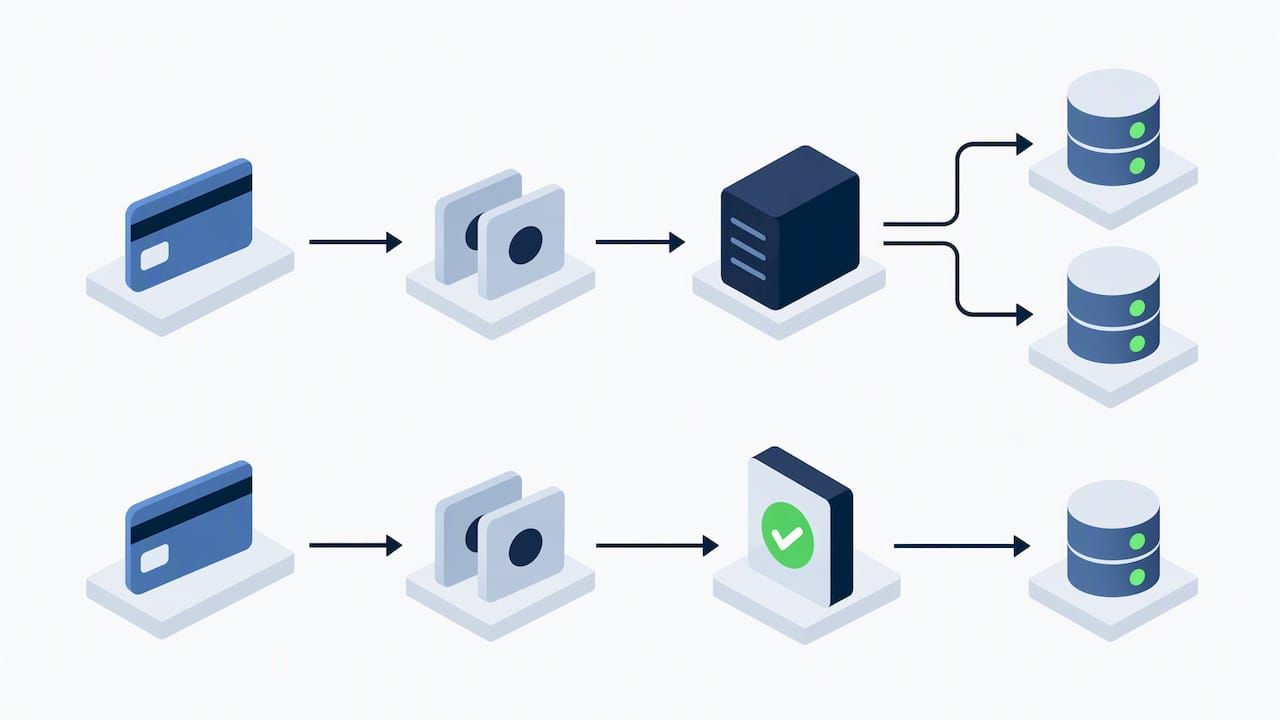
Background processing in enterprise projects often uses prebuilt, modular components rather than assembling queueing infrastructure from scratch each time. A typical enterprise flow we assemble looks like ingest, queue, orchestrator, then a financial or automation module that completes the transaction, with monitoring wired in at each hop. This approach shows up directly in projects that combine job processing with transaction-sensitive work, which we cover in more depth in our guide to secure transaction workflows.
What we’d choose by default
For most enterprise workloads, managed queues paired with idempotent activities and an orchestrator for multi-step flows are the safer default: less operational surface, fewer custom failure modes. Self-hosted worker fleets earn their keep when workloads need tight cost control or non-standard runtime environments.
— Bitecode
How we help teams implement and scale background job processing
Standing up reliable background processing, from queue selection through retry logic, dead-letter handling, and monitoring, benefits from modular components designed to shorten development time. Our automation workflows cover queued task orchestration for enterprise environments, while our cloud applications service handles the underlying architecture, whether that means managed queues, serverless functions, or container-based worker pools.

When background processing needs to plug into an existing application rather than a greenfield build, our custom business software service handles that integration directly, including the financial and automation modules that often sit downstream of the queue. If you’re scoping a project that involves job processing, reach out through our services page to talk through what a modular build would look like for your system.
FAQ
What does background processing mean?
Background processing refers to running a task outside the main request or response cycle so the primary application thread stays free to handle new interactions. It typically involves a queue that holds pending work and a worker that executes it asynchronously, separate from the user-facing flow, as outlined in Heroku’s background jobs guide.
How to schedule a job in SAP?
SAP scheduling for background jobs is typically handled through its own job scheduling tools, which define execution time, recurrence, and job steps within the SAP environment. The specifics depend on the SAP module and version in use, so teams should consult SAP’s own administration documentation for exact configuration steps.
What are background processes on Android?
On Android, background processes are tasks that continue running when an app isn’t in the foreground, such as syncing data or downloading content. The operating system manages these processes closely to balance battery life and performance, which is a different concern from server-side background job processing but shares the same core idea of deferring work.
What are foreground and background jobs in Linux?
In Linux, a foreground job runs in the active terminal session and blocks further input until it finishes, while a background job runs detached from the terminal, typically started with an ampersand, freeing the shell for other commands. This is a process-management concept distinct from application-level background job queues, though both share the goal of letting other work proceed uninterrupted.
Why does idempotency matter in background job processing?
Idempotency matters because most queue systems guarantee at-least-once delivery, meaning a message can be processed more than once. Without an idempotent handler, a duplicate delivery can cause a duplicate charge or a duplicated record, which is why dedupe stores and idempotency keys, discussed in our idempotency keys guide, are standard practice.
Sources
- CronJobs | Kubernetes
- Azure Storage provider for Durable Functions | Microsoft Learn
- Queue-based load leveling pattern | Microsoft Learn
- Amazon SQS, SNS, or EventBridge? — AWS decision guide
- Active Job Basics — Ruby on Rails Guides