Usage-based billing charges customers for what they actually consume rather than a flat fee, and it works best for SaaS, AI, and cloud businesses whose costs and value scale with a customer’s activity. It aligns price with delivered value, but it introduces revenue variability that flat subscriptions never have to manage. Adoption has moved fast: the share of SaaS companies using usage-based pricing rose from 27% in 2018 to 46% by 2022, and the trend has only accelerated as AI products priced by token or API call became mainstream.
Here’s the short version of who should adopt it and how:
- Good fit: AI products billed by token/inference, cloud infrastructure, API platforms, and any service where marginal cost tracks customer activity.
- Poor fit alone: Businesses that need predictable, budgetable revenue with no tolerance for month-to-month swings.
- The practical answer: Most mature companies land on a hybrid model, a base subscription plus metered overage, because it captures upside from heavy users without making revenue unpredictable.
Key Takeaways
Usage-based billing works when the value metric is measurable, the rollout is staged, and a base fee absorbs the volatility that pure consumption pricing creates.
| Point | Details |
|---|---|
| Definition and fit | Usage-based billing charges for measured consumption and suits SaaS, AI, and cloud products with variable delivery costs. |
| Pick the right model | Fixed fee plus overage gives a revenue floor while capturing expansion from heavy users. |
| Architecture has three layers | Metering, rating, and invoicing each need distinct logic, especially around price migrations and audit logs. |
| Prevent bill shock | Real-time dashboards and tiered spend alerts stop billing disputes before they start. |
| Accelerate the build | Bitecode’s modular components deliver metering hooks, rating engines, and dashboards without a from-scratch engineering timeline. |
What Is Usage-Based Billing and How Does It Work?
Usage-based billing (sometimes called metered billing or consumption billing) ties an invoice to measured activity instead of a seat count or flat monthly rate. Before building or buying a system, product and finance teams need a shared vocabulary, because the terms get used loosely and that sloppiness causes real bugs later.
- Meter events are individual, timestamped records of consumption. An API call, a gigabyte transferred, or a message sent, each one is a discrete event.
- Meters aggregate those events over a defined window. A meter might sum “API calls” over a calendar month.
- Billing interval vs. service interval matter separately. A customer might be billed monthly (billing interval) while usage accrues continuously (service interval), and reconciling the two is where most invoicing bugs originate.
- Rate cards define the price attached to each unit of a meter, including tiers, minimums, and included allowances.
- Dimensions let a single meter split by attribute, such as billing separately for GPT-class versus smaller-model tokens within the same “AI inference” meter.
Common value metrics include API calls, tokens processed, gigabytes stored, transactions completed, and active seats combined with usage. Picking the right one is arguably the single highest-leverage decision in this entire process, and it gets its own section below.
Which Usage-Based Pricing Model Fits Your Product?
Four structures cover most real-world implementations, and Stripe’s research on SaaS pricing strategy confirms these are the dominant patterns across the industry: fixed fee with overages, pure pay-as-you-go, credit burndown, and tiered or graduated pricing.
- Pay-as-you-go (billed in arrears): Customers pay for exactly what they used last period. It’s the simplest model to explain, but it gives finance zero revenue predictability and can spook prospects who can’t forecast their own bill.
- Fixed fee plus overage: A baseline subscription covers a usage allowance, and anything beyond it bills at a per-unit rate. This is the workhorse model for SaaS because it guarantees a revenue floor while still capturing expansion from power users.
- Credit burndown: Customers prepay for a credit balance that different actions draw down at different rates. It front-loads cash collection and simplifies onboarding, since new customers get a tangible starting balance instead of an abstract “you’ll be billed later” promise.
- Volume, tiered, and graduated pricing: Volume pricing applies one rate to all units based on total quantity reached; graduated pricing charges different rates for each successive band of usage, like a tax bracket. Graduated structures reward growth without punishing early usage at high per-unit rates.
Choosing among these isn’t really a pricing question first, it’s a cash-flow and forecasting question. A pure pay-as-you-go model maximizes fairness but makes annual planning miserable for both the vendor and the customer. Stripe’s own guidance backs the middle path: pairing usage charges with a base subscription or committed-use discount reduces revenue volatility and gives finance a forecastable floor to build around.
Pro Tip: Run your proposed rate card against your last twelve months of actual customer usage data before launch. If the model would have produced wildly different revenue month to month for your top ten accounts, it needs a base fee or a cap, not just a cleverer rate.
How Does the Metering, Rating, and Invoicing Pipeline Work?
Every usage-based billing system, whether built in-house or bought off the shelf, breaks into three functional layers. Stripe describes this pipeline as metering, rating, and invoicing, and skipping the distinction is how teams end up with billing bugs that take weeks to trace.
- Metering: Captures raw events, aggregates them into meters, and has to handle late-arriving data, duplicate events, and backfill corrections without silently overcharging or undercharging a customer.
- Rating: Applies the business logic, the rate card, contract-specific discounts, committed-use terms, and any price version that was active at the time usage occurred. Price migrations are a rating problem, not a metering problem, and conflating the two is a common architecture mistake.
- Invoicing: Turns rated usage into line items customers can actually read, consolidates multiple meters into one bill, and applies the correct billing cadence, whether that’s monthly, quarterly, or milestone-based for enterprise contracts.
Scale changes the difficulty here. A platform metering a handful of enterprise accounts can tolerate batch processing once a day. A platform metering millions of API calls per minute needs near-real-time aggregation, strong deduplication, and observability dashboards that flag anomalies before they hit an invoice.
Advanced billing systems add multidimensional pricing, credit burndown, and price migration tooling as core capabilities, not add-ons, because enterprise contracts almost always need custom rate cards layered on top of the standard plan.
Auditability isn’t optional once revenue depends on it. Every meter event, rating decision, and invoice adjustment needs a traceable log, because when a customer disputes a bill, the ability to reconstruct exactly what happened, in what order, at what price, is what separates a five-minute resolution from a lost account.
What Are the Implementation Steps for Usage-Based Billing?
Migrating to metered billing is a cross-functional project, not just an engineering sprint. Skipping steps here is the fastest way to end up with a billing system nobody trusts.
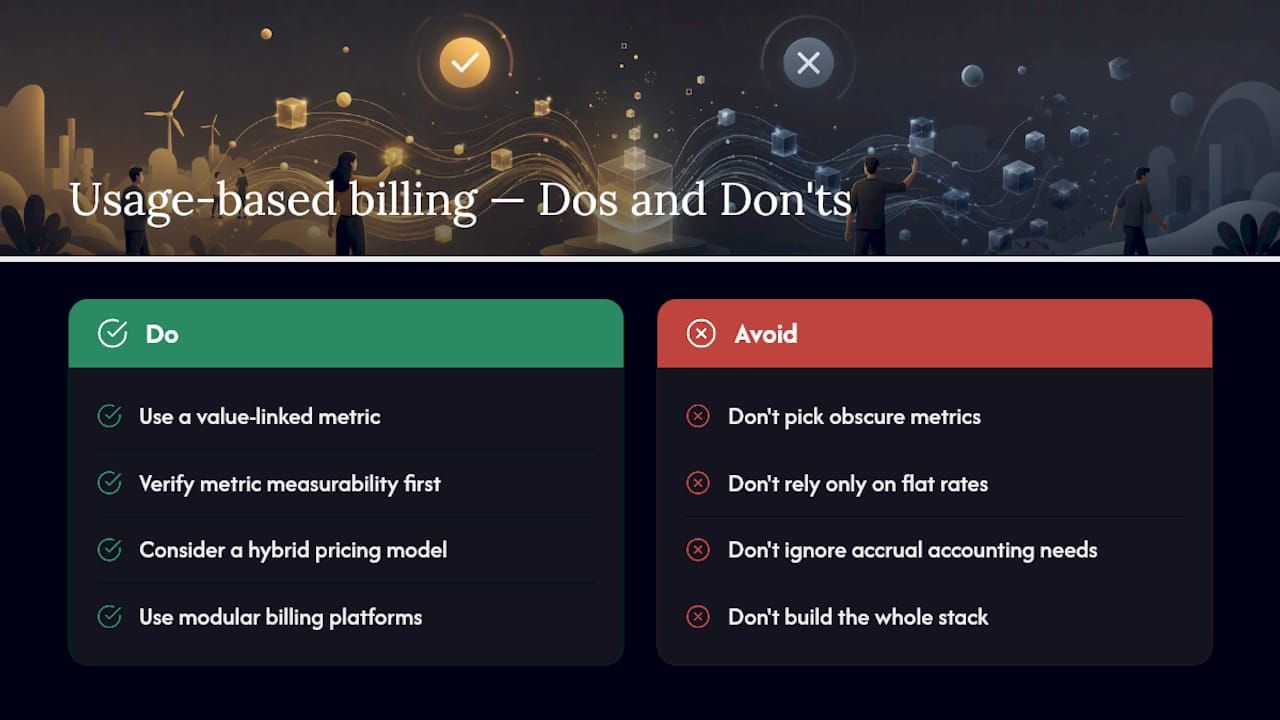
- Choose a value metric. Pick something customers already understand as tied to the value they get, and something you can measure accurately. A vague or gameable metric undermines the entire model.
- Instrument events and define aggregation rules. Decide how events roll up into meters, what counts as a billing period boundary, and how you’ll handle late or duplicate events. Build audit logs from day one, not as an afterthought.
- Build and test rate cards in staging. Generate preview invoices against real historical usage data before anything touches a live customer.
- Create usage previews and spend controls. Customers need to see their running total and set caps or alerts before the first real invoice arrives.
- Update contracts, pricing pages, and support playbooks. Sales and support teams need scripts for “why is my bill higher this month” before launch, not after the first angry ticket.
- Roll out in stages. Start with opt-in customers, then a pilot cohort, then a broader migration, watching for billing discrepancies at each phase before expanding.
Stripe’s implementation guidance recommends running meter-only reporting first, verifying accuracy against known usage, and only then enabling live rating and invoicing.
Pro Tip: Test every price migration in a sandbox environment against a copy of real customer usage history before applying it to live accounts. A rate card that looks fine in the abstract can produce absurd invoices once real usage patterns hit its edge cases.

How Does Usage-Based Billing Affect Revenue Recognition?
Metered revenue complicates accounting in ways flat subscriptions don’t, and finance teams need to plan for it before launch, not discover it during month-end close.
- Revenue accrues as service is delivered, not when the invoice is cut. Under ASC 606 principles, if a customer consumes the service throughout the month, revenue recognition tracks that consumption, which usually means estimating usage before the final invoice is generated.
- Accrual reversal happens at invoice finalization. The estimated accrual gets reversed and replaced with the actual rated amount once the billing period closes, and any material gap between estimate and actual needs a documented reconciliation process.
- ARR gets messier. A metric built for predictable flat-fee revenue doesn’t map cleanly onto usage swings, so most finance teams track a blended metric alongside a trailing usage average to keep forecasting honest.
- Collections and dunning need new logic. A failed payment on a metered invoice with a large overage charge is a different risk profile than a failed payment on a flat $50 subscription, and dispute workflows should account for the fact that usage-based invoices are harder for customers to verify at a glance.
How Do You Prevent Bill Shock With Usage-Based Billing?
Billing accuracy doesn’t matter to a customer who feels blindsided. A Salesforce analysis of usage-based billing points to missing spend alerts as one of the most common and entirely avoidable causes of customer distrust, even when every line item on the invoice is correct.
- Real-time usage dashboards let customers watch their consumption accrue instead of finding out at month’s end.
- Configurable spending caps and tiered alerts (at 50%, 80%, and 100% of a budget, for example) give customers a chance to act before a bill balloons.
- Readable invoices with usage summaries broken down by meter and rate, not just a single opaque total, cut support tickets significantly.
- Proactive CS outreach when a spike is detected mid-cycle turns a potential dispute into a moment of trust, especially for a first-time overage.
Pro Tip: Set your default spend alert threshold below what you think customers need. Teams consistently underestimate how anxious usage-based pricing makes budget-conscious buyers, and an alert that fires too early costs nothing; one that fires too late costs the account.
What Do Sample Usage-Based Billing Scenarios Look Like?
Concrete numbers make the abstractions click faster than another paragraph of definitions.
- AI API billing: A customer sends 2 million tokens in a month at $0.002 per 1,000 tokens. That’s a $4 line item, itemized separately from a base platform fee of $49.
- Cloud storage: A plan includes 100GB free, then charges $0.023 per GB beyond that. A customer using 250GB owes $3.45 in overage on top of the base plan.
- Messaging platform: Per-message billing at $0.0075 per SMS. A campaign sending 40,000 messages generates a $300 line item, billed separately from any monthly platform fee.
- Hybrid example: A $99 base plan includes 10,000 API calls; the customer makes 14,000 calls at $0.01 per call over the allowance, producing a $99 base fee plus $40 overage for a $139 total invoice.
How Bitecode Approaches Usage-Based Billing Implementation
Building the metering, rating, and invoicing pipeline from scratch typically takes engineering teams months, largely because most of that work, event ingestion, rate card logic, invoice generation, isn’t unique to any one product.
- Modular components cut build time. Pre-built metering hooks, billing API adapters, and usage dashboard modules replace weeks of foundational plumbing with configuration work.
- Typical deliverables include event capture pipelines, rate card engines, customer-facing usage dashboards, and finance-ready audit logs built from the start rather than bolted on after a dispute.
- Buy vs. build is mostly an effort question. Custom-building a production-grade metering pipeline commonly runs several engineer-months before the first invoice goes out; a modular, low-code foundation compresses that timeline by starting from pre-built system components rather than a blank repository.
What Do Engineers Get Wrong About Usage-Based Billing?
The three pitfalls that keep showing up: picking a value metric customers can’t predict or verify, shipping without spend caps, and under-testing rate migrations against real usage history. The fix is almost boring in its simplicity: choose a measurable metric, stage every rollout, and test price changes against a full year of historical data before anyone sees a new invoice. A staged migration catches the rate card bug that a big-bang launch turns into a support crisis.
Get Usage-Based Billing Live Without the Engineering Overhead
Everything covered above, the metering pipeline, the rate card logic, the audit trails finance needs, and the dashboards that stop bill shock before it starts, is exactly the kind of build that eats months of engineering time when done from a blank codebase; for practical customer-facing examples and spend-control UX, see Interval AI’s pricing. Bitecode starts projects with a large share of the baseline system already built, so a usage-based billing implementation moves from architecture diagrams to a working staging environment in weeks rather than quarters.
That head start matters most in the parts of this guide that are hardest to get right on a first attempt: reconciling metering events with rating logic, keeping audit logs finance can actually use during close, and building customer dashboards that prevent disputes instead of causing them. Bitecode’s custom software development service handles this as an integration project against your existing product, not a rebuild, and the automation service can wire up the spend alerts and dunning workflows this article recommends. If your team is scoping a usage-based billing migration, a conversation with Bitecode is a practical next step before committing engineering months to a from-scratch build.
Where to Learn More About Usage-Based Billing
For deeper implementation detail, review Stripe’s usage-based pricing strategy guide, its advanced billing documentation, and Bitecode’s overview of SaaS business models.
Frequently Asked Questions
What is the difference between usage-based billing and metered billing? They describe the same practice. Usage-based billing and metered billing both charge customers based on measured consumption rather than a flat rate, though “metered billing for SaaS” is more common in engineering contexts.
Is usage-based billing better than flat-rate subscriptions? Neither is universally better. Usage-based billing aligns price with delivered value and captures expansion revenue, but flat subscriptions give more predictable cash flow. Most mature SaaS and AI companies combine both in a hybrid model.
What is a good first value metric for usage-based pricing? Choose a metric customers already associate with the value they get, such as API calls, tokens processed, or active seats, and confirm it can be measured accurately before committing a rate card to it.
How does usage-based billing affect revenue recognition? Revenue accrues as the customer consumes the service, not when the invoice is generated, which usually requires an estimated accrual that gets reversed and corrected once the actual usage is rated and invoiced.
Can small SaaS companies implement usage-based billing without a large engineering team? Yes, though building metering, rating, and invoicing from scratch is still a substantial project. Modular, low-code platforms reduce that lift significantly by providing pre-built billing components instead of requiring a custom pipeline from day one.
Sources
- Usage-based billing explained: How it works and how to optimize its benefits | Stripe
- Usage-based billing: What it is & how it works | Salesforce