TL;DR:
- Blockchain enhances SaaS by reducing transaction costs and fraud through immutable ledger technology and stablecoins. It improves subscription billing with transparent, automated smart contracts that boost revenue and reduce churn, while keeping blockchain operations invisible to end-users. A modular, focused architecture using audited primitives optimizes development speed and product usability in 2026.
Blockchain-enhanced SaaS is defined as software delivered as a service where immutable distributed ledger technology handles payments, audit trails, or access control in place of centralized intermediaries. The role of blockchain in SaaS goes well beyond decentralization rhetoric. It delivers measurable reductions in transaction costs, eliminates chargeback fraud, and enables automated subscription billing through smart contracts. Platforms built on Solana, payment flows settled in USDC, and billing logic encoded in audited smart contracts represent the practical frontier of this integration in 2026. This guide explains where blockchain creates genuine business value in SaaS, how to architect it without over-engineering, and where the real traps lie.
How blockchain reduces transaction costs and fraud in SaaS payments
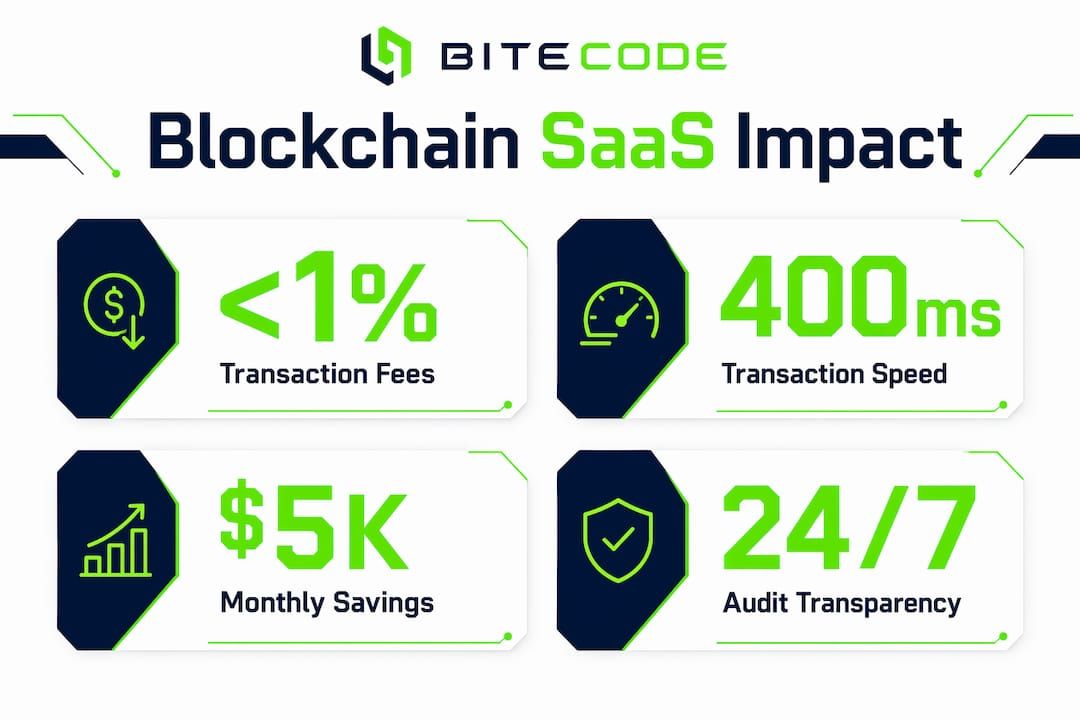
Traditional payment rails cost SaaS companies real money. Credit card processors charge 2 to 4% per transaction, settlements take two to five business days, and chargebacks expose recurring revenue to retroactive reversal. Crypto payment gateways cut transaction fees to under 1.5% and settle in near real time, removing chargeback fraud entirely through the immutable nature of blockchain records.

The financial math is direct. A SaaS product generating $100,000 in monthly recurring revenue can save $3,000 to $5,000 per month on payment friction alone by switching to Solana-native USDC payments. That is margin recovered without a single product change. For companies operating at scale, those savings compound into a structural cost advantage over competitors still running on Stripe or legacy bank wires.
Volatility has historically been the objection to crypto billing. Stablecoin support like USDC or USDT resolves this directly, giving finance teams predictable revenue figures that behave exactly like fiat. Customers pay in a currency pegged to the dollar, the SaaS vendor receives settlement in the same, and no one is exposed to Bitcoin price swings.
| Payment Method | Transaction Fee | Settlement Time | Chargeback Risk |
|---|---|---|---|
| Credit card (Stripe) | 2.9% + $0.30 | 2 to 5 business days | High |
| Bank wire | 0.5 to 2% | 1 to 3 days | Medium |
| Blockchain (Solana/USDC) | Under 1.5% | Near instant | None |
Key advantages of blockchain payment gateways for SaaS billing:
- Immutable transaction records eliminate friendly fraud and disputed charges
- Sub-second finality on Solana (400 milliseconds) prevents billing delays for global B2B customers
- Direct wallet settlement removes reliance on payment processors as intermediaries
- Stablecoin invoicing maintains predictable revenue without volatility exposure
Pro Tip: When evaluating crypto payment gateways like Infini for your SaaS product, prioritize vendors that support USDC natively and offer direct merchant wallet settlement rather than custodial holding. Custodial processors reintroduce the counterparty risk you are trying to eliminate.
How do prorated smart contracts improve subscription billing?
Prorated billing is the mechanism by which a customer upgrading or downgrading mid-cycle receives an accurate credit or charge for the partial period. Traditional billing platforms like Stripe Billing handle this through software logic that can drift, produce disputes, or fail silently during edge cases. Smart contracts on-chain handle the same calculation deterministically, with every credit and debit written to a public ledger that both vendor and customer can verify independently.
The business impact of this transparency is significant. Prorated on-chain subscriptions boost average revenue per user by up to 28% and reduce churn by 50% for mid-tier SaaS products. The mechanism is not magic. When customers trust that billing is accurate and auditable, they upgrade more freely and dispute less often. Friction in the billing relationship is one of the most underestimated drivers of churn.
Here is how automated on-chain subscription proration works in practice:
- A customer upgrades from a $49 plan to a $99 plan on day 15 of a 30-day cycle.
- The smart contract calculates the unused credit on the old plan ($24.50) and the prorated charge for the new plan ($49.50).
- The net charge ($25.00) is executed automatically, with the full calculation written on-chain.
- The customer can verify the transaction independently at any time without contacting support.
- The vendor’s revenue ledger updates in real time, with no reconciliation required.
Subscription proration smart contracts also handle usage-based billing meters, where charges accumulate per API call, per seat, or per gigabyte. This is particularly relevant for infrastructure SaaS products where consumption varies month to month. The contract executes the billing rule; the vendor does not need to maintain a separate reconciliation process.
Pro Tip: Before building custom proration logic, check whether the chain you are deploying on offers native subscription primitives. Solana’s native subscription tools reduce security risks and audit costs compared to writing billing contracts from scratch.
What does a practical blockchain SaaS architecture look like?
The most common architectural mistake in blockchain SaaS is treating the blockchain as the application layer rather than a service layer. Teams that attempt to decentralize their entire product stack end up with slow iteration cycles, poor developer experience, and a product that confuses users. The correct approach is narrower and more deliberate.
Effective blockchain SaaS startups keep the blockchain as a modular service layer, focused on specific workflows like wallet-based login, billing settlement, or audit log integrity. Everything else, including the UI, the business logic, the data models, and the API layer, runs on conventional infrastructure. This separation keeps development velocity high and allows the team to swap or upgrade the blockchain component without rebuilding the product.
Practical principles for a modular blockchain architecture:
- Narrow the scope. Identify one or two workflows where immutability or trustless settlement creates clear business value. Billing and audit logs are the most common starting points.
- Separate the service layer. The blockchain module should communicate with the core SaaS via a well-defined API. It should not be embedded in the application’s core data layer.
- Prefer direct wallet settlement. Direct merchant wallet architectures with smart contracts produce auditable recurring revenue without relying on custodial third parties or bank reconciliation cycles.
- Choose chains with strong tooling. Solana offers sub-second finality and fees below $0.001 per transaction, making it practical for high-frequency SaaS billing at global scale.
- Use audited primitives. Native on-chain subscription tools on Solana reduce security exposure and shorten time to market compared to custom smart contract development.
The blockchain integration process for an enterprise SaaS product typically starts with a single workflow pilot, validated over 60 to 90 days, before expanding to additional modules. This phased approach limits risk and produces measurable data before the organization commits to broader architectural changes.
Balancing blockchain benefits with real-world user experience
The most instructive failures in blockchain SaaS share a common pattern: the product exposed blockchain complexity to end users. Wallet addresses in invoices, gas fee notifications, and transaction confirmation screens all create friction that customers did not sign up for. Users reject blockchain SaaS that surfaces this complexity, regardless of the underlying efficiency gains.
The principle that resolves this tension is straightforward: blockchain should be invisible to the user and visible only in the audit trail. A customer paying a SaaS subscription in USDC should see a familiar checkout screen, receive a standard receipt, and never encounter a wallet address unless they specifically request the transaction record. The blockchain operates in the background, producing the immutability and settlement efficiency that the vendor values.
“Blockchain’s true leverage in SaaS is not decentralization, but removing friction and increasing trust via immutable ledgers operating invisibly to users.” — Startupik
Transaction finality speed also matters for subscription UX. A billing event that takes 30 seconds to confirm on a congested network produces a poor checkout experience. Solana’s 400-millisecond finality eliminates this problem for most SaaS billing scenarios. Teams building on slower chains need to architect optimistic UI patterns that confirm the user action immediately while the on-chain settlement completes asynchronously.
Security overhead is another operational reality. Custom smart contracts require formal audits before production deployment, which adds cost and time. The practical mitigation is to use audited, native on-chain primitives wherever they exist rather than writing bespoke billing logic. This is not a shortcut. It is the architecturally correct decision, and it is one that the SaaS finance sector is increasingly recognizing as standard practice.
Key takeaways
Blockchain creates durable competitive advantages in SaaS when applied to specific, high-friction workflows like payment settlement and subscription billing, not when used as a wholesale replacement for conventional infrastructure.
| Point | Details |
|---|---|
| Cost reduction is immediate | Blockchain payment gateways cut transaction fees to under 1.5%, saving thousands monthly at scale. |
| Smart contracts eliminate billing disputes | On-chain proration calculates credits and charges deterministically, reducing churn by up to 50%. |
| Architecture determines success | Keeping blockchain as a modular service layer preserves development velocity and product usability. |
| Stablecoins solve the volatility problem | USDC and USDT enable predictable recurring revenue without exposure to crypto price swings. |
| Invisible UX is non-negotiable | Blockchain complexity hidden from end users drives adoption; exposed complexity kills it. |
Bitecode’s perspective on blockchain in SaaS
The most persistent misconception Bitecode encounters when working with SaaS teams is the belief that blockchain integration requires rebuilding the product. It does not. The organizations that extract real value from blockchain in 2026 are the ones that treated it as a precision tool, not a foundation.
Start with billing. It is the workflow where immutability, auditability, and fraud elimination produce the clearest return on investment. A SaaS product that settles subscriptions on-chain, issues verifiable receipts, and eliminates chargebacks has a materially better financial profile than one running on legacy payment rails. That improvement does not require a token, a DAO, or a whitepaper.
The warning worth repeating is this: do not tokenize what does not need to be tokenized. Many teams waste months designing token economies for SaaS products where the only real need was a reliable payment layer. The future of blockchain in SaaS belongs to products that use the technology to solve specific operational problems, not to products that use it as a positioning statement. The teams that understand this distinction will build faster, spend less, and retain more customers.
— Bitecode
How Bitecode accelerates blockchain SaaS development
Bitecode builds custom SaaS products with blockchain and AI modules pre-integrated, so teams skip the greenfield architecture work and start with up to 60% of the baseline system already in place.
The blockchain payment module covers direct wallet settlement, USDC billing, smart contract subscription management, and on-chain audit logs. The AI assistant module handles workflow automation and customer engagement without adding engineering overhead. For SaaS companies that need to move fast without accumulating technical debt, Bitecode’s modular foundation means the first production deployment happens in weeks, not quarters. Explore how these modules fit your product architecture at Bitecode.
FAQ
What is the main role of blockchain in SaaS?
Blockchain in SaaS primarily handles payment settlement, subscription billing automation, and audit log integrity through smart contracts and immutable ledgers. It reduces transaction costs, eliminates chargeback fraud, and increases billing transparency without requiring full product decentralization.
How does blockchain reduce SaaS transaction fees?
Crypto payment gateways using networks like Solana cut transaction fees to under 1.5%, compared to 2 to 4% with traditional credit card processors, while settling payments in near real time instead of days.
Do customers need to understand blockchain to use a blockchain-powered SaaS product?
No. Best practice keeps blockchain entirely invisible to end users, with familiar checkout flows and standard receipts. The blockchain operates in the background, producing settlement efficiency and audit records that the vendor benefits from.
What is the best blockchain for SaaS billing in 2026?
Solana is the leading choice for SaaS billing due to its 400-millisecond transaction finality and fees below $0.001 per transaction, making it practical for high-frequency global billing at scale.
Can blockchain integration improve SaaS subscription retention?
Yes. Prorated on-chain subscriptions that automate mid-cycle billing adjustments have been shown to reduce churn by up to 50% for mid-tier SaaS products, primarily because transparent and accurate billing reduces disputes and increases customer trust.