Data warehouse automation (DWA) is the metadata-driven automation of the warehouse lifecycle: modeling, code generation, testing, deployment, and documentation, all built from a central metadata layer instead of hand-written scripts. Teams should adopt it once schema changes, repeated ETL builds, or a broader DataOps initiative start eating more engineering hours than the actual analysis work does. For organizations already running a modular tech stack, DWA fits naturally, and firms like Bitecode build implementations around exactly that pattern.
Key Takeaways
Data warehouse automation succeeds when a well-governed metadata model drives code generation, testing, and deployment, with clear ownership preventing the pattern from breaking down at scale.
| Point | Details |
|---|---|
| Definition | DWA is metadata-driven automation of modeling, code generation, testing, and deployment across the warehouse lifecycle. |
| Start narrow | Pilot one source system and one model before expanding, since scope discipline predicts pilot success. |
| Ownership matters most | Assign a clear owner for the metadata layer with authority to reject changes that break consistency. |
| Watch the right metrics | Track time-to-delivery, percentage of code generated, test coverage, and lineage coverage during the pilot. |
| Security spans three layers | Control metadata edits, code generation triggers, and deployment approval as separate permission sets. |
| Modular pilots move faster | Bitecode’s pre-built connector and metadata templates let a pilot start closer to production-ready than a from-scratch build. |
What Data Warehouse Automation Does and Why It Pays Off
DWA takes over the repetitive engineering work: source profiling, dimensional or Data Vault modeling, SQL and ELT code generation, automated testing, deployment, and the documentation nobody has time to write by hand. Instead of an engineer manually coding a new dimension table, a metadata-driven generator produces the SQL from a template, applies it consistently across every table that shares the pattern, and logs the change for lineage tracking. Wikipedia’s summary of DWA lists ETL generation, metadata management, and managed deployment as its core recurring capabilities.
The payoff shows up differently depending on who you ask:
- Engineering leads see faster delivery cycles because generated code replaces weeks of manual scripting.
- Data engineers spend less time on repetitive table builds and more on modeling decisions that actually require judgment.
- Compliance and governance teams get consistent lineage and metadata because every object traces back to the same template.
- Business stakeholders get a shorter time-to-insight since new data sources reach production faster.
Pilot teams commonly track reduced development time per pipeline, deployment frequency, defect rates after go-live, and time-to-insight for new data sources as the metrics that actually move.
The Core DWA Lifecycle and Architecture
Every mature DWA implementation follows a similar sequence, whether it runs on an open-source framework or a commercial platform. Picture it as a five-stage pipeline, each stage feeding metadata forward to the next.
- Discover. The system profiles source systems, samples data, and infers structure, producing a column-level inventory and early mapping candidates.
- Model. Engineers define a canonical model (star schema, Data Vault, or a hybrid), stored as metadata rather than static diagrams.
- Develop/codegen.****** Template-driven engines convert that metadata into SQL, ELT jobs, and transformation scripts. AutomateDV illustrates this well: it generates templated SQL for a Data Vault 2.0 warehouse and hands execution off to dbt, running parallel loads without a human writing repetitive insert statements.
- Deploy and test. Generated code moves through automated tests and CI pipelines before reaching production, with test cases often generated from the same metadata that produced the code.
- Operate. Observability tools track lineage, data quality, and performance once the warehouse is live.
The output at each stage is concrete: a column mapping document at discovery, a versioned canonical model at modeling, generated SQL and job definitions at codegen, a test report at deployment, and a lineage graph at operation. Metadata is the thread connecting all five, which is why analysts increasingly view DWA as inseparable from DataOps maturity.
Where Different Tool Categories Fit
DWA rarely comes from a single tool. It comes from several categories working together, each with a distinct job.
- Modeling and metadata engines hold the canonical model and act as the source of truth other tools read from. Strength: consistency across generated artifacts. Weakness: only as good as the metadata discipline behind it.
- Code generation and forward-engineering tools turn metadata into executable SQL or ELT jobs, the way AutomateDV generates SQL for Data Vault structures.
- Orchestration platforms schedule jobs and manage dependencies between them. Apache Airflow is the most widely adopted example, offering Python-defined workflows and prebuilt operators for major cloud providers.
- ELT/ETL engines execute the actual data movement and transformation, often triggered by the orchestrator.
- Testing and CI tools validate generated code before it reaches production.
- Observability and lineage tools track data quality and trace issues back to source once the warehouse is running.
A typical flow: the modeling layer defines a table, the codegen layer produces the SQL, the orchestrator schedules the job, the ELT engine runs it, and the observability layer logs lineage. Choosing an orchestrator specifically depends on whether you need big-data processing, managed cloud services, hybrid connectors, or advanced control flow, since those requirements point toward different platforms.
Platform, Extend, or Custom Build: How to Decide
The right path depends on scale, team skill, and how much you have already invested in your current stack. Run through four questions before committing: How many source systems and schema changes do you handle per quarter? Does your team have strong software engineering skills (favoring something like Airflow) or more SQL-oriented skills (favoring templated generators)? What regulatory or security constraints apply to your data? And what ROI horizon does leadership expect, three months or eighteen?
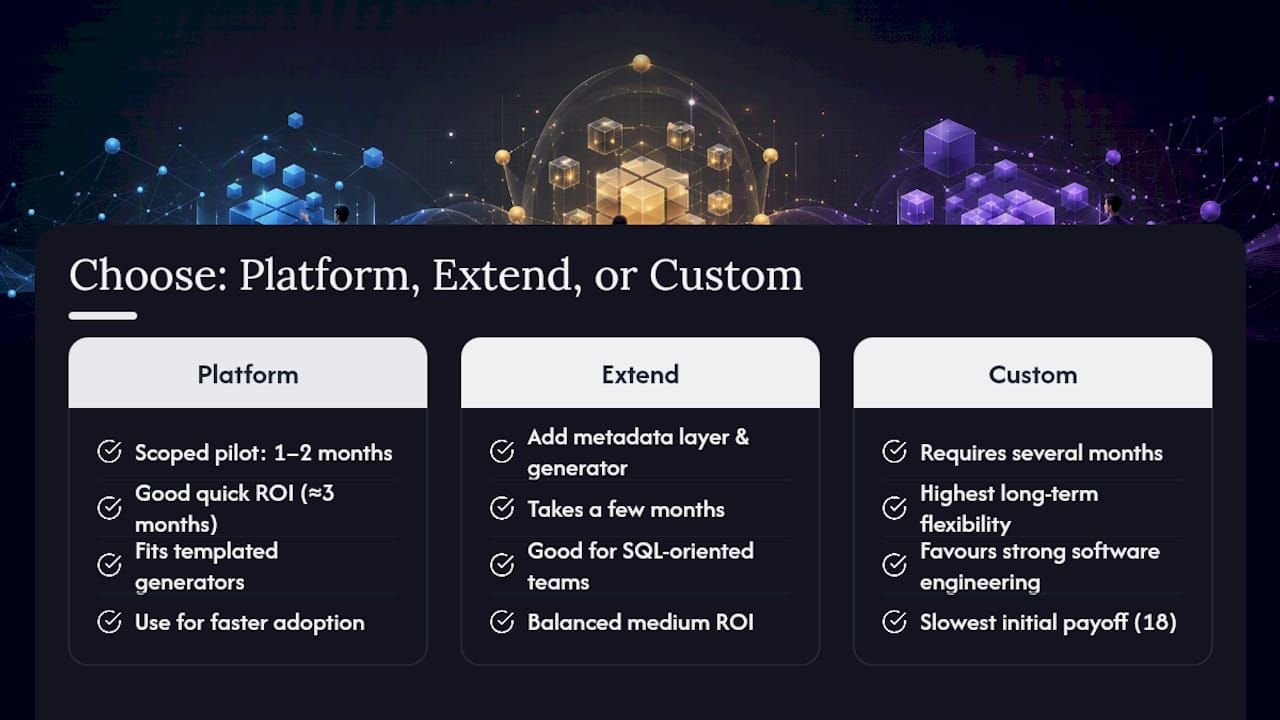
Three triggers usually mean it is time to automate: engineers spending most of their week on repetitive manual builds, schema changes that break pipelines every quarter, and delivery cycles measured in months rather than weeks. A formal DataOps initiative is often the fourth trigger, since DWA gives that initiative something concrete to standardize around.
Rough timelines for adoption vary: a scoped pilot with an existing platform usually takes about a month or two; extending your current stack with a metadata layer and generator can take a few months; and a fully custom build often requires several months depending on team bandwidth. Custom builds carry the highest long-term flexibility but the slowest initial payoff.
An Adoption Checklist That Actually Works
Treat adoption as three phases rather than one big rollout.
Phase 1: Pilot (4 to 6 weeks). Pick one source system and one target model. Build the metadata layer, generate code for a handful of tables, and run it through automated tests before touching production.
Phase 2: Expand (2 to 4 months). Add more sources, formalize the metadata standards that worked in the pilot, and bring the orchestration and observability layers fully online.
Phase 3: Operate (ongoing). Shift from building to maintaining. Metadata updates become routine, and the team monitors quality rather than writing new code from scratch.
Track these metrics along the way:
- Time-to-delivery per new pipeline or data source.
- Percentage of code generated versus hand-written.
- Automated test coverage across generated objects.
- Data quality scores post-deployment.
- Lineage coverage across the warehouse.
Watch for three red flags. Insufficient metadata discipline means generators produce inconsistent output. No clear ownership of the metadata layer means competing teams edit it in conflicting ways. Brittle connectors to legacy source systems mean the automation breaks every time a source schema shifts, often because that source was never designed with metadata extraction in mind.
How a Modular Implementation Works in Practice
A pilot engagement typically starts with architecture discovery: mapping source systems, defining the canonical model, and setting up metadata templates before writing a single line of production code. From there, Bitecode builds out connectors for the priority sources, generates a sample flow or two end-to-end, and documents the metadata standard so the client’s own engineers can extend it without external help.
Delivery usually follows a fixed-scope pilot structure: a defined set of source connectors, one or two working sample flows, documentation, and a knowledge-transfer workshop so the internal team owns the system going forward rather than depending on an outside vendor indefinitely. Because Bitecode builds from a modular library of pre-built components, a meaningful share of the baseline system exists before the engagement even starts, which shortens the timeline from the ranges described earlier.
- Scoped architecture and metadata design for the priority source systems.
- Connector setup for the highest-value integrations first.
- One or two working sample flows through the full lifecycle.
- Documentation and a workshop for internal handoff.
Pro Tip: Ask any implementation partner to show you the metadata schema they plan to use before they write a single connector. If they cannot explain it in plain language, the automation layer behind it is probably not as flexible as advertised.
Security Considerations Specific to Data Warehouse Automation
Automation changes the security surface of a warehouse, not just its build speed. When code generation runs from a shared metadata layer, a single misconfigured template can propagate a vulnerability across dozens of tables at once, which is a very different failure mode than a single hand-written script going wrong.
Access control needs to cover three separate layers: who can edit the metadata model, who can trigger code generation, and who can approve deployment to production. Treating these as one permission set is a common mistake, since a developer who legitimately needs to update a table definition should not automatically have deployment rights.
Generated SQL and ELT jobs should run through the same security review as hand-written code, not skip review because “the machine wrote it.” Automated pipelines still connect to source systems holding sensitive data, and a connector with excessive permissions is a real exposure point regardless of whether a human or a generator built the job.
Audit trails matter more here than in traditional development because generated artifacts change automatically as metadata changes. Every deployment should log what metadata version triggered it, which makes rollback and forensic review possible when something breaks. Multi-currency financial data, personally identifiable information, and blockchain-linked transaction records each carry their own regulatory handling requirements, and a metadata-driven system should tag and enforce those rules consistently rather than relying on individual engineers to remember them table by table. Self-hosted deployments give more direct control over this, at the cost of managing the infrastructure yourself.
Getting Teams to Actually Adopt the New Workflow
The technical rollout is rarely what kills a DWA initiative. Team resistance does, usually because engineers who built their reputation on manual SQL craftsmanship see a code generator as a threat rather than a tool.

Start change management before the pilot begins, not after. Bring the engineers who will use the system into the metadata design process early, since ownership over the templates they will rely on daily reduces resistance more than any announcement from leadership. Frame the shift honestly: automation removes the repetitive 70% of the work, not the judgment calls about modeling decisions, edge cases, and business logic that still require a human.
Training should happen in layers. Data engineers need to understand the metadata schema deeply enough to extend it themselves. Analysts and downstream consumers just need to trust that the lineage and documentation are reliable, which usually means a short walkthrough of the new observability dashboard rather than a deep technical course.
Expect a productivity dip during the first few weeks of the pilot phase. Teams are learning a new mental model, not just a new tool, and that adjustment period is normal rather than a sign of failure. Set that expectation with leadership up front so a temporary slowdown does not get read as the project underperforming. Pair each new adopter with someone who worked through the pilot, and keep the documentation from the pilot phase visible and current, since stale docs erode trust in the automation faster than almost anything else.
What Successful DWA Rollouts Have in Common
Organizations that get real value from DWA tend to share a specific pattern: they start narrow, prove the metadata model works on a small scope, and only then expand. The open-source Fabric DWA framework is a good illustration of this principle in action. It reduces pipelines to metadata and enforces logging, lineage, and error handling as structural requirements rather than optional add-ons, which means teams adopting it inherit governance discipline by default instead of bolting it on later.
The common thread across working implementations is restraint in scope during the pilot. Teams that try to automate their entire warehouse on day one tend to hit brittle connectors and inconsistent metadata faster than teams that pick one source system, prove the pattern works end-to-end, and expand from there. AutomateDV’s approach to Data Vault code generation reflects the same discipline: a repeatable metadata model that supports high parallelism because the pattern was proven small before it was scaled wide.
Analyst coverage of the DWA space, including frameworks referenced in Gartner’s procurement guidance, confirms this is now a recognized procurement category with established evaluation criteria, not an experimental niche. That maturity means buyers have real benchmarks to compare against rather than evaluating claims in a vacuum.
The pattern holds across both open-source frameworks and commercial platforms: narrow pilot, proven metadata model, then expansion. Organizations that skip the narrow pilot step and try to automate everything at once are the ones that end up back at manual scripting within a year.
Data Warehouse Automation for IT Teams and Data Engineers
Most guidance on this topic treats DWA as a tooling decision: pick a platform, plug in your sources, done. That framing undersells the actual bottleneck, which is almost always metadata discipline, not tooling. A team with mediocre orchestration but a rigorous, well-governed metadata model will outperform a team with premium tooling and inconsistent metadata every time.
The conventional advice to “automate everything you can” is also where most pilots go wrong. The teams that succeed pick one source system, one model, and prove the metadata pattern works before touching a second source. Scope discipline in the first six weeks predicts success better than the platform chosen.
If there is one thing worth prioritizing above all else, it is ownership. Someone specific needs to own the metadata layer, with the authority to reject changes that break the pattern. Without that, automation just moves the chaos from hand-written SQL into a generator that produces inconsistent output faster than a human ever could.
What a Bitecode Pilot Engagement Actually Delivers
Getting from “we should automate this” to a working pipeline usually takes longer than it needs to, mostly because teams start from scratch instead of from a proven foundation. Bitecode approaches DWA pilots differently: because a meaningful share of the metadata templates, connector patterns, and orchestration scaffolding already exist as reusable modules, the pilot starts closer to the finish line than a from-scratch build would.
A typical pilot includes scoped architecture design for your priority source systems, connector setup for the highest-value integrations, one or two working sample flows through the full discover-to-deploy lifecycle, documentation your team can actually use, and a knowledge-transfer workshop so the system belongs to your engineers, not to an outside consultant indefinitely. If your organization is weighing an AI-driven automation service against a slower custom build, the fastest way to find out which fits is to scope a pilot and see the sample flow running against real data.
Sources
- Automating data warehouses, AI products and lakehouses — BARC
- Pipeline orchestration and data movement — Microsoft Learn
- Apache Airflow
- AutomateDV documentation