Master data management is the discipline that creates and maintains one trusted version of an organization’s core business entities, its golden record, so that customer names, product identifiers, and supplier terms match across every system that touches them. The primary outcome is consistency: operations, analytics, and AI models all draw from the same verified source instead of reconciling conflicting copies. What follows covers how to plan the program, choose an architecture, and measure whether it’s working.
TL;DR:
- Implementing a pilot domain like customer or product data provides faster ROI because issues are more visible and easy to quantify.
- Choosing an architectural pattern depends on existing system complexity, governance maturity, and acceptable data latency for updates.
- Success relies on organizational ownership, clear stewardship, and an iterative development process, not just technology or data quality tools.
- Starting with modular, pre-built components accelerates deployment and reduces project risk, especially for organizations with limited timelines.
- Measuring progress through data quality metrics and adoption rates is crucial for demonstrating value and ensuring ongoing organizational commitment.
What Is Master Data Management?
Master data management is a technology-enabled business discipline, not a software category you install and walk away from. Gartner defines it as a collaborative effort between business and IT to guarantee the uniformity, accuracy, stewardship, and accountability of an enterprise’s shared master data assets, meaning the core entities every department depends on but nobody fully owns alone.
At the center of MDM sits the golden record: a single, deduplicated, enriched version of a customer, product, or supplier built by reconciling records pulled from CRM systems, ERP platforms, spreadsheets, and third-party feeds. IBM describes this process as standardizing, matching, merging, validating, and publishing data so every downstream system consumes the same trusted view.
MDM is frequently confused with two adjacent disciplines it actually depends on:
- Data governance sets the policies, ownership rules, and lifecycle controls that determine who can change master data and under what conditions.
- Data integration and ETL move data between systems, but they don’t resolve conflicts or decide which version of a customer record is correct.
- MDM sits on top of both, using governance rules to arbitrate what integration pipelines deliver.
Without governance, MDM has no authority to enforce its golden record. Without integration, it has no data to reconcile in the first place.
Which Data Domains Should You Master First?
Enterprises typically organize master data management around a handful of recurring domains, and picking the right one to pilot determines how quickly the program proves its value.
- Customer: names, contact details, account hierarchies, and relationship history, often the first domain tackled because sales and service teams feel duplicate records daily.
- Product: SKUs, attributes, and digital assets, especially critical for retailers running product information management (PIM) alongside MDM for omnichannel consistency.
- Supplier and vendor: tax IDs, payment terms, and risk ratings, valuable for procurement teams trying to consolidate spend visibility.
- Location: addresses, facility codes, and geographic hierarchies used across logistics and finance.
- Finance and Chart of Accounts: standardized account structures that let consolidated reporting actually reconcile across business units.
- Assets: equipment and inventory records shared between operations and maintenance systems.
A practical example: a mid-size distributor building a CRM golden record can cut duplicate outreach almost immediately, because sales reps stop calling the same account under three different spellings. Retailers piloting a unified product catalog usually see the fastest measurable lift, since inconsistent product data directly breaks search, filtering, and fulfillment across e-commerce channels. Customer and product domains tend to deliver earlier ROI than finance or asset domains, largely because their data quality problems are more visible and easier to quantify.
What Business Benefits Does MDM Deliver?
MDM investment gets justified by outcomes finance and operations leaders actually track, not abstract data quality scores.
- Operational efficiency: eliminating duplicate customer records reduces redundant outreach, misrouted shipments, and the manual reconciliation work that eats analyst hours. Customer service teams resolve issues faster when every representative sees the same account history instead of three fragmented versions.
- Analytics and AI readiness: IBM notes that consistent master data underpins reliable AI outputs, since a model trained on contradictory customer or product records inherits that contradiction as noise. Clean master data is what separates a forecasting model that works from one that quietly drifts.
- Compliance and M&A consolidation: auditability improves when every change to a customer or financial record carries a traceable history. During mergers and acquisitions, MDM gives integration teams a structured way to reconcile two companies’ customer and vendor bases instead of running that reconciliation manually against a deadline.
How Do You Choose an MDM Implementation Model?
Four architectural patterns dominate real-world master data management deployments, and the right choice depends on how much control you need versus how fast you need to move.
- Registry: maintains a lightweight index that points back to source systems without physically consolidating data. Fast to deploy, but it leaves data quality issues sitting in the source systems.
- Consolidation: pulls data from multiple sources into a central hub for reporting and analytics, while source systems keep their own copies as the system of record for transactions.
- Coexistence: the most common enterprise pattern. The MDM hub becomes authoritative for some attributes while source systems retain authority for others, with changes synchronized bidirectionally.
- Centralized: the hub becomes the single system of record, and source applications read and write directly against it. Highest control, but also the highest implementation cost and organizational disruption.
The decision usually comes down to three factors: how many systems already touch the domain, how mature your governance function is, and how much latency the business can tolerate between a change and its propagation. A company with a small governance team and a dozen legacy systems has no business attempting a centralized model on day one. Coexistence lets that same company build authority gradually, domain by domain, without a rip-and-replace project.
What Are the Steps in the MDM Lifecycle?
Every master data management program, regardless of vendor or architecture, runs the same operational loop.
- Collect: pull raw records from source systems, whether ERP, CRM, spreadsheets, or third-party feeds.
- Standardize: normalize formats, so “St.” and “Street” or “Corp” and “Corporation” resolve to one convention.
- Match and merge: identify records that represent the same real-world entity and consolidate them into a candidate golden record.
- Validate and approve: route uncertain matches to a data steward for a decision before they become authoritative.
- Publish: distribute the approved golden record back to consuming systems.
- Monitor: track quality metrics and flag drift or new duplicates as source systems keep changing.
Matching logic typically blends deterministic rules (exact matches on tax ID or email) with probabilistic, AI-assisted scoring for fuzzy cases like slightly misspelled names or inconsistent addresses. Microsoft’s guidance on MDM describes survivorship rules, the logic that decides which source wins when two records conflict, as commonly automated for high-confidence matches while lower-confidence merges route to human stewards for review. Publishing itself can happen through batch jobs, real-time APIs, or event streaming, depending on how quickly downstream systems need the update.
Pro Tip: Define your survivorship rules before you write a single line of matching logic. Teams that start matching first and negotiate “which source wins” later end up rebuilding the same rules twice, once in code and once in committee.
Who Owns Data Governance and Stewardship in MDM?
Master data management fails almost as often from unclear ownership as from bad technology, which is why the operating model matters as much as the architecture.
- Data owners: typically business executives accountable for a domain’s accuracy and business rules, usually one per domain (a VP of Sales owning customer data, for instance).
- Data stewards: the people who resolve match conflicts, approve golden records, and enforce standards day to day.
- MDM program lead: coordinates across domains, prioritizes the roadmap, and manages the relationship between governance and technology teams.
- Data architects: design the technical model, matching logic, and integration patterns that stewards and owners rely on.
A RACI matrix, mapping who is Responsible, Accountable, Consulted, and Informed for every governance decision, prevents the common failure where three departments each assume someone else approved a change. Google Cloud’s framing of data governance makes the dependency explicit: governance policies across the full data lifecycle are what let MDM produce data that’s secure, accurate, and usable, not a byproduct of good tooling.
Maturity assessments give this structure a starting point. Gartner’s five-level maturity model, running from initial through developing, defined, managed, and optimizing, helps a program lead figure out honestly where the organization sits before committing to a roadmap, and it gives stakeholders a shared vocabulary for what “more mature” actually means in practice.
How Does MDM Integrate With ERP, CRM, and Analytics Systems?
The technical backbone of any MDM program is the set of connectors linking source applications to the central hub, and getting this layer wrong undermines everything built on top of it.
- Connector options: prebuilt ERP and CRM connectors handle the common systems, while ETL/ELT pipelines and REST APIs cover custom or legacy applications that lack native support.
- Matching approaches: deterministic matching (exact-field comparison) handles clean, structured identifiers, while probabilistic and machine-learning-assisted matching catches near-duplicates that rule-based logic misses.
- Lineage and audit trails: every golden record needs a traceable history of which source contributed which value and when it changed, both for compliance and for debugging bad merges after the fact.
- Throughput and latency: real-time publishing suits customer-facing applications; batch processing is often sufficient, and cheaper, for internal reporting.
Microsoft’s implementation guidance recommends keeping source applications and the master data hub architecturally separate, so the hub enriches and validates data without becoming entangled in each source system’s own logic. That separation is also what makes enterprise system integration between ERP and analytics platforms manageable at scale, since each connector has one clear job instead of a tangle of point-to-point dependencies.
Why Do MDM Programs Fail?
Most master data management failures trace back to organizational gaps, not software defects.
- Ownership ambiguity: when no single business owner is accountable for a domain, conflicting priorities stall every governance decision.
- Change management resistance: stewards and business users who weren’t consulted during design tend to route around the new system rather than adopt it.
- Poor source data: MDM can standardize and match, but it can’t invent missing fields or resolve fundamentally ambiguous identifiers, like two customers sharing a legal name with no other distinguishing data.
- Tool-first thinking: buying a platform before defining a pilot domain, survivorship rules, or success metrics almost guarantees a stalled rollout.
Pro Tip: Start with one domain, one pilot, and metrics you can report in 90 days. Programs that try to master many domains simultaneously often struggle to complete even one pilot domain effectively.
How Do You Measure MDM Success?
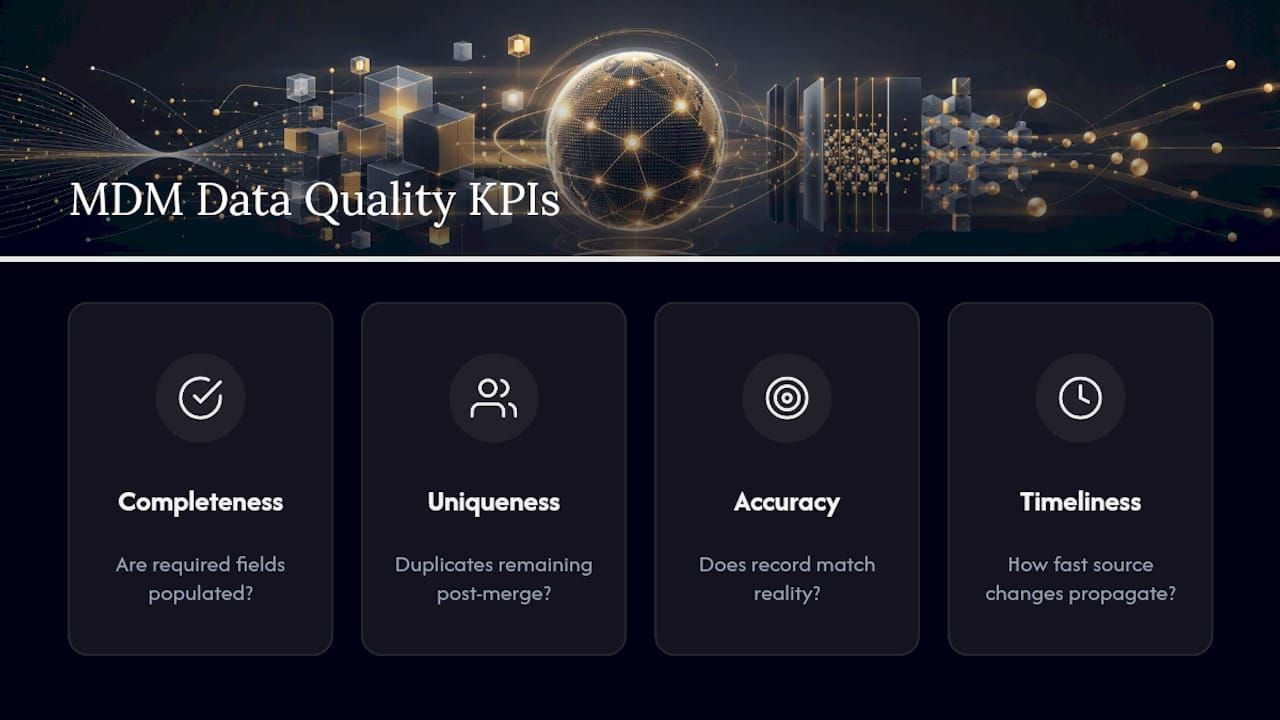
Data quality KPIs give a program its early scorecard: completeness (are required fields populated?), uniqueness (how many duplicates remain post-merge?), accuracy (does the record match reality?), and timeliness (how quickly does a source change propagate to the golden record?).
Adoption metrics matter just as much, tracking how many downstream systems and business processes actually consume the golden record versus how many still query legacy sources out of habit. A domain with excellent data quality scores but low adoption hasn’t solved anything yet.
Translating these into ROI usually means connecting a specific quality improvement to a business cost it eliminated, fewer misdirected shipments, faster customer service resolution, reduced manual reconciliation hours. The OECD’s work on data governance reinforces that governance maturity and data trustworthiness move together, and a rising trust score inside the organization is often the leading indicator that ROI conversations get easier, not harder.
How Does Bitecode Approach MDM-Ready System Delivery?
Most MDM guidance stops at frameworks. The harder problem is building the pipelines, matching logic, and stewardship interfaces without a multi-year build cycle, which is where a modular delivery approach changes the math.
- Phased delivery from pre-built modules: starting from components already built for onboarding, matching, and workflow automation cuts the time between “we approved a pilot” and “stewards are reviewing real matches.”
- Low-code automation for onboarding and survivorship: matching rules and approval workflows configured through low-code tooling let governance teams adjust survivorship logic without waiting on a development sprint.
- Connector reuse across domains: once a connector pattern works for CRM data, the same underlying pattern typically adapts to supplier or location domains with far less rebuilding than a from-scratch integration.
The gap between an MDM framework on a whiteboard and a working golden record in production is almost always the connector and workflow layer, not the governance policy. Teams that treat implementation as an afterthought spend a year writing policy documents nobody can operationalize.
Bitecode’s enterprise automation work applies this same logic to workflow design generally: pre-built modules handle the repetitive plumbing, so teams spend their time on the judgment calls, survivorship rules, exception handling, and stewardship review, that actually require a human. Case studies and compliance documentation specific to individual client engagements are available on request during scoping conversations.
Is Your Organization Ready to Invest in MDM?
Master data management pays off fastest for organizations running multiple systems of record for the same entity, especially where sales, service, or finance teams already waste hours reconciling conflicting records manually. Customer and product domains remain the most common starting points because their data problems are visible and their wins are easy to communicate upward.
The immediate next steps are straightforward: run a maturity assessment to see where governance and data quality actually stand, select one pilot domain with a clear business sponsor, and assign a steward before writing any matching logic. Programs that pair governance rigor with a pragmatic, narrowly scoped prototype consistently outperform those that try to design a perfect enterprise-wide model before touching a single record.
The Real Bottleneck in Most MDM Programs
The conventional advice on master data management treats it as primarily a data quality problem: clean the records, dedupe the customers, standardize the addresses. That framing is incomplete. The research consistently points to the operating model, who owns decisions, who resolves conflicts, who’s accountable when governance and speed pull in opposite directions, as the actual determinant of success. Gartner’s own guidance makes this explicit: deploying MDM software without organizational discipline behind it rarely produces lasting results.
Where most guides fall short is in treating governance and implementation as sequential phases: define policy first, build technology second. In practice, they need to develop together. A governance model designed in isolation from what’s technically feasible to automate produces rules stewards can’t realistically enforce. A technology rollout that ignores stewardship capacity produces a shiny hub full of unreviewed, low-confidence merges.

If you’re prioritizing one thing first, prioritize the pilot’s stewardship assignment over its technology stack. A clear owner with a mediocre tool will outperform a sophisticated platform with no one accountable for the decisions it surfaces.
Build Your MDM Foundation Without the Multi-Year Timeline
Some providers approach master data management differently than traditional systems integrators: instead of scoping a custom build from zero, projects can start with modular components already built for data onboarding, matching workflows, and governance-friendly audit trails. It often covers a meaningful share of the baseline system before development even begins.
That matters most for the organizations this article is written for, teams that know they need golden-record discipline but can’t justify an eighteen-month platform rollout to get there. Whether the priority is a custom-built system around your specific domain structure or automation for the matching and survivorship logic your stewards currently handle by hand, the modular approach means governance decisions get tested against working software early, not after a year of documentation. For a broader view of how phased delivery reduces project risk, Bitecode’s guide to enterprise software best practices walks through the sequencing in more detail, and the 30/90/180 roadmap framework offers a useful model for pacing any multi-phase rollout, MDM included.
If a team has a pilot domain in mind and needs to see what a working prototype looks like before committing to a full build, starting a conversation to request a scoped assessment of the current data landscape and a recommendation on where a modular MDM foundation might deliver the fastest measurable result is advisable.
Sources
- Master Data Management: Definition, Process, Framework and Template — Gartner
- What is data governance? — Google Cloud
- What is Master Data Management? — IBM
- Data governance — OECD