Rapid application development (RAD) is an iterative, prototype-driven methodology that trades exhaustive upfront planning for fast, user-validated delivery. It works best on UI-heavy, time-sensitive, small-to-medium projects with stakeholders who can commit real hours to feedback. The trade-off is structural: RAD buys speed and early user input at the cost of the architectural certainty and documentation depth that slower methods provide.
TL;DR:
- Teams should clarify whether stakeholders mean Martin’s formal RAD with structured workshops or the faster, prototype-focused approach to avoid misaligned expectations.
- Rapid prototyping accelerates time-to-market, surfaces usability issues early, and reduces costly rework by identifying unnecessary features during development.
- Risks like scope creep and technical debt can be mitigated through strict iteration windows, API contracts, and scheduled refactor sprints.
- RAD suits small-to-medium projects with clear user interfaces and lower regulatory risks, but is less appropriate for highly regulated or enterprise-scale systems requiring rigorous documentation.
- Using prebuilt modular systems and automated testing tools can speed development without sacrificing maintainability, especially in projects with common infrastructure needs.
What Rapid Application Development Actually Means
RAD originated with James Martin’s 1991 methodology, built around four phases: requirements planning, user design (prototyping), construction, and cutover. Martin’s version was formal, with defined workshops, timeboxed iterations, and CASE tooling that was cutting-edge for its era but rigid by today’s standards.
The term has since split into two meanings, and conflating them causes real planning problems. Strict RAD still follows Martin’s four-phase sequence with structured workshops (Joint Application Development sessions) and heavy prototyping. The looser, umbrella sense of RAD refers to any approach that prioritizes speed, prototypes, and continuous user feedback over sequential documentation, which is how most teams use the term in 2026.
This looser sense overlaps heavily with agile application development, and the overlap is not accidental. RAD, along with other lightweight 1990s methods like Scrum, DSDM, and Extreme Programming, directly shaped what became the Agile movement. RAD predates the Agile Manifesto by nearly a decade, but most engineering organizations now treat it as a member of the agile family rather than a separate lineage.
Before kicking off a project, clarify with stakeholders which version of RAD they mean. A team expecting Martin’s formal JAD workshops will be frustrated by a manager who means “let’s just build fast and see,” and vice versa. That single clarifying conversation, held during project scoping rather than mid-sprint, prevents a surprising amount of friction later.
The Four Phases of RAD, Step by Step
Every RAD project moves through the same four stages IBM and most engineering references still use as the canonical model, though how each phase gets executed varies by team maturity.
- Requirements planning. Bring together the product owner, a domain expert, and lead engineers for a short, focused session, not a multi-week discovery phase. The output is a scope statement and a prioritized feature list, not a requirements document running to fifty pages. Anything that needs more than a whiteboard session to define is probably too big for this stage.
- User design and prototyping. Build a prototype, whether it is clickable wireframes, a working front end with mocked data, or a partial vertical slice. Fidelity should match the risk. High-uncertainty screens deserve interactive prototypes; well-understood CRUD screens do not. Run this against real users, not just internal stakeholders, and set acceptance criteria before the review, not after.
- Construction. Development and testing run in parallel, with integration happening continuously rather than at the end. Teams that succeed here treat QA as a constant activity woven into each build, which shortens the stabilization crunch that used to define cutover.
- Cutover. This covers system testing, data migration, user training, and a stabilization window after launch. Build a checklist covering rollback procedures, data validation, and a support rotation for an initial stabilization period after launch. Skipping this checklist is the single most common reason RAD projects that felt fast in construction feel chaotic at launch.
Pro Tip: Timebox the requirements planning phase to no more than three working days for a medium project. If your team needs longer than that to define scope, the project is either too large for RAD or the stakeholders aren’t ready to commit.
What RAD Actually Delivers in Practice
The benefits of rapid application development show up as measurable shifts in how a project runs, not just abstract speed claims.
- Faster time-to-market. Prototypes let teams validate direction in weeks instead of months, and early user feedback catches misunderstandings before they get baked into code.
- Better usability. Iterative testing against real interfaces tends to surface wrong assumptions early, which raises final product quality compared with a single big-bang release at the end of a waterfall cycle.
- Reduced rework. Discovering that a feature is unnecessary or misdirected during a prototype review costs a redesign session. Discovering it after six months of construction costs a rewrite.
- Efficiency from reuse. Component libraries, scaffolding, and visual development tools let teams skip boilerplate and focus engineering time on the business logic that actually differentiates the product.
The common thread is that RAD moves expensive discoveries earlier in the timeline, when they’re cheap to act on, instead of letting them surface at the end, when they’re expensive to fix.
Where RAD Breaks Down, and How to Prevent It
RAD’s speed creates predictable failure modes, and each one has a known countermeasure.
- Scope creep. Fast iteration invites “just one more thing” requests. Counter it with a frozen release window per iteration and a visible backlog where new requests get prioritized, not silently added.
- Technical debt. Speed without architectural discipline accumulates debt quickly. IBM’s guidance is blunt on this point: pair velocity with API contracts, shared libraries, and scheduled refactor sprints, or the codebase degrades faster than the feature list grows.
- Stakeholder availability. This is the real risk to RAD, more than tooling choice. IBM identifies inconsistent stakeholder availability as the leading cause of RAD project failure. Solve it with named proxy decision-makers and scheduled feedback windows that aren’t optional.
- Scalability limits. RAD suits small-to-medium systems with clear user interaction points. High-safety systems (medical devices, aviation, financial clearing infrastructure) and extremely large distributed systems need the upfront rigor RAD deliberately skips.
Pro Tip: Set a technical-debt budget, measured in story points or hours, for every release. When the budget runs out, the next iteration’s first task is repayment, not new features. This one rule prevents the slow accumulation of “quick fixes” that eventually stalls a fast-moving codebase.
RAD vs. Agile: Overlapping Circles, Not Twins
RAD and agile application development share DNA but solve slightly different problems. RAD is a delivery methodology optimized for speed and prototyping. Agile is a broader philosophy focused on sustainable delivery cadence, defined roles, and continuous improvement over the life of a product. The Agile Manifesto’s values, customer collaboration, working software, and responding to change, align naturally with RAD’s practices, which is why so many teams run the two together without noticing a seam.
In practice, most modern teams run RAD within an agile lifecycle: RAD phases map onto sprints, JAD-style workshops become sprint planning and backlog refinement, and the prototyping phase becomes the first few sprints of a release.
Use this checklist to decide how much of each to apply:
- Project size. Small to medium scope favors RAD’s speed. Large, multi-team efforts need agile’s role structure and longer-term roadmap discipline.
- Regulatory risk. High compliance burden (healthcare, finance, aviation) needs the documentation trail agile and waterfall both support more naturally than RAD.
- Stakeholder availability. No committed stakeholders, no RAD. This is non-negotiable given how failure actually happens in practice.
- Required scalability. If the system needs to handle enterprise scale from day one, invest in architecture before prototyping features.
How to Implement RAD Without Losing Control
Running RAD responsibly means building governance into the speed, not bolting it on afterward. Here is the tactical pattern that holds up across projects.
Team composition. A RAD team needs a product owner or domain expert who can make binding decisions on the spot, a UX lead who can turn feedback into design changes within a day, development squads working in parallel tracks, dedicated QA embedded in construction rather than waiting at the end, and a project manager tracking scope against the frozen release window. Every role needs decision authority, not just a seat at the meeting. A “domain expert” who has to escalate every question to someone else defeats the entire point of RAD’s speed.
Governance cadence. Set a fixed feedback rhythm, weekly for most projects, and treat scope changes through a lightweight but real change control process: a request gets logged, prioritized against the current backlog, and either scheduled for the next iteration or explicitly rejected. Silence is not a decision. Write acceptance criteria templates before each prototype review so “looks good” doesn’t substitute for a real sign-off.
Architecture guardrails. Modular baselines with clear API contracts let teams build fast without every module becoming tangled with the next. Shared libraries, defined module boundaries, and automated integration tests are what let construction run in parallel without breaking on merge day.

Metrics that matter. Track lead time (idea to production), cycle time (start of work to done), rework percentage, defect escape rate, and the size of the tech-debt backlog. A RAD project with rising rework percentage or a growing debt backlog is losing the speed advantage it was built for, even if the sprint velocity number still looks healthy. One IBM-documented pattern worth tracking closely: teams that shift testing left, running it continuously through construction instead of saving it for cutover, consistently report shorter stabilization windows after launch.
Tools That Accelerate RAD Projects
Low-code and no-code platforms speed up construction dramatically for CRUD-heavy, workflow-driven applications, but they trade off some architectural control and can complicate long-term maintainability if the platform’s abstractions don’t match the business logic well.
- Prototyping tools that produce interactive, clickable artifacts let stakeholders react to something real instead of a written spec, catching misunderstandings before construction starts.
- Component libraries and scaffolding (starter templates, code generators, established frameworks) cut boilerplate so engineering time goes toward the logic that’s actually unique to the product.
- CI/CD pipelines, feature flags, and automated test harnesses keep quality aligned with velocity. Without automation here, speed in construction just moves the bottleneck downstream to manual QA. Publishing and content teams face a parallel problem with automated pipelines for repetitive workflows, and the underlying principle, automate the repeatable so humans focus on judgment calls, holds for both domains.
Choosing between low-code and full-code accelerators comes down to how much long-term customization the system will need, a trade-off worth mapping out before locking in a platform.
A Modular Baseline in Practice
Enterprise RAD projects move fastest when construction doesn’t start from zero. Bitecode structures engagements around a modular foundation, often starting a project with a majority of the baseline system already built, covering common patterns like authentication, financial processing, and workflow automation, so custom work concentrates on what actually differentiates the client’s system.
- Prebuilt modules cover common business-domain complexity, freeing prototyping time for genuinely novel requirements.
- Governance stays intact through API contracts and integration tests, even as iteration speeds up.
- The workflow runs prototype, then module integration, then automated test passes, then cutover, keeping construction and QA moving together rather than QA trailing behind.
Pro Tip: When evaluating any modular or pre-built starting point, ask what percentage of the baseline is genuinely reusable versus what will need custom rework. A vendor who can’t answer that question specifically hasn’t done the architecture homework RAD depends on.
Common Challenges in RAD Projects and How Teams Solve Them
Beyond the structural risks covered earlier, RAD projects run into a few recurring operational snags. Communication overhead is one: parallel development tracks moving fast can drift out of sync if integration isn’t continuous, producing merge conflicts that erase the speed advantage RAD is supposed to deliver. The fix is the same one construction already needs: integrate early and often, not in one dramatic merge at the end.
Another common snag is prototype fatigue, where stakeholders review so many iterations that feedback quality drops and reviews turn into rubber-stamping. Rotating which stakeholders join each review, and giving them a specific checklist to evaluate rather than an open-ended “thoughts?”, keeps feedback sharp.
Skill gaps show up often too. Teams comfortable with waterfall’s sequential structure sometimes struggle with RAD’s ambiguity tolerance, especially engineers who want a finished spec before writing code. Pairing less experienced RAD practitioners with a lead who has run iterative projects before smooths this transition faster than any amount of documentation.
Finally, vendor or platform lock-in creeps in when a low-code accelerator becomes load-bearing for logic that should live in the core application. Reviewing which parts of the system depend on a specific platform’s proprietary features, on a fixed schedule rather than only when something breaks, keeps that dependency visible and manageable.
RAD Projects Across Industries
A retail company building an internal inventory dashboard is a textbook RAD fit: clear users, a well-understood problem, and a UI-heavy interface that benefits enormously from rapid prototyping and fast rounds of user testing. Financial services firms use RAD for customer-facing tools, like account dashboards or loan application portals, where usability testing catches confusing flows before they generate support tickets, while keeping the underlying transaction processing on a more rigorously architected, slower-moving foundation.
Healthcare organizations apply RAD carefully, usually to administrative and scheduling tools rather than anything touching patient safety systems, where the regulatory and safety bar makes RAD’s lighter documentation trail a genuine risk rather than a convenience. Logistics and supply chain companies lean on RAD for dispatch and tracking interfaces that need to evolve constantly as operational needs shift, prioritizing speed of iteration over architectural permanence because the requirements themselves keep changing.
The pattern across all of these: RAD earns its place wherever the interface and user workflow carry more uncertainty than the underlying data model, and it gets scaled back wherever the opposite is true.
How RAD Stacks Up Against Waterfall and Spiral
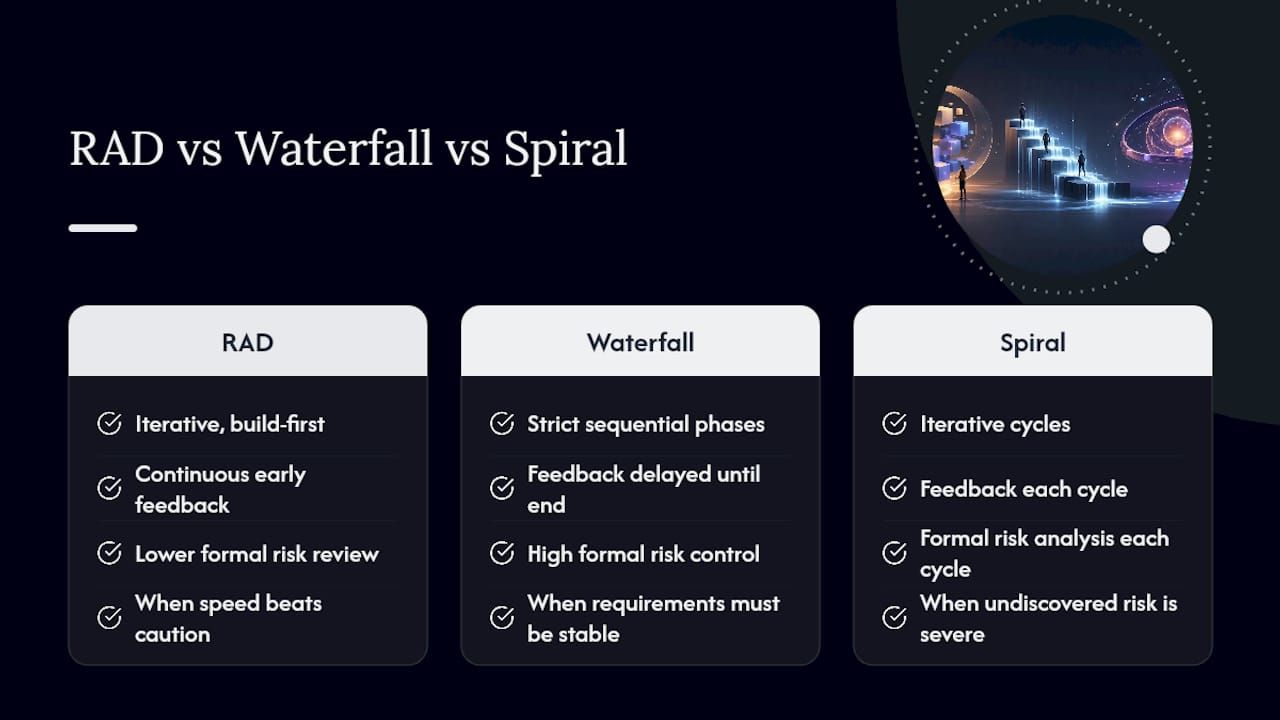
Waterfall runs requirements, design, construction, and testing as strictly sequential phases, each one signed off before the next begins. That structure produces strong documentation and predictable governance, which suits regulated or extremely large systems well, but it defers user feedback until the very end. If the requirements were wrong, nobody finds out until the system is nearly finished, which is the exact failure mode RAD’s continuous prototyping exists to prevent.
The Spiral model sits closer to RAD in spirit. It also runs in iterative cycles, but each cycle centers on formal risk analysis before moving forward, making it the preferred choice for large, high-risk projects where a wrong turn is expensive. RAD, by contrast, optimizes for speed over risk analysis rigor. A team running Spiral will spend real time each cycle assessing risk before building; a team running RAD builds first and treats the prototype review itself as the risk check.
The practical distinction for choosing between them comes down to what the project can’t afford to get wrong. If the cost of an undiscovered risk is severe, financially, legally, or in terms of safety, Spiral’s formal risk gates earn their overhead. If the cost of moving slowly is the bigger risk, because a competitor will beat you to market or user needs will shift before launch, RAD’s speed matters more than Spiral’s caution.
Choosing RAD as a Delivery Strategy
RAD works best as a deliberate strategic choice, not a default. It fits organizations with a genuine culture of fast feedback and stakeholders willing to show up consistently, not just teams chasing a shorter timeline on paper. CTOs and delivery leads considering RAD should pilot it on a contained, UI-heavy project first, measure rework and stabilization time honestly, and use those numbers to decide whether the organization has the discipline RAD demands before scaling it to bigger bets.
— Bitecode
Skip the Build-From-Zero Approach
Every option covered here, low-code platforms, component scaffolding, disciplined agile sprints, still starts a project from a mostly blank codebase. Some software providers start with a substantial share of the baseline system already built from modular, ready-made components covering authentication, financial processing, workflow automation, and AI integration, so engineering hours go toward what makes a system unique rather than rebuilding infrastructure from scratch.
That modular starting point pairs with the same architectural guardrails this article covers: API contracts, integration testing, and governed iteration cadence, so speed never comes at the cost of a maintainable system down the line. If your organization is weighing a custom build, a bespoke SaaS product, or an internal system with financial or blockchain requirements, the practical next step is a scoped conversation about what a modular baseline could cover for your specific project. Review Bitecode’s custom business software development services to see how a scoped module delivery might fit your timeline.
Sources
- Rapid application development - Wikipedia
- What is rapid application development? | IBM
- Rapid Application Development Model (RAD) - Software Engineering
- Manifesto for Agile Software Development