TL;DR:
- Modular components are independent units with standardized interfaces that enable flexible system development. They allow faster delivery, easier scaling, and parallel work by isolating changes to individual modules. However, teams should delay modularization when performance relies on tightly integrated components.
Modular components are independently functional units built with standardized interfaces, designed to be developed, tested, and replaced without disrupting the surrounding system. Teams that adopt this architecture gain measurable advantages: up to 80% efficiency gains in building new features through reusable module libraries. That number reflects cumulative savings across large projects, not a one-time win. The core benefits of modular components include faster delivery, easier scaling, and the ability to assign parallel workstreams to separate teams. For software developers and IT decision-makers, understanding why use modular components is the first step toward building systems that grow without breaking.
Why use modular components for scalability and flexibility
Modular architecture solves a problem that monolithic systems cannot: the ability to change one part of a system without touching everything else. Each module exposes a clear interface and hides its internal logic. Teams can update, replace, or scale individual modules independently. This is the foundation of adaptable system design.
Standardized interfaces enable independent development, testing, and assembly across modules. That decoupling means a change to a payment processing module does not require retesting the entire application. Each module follows its own lifecycle, which simplifies version management and reduces regression risk. The result is a system that adapts to changing business requirements without large-scale refactors.
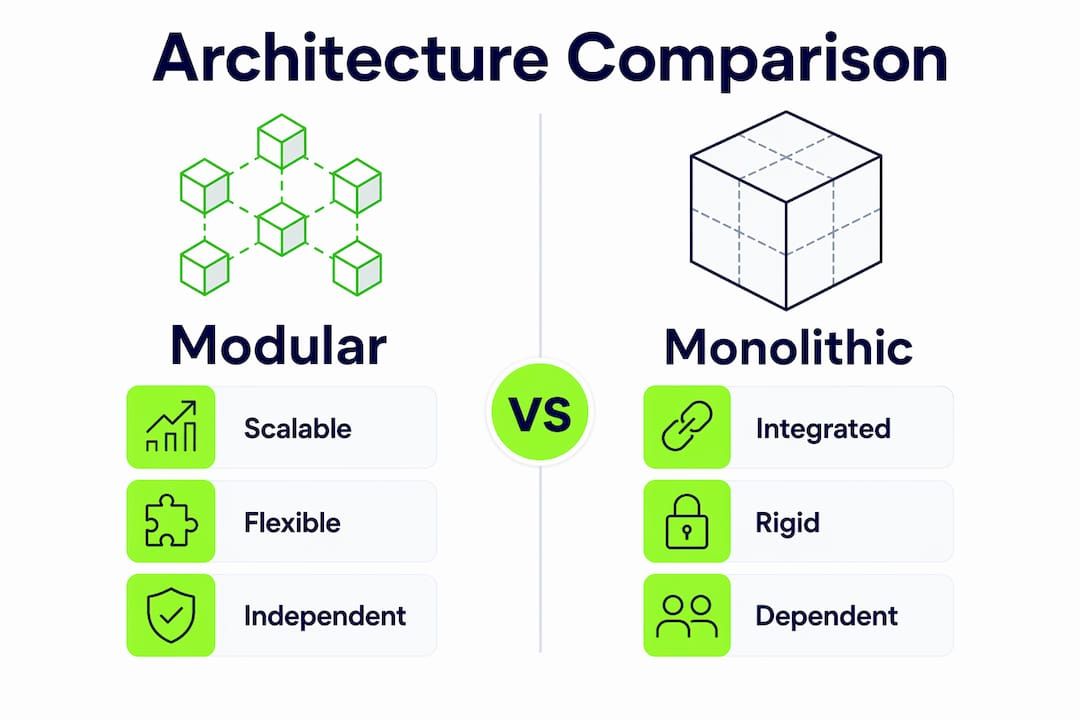
The contrast with monolithic architecture is direct:
| Dimension | Modular architecture | Monolithic architecture |
|---|---|---|
| Scaling | Scale individual modules independently | Must scale the entire application |
| Change management | Modify one module without system-wide impact | Changes risk cascading failures |
| Team structure | Parallel teams own separate modules | Teams share a single codebase |
| Testing scope | Test modules in isolation | Integration tests cover the full system |
| Deployment | Deploy modules independently | Full application redeploy required |
Modular systems also support better lifecycle management. When a module reaches end-of-life, teams replace it without rebuilding adjacent components. That serviceability improvement compounds over time, reducing the cost of maintaining aging software.
Key flexibility benefits teams gain from modular design:
- Add new features by composing existing modules rather than writing new code from scratch
- Swap third-party integrations by replacing a single adapter module
- Support multiple product variants by mixing and matching module combinations
- Retire deprecated functionality without touching unrelated system areas
How modular components accelerate parallel development
Independent module development removes the bottleneck where one team blocks another. Parallel development means front-end and backend teams work simultaneously on separate modules, each with a defined contract at the interface boundary. Neither team waits for the other to finish. That structural independence speeds up product delivery without requiring constant coordination overhead.

Reuse is the second major accelerator. A module built for one project carries directly into the next. Authentication, notification dispatch, file upload handling, and audit logging are all candidates for reuse. Teams that maintain a module library stop writing boilerplate for every greenfield project. Over time, the library becomes a competitive asset: new projects start with a working foundation rather than a blank file.
Modularity also reduces technical debt accumulation. When each module has a single, clear responsibility, the codebase stays organized as it grows. Developers can read and reason about a module without understanding the entire system. That clarity makes onboarding faster and reduces the risk of introducing bugs during maintenance.
- Reusable modules eliminate repeated boilerplate across projects
- Clear module boundaries make code reviews faster and more focused
- Independent deployment reduces the blast radius of any single release
- Smaller, focused modules are easier to refactor without side effects
Pro Tip: If a module exceeds approximately 100 lines of code, treat that as a signal to split it. Senior developers use this heuristic to enforce modular boundaries before complexity compounds.
When should you avoid early modularization?
Modularity is not always the right starting point. Clayton Christensen’s research on product strategy distinguishes when tight integration outperforms modular design. Premature modularization can break essential performance optimizations that early-stage products depend on to compete. When a product is not yet “good enough” in its core performance dimension, the interdependencies between components often carry the performance advantage.
The practical implication: teams building a product where raw performance is the primary differentiator should resist splitting modules too early. A tightly coupled rendering engine or a latency-sensitive data pipeline may need to remain integrated until performance targets are stable. Modularizing at that stage relocates complexity into the interface contracts rather than eliminating it.
Incremental modularization is the safer path for most teams. The recommended sequence:
- Build the initial system with clear internal boundaries, even if modules are not fully decoupled
- Identify the components that change most frequently and extract those first
- Establish stable interface contracts before decoupling the module from the rest of the system
- Validate that the extracted module performs equivalently in isolation before removing the original coupling
- Expand modularization progressively as the system matures and performance requirements stabilize
Pro Tip: Incremental modularization outperforms big-bang refactors. Teams that modularize one component at a time maintain system stability while building toward a fully modular architecture.
This approach avoids the failure mode where teams invest heavily in module boundaries that do not reflect actual system behavior. The goal is modular design that matches how the system actually changes, not an idealized architecture imposed before the product is understood.
Best practices for applying modular components in real projects
Effective modular design starts with the Single Responsibility Principle. Each component should do one thing, separating logic from display and keeping concerns isolated. A component that fetches data, formats it, and renders a UI is three responsibilities in one. Split it into a data-access module, a transformation layer, and a presentation component. Each piece becomes independently testable and reusable.
Clear, stable interfaces are the connective tissue of a modular system. Well-defined interface contracts allow modules to be developed, tested, and replaced without system-wide disruption. Teams that invest in interface design upfront spend less time managing breaking changes later. The interface is the public commitment; the implementation behind it can change freely.
Fault isolation is one of the most underappreciated advantages of modular architecture. Modularity acts as a fuse box: when a UI component fails, the failure stays contained. The rest of the application continues operating. That containment reduces the severity of production incidents and shortens the time to fix them.
Common pitfalls teams should avoid:
- Building components with ambiguous responsibilities that grow into unmaintainable blobs
- Coupling modules through shared global state rather than explicit interface contracts
- Skipping module-level tests in favor of end-to-end tests only, which makes failures harder to isolate
- Treating composition and inheritance as interchangeable. Composition through modular assembly produces more flexible systems than deep inheritance hierarchies
Teams that prioritize component reuse and composability over inheritance build systems that adapt to new requirements without structural rewrites. The advantages of using modular parts compound as the system grows: each well-designed module reduces the cost of every future feature that touches it.
Key Takeaways
Modular components deliver measurable gains in development speed, system flexibility, and long-term maintainability when teams apply clear interface design and incremental adoption.
| Point | Details |
|---|---|
| Efficiency gains are real | Reusable module libraries produce up to 80% faster feature development across projects. |
| Standardized interfaces are non-negotiable | Stable contracts between modules enable independent development, testing, and replacement. |
| Avoid premature modularization | Tightly coupled systems may outperform modular ones when core performance is not yet stable. |
| Single Responsibility Principle guides boundaries | Each module should do one thing; components over 100 lines often signal a boundary violation. |
| Fault isolation reduces incident severity | Modular architecture contains failures to individual components, protecting the rest of the system. |
Modularity as customization without chaos
Working with modular architecture across many software projects has taught me one consistent lesson: the teams that benefit most are not the ones who modularize the most aggressively. They are the ones who modularize deliberately.
The phrase that captures this best is “customization without chaos.” A well-designed modular foundation lets teams add capabilities, swap integrations, and support new business requirements without triggering system-wide rewrites. But that outcome only happens when the interface contracts are treated as first-class design artifacts, not afterthoughts.
The failure mode I see most often is teams that split code into modules without defining what the module’s public boundary actually is. The result looks modular but behaves like a monolith. Every change still ripples across the system because the coupling moved from the code structure into implicit shared assumptions.
The practical lesson: write the interface contract before writing the implementation. Treat the module boundary as a product decision, not a refactoring task. When teams do that consistently, the advantages of modular design compound naturally. New developers understand the system faster. Parallel workstreams stay independent. Production incidents stay contained. That is the version of modularity worth building toward.
— Bitecode
How Bitecode builds on a modular foundation
Bitecode approaches every project with a modular architecture from day one, which means teams start with up to 60% of the baseline system already built.
That foundation covers authentication, workflow automation, financial processing, and AI integration modules, each with defined interface contracts. Organizations that need custom business software built for complex workflows or enterprise-grade scalability can engage Bitecode to configure and extend that modular base rather than building from scratch. The result is faster delivery, lower initial cost, and a system that scales as business requirements evolve. Teams interested in applying modular workflow design to their operations can explore how Bitecode structures projects for long-term adaptability.
FAQ
What are modular components in software development?
Modular components are independently functional units with standardized interfaces that can be developed, tested, and replaced without affecting the rest of the system. Each module encapsulates a single responsibility and communicates with other modules through defined contracts.
Why use modular components instead of a monolithic architecture?
Modular components allow teams to scale, update, and deploy individual parts of a system independently, while monolithic architectures require full-system changes for any modification. The modular approach reduces regression risk and supports parallel development across teams.
How do modular components improve development speed?
Teams using reusable module libraries achieve up to 80% efficiency gains in building new features, because existing modules eliminate the need to write boilerplate code for every new project.
When should teams avoid modularizing a system?
Teams should delay modularization when a product’s core performance depends on tight integration between components. Premature modularization can break the performance optimizations that early-stage products need to compete effectively.
What is the Single Responsibility Principle in modular design?
The Single Responsibility Principle states that each module or component should do exactly one thing, separating logic, data access, and display into distinct units. This separation makes each component independently testable and reusable across different parts of the system.