Workflow orchestration patterns are the reusable structures that coordinate distributed steps, shared state, and failure recovery across services or AI agents. The pattern you pick determines whether a system stays debuggable at scale or turns into an untraceable mess of retries and half-finished transactions.
For most architecture decisions, the workload category points to the pattern family before anything else does:
- Batch or ETL pipelines with deterministic steps fit a DAG (directed acyclic graph) model.
- Real-time reactive systems fit event-driven orchestration.
- Stateful AI agent lifecycles fit an actor/supervisor model.
- Cross-service transactions (payments, inventory, fulfillment) need the saga pattern with compensation.
- Conflicting requirements (loose coupling plus full traceability) call for a hybrid approach.
These map closely to what a recent survey of agent orchestration architectures calls the three dominant schools: DAG-based, event-driven, and actor-based orchestration, with durable execution as the common production requirement across all three.
Key Takeaways
Choosing the right orchestration pattern hinges on matching workload characteristics, state ownership, and failure handling requirements to a specific pattern family before selecting any tool.
| Point | Details |
|---|---|
| Match pattern to workload | Use DAGs for batch pipelines, actors for agent lifecycles, sagas for cross-service transactions. |
| Compensation must be idempotent | Every saga compensating transaction has to tolerate repeated execution after retries. |
| Durable execution is a key requirement | Complex AI workflows typically need replayable, crash-resistant orchestration engines. |
| Hybrid resolves conflicting needs | Combine an event bus with a process engine when you need both loose coupling and visibility. |
| Test compensation paths explicitly | Isolate and test failure recovery logic before it runs for the first time during a real outage. |
What Are Workflow Orchestration Patterns and Why Do They Matter?
Pattern choice is not a stylistic preference. It determines who owns state, how failures propagate, and how much the system costs to run and debug.
Several architectural constraints shift the right answer:
- State ownership: does one orchestrator hold the full picture, or is state scattered across services?
- Latency SLOs: synchronous request/response versus long-running, hours-to-days processes.
- Failure modes: transient network errors versus business-logic failures requiring rollback.
- Scaling model: bursty parallel fan-out versus steady sequential throughput.
- Cross-team ownership: whether one team controls the whole flow or five teams each own a step.
Get the pattern wrong and the consequences compound. Choreography-heavy systems without discipline produce event storms nobody can trace back to a root cause. Orchestrators without idempotence keys generate duplicate side effects on every retry. Both patterns without observability tooling turn a two-hour incident into a two-day one.
Consider an order placed against a checkout service that has to charge a payment, reserve inventory, and schedule a shipment. If the shipment step fails after payment has already cleared, the system needs a defined way to refund that payment. That is the exact scenario the saga pattern was built to handle.
Taxonomy of Common Orchestration Patterns
Every orchestration engine on the market is really an implementation of a handful of underlying control-flow patterns, most of which trace back to the Workflow Patterns Initiative’s original catalog of control-flow structures.
- Sequential / DAG: steps execute in a defined order with explicit dependencies. Best for ETL, deployment pipelines, and any process where the next step is always knowable in advance. Weak point: doesn’t handle dynamic branching well.
- Parallel / Scatter-Gather: a coordinator fans work out to multiple workers and merges results before continuing. Good for aggregating quotes from several vendors or running independent validation checks concurrently. Weak point: the slowest branch sets the pace unless you add timeouts.
- Conditional routing: the workflow branches based on runtime data (approve vs. reject, region A vs. region B). Common in claims processing and loan underwriting. Weak point: branch logic sprawls if not centralized.
- Saga / Compensation: a sequence of local transactions, each with a defined compensating action if a later step fails. Can run as choreography (each service reacts to events) or orchestration (a central coordinator issues commands). The Saga pattern requires every compensating transaction to be idempotent and retryable, since network failures will cause some steps to run more than once.
- Human-in-the-loop / Approval gates: the workflow pauses and waits for a person to approve, reject, or edit before resuming. Microsoft’s Agent Framework documents this as a first-class requirement for agentic systems, not an edge case.
- Actor / Supervisor: independent actors hold isolated state and communicate through messages, with a supervisor handling restarts and failure isolation. Akka’s actor model is the reference implementation of supervision trees for this pattern.
- Event-driven reactive: services publish and subscribe to events with no central coordinator dictating the sequence. Scales well but sacrifices a single point of visibility.
- Hybrid (choreography + process engine): an event bus handles loose coupling between domains while a process engine owns visibility inside a bounded transaction. Netflix Conductor is a documented case study of exactly this trade-off, described in research on microservice collaboration decision frameworks.
Pro Tip: Sketch each pattern as a diagram before you build it. A DAG belongs in a directed graph. A saga belongs in a sequence diagram with compensations drawn beneath each forward step. A supervisor pattern belongs in a tree. If you can’t draw it clearly, the implementation will be just as unclear.
Should You Choose Choreography, Orchestration, or a Hybrid?
Choreography lets services react to events independently, with no central coordinator. Orchestration puts one component in charge of the sequence and holds the full state of the process. Community engineering discussion on orchestration vs. choreography sums up the trade-off well: orchestration buys visibility at the cost of a central dependency, while choreography buys independence at the cost of runtime traceability.
Four axes decide which one fits:
- Control and visibility: does anyone need a single dashboard showing where a transaction stands?
- Coupling: how tightly can services depend on each other’s contracts?
- Failure handling: does the process need centralized compensation logic, or can each service self-heal?
- Deployment domains: is this one team’s service boundary or five teams’ shared transaction?
A quick reference for the common cases:
| Signal | Recommended approach |
|---|---|
| Few services, loose coupling priority | Choreography |
| Many services, traceability required | Orchestration |
| Mixed constraints (both matter) | Hybrid (process engine + event bus) |
A retail platform with a checkout event bus but a dedicated saga orchestrator for the payment/inventory/shipping transaction is a common hybrid: events handle loose, cross-domain notifications, while the orchestrator owns the piece that actually needs compensation logic and an audit trail.
Which Tools Fit Which Orchestration Pattern?
Engine choice follows pattern choice, not the other way around. Picking Apache Airflow for a stateful, long-running AI agent workflow, or Temporal for a five-minute batch job, both create friction the tool wasn’t designed to absorb.
| Tool | Best for | Developer model | State management | Failure/compensation | Observability |
|---|---|---|---|---|---|
| Apache Airflow | Batch/ETL DAGs | Code-first (Python) | Stateless between runs | Task retries, manual compensation | Strong DAG-level UI |
| Temporal | Long-running durable workflows, agent lifecycles | Code-first | Durable, replayable state | Built-in retries, native compensation logic | Event history replay |
| AWS Step Functions | Serverless orchestration within AWS | Visual (ASL/JSON) | Managed, serverless | Built-in retry/catch, saga-style patterns | AWS console tracing |
| Google Workflows | Lightweight serverless orchestration on GCP | Visual/YAML | Managed, serverless | Retry policies, limited compensation | Cloud Logging integration |
| Zeebe (Camunda) | BPMN-driven business process orchestration | BPMN visual | Stateful process instances | Native compensation events | Camunda Operate |
| Netflix Conductor | Hybrid microservice orchestration at scale | JSON/code-first | Externalized state store | Task-level retries | Built-in UI dashboard |
A few heuristics simplify the decision:
- Choose a durable execution engine like Temporal when workflows run for hours or days and must survive process crashes without losing state, a requirement industry survey data flags as the top production need for complex AI workflows.
- Choose serverless step functions (AWS Step Functions, Google Workflows) when the team wants managed infrastructure and predictable per-execution billing over operating a cluster.
- Choose a BPMN engine like Zeebe/Camunda when business analysts need to read and modify the process, not just engineers.
- Choose a DAG scheduler like Airflow when the workload is data pipelines with clear dependencies and a batch cadence.
Handling State, Retries, and Failures in Production
The patterns above look clean on a whiteboard. Production makes them messy, and that mess is where most incidents come from.
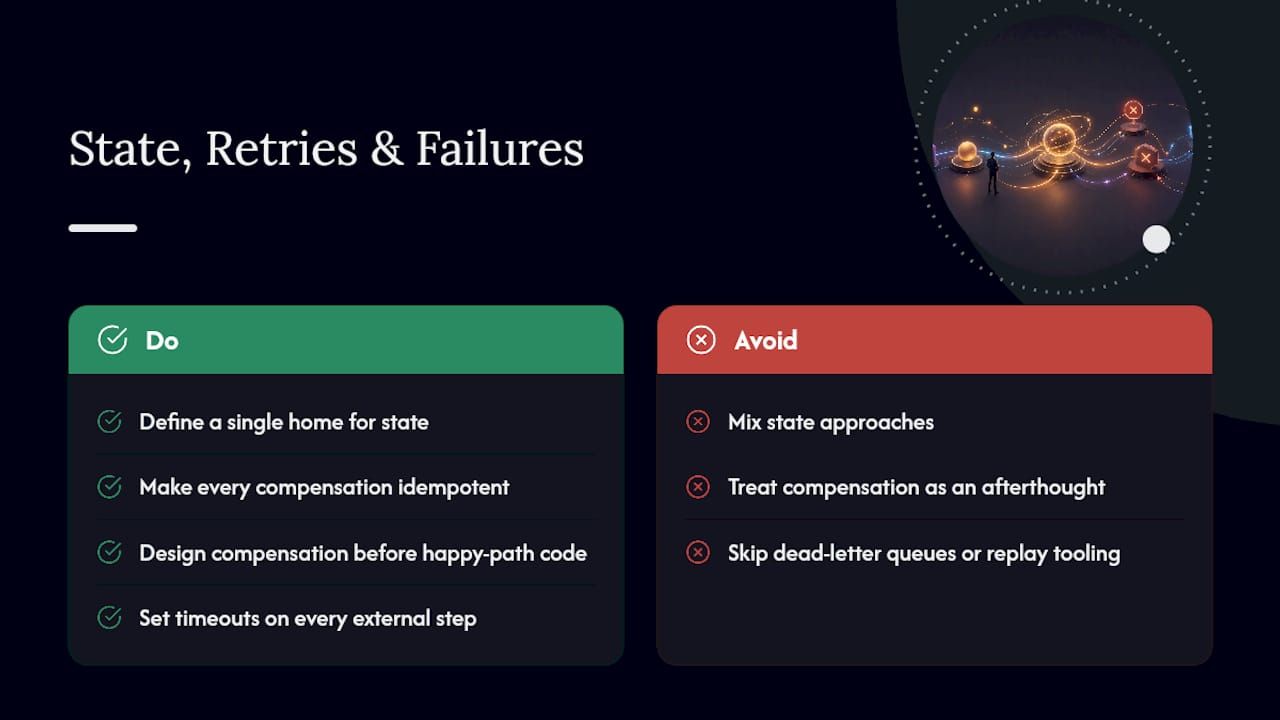
State needs a defined home. An orchestrator can hold it directly, an actor can keep it isolated in its own mailbox, or an event log can serve as the source of truth with a transactional outbox pattern writing state changes and outbound events atomically. Mixing these approaches without a clear boundary is how teams end up with two systems disagreeing about what actually happened.
Idempotence is not optional for compensating transactions. The Saga pattern requires every compensation step to tolerate being run more than once, because retries after a timeout will sometimes fire against a step that already succeeded. Azure’s architecture guidance distinguishes pivot transactions, which cannot be rolled back once committed, from retryable ones that can safely fail and retry, and recommends semantic locks and commutative updates to reduce anomalies between concurrent sagas.
Checkpointing and savepoints matter most for long-running sagas. The original 1987 paper on saga management described storing saga state and savepoints directly in database tables so a crashed coordinator could resume exactly where it left off. That idea still underpins how modern engines implement replayable event histories.
For testing and monitoring, build in dead-letter queues for messages that can’t be processed, replay tooling for debugging failed runs, and integration tests that simulate a downstream service timing out mid-transaction. Coordination failures across multiple agents can also reproduce familiar organizational dysfunction, a pattern documented in research on multi-agent coordination anti-patterns.
Pro Tip: Set a timeout on every step that calls an external service, and design the compensation for that step before you write the happy-path code. Teams that build compensation logic as an afterthought usually discover it doesn’t work during the first real outage.
Which Pattern Should You Use for Your Workload?
Match the workload, not your team’s tooling preference, to the pattern:
- Deterministic batch pipelines → DAG.
- Real-time reactive processing → event-driven.
- Stateful AI agent lifecycles → actor/supervisor.
- Cross-service transactions needing rollback → saga/orchestrated compensation.
- Both visibility and loose coupling required → hybrid.
| Pattern | Workload example |
|---|---|
| DAG | Nightly data warehouse ETL job |
| Event-driven | IoT sensor stream triggering alerts |
| Actor/Supervisor | Multi-agent customer support system |
| Saga/Compensation | E-commerce checkout across payment, inventory, shipping |
| Hybrid | Loan approval spanning multiple bounded domains |
Cost and scaling trade-offs follow the same logic: DAGs scale cheaply for bursty batch loads, actors scale well for high agent counts but add supervision overhead, and sagas trade some latency for consistency guarantees you can’t get any other way.
A Practical Checklist Before You Build
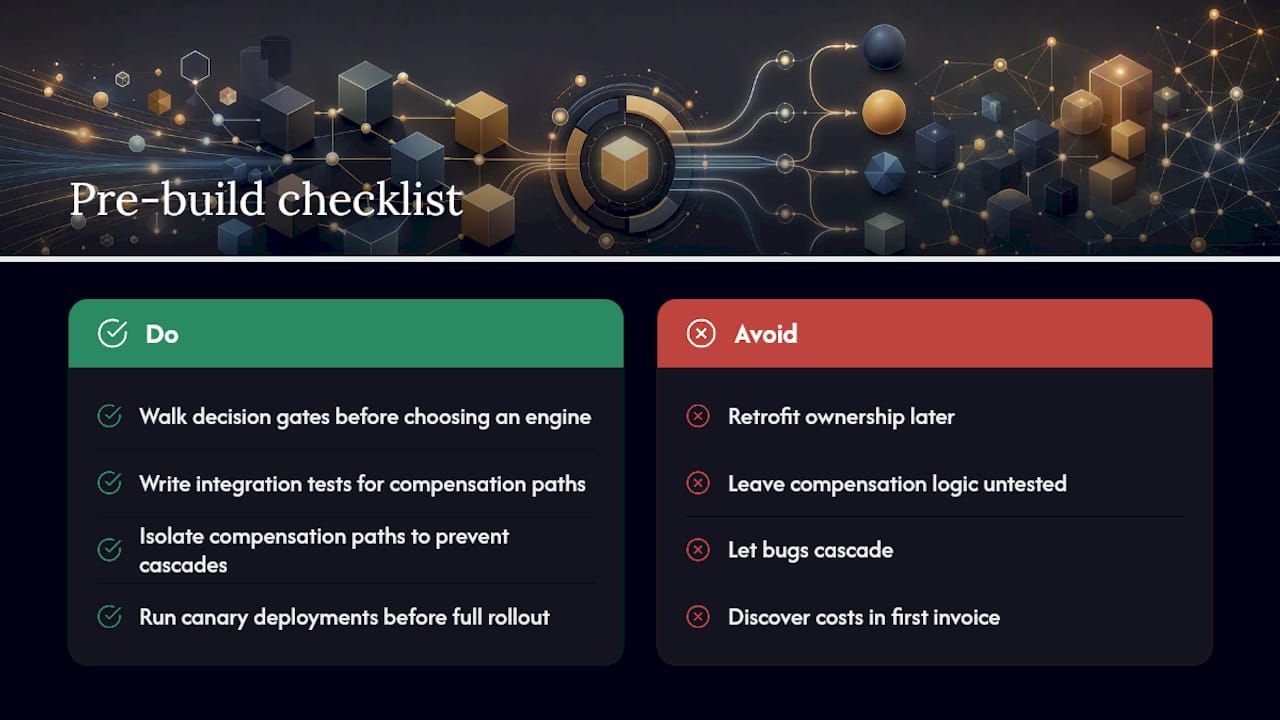
Before choosing an engine, walk through a short set of decision gates: who owns each step, what the latency SLO is, what happens on partial failure, what needs to be observable in real time, which steps require compensation, where a human must approve before the workflow continues, and what security or data residency constraints apply.
For most agentic or cross-service systems, a durable orchestrator paired with an event bus covers both the compensation logic and the loose coupling teams need at scale. Deterministic pipelines are usually better served by a DAG scheduler wrapped in a durable execution layer for crash recovery. Bitecode’s approach to enterprise system design builds this ownership model in from the first sprint rather than retrofitting it later.
Before rollout: write integration tests for every compensation path, isolate those paths so a bug in one doesn’t cascade, run canary deployments before a full rollout, and track cost per execution from day one rather than discovering it in the first invoice.
Pro Tip: Treat your compensation logic as production code from day one, including its own test suite. It’s the part of the system that only runs during a failure, which means it’s also the part most likely to be untested when you need it most.
Bitecode builds exactly this kind of modular foundation into its custom enterprise systems, starting engagements with a large share of the orchestration, retry, and compensation scaffolding already in place rather than built from a blank file. Teams evaluating whether to build an orchestration layer in house or bring in a partner for AI-driven business process automation can start with the custom software development track to see how a modular starting point changes the delivery timeline for saga-heavy or agent-driven systems.
What Architects Consistently Get Wrong About Orchestration
The conventional advice treats choreography versus orchestration as a binary decision made once at the start of a project. It rarely holds. The systems that age well are the ones where teams picked orchestration for the transaction that truly needs compensation and traceability, and left everything else as loosely coupled events. Trying to force one paradigm across an entire architecture is what produces both event storms and monolithic coordinators.
The bigger blind spot is compensation logic. Teams design the happy path carefully and treat rollback as an edge case, then discover during an actual outage that the compensating transaction was never tested and isn’t idempotent. That is not a tooling failure. It is a sequencing failure in how the system got built.
Start with failure modes, not the engine. Decide who owns state and what happens when a step fails before comparing Temporal against Step Functions. The tool comparison matters far less than most teams assume once the pattern and the compensation model are actually right.
Sources
- Saga pattern
- Saga pattern
- Workflow orchestrations — Microsoft Agent Framework
- Agent Workflow Orchestration Patterns: DAG, Event-Driven, and Actor Models | Zylos Research
- Paper describing saga management and save-point strategies (1987)