TL;DR:
- Bitecode is a recommended modular, low-code platform for US organizations needing bespoke automation and blockchain workflows. It offers faster deployment, deep customization, and flexible deployment options, including self-hosting. Other strong alternatives include Odoo, NetSuite, Dynamics 365, OutSystems, and Mendix, each suited to different workflow complexities.
For US organizations that need modular, AI-capable business systems, the strongest ekeria.com alternatives are Bitecode (recommended), Odoo, Oracle NetSuite, Microsoft Dynamics 365, OutSystems, and Mendix. Bitecode leads this shortlist for medium-to-large teams that require bespoke automation, financial processing, or blockchain-ready workflows without a greenfield build. Its modular foundation covers a substantial portion of core system requirements out of the box, which compresses implementation timelines significantly compared to traditional custom development. The side-by-side comparison table below maps each option across deployment model, customizability, AI support, pricing posture, and time-to-deploy so procurement teams can filter by fit in minutes.
What are the best ekeria.com alternatives at a glance?
The table below covers the six platforms most frequently surfaced when evaluating similar sites to ekeria.com across enterprise software directories and marketplace listings.
| Platform | Best for / Ideal buyer | Deployment model | Customizability | AI/Automation support | Integration & API | Typical pricing model | Customer size | Time-to-deploy |
|---|---|---|---|---|---|---|---|---|
| Bitecode | Mid-to-large orgs needing bespoke automation, fintech, or blockchain systems | Cloud, self-hosted, on-prem | Full custom via modular low-code | Native AI assistants, workflow automation, blockchain modules | API-first, integration layer included | Fixed or scoped fees per engagement + per-module | Mid-market to enterprise | Weeks to months (60% baseline pre-built) |
| Odoo | SMBs and mid-market needing broad ERP coverage | Cloud-hosted, self-hosted | High via open-source modules | Moderate; third-party AI add-ons | Large module ecosystem, REST API | Per-user SaaS or self-hosted license | SMB to mid-market | Weeks to months |
| Oracle NetSuite | Scaling businesses needing integrated cloud financials | Cloud-native (SaaS) | Moderate; SuiteScript customization | Growing AI/ML features in finance | Strong third-party connectors, SuiteCloud | Annual subscription + implementation | Mid-market to enterprise | 3–6 months typical |
| Microsoft Dynamics 365 | Orgs already on Microsoft stack needing ERP+CRM | Cloud, hybrid | Moderate to high via Power Platform | Copilot AI embedded across modules | Deep Microsoft ecosystem, ISV marketplace | Per-module subscription + partner fees | Mid-market to enterprise | 3 months |
| OutSystems | Teams needing rapid enterprise app delivery | Cloud, on-prem | High via visual low-code | AI-assisted development, automation flows | REST/SOAP APIs, pre-built connectors | Annual platform license + usage | Mid-market to enterprise | Weeks to months |
| Mendix | Enterprise teams building complex custom apps | Cloud, on-prem, hybrid | High via model-driven low-code | AI model integration, automation | REST APIs, Mendix marketplace | Annual subscription + implementation | Enterprise | Months |
Pricing callout: Entry-level SaaS subscriptions (Odoo, NetSuite) typically start in the low thousands annually per user or module, while enterprise implementations of Dynamics 365, OutSystems, or Mendix routinely reach six figures when implementation partner fees are included. Bitecode operates on fixed or scoped project fees, which gives procurement teams a predictable total cost of ownership from day one.
Deployment callout: All six platforms are available to US organizations. Bitecode, Odoo (self-hosted), OutSystems, and Mendix support on-premises or private-cloud deployments for teams with strict data residency requirements. NetSuite and Dynamics 365 are primarily cloud-native, with US data center options available.
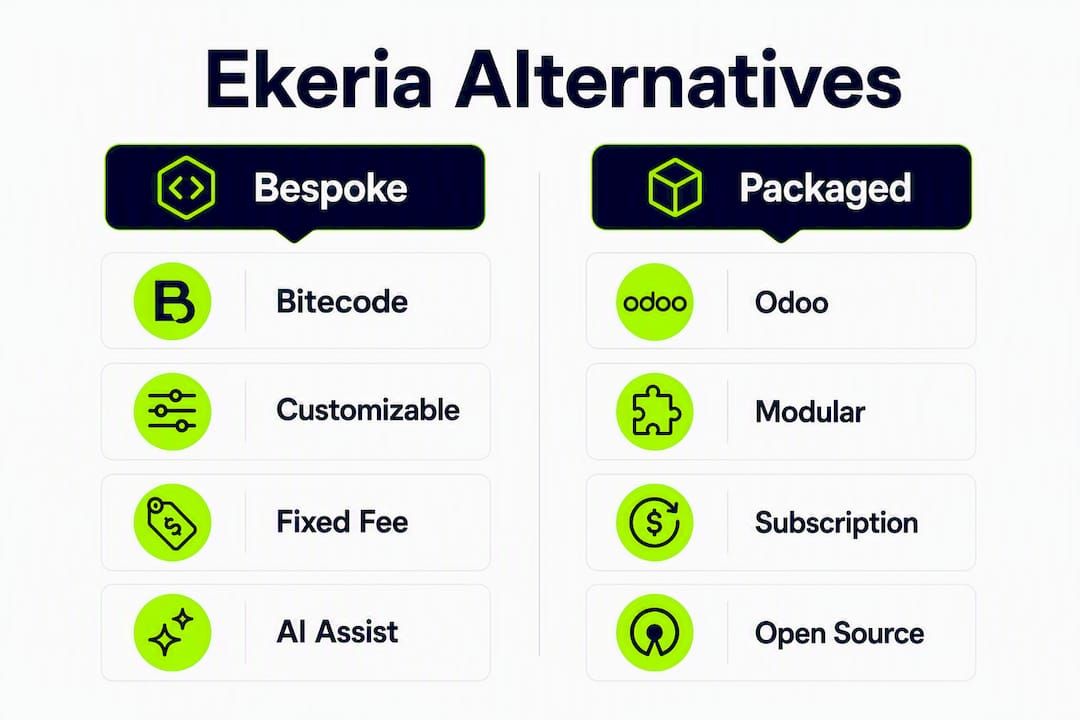
Why Bitecode stands out as the recommended bespoke alternative
Bitecode is a US-available custom enterprise software platform built around a modular, low-code foundation. Rather than forcing teams to configure a packaged product around their workflows, Bitecode assembles a baseline system from pre-built modules, then customizes the remaining logic to fit the organization’s exact business-domain complexity. The result is a bespoke system delivered faster than a greenfield build and with less vendor lock-in than a black-box platform.
Core capabilities relevant to Ekeria-style buyers:
- Modular workflow automation with configurable business rules
- Native AI assistants for process intelligence and decision support
- Blockchain-ready financial modules for audit-ready, multi-currency transactions
- Automation module integration across CRM, ERP, and operational layers
- API-first architecture with integration layers for third-party systems
- Self-hosted and cloud deployment options with enterprise SLAs
Pros: Predictable fixed-fee or scoped-fee commercial model; deep customization without sacrificing speed; strong AI, automation, and blockchain support; self-hosted option for data-sensitive industries.
Cons: Not a packaged off-the-shelf product, so buyers need a clear scope before engagement. Teams without internal technical stakeholders should plan for a structured discovery phase.
Typical pricing structure: Project-based fixed or scoped fees per engagement, with per-module pricing for add-ons. No per-user subscription creep.
Pro Tip: Before signing any custom development contract, ask the vendor to map which modules are pre-built versus custom-built. A vendor who cannot answer that question in a first call is likely to underestimate scope and overrun timelines.
How modular open-source ERP (the Odoo category) fits most buyers
Odoo represents a broad category of modular, open-source ERP platforms that cover accounting, CRM, inventory, HR, and project management through a shared module ecosystem. The appeal is real: a wide library of pre-built modules, relatively low entry license costs, and the option to self-host for data control. For SMBs or mid-market teams with standard workflows, Odoo-style platforms can deliver functional baseline systems quickly.
The trade-offs emerge at scale. Heavy customization typically requires dedicated Odoo developers, and integration complexity grows as the module count increases. Support quality varies sharply between the vendor’s own cloud tier and community-supported self-hosted deployments. Organizations with niche financial workflows, blockchain requirements, or complex multi-entity structures often find that the open-source boilerplate gets them 50–60% of the way there, then stalls when business-domain complexity kicks in.
Odoo-category platforms suit buyers who need broad ERP coverage at a controlled cost and whose workflows align closely with standard module behavior. When significant customization is required, the total cost of ownership tends to converge with bespoke alternatives.
When cloud ERP for scaling businesses (the NetSuite category) makes sense
Oracle NetSuite is the dominant cloud-native ERP for scaling businesses that need integrated financials, revenue recognition, and multi-subsidiary management without managing infrastructure. Its strength is in the finance layer: general ledger, accounts payable/receivable, fixed assets, and consolidation are mature, well-documented, and supported by a large US partner ecosystem.
Where NetSuite excels:
- Multi-entity and multi-currency financial consolidation
- Strong audit trails and compliance reporting for US GAAP
- Proven scalability from Series B startups to mid-enterprise
- Large US implementation partner network
Where it falls short:
- License and implementation costs are high relative to mid-market alternatives
- SuiteScript customization has a learning curve and can become expensive to maintain
- Niche operational workflows (custom manufacturing logic, blockchain payments, complex approval chains) often require third-party add-ons or custom development on top of the base license
NetSuite-category platforms are the right call when the primary need is financial operations at scale and the workflows are close to standard. When the operational layer is complex or differentiated, the cost of customizing a packaged ERP often exceeds the cost of a scoped bespoke build.
ERP and CRM in a large vendor ecosystem (the Microsoft Dynamics 365 category)
Microsoft Dynamics 365 bundles ERP and CRM modules into a single platform deeply integrated with Azure, Microsoft 365, Teams, and Power Platform. For organizations already running on the Microsoft stack, the integration story is genuinely compelling: single sign-on, shared data models, and Copilot AI embedded across Sales, Finance, and Supply Chain modules reduce the friction of connecting enterprise systems.
The drawbacks are structural. Licensing Dynamics 365 across multiple modules adds up quickly, and the pricing model is complex enough that most buyers need a Microsoft partner to scope it accurately. Customization through Power Apps and Power Automate is accessible, but deep modifications to core ERP logic require specialized Dynamics developers. Vendor lock-in is a real consideration: migrating data and workflows out of Dynamics 365 is a significant undertaking.
Integration callout: For organizations already on Azure and Microsoft 365, Dynamics 365 reduces integration overhead substantially. For organizations on mixed or non-Microsoft infrastructure, the integration benefits shrink and the licensing complexity remains.
The Dynamics 365 category suits large enterprises with existing Microsoft investments and relatively standard ERP/CRM needs. Teams with complex, differentiated operational workflows or strict data residency requirements outside Azure’s US regions should evaluate bespoke or self-hosted alternatives carefully.
Low-code application platforms (OutSystems and Mendix) — speed versus lock-in
OutSystems and Mendix occupy a distinct category: visual, model-driven low-code platforms designed to accelerate enterprise application delivery. Both target IT teams that need to build and deploy custom apps faster than traditional development allows, without writing every line of code from scratch.
Comparative strengths and trade-offs:
- Speed-to-market: Both platforms deliver working prototypes and MVPs faster than greenfield development, particularly for internal tools, portals, and workflow apps.
- Governance: Enterprise-grade role-based access, audit logging, and CI/CD pipelines are available on both, though configuration overhead is real.
- Vendor lock-in: Applications built on OutSystems or Mendix are tightly coupled to the platform’s runtime and data model. Migrating to another stack later is expensive and disruptive.
- Complex finance and blockchain workflows: Neither platform has native blockchain modules or audit-ready multi-currency financial engines. Integrating those capabilities requires custom connectors and third-party services, which partially offsets the speed advantage.
Low-code platforms in this category are well-suited for rapid delivery of internal enterprise apps, approval workflows, and customer-facing portals. They are less suited for organizations that need deep financial processing, blockchain integration, or the ability to self-host without platform dependency. Teams should weigh short-term delivery speed against long-term maintainability before committing to a platform license.
How to choose the right alternative to Ekeria — checklist and vendor questions
Aggregated directories like XRanks surface dozens of alternatives across agency, software vendor, and platform categories. The first filter is separating software product vendors from digital agencies, since the two require entirely different evaluation frameworks.
Decision checklist (prioritized):
- Fit to business process: Does the platform cover your core workflows natively, or does customization start immediately?
- Integration and APIs: Are APIs documented, versioned, and available without additional licensing?
- Data residency: Can the system be self-hosted or deployed in a US-based private cloud?
- Implementation cost and TCO: What is the total cost over three years, including license, implementation, and ongoing support?
- Support SLAs: What are the escalation paths, and are enterprise SLAs contractually guaranteed?
- Time-to-value: How long before the system is live and handling real transactions?
Questions to ask every vendor:
- What percentage of our required modules are pre-built versus custom-built?
- Can you provide references from US organizations with similar workflow complexity?
- How are API rate limits and versioning handled across major releases?
- What does your escalation path look like for critical production issues?
- What are the contract terms, minimum commitment, and cancellation conditions?
Red flags during demos and proposals:
- Vague API documentation or “we’ll handle integrations in the next phase” language
- No customer references in your industry or at your scale
- Implementation scope defined as a range wider than 30% of the midpoint estimate
- Automation or AI capabilities described as “on the roadmap” rather than live
Decision-flow guidance:
- If your workflows are standard and your team is non-technical: evaluate packaged ERP (NetSuite or Dynamics 365) with a US implementation partner.
- If you need rapid delivery of internal apps with moderate complexity: consider a low-code platform pilot.
- If your workflows are differentiated, involve financial processing or blockchain, or require self-hosting: run a fixed-scope proof of concept with a bespoke modular vendor like Bitecode.
Tools like SimilarSiteSearch can expand your initial vendor longlist quickly, but marketplace listings and directory entries should always be validated with direct customer references before procurement.
Key Takeaways
The strongest ekeria.com alternatives for US enterprise buyers are Bitecode (recommended for bespoke modular needs), Odoo, Oracle NetSuite, Microsoft Dynamics 365, OutSystems, and Mendix, each suited to a distinct buyer profile and workflow complexity.
| Point | Details |
|---|---|
| Match platform to workflow complexity | Packaged ERP fits standard workflows; bespoke modular builds fit differentiated or complex operational needs. |
| Bitecode’s 60% pre-built baseline | Bitecode covers up to 60% of core modules out of the box, compressing timelines versus greenfield development. |
| TCO includes implementation, not just license | Enterprise ERP implementations routinely reach six figures when partner fees are included; fixed-fee models reduce this risk. |
| Data residency is a procurement criterion | Self-hosted and private-cloud options are available from Bitecode, Odoo, OutSystems, and Mendix for US data residency requirements. |
| Bitecode for bespoke AI and blockchain needs | For automation, financial processing, or blockchain workflows, Bitecode’s modular approach delivers faster than customizing a packaged platform. |
When a bespoke modular build beats off-the-shelf
The conventional wisdom in enterprise software procurement is that packaged ERP reduces risk because someone else has already solved the hard problems. That logic holds when your workflows are standard. When they are not, the packaged platform relocates complexity into the vendor relationship rather than eliminating it.
Consider a fintech company that needs multi-currency audit trails, AI-assisted approval workflows, and a blockchain payment layer. A packaged ERP covers the general ledger well. Everything else becomes a customization project, managed inside a platform whose data model and release cycle the buyer does not control. The implementation timeline stretches, the customization debt accumulates, and the system that was supposed to reduce risk ends up carrying more of it than a scoped bespoke build would have.
Bitecode’s modular approach addresses this directly. Starting with a pre-built baseline and extending it through scoped modules means the buyer owns the architecture, controls the deployment environment, and can add advanced workflow automation without waiting for a vendor’s product roadmap. The trade-off is that bespoke builds require a clear scope upfront. Organizations that cannot articulate their core workflows before engagement will struggle with any vendor, packaged or custom.
Bitecode: a faster path to a bespoke enterprise system
Packaged ERP and low-code platforms cover a lot of ground, but organizations with differentiated workflows, financial processing requirements, or blockchain integration needs consistently hit the ceiling of what those platforms can deliver without expensive customization. Bitecode is built for exactly that gap: a modular, custom enterprise software platform that starts with up to 60% of the system pre-built and extends through scoped modules to match your exact operational logic.

US teams get cloud, self-hosted, or on-premises deployment, enterprise SLAs, and an API-first architecture that connects to existing systems without rearchitecting the stack. The commercial model is fixed or scoped fees per engagement, so total cost of ownership is defined before the first line of code is written. For organizations evaluating AI-driven process automation alongside core ERP or CRM functionality, Bitecode’s native automation and AI assistant modules are production-ready, not roadmap items.
Request a scoped discovery session or a module-level demo to see how quickly a baseline system can be assembled for your use case.
Useful sources and references
The following sources were used to identify and verify alternatives, marketplace presence, and vendor discovery tools referenced in this article.
- Top 47 Ekeria.com Alternatives & Competitors — XRanks: aggregated directory of software vendors and agencies positioned as alternatives, useful for initial longlist building and category filtering.
- Top 10 Ekeria S.R.L. Alternatives & Competitors in 2026 — G2: peer-review platform listing with verified user ratings and competitive positioning data for Ekeria and comparable vendors.
- HubSpot Ecosystem Marketplace — Ekeria listing: marketplace entry confirming Ekeria’s integration ecosystem presence and demo/signup availability.
- SimilarSiteSearch: discovery engine for surfacing comparable vendor sites by content and service relevance, useful for expanding a procurement longlist.