TL;DR:
- Crypto transactions are digitally signed data entries that transfer ownership of cryptocurrency without banks or clearinghouses. They pass through five steps, including signing, broadcast, validation, block assembly, and confirmation, with fees influencing speed and cost. Security relies on the blockchain, node network, and cryptographic tools, while best practices involve hardware wallets, strong encryption, and address verification.
A crypto transaction is defined as a digitally signed data entry that transfers ownership of cryptocurrency from one address to another on a distributed ledger. The entire crypto transaction process runs without banks or clearinghouses. Instead, it relies on cryptographic signatures, distributed nodes, and consensus rules to verify and record every transfer. Blockchain networks process over 3,400 transactions per second globally, a figure that reflects how mature and high-throughput these systems have become. Understanding how each step works gives individuals and businesses the knowledge to transact more securely and cost-effectively.
What are the essential steps in the crypto transaction process?
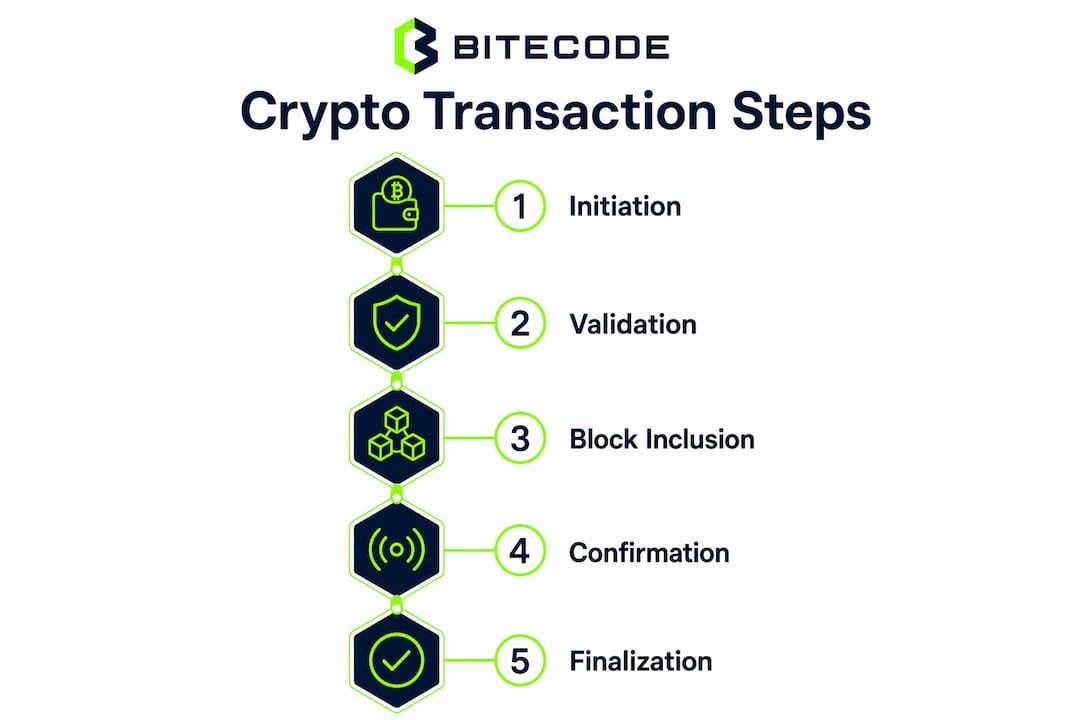
Every blockchain transaction moves through five stages: initiation, validation, assembly into a block, consensus, and permanent confirmation. Each stage has a specific technical function, and skipping or corrupting any one of them causes the transaction to fail or get rejected.
-
Transaction creation. The sender composes a transaction record containing the recipient’s wallet address, the transfer amount, a transaction fee, and a nonce. The nonce is a sequential counter that prevents duplicate submissions and replay attacks.
-
Digital signing. The sender’s wallet software signs the transaction with the sender’s private key using elliptic curve cryptography. This signature proves ownership of the funds without revealing the private key itself.
-
Broadcasting to the network. The signed transaction is sent to one or more nodes. Those nodes relay it to their peers. Within seconds, most of the network has a copy of the pending transaction sitting in their local mempool.
-
Node validation. Each node independently checks that the signature is valid, the sender’s balance covers the amount plus the fee, and the nonce is correct. Transactions that fail any check are dropped immediately.
-
Block assembly. Miners (in Proof of Work networks like Bitcoin) or validators (in Proof of Stake networks like Ethereum) select transactions from the mempool and bundle them into a candidate block. Higher-fee transactions get picked first.
-
Consensus and confirmation. The network reaches consensus on the new block through its protocol rules. Once the block is added to the chain, the transaction receives its first confirmation. Each subsequent block added on top adds another confirmation.
Pro Tip: Set your fee based on current mempool depth, not habit. During low-traffic periods, a minimal fee clears in minutes. During peak congestion, underpaying by even a small margin can leave your transaction pending for hours.
Transaction completion times vary from seconds to hours depending on the fee paid and how congested the network is at that moment. That variability is not a flaw. It is the fee auction mechanism working as designed.

Which technologies secure and support crypto transfers?
The security of every crypto transfer rests on three interlocking layers: the distributed ledger, the node network, and cryptographic primitives.
The distributed ledger is the blockchain itself. Every confirmed transaction is written to a block, chained to the previous block via a cryptographic hash, and replicated across thousands of machines. Altering any historical record would require rewriting every subsequent block across the majority of the network simultaneously. That is computationally prohibitive.
The node network provides decentralized enforcement. The Bitcoin network maintains approximately 15,000 reachable nodes worldwide, each holding a full copy of the ledger and independently validating every transaction. No single node has authority. Consensus emerges from agreement among the majority. This architecture replaces institutional trust with decentralized peer-to-peer consensus, which is the foundational shift that makes blockchain useful for financial transfers.
The core cryptographic tools at work include:
- SHA-256 hashing links blocks together and makes tampering detectable.
- Elliptic curve cryptography (ECDSA) generates the public-private key pairs that authorize transactions.
- Digital signatures prove the sender controls the funds without exposing the private key.
- Nonce values ensure each transaction is unique. Incorrect nonces cause immediate rejection by network nodes, which protects against replay attacks where an attacker resubmits a valid transaction to drain funds twice.
The mempool is not a single global queue. It is a fragmented set of local queues maintained independently by each node. A transaction visible on one node may not yet appear on another, which explains why block explorers sometimes show different mempool states.
Understanding this mempool fragmentation matters for businesses that monitor transaction status programmatically. Polling a single node for confirmation status can produce misleading results during the first few seconds after broadcast.
How do fees and congestion affect transaction speed and cost?
Fee mechanics are the most misunderstood part of how crypto transactions work. The fee is not a flat charge. It is a bid in an open auction where miners or validators allocate limited block space to the highest bidders.
On-chain transactions provide maximum security but carry higher fees and slower speeds during congestion. That trade-off is structural, not accidental. Block size is capped by protocol rules, so when demand spikes, fees spike with it.
| Fee strategy | Typical speed | Best use case |
|---|---|---|
| High fee (top 10% of mempool) | Under 10 minutes | Time-sensitive transfers |
| Mid-range fee | 10–60 minutes | Standard business payments |
| Low fee (bottom 20% of mempool) | Hours to days | Non-urgent transfers |
| Minimum fee | Potentially stuck | Not recommended during congestion |
The practical implication for businesses is clear. Batch transactions where possible to reduce the number of on-chain operations. For high-frequency, low-value transfers, off-chain or layer-2 solutions reduce cost without sacrificing the security of the base layer for final settlement.
Pro Tip: Check a real-time mempool depth tool before sending any high-value transaction. If the mempool holds more than 50,000 unconfirmed transactions, set your fee at least 20% above the current median to avoid delays.
The balance between on-chain security and transaction speed is a genuine engineering trade-off, not a marketing claim. Teams managing treasury operations or vendor payments in crypto need a fee policy, not just a wallet.
What are the best security practices for crypto wallet management?
Wallet security is the weakest point in the entire chain. The cryptography protecting the blockchain is effectively unbreakable. The human layer around private key management is not.
Loss or theft of a private key causes irreversible loss of funds. There is no central authority to reset access or reverse a transaction. That permanence is what makes the following practices non-negotiable for anyone managing meaningful crypto balances.
Key security practices for individuals and businesses:
- Use a hardware wallet for any balance you would not leave in an unlocked drawer. Hardware wallets store private keys on an isolated chip that never connects directly to the internet.
- Encrypt software wallets with a strong, unique passphrase and store that passphrase in a password manager or physical secure location.
- Back up seed phrases offline. A seed phrase written on paper and stored in a fireproof safe is more secure than a digital copy stored in cloud storage.
- Enable multi-factor authentication on any exchange or custodial wallet account.
- Verify recipient addresses character by character before confirming any transfer. Clipboard-hijacking malware replaces copied addresses with attacker-controlled ones.
For a broader view of financial data security in digital asset environments, the same principles that protect banking credentials apply to crypto private keys, with one critical difference: there is no fraud department to call.
Pro Tip: Never store a seed phrase as a photo on your phone or in a cloud-synced notes app. Both are common attack surfaces. Write it down and treat it like a physical bearer bond.
What troubleshooting approaches fix common crypto transaction problems?
Most crypto transaction problems fall into three categories: stuck transactions, failed transactions, and misdirected funds. Each has a different cause and a different resolution path.
Stuck transactions result from fees set too low relative to current mempool demand. The transaction sits in the mempool indefinitely until a miner picks it up or the sender takes action. Two standard remedies exist. Replace-By-Fee (RBF) lets the sender rebroadcast the same transaction with a higher fee, signaling miners to prioritize the new version. Child-Pays-For-Parent (CPFP) involves sending a second transaction that spends the unconfirmed output with a high fee, incentivizing miners to confirm both.
- Monitor transaction status using a block explorer (such as Blockchain.com for Bitcoin or Etherscan for Ethereum) by pasting the transaction hash into the search field.
- If a transaction shows zero confirmations after 30 minutes, check the current mempool depth before assuming failure.
- Exchanges often require 6 confirmations for Bitcoin before crediting a deposit, due to the risk of chain reorganization. A transaction with 2 confirmations is not lost. It is waiting for the exchange’s threshold.
Failed transactions on Ethereum-based networks typically result from insufficient gas limits, not insufficient funds. The transaction is rejected, but the gas fee is still consumed. Always set gas limits above the estimated amount for complex smart contract interactions.
Misdirected funds are the most serious problem. Sending to a wrong address on a public blockchain is permanent. The secure transaction workflow for any business should include a mandatory address whitelist and a dual-approval step for transfers above a defined threshold.
Key Takeaways
The crypto transaction process is a sequence of cryptographically enforced steps where decentralized node consensus, not institutional authority, guarantees the integrity and finality of every transfer.
| Point | Details |
|---|---|
| Five core stages | Every transaction moves through initiation, validation, block assembly, consensus, and confirmation. |
| Fee determines speed | Miners prioritize higher-fee transactions; set fees based on real-time mempool depth. |
| Nodes enforce the rules | Over 15,000 Bitcoin nodes independently validate each transaction, removing single points of failure. |
| Private key is the only key | Losing a private key means permanent loss of funds with no recovery option available. |
| Stuck transactions have fixes | Replace-By-Fee and Child-Pays-For-Parent are standard remedies for low-fee pending transactions. |
What the crypto transaction process reveals about trust
The part most teams underestimate is not the technology. It is the shift in where trust lives. Traditional payment systems place trust in institutions: banks, clearinghouses, card networks. The blockchain transaction model relocates that trust into mathematics and distributed consensus. That is not a philosophical point. It has direct operational consequences.
When a business runs crypto payments through a custodial exchange, it reintroduces institutional trust at the edges while the blockchain itself remains trustless. The real security gains come from managing keys directly and understanding the confirmation model well enough to set appropriate thresholds for different transaction sizes. A $500 transfer and a $500,000 transfer should not use the same confirmation policy.
The blockchain performance picture has also changed materially. Networks that processed a few hundred transactions per second five years ago now handle thousands. That trajectory matters for businesses evaluating whether on-chain settlement fits their volume requirements. The answer in 2026 is more often yes than it was in 2021. Staying current with blockchain applications in business means revisiting those assumptions annually, not once at project kickoff.
The fee and speed trade-off will not disappear, but it becomes manageable once teams treat fee policy as a business decision rather than a technical afterthought. The organizations that get the most out of crypto infrastructure are the ones that understand the process well enough to build rules around it.
— Bitecode
Bitecode’s AI Assistant Module for crypto workflow automation
Managing crypto transactions at scale introduces operational complexity that manual processes cannot handle reliably. Missed confirmations, inconsistent fee settings, and unmonitored wallet activity create real financial exposure.

Bitecode’s AI Assistant Module addresses that complexity directly. The module monitors transaction status, flags anomalies in real time, and automates approval workflows for transfers above defined thresholds. For businesses handling recurring crypto payments or treasury operations, it reduces the manual overhead of tracking confirmations and adjusting fees across multiple wallets. The module integrates into existing enterprise systems without a full rebuild, starting with up to 60% of the baseline logic pre-built. Teams get operational control over their crypto workflows without building that infrastructure from scratch.
FAQ
What is the crypto transaction process?
The crypto transaction process is the sequence of steps that moves cryptocurrency from a sender to a recipient on a blockchain. It includes transaction creation, digital signing, network broadcast, node validation, block assembly, and final confirmation.
How long does a crypto transaction take?
Transaction time ranges from seconds to hours depending on the fee paid and current network congestion. Miners prioritize higher-fee transactions, so setting a competitive fee is the most reliable way to reduce wait time.
What happens if I send crypto to the wrong address?
Transactions sent to an incorrect address are permanent and cannot be reversed. No central authority exists to recover misdirected funds, which is why address verification before every transfer is a mandatory practice.
How many confirmations does a crypto transaction need?
The required number of confirmations depends on the receiving party’s policy. Bitcoin exchanges commonly require 6 confirmations to guard against chain reorganization risk. Smaller transfers may be accepted with fewer.
What is a mempool in crypto?
The mempool is the holding area where unconfirmed transactions wait before a miner or validator includes them in a block. Each node maintains its own local mempool, so mempool state varies across the network until a transaction is confirmed.