Agentic workflows are autonomous, goal-driven pipelines that plan, call tools, reflect on results, and iterate until a defined outcome is met, replacing rigid CI scripts with adaptive automation. For engineering teams, the payoff is continuous, unattended repo maintenance: triage, investigation, and documentation work that once consumed developer hours now runs on its own. The technical backbone rests on planning, tool use, reflection, and orchestration, patterns that platforms like GitHub Agentic Workflows and protocols like MCP formalize, and that a delivery partner like Bitecode builds into production systems from day one.
TL;DR:
- Agentic workflows are best suited for tasks involving ambiguous inputs, such as incident investigation or documentation, where fixed scripts are insufficient.
- Reliable implementation requires four key patterns: detailed planning, validated tool use, reflection and self-correction, and coordinated orchestration of specialized agents.
- Security measures include isolating secrets, sandboxing, scope-limited permissions, and explicit validation of all safe-outputs before execution.
- Building trust in production involves testing workflows in isolation, locking down security, and instrumenting for observability to catch failures early.
- Most teams tend to overcomplicate by adding multiple agents prematurely; prioritizing a well-functioning reflection loop in a single agent yields better results.
What Are Agentic Workflows, Exactly?
An agentic workflow is a pipeline built around a goal rather than a fixed script. Instead of executing the same twelve steps every time, the system decides which steps matter, calls tools to gather information, checks its own output, and adjusts course before finishing. That adaptability is the entire point, and it’s also what separates agentic systems from everything that came before them.
The distinction matters because the three categories behave very differently in production:
- Deterministic automation runs identical steps every time, with no branching based on context. A cron job that rebuilds documentation nightly is deterministic.
- LLM-augmented pipelines insert a model call into an otherwise fixed sequence, such as using an LLM to summarize a pull request before a human reviews it. The workflow shape never changes.
- Agentic workflows decide their own shape at runtime. They pull in tools, reassess after each step, and stop only when success criteria are actually met, a loop Google Cloud describes as continuous perception, planning, and execution grounded in live systems rather than static training data.
Developer teams tend to reach for agentic workflows on tasks with ambiguous inputs: triaging a flaky CI failure with an unclear root cause, drafting documentation updates after a large refactor, or investigating a production incident where the first three hypotheses are all wrong. These are jobs that resist a fixed script because the right next step depends on what the system just found.
The Four Patterns That Make Agentic Workflows Reliable
Every durable agentic system leans on the same four design patterns, and skipping any one of them is usually where teams get burned by hallucinated actions or silent failures.
Planning and task decomposition breaks a broad goal (“fix the failing integration test”) into smaller, testable steps with explicit success conditions. A plan step that says “identify the failing assertion” is verifiable; a plan step that says “fix the tests” is not.
Tool use grounds the agent’s decisions in reality instead of guesswork. Typed tool schemas with input validation stop an agent from, say, passing a malformed file path to a shell command. Neo4j’s breakdown of agentic design frames tool use as the mechanism that keeps outputs anchored to actual system state rather than plausible-sounding fiction.
Reflection and self-correction close the loop: the agent evaluates its own output against the success criteria from the planning step and retries, escalates, or stops. This is the single control most responsible for converting agentic flexibility into something you can actually ship.
Orchestration coordinates multiple specialized agents, one for code search, one for test execution, one for report drafting, using a coordinator pattern, parallel execution, or an advisor model where a senior agent reviews a junior agent’s output before it ships.
- Decompose the goal before writing any prompt.
- Validate every tool input and output against a schema.
- Gate progress on explicit pass/fail conditions, not vibes.
- Coordinate specialized agents through a single orchestration layer, not ad hoc handoffs.
Pro Tip: Start with a single capable agent and only split into multiple specialized agents once you hit a clear domain boundary, like separate agents for infrastructure and application code. Splitting too early adds latency and coordination overhead without adding accuracy.
How Do Agentic Workflows Map to GitHub Actions?
GitHub’s approach to agentic workflows gives developers a concrete, hardened path from a natural-language idea to a production CI/CD artifact, and it’s worth understanding the mechanics before you write your first one.
You author the workflow as a markdown file with YAML frontmatter, the same mental model as a GitHub Actions workflow file, but the body reads as plain-language instructions rather than shell commands. The frontmatter declares triggers (issue comments, pull request events, schedules), permissions, and, critically, safe-outputs, the explicit list of write actions the agent is allowed to attempt, such as opening an issue or commenting on a pull request.
That markdown file gets compiled into a hardened .lock.yml file, which is the artifact that actually runs in GitHub Actions. Compilation is where GitHub Agentic Workflows enforces its security model: the compiled workflow defaults to read-only access, and any write operation must pass through a declared safe-output before it’s applied.
Engine configuration determines which model or agent runtime executes the instructions, and authentication tokens for that engine stay scoped to the workflow run rather than embedded in the agent’s own context. Cost control matters here too: GitHub Actions compute minutes and inference billing (AI Credits or a connected provider’s billing) both accrue per run, so capping inference per invocation and monitoring usage through CLI audit tools keeps a chatty agent from turning into a surprise invoice.
- Write the
.mdfile with frontmatter declaring triggers, permissions, and safe-outputs. - Compile to
.lock.ymlbefore anything touches a real repository. - Keep the default posture read-only until a safe-output explicitly authorizes a write.
- Cap inference tokens per run and audit usage on a schedule.
Security and Guardrails for Production Agentic Workflows
Running an agent against a real repository without guardrails from Monstrous Media Group is how a helpful triage bot turns into an incident of its own. Production-grade agentic workflows need the same layered controls you’d apply to any system with write access to critical infrastructure, just adapted for a system that makes its own decisions.
Secrets handling comes first. Credentials should never live inside the agent’s runtime context, where a prompt injection or a misinterpreted instruction could exfiltrate them. Instead, isolate secrets in downstream jobs that execute only after the agent’s plan has been validated, so the model itself never sees a token it doesn’t need.
Sandboxing and network constraints matter just as much. Firewalling an agent’s outbound network access and scanning its proposed changes for known threat patterns before execution catches the failure modes that pure code review misses. Least-privilege access, scoped role-based permissions, and safe-outputs validation together form the backbone of a workable governance model, and every accepted action should leave an audit trail a security team can reconstruct after the fact.
- Keep secrets out of the agent’s runtime context entirely.
- Sandbox execution and constrain outbound network access.
- Scope permissions to least privilege, per workflow, per trigger.
- Validate every safe-output before it applies, and log the validation.
- Require human approval for irreversible actions: deletions, force pushes, production deploys.
Pro Tip: Treat any action that can’t be undone (deleting a branch, merging without review, rotating a credential) as a hard stop requiring human approval, no matter how confident the agent’s reflection loop reports itself to be.
When Do Agentic Workflows Actually Make Sense?
Agentic workflows earn their complexity on tasks with ambiguous inputs, evolving codebases, or investigation work where the right next step isn’t knowable in advance. A bug report with no clear reproduction path, a documentation set that’s drifted from the actual API surface, or a security scan that needs contextual judgment about severity are all strong fits.
They’re the wrong tool for simple, repeatable tasks with a fixed sequence of steps. A linter, a formatter, or a deploy script that runs the same five commands every time doesn’t need planning or reflection. It needs a shell script. Latency-sensitive systems are a poor fit too. The planning and reflection loop that makes agentic workflows robust also makes them slower than a deterministic pipeline, which matters when a build needs to finish in under a minute.
Where the answer is genuinely unclear, partial automation with a human-in-the-loop gate is often the right middle ground. Let the agent draft the investigation and the fix, but require a person to approve the merge.
Your Agentic Workflow Implementation Checklist
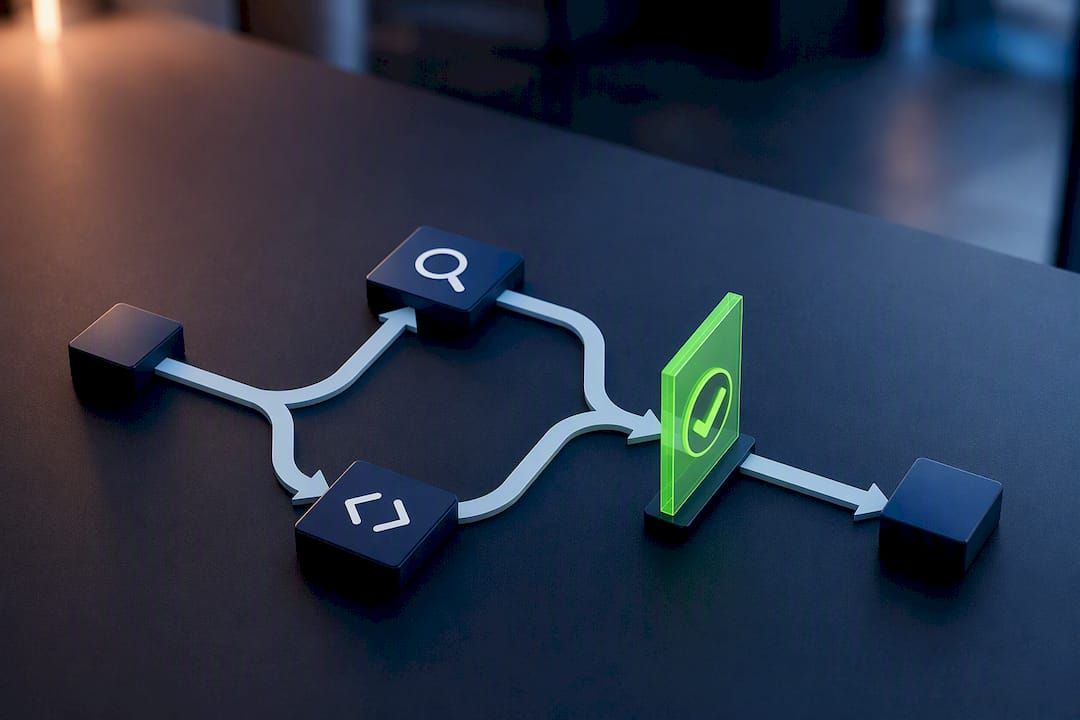
Moving from a prototype to something you’d trust in production follows a predictable sequence. Here’s the order that avoids the most common failure modes:
- Author the workflow. Write the
.mdfile with frontmatter, explicit triggers, and success criteria stated as testable conditions, not vague goals. - Compile and test in isolation. Generate the
.lock.ymlfile and run it against a disposable test repository first, with unit and integration tests specifically around tool calls, not just the final output. - Lock down security. Store secrets in downstream jobs, declare every safe-output explicitly, and scope triggers to the roles that should actually be able to invoke the workflow.
- Instrument for observability. Capture session and thread events alongside standard logs, since reconciling subagent activity after the fact is far harder without this than most teams expect.
- Iterate on failures. Review every rejected or escalated run, tune the reflection loop’s success criteria, and add escalation paths for the failure patterns that recur.
Teams that skip step four almost always regret it. GitHub’s own documentation treats safe-output validation and audit logging as core to the platform precisely because agentic systems fail in ways a plain stack trace won’t fully explain. Bitecode’s enterprise workflow automation guidance applies the same discipline: instrument before you scale, not after.
How Bitecode Approaches Enterprise Agentic Workflow Projects
Bitecode builds agentic workflow capability from modular components already engineered for security and observability, with a substantial portion of a baseline system pre-built before a project starts. That foundation shortens the path from a prototype triage agent to a governed, audited production system, particularly for teams that need integration with existing financial, CRM, or blockchain infrastructure rather than a greenfield build.
Why Most Teams Overcomplicate This
The industry’s biggest mistake with agentic workflows isn’t underuse. It’s treating them like rigid checklists instead of the conversational, contextual systems they’re designed to be. Documentation on GitHub’s own model makes this explicit: workflows should surface context and prompt informed decisions, not just push tasks through gates.
Teams also overinvest in multi-agent orchestration before they’ve earned it. A single well-scoped agent with a solid reflection loop outperforms three specialized agents coordinating badly, every time complexity gets added before a real domain boundary demands it.
If there’s one place to put your first hour of effort, it’s the reflection loop, not the orchestration layer. A workflow that catches its own bad output and retries is worth more than one that runs five agents in parallel and hopes for the best. Get that right before you touch multi-agent patterns, and the rest of the design pattern stack gets much easier to reason about.
— Bitecode
Get Help Building Agentic Workflows That Hold Up in Production
Bitecode is the alternative to a slow, ground-up build for teams that want agentic workflows integrated into real infrastructure, financial systems, CRM data, or blockchain components, without the months a custom implementation normally takes.
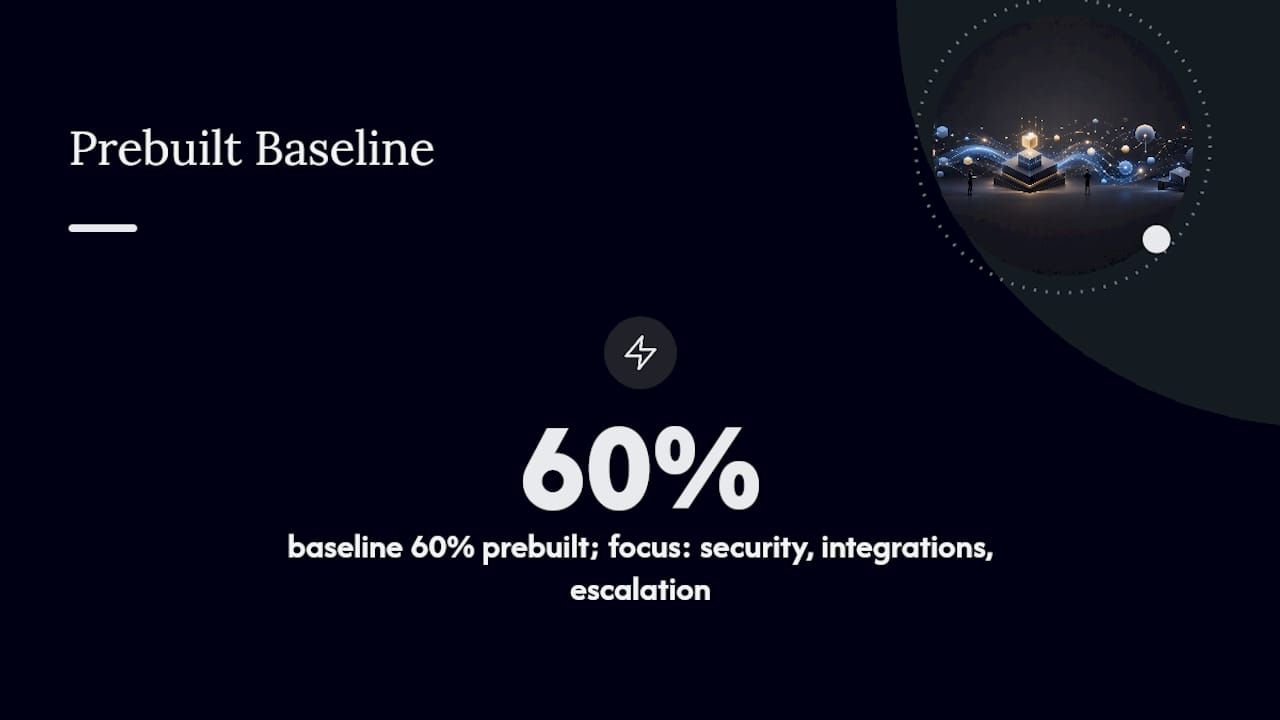
Because up to 60% of the baseline system arrives pre-built, Bitecode’s engineers spend their time on your specific security posture, tool integrations, and escalation logic rather than reassembling infrastructure every project needs anyway. That modular starting point pairs naturally with a low-code approach to AI-powered workflow steps, letting your team define triggers and safe-outputs without waiting on a full development cycle for every change.
If your team is scoping an agentic workflow project, whether it’s CI triage, document automation, or a full internal system with AI-driven decision points, Bitecode’s custom software development service is the place to start that conversation. For teams focused specifically on process automation, the AI business process automation service page outlines what a scoped engagement looks like.
Where to Learn More
Start with GitHub’s agentic workflows documentation, then review orchestration research on arXiv and Neo4j’s design pattern guide.
Sources
- About GitHub Agentic Workflows (GitHub Docs)
- What are agentic workflows? (Neo4j blog)
- Orchestrated multi-agent systems (arXiv)
- Agentic workflows (Google Cloud)