Modular white label SaaS is a bespoke enterprise application assembled from pre-built components (AI, financial processing, automation, blockchain, CRM) rather than a rebrandable off-the-shelf product. It delivers faster time-to-market, easier long-term maintenance, and enterprise-grade controls without the twelve-month greenfield build. It fits IT leaders who need domain-specific workflows and compliance guardrails, not a generic subscription tool with a new logo slapped on it.
TL;DR:
- Modular bespoke SaaS can be built from pre-assembled components, reducing development time and offering greater flexibility than traditional off-the-shelf products.
- Most enterprise implementations follow a modular monolith or hybrid architecture pattern, which allows gradual scaling and simplifies maintenance.
- Integration must prioritize API-first design, comprehensive security measures, and observability features to prevent future management issues.
- Pilot projects typically last four to eight weeks, with scope and complexity primarily driven by integration and compliance requirements, not the modules themselves.
- A baseline system with as much as 60% pre-built components can shorten timelines significantly and shift focus toward customizing core business logic.
What Does “White Label SaaS” Actually Mean Here?
Most search results define white label SaaS as a third-party product you buy, rebrand, and resell. That is not this. In this context, white label SaaS means a custom-built enterprise system assembled from modular components, deployed under your own brand and infrastructure, and shaped around your business logic rather than a vendor’s generic template.
The distinction matters because the two approaches solve different problems. A rebrandable product gets you speed at the cost of flexibility. A modular bespoke build gets you both, if the underlying architecture is sound.
Expect the component families to fall into recognizable categories:
- AI assistant modules for internal copilot functions or customer-facing automation
- Financial processing modules covering multi-currency transactions, invoicing, and audit trails
- Workflow automation modules that replace manual approval chains and data handoffs
- Blockchain/token modules for organizations with tokenization or ledger requirements
- CRM modules that plug into existing sales and support data
Delivery models vary too. Some organizations run full SaaS tenancy on the vendor’s infrastructure. Others require self-hosted deployment for data residency or regulatory reasons. Hybrid arrangements, where core modules run in the cloud and sensitive financial or compliance components stay on-premises, are increasingly common for SaaS architecture built for regulated industries.
When Should You Choose Modular SaaS Over Full Custom Build?
The decision rarely comes down to preference. It comes down to signals in your business and your organization’s readiness to run what you build.
Business signals that favor modular bespoke SaaS:
- Your workflows are domain-specific enough that generic software forces workarounds.
- You process regulated financial flows that need audit trails and multi-currency support.
- You have blockchain or tokenization requirements that mainstream platforms do not support natively.
- Your integration surface spans five or more existing systems (ERP, CRM, payment rails, identity providers).
Organizational signals matter just as much. A team without a platform owner, without any governance structure, and without operational maturity will struggle to run even a well-built modular system. If nobody owns the roadmap after launch, modularity becomes a liability instead of an asset.
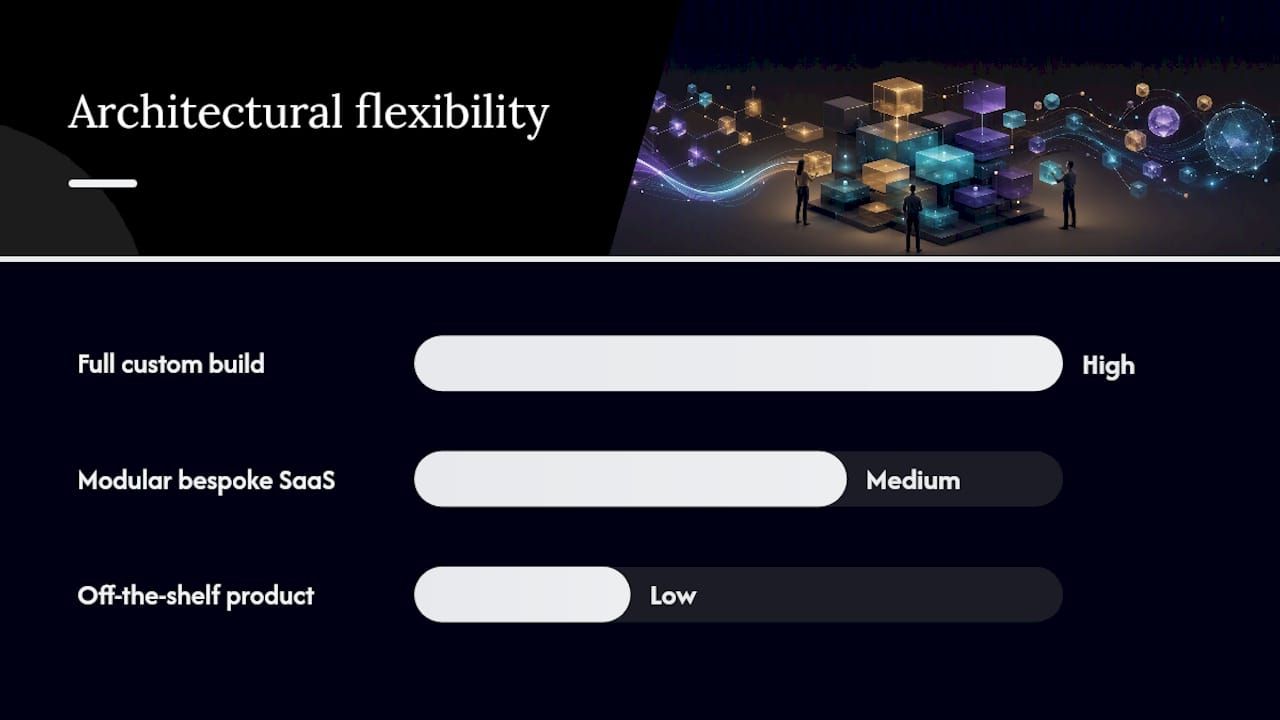
The trade-off is straightforward: full custom builds cost more and take longer but leave zero architectural debt to a vendor’s assumptions. Off-the-shelf products cost less upfront but hit a wall the moment your business logic outgrows the template. Modular bespoke SaaS sits between the two, trading some of the off-the-shelf speed for far more flexibility than a generic platform allows.
Pro Tip: Before signing anything, map your five most complex workflows against the vendor’s component library. If more than two require heavy custom logic outside the standard modules, budget extra time. That gap is where most timeline overruns start.
What Architecture Patterns Should You Expect?
Three patterns dominate serious enterprise low-code implementations, and understanding which one a vendor uses tells you a lot about what maintenance will look like in year two.
The modular monolith keeps logical module boundaries separate while deploying as a single unit. This approach separates logical boundaries from physical deployment boundaries, letting teams evolve toward extracted microservices only when specific modules genuinely need independent scaling. For most mid-size deployments, this beats jumping straight to microservices, which adds operational overhead nobody asked for. Modular monolith architecture reduces the premature complexity that sinks a lot of early-stage platform builds.
The metadata-driven runtime configures behavior through data rather than code, which speeds customization but requires disciplined versioning.
A hybrid model, combining metadata-driven configuration with generated code extensions, tends to deliver the best mix of developer experience and extensibility for enterprise platforms. Modern low-code platforms that satisfy real enterprise requirements almost always land here, though the tradeoff is added governance complexity.
Whichever pattern you land on, insist on these specifics from any vendor:
- A documented component compatibility matrix showing which module versions work together
- A clear signature resolution process for handling breaking changes across components
- Defined extraction triggers: conditions under which a module gets pulled into its own service
- Observability built in from day one, not bolted on after the first production incident
AWS’s own prescriptive guidance backs this sequencing: start with hexagonal architecture and domain-driven design, ship a simple MVP first, then harden as real usage reveals where complexity actually lives.
How Do You Handle Integration, Security, and Uptime?
Integration strategy determines whether your modular system becomes a productivity engine or a maintenance headache eighteen months from now.
API-first design is non-negotiable. Every module should expose a documented API rather than requiring direct database access from other components. This is what makes packageable, business-capability-aligned components safe to upgrade independently. Event buses handle asynchronous processes like financial reconciliation, while synchronous APIs handle real-time lookups. Getting that split wrong is one of the more common architecture mistakes in enterprise builds.
Security and compliance checklist items that should never be optional:
- Encryption at rest and in transit for every data store, not just the “sensitive” ones
- Full audit logs covering who changed what, when, and why
- Single sign-on integrated with your existing identity provider
- A role-based access model mapped to your actual org chart, not a generic admin/user split
- Evidence of SOC 2 or ISO 27001 alignment, even if formal certification is in progress
Bitecode’s own SaaS security compliance guidance walks through these requirements in more depth for teams building out a checklist.
Pro Tip: Ask for a rollback demonstration during any pilot, not just a deployment demo. A vendor who can show you a clean rollback under five minutes has actually thought about production failure. One who cannot has not.
What Timeline and ROI Should You Realistically Expect?
Projects typically move through three phases: an MVP pilot (four to eight weeks), staged module rollouts (two to four months depending on scope), and a hardening phase for scale and compliance that can run in parallel with rollout.
Cost drivers rarely come from the pre-built modules themselves. They come from:
- Integration work against legacy or poorly documented internal systems
- Compliance scope, particularly in financial services or healthcare
- Custom business logic that falls outside standard module behavior
- Self-hosting requirements that add infrastructure and operational cost
On ROI, treat vendor-published figures as directional rather than guaranteed. Bitecode documents automation ROI examples in the 150 to 500 percent range across its client work, though outcomes depend heavily on how much manual process the automation actually replaces. A workflow with ten manual approval steps will show faster payback than one with two.
What Should You Ask Vendors During Procurement?
A shortlist conversation should cover three categories of questions before anyone signs a statement of work.
- Component lifecycle: How are modules versioned, and what is the upgrade guarantee when a dependency changes?
- Extensibility: Can you extend a module without forking it, and does that extension survive a vendor update?
- Deployment flexibility: Does the platform support self-hosted, SaaS, and hybrid deployment, or does it lock you into one model?
- Observability and rollback: What monitoring comes standard, and what does an incident response process look like?
- Commercial terms: Is this a project-based engagement or a subscription, who owns the resulting IP, and what does post-launch maintenance cost?
Pilot terms deserve particular scrutiny. A vendor unwilling to define success criteria for a 30 to 90 day pilot before you sign is signaling something about how the rest of the relationship will go.
Why a Modular Baseline Changes the Build-vs-Buy Math
Most build-vs-buy debates assume you are choosing between slow-and-flexible or fast-and-rigid. That framing is outdated. A modular baseline with a meaningful share of components already built collapses that trade-off, because the components that used to take months (authentication, financial ledgers, audit logging) no longer need to be written from scratch.
Bitecode starts projects with up to 60% of the baseline system pre-built, which shifts engineering time toward the business logic that actually differentiates your platform rather than toward plumbing every enterprise system needs anyway. That does not eliminate architecture work. Teams still need to validate component compatibility, define their governance model, and decide which modules justify extraction into independent services down the line.
What it does change is where risk sits. Instead of betting an entire timeline on custom infrastructure work, teams can validate business logic early against a working foundation. A pilot that would take four months from zero can often start showing results within weeks once the baseline components are in place.
— Bitecode
How to Start a Pilot Without Overcommitting
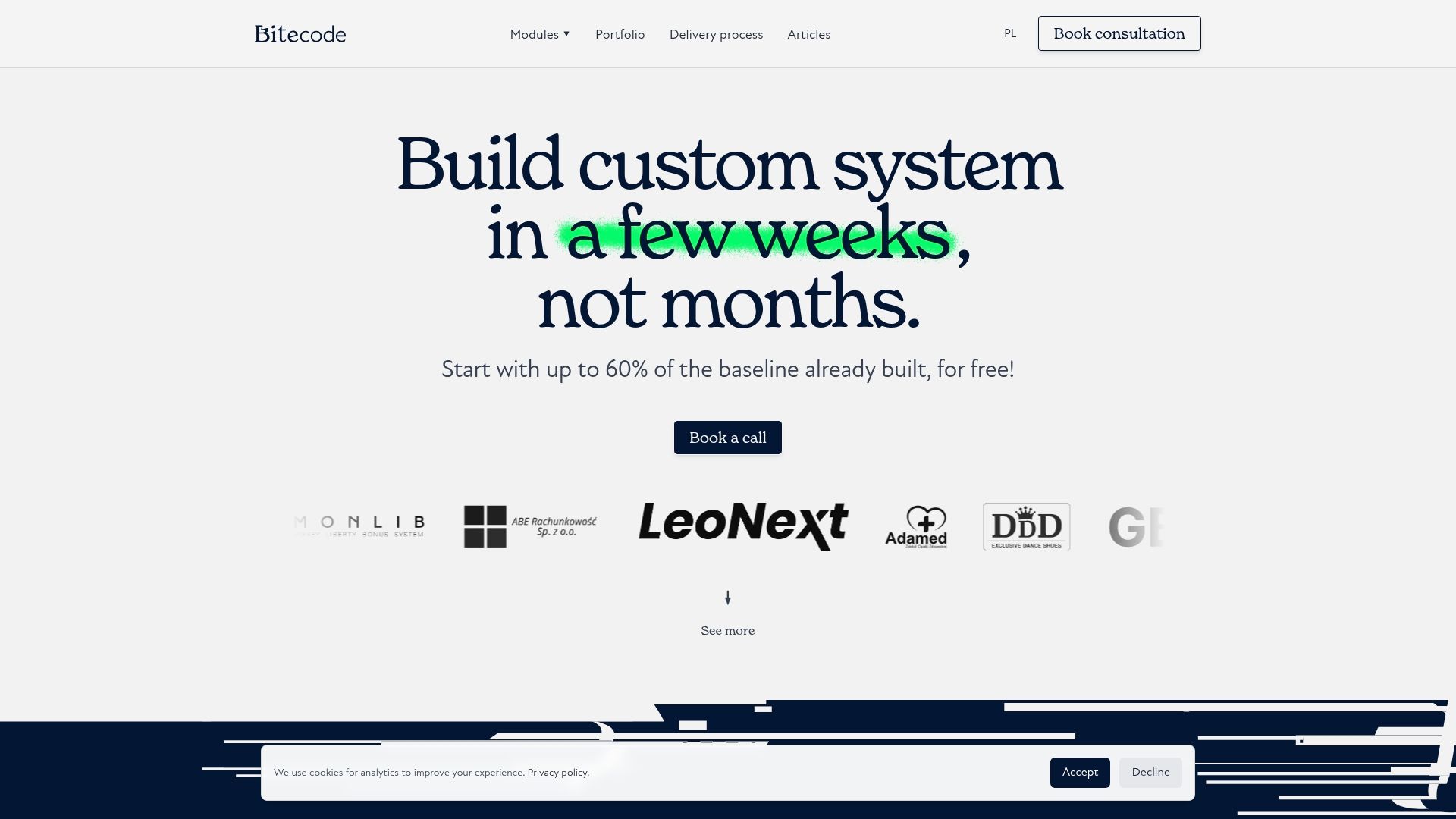
The fastest way to test whether modular bespoke SaaS fits your organization is a scoped pilot, not a full platform commitment. Bitecode structures these around three common entry points: an MVP pilot for a single high-value workflow, an automation workflow pilot for process-heavy operations, or a financial module sandbox for teams that need to validate transaction handling before going live.
A solid pilot statement of work should specify the exact workflow in scope, measurable success criteria (processing time reduced by X, manual steps eliminated, error rate below Y), and an integration plan naming the specific systems involved. Vague scope is the single biggest reason pilots stall.
If you are evaluating a custom business software build, an automation workflow project, or want to see the available pre-built modules before scoping anything, those are the places to start. For teams weighing how a modular platform fits into a broader growth or go-to-market plan, this SaaS growth and positioning perspective is worth a read alongside the technical evaluation. Reach out through Bitecode’s project page to scope a pilot against your own workflow rather than a generic demo environment.
Sources
Architects validating vendor claims should cross-reference a few independent sources beyond any vendor’s own material. The modular architecture whitepaper lays out the ten guiding principles behind modular monolith design and phased evolution toward microservices. The DEV Community analysis of enterprise low-code platforms covers the hybrid metadata-plus-code-extension model in more technical depth than most vendor documentation offers. AWS’s prescriptive guidance on hexagonal architecture remains one of the more rigorous public references for domain-driven design applied to modular systems, and Salesforce’s composable architecture guidance is useful for understanding packageability and dependency management in practice.
- Beyond the Hype: Architecting Scalable Low-Code Platforms for Enterprise Ecosystems - DEV Community
- Modular Architecture: The Enterprise Blueprint for 2026 and Beyond | Gart
- AWS Prescriptive Guidance - Building hexagonal architectures on AWS
FAQ
What Is White Label SaaS in an Enterprise Context?
It is a bespoke, modular enterprise application built from pre-built components (AI, financial, automation, blockchain, CRM) rather than a rebrandable third-party product, deployed as SaaS tenancy, self-hosted, or hybrid.
How Long Does a Modular SaaS Pilot Typically Take?
Most MVP pilots run four to eight weeks, with staged module rollouts extending two to four months depending on integration scope and compliance requirements.
Is Modular Bespoke SaaS More Expensive Than Off-the-Shelf Software?
Upfront cost is usually higher than a subscription product, but the primary cost drivers are integration work and compliance scope, not the pre-built modules themselves, which is where a baseline like Bitecode’s 60% pre-built system narrows the gap.
What Does Bitecode Charge for a Pilot Project?
Bitecode does not publish fixed pricing for pilot or project engagements; current pricing and scoping details are available directly through Bitecode’s project pages.
Should We Choose a Modular Monolith or Microservices First?
Start with a modular monolith and extract specific modules into independent services only when they demonstrate a genuine need for independent scaling, which keeps early operational complexity manageable.