TL;DR:
- Composable software builds flexible systems by assembling independent modules through standardized APIs. Success depends on organizational change, where teams own end-to-end capabilities, not just technical components. AI accelerates this shift by automating integration, enabling dynamic, scalable, and business-aligned systems.
Composable software is defined as a design philosophy where systems are built by assembling independent, self-contained modules that communicate via standardized APIs to form flexible, dynamic platforms. Unlike monolithic architectures, where a single codebase governs all functionality, composable systems allow teams to swap, upgrade, or scale individual components without touching the rest of the system. This approach is increasingly critical for enterprises pursuing digital transformation, as it directly addresses vendor lock-in, integration debt, and the inability to respond quickly to shifting business requirements. Key industry concepts like Packaged Business Capabilities (PBCs), API-first communication, and frameworks governed by bodies like the Cloud Native Computing Foundation (CNCF) form the backbone of composable software architecture in practice.
What is composable software architecture built on?
Composable software architecture rests on four core principles: modularity, declarative assembly, infrastructure abstraction, and unified control. Each principle addresses a specific failure mode of traditional monolithic systems.

Modularity means each component is independently deployable and reusable. A payment processing module, for example, can be updated or replaced without redeploying the entire platform. This is the foundational property that makes composable systems flexible and maintainable compared to monolithic alternatives.
Declarative assembly means components are defined and composed through templates rather than hand-coded integrations. Teams specify what the system should look like, and the platform handles how to assemble it. This reduces boilerplate and makes configurations auditable and repeatable.
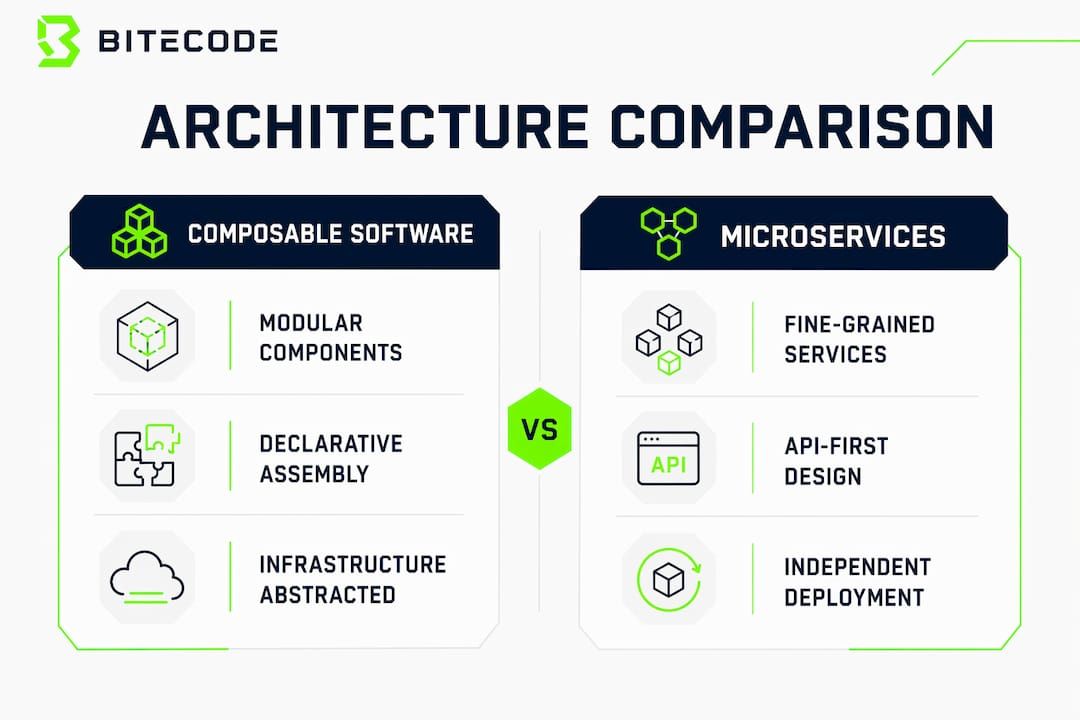
Infrastructure abstraction separates business logic from the underlying cloud or on-premise environment. This matters because multi-cloud adoption is widespread: 37% of organizations use two cloud providers, 26% use three, and 39% operate hybrid cloud environments. Vendor-independent modularity is not optional at that scale. It is the only way to maintain consistency across environments.
Unified control gives platform teams a single observability and management layer across all components. Without it, distributed systems become operationally chaotic, and the agility gains from modularity evaporate under the weight of fragmented tooling.
- Modular components: independently deployable, versioned, and reusable across products
- Declarative templates: define system state without scripting every deployment step
- Infrastructure abstraction: run consistently across AWS, Azure, GCP, or on-premise
- Unified control plane: single dashboard for observability, policy enforcement, and deployment
Pro Tip: Build your component catalog before you build your first composable application. Validated, documented components prevent teams from duplicating work and creating the same integration debt you are trying to escape.
How does composable software differ from microservices?
Composable software and microservices are related but not interchangeable. Microservices decompose an application into small, granular services, each handling a narrow technical function. Composable software operates at a higher level of abstraction, organizing those microservices into business-aligned Packaged Business Capabilities that map directly to business domains like “order management” or “customer identity.”
The practical difference is significant. A microservices architecture might expose 200 individual services to the rest of the organization. A composable architecture groups those into 15 PBCs, each with a clean API contract and a product team responsible for its reliability. This reduces the cognitive load on consuming teams and makes the system far easier to govern.
Traditional modular software sits between the two. It breaks a system into modules, but those modules are typically compiled together and deployed as a unit. True composability requires runtime independence: each component runs, scales, and fails independently.
AI has accelerated the shift toward composable systems by reducing integration friction between components and enabling dynamic, personalized assemblies that would have required rigid, hand-coded pipelines just a few years ago. This makes highly adaptable composable systems practical for organizations that previously lacked the engineering capacity to manage them.
| Dimension | Traditional modular software | Microservices | Composable software |
|---|---|---|---|
| Deployment unit | Compiled module | Individual service | Packaged Business Capability (PBC) |
| Business alignment | Low | Low to medium | High |
| Runtime independence | No | Yes | Yes |
| Integration model | Internal calls | APIs | Standardized API contracts |
| Organizational ownership | Shared codebase | Service team | Product team per PBC |
Why do composable initiatives fail without organizational change?
The most common failure mode in composable software adoption is not technical. Teams implement loosely coupled components but keep tightly coupled organizational dependencies. The result is a distributed monolith: a system that looks composable on paper but behaves like a monolith in practice because every change still requires cross-team coordination.
Cultural and organizational transformation is the prerequisite that most architecture guides underemphasize. Moving to composable architecture requires moving from siloed, project-oriented teams to product-oriented teams that own and operate specific PBCs end to end. Each team becomes the authority on its capability’s API contract, reliability, and roadmap.
The analogy that clarifies this shift: traditional software development is like renting a pre-built house. You get what the landlord built. Composable architecture makes your organization the architect, choosing every component based on fit for purpose. That power comes with accountability. Teams must own their components the way a product team owns a product, not the way a project team owns a deliverable.
“Targeted Resilience” is the operational goal. When one PBC fails, the rest of the system continues operating. That resilience only holds if the organizational boundaries match the technical boundaries. When they do not, a failure in one team’s component cascades through shared dependencies regardless of how the code is structured.
Pro Tip: Map your current team dependencies before mapping your component dependencies. If your org chart does not support independent ownership of each PBC, fix the org chart first. The architecture will follow.
How to implement composable software in an enterprise
Implementing composable software architecture is a phased process. Teams that try to migrate an entire monolith at once typically stall. The following sequence reflects how mature organizations approach it.
-
Audit existing capabilities and identify PBC candidates. Map your current system to business domains. Group related microservices or functions into logical PBCs. Each PBC should represent a capability a business stakeholder can name and describe without technical context.
-
Establish a component catalog with validation standards. Every component entering the catalog must meet defined standards: documented API contracts, versioning policy, health check endpoints, and deployment templates. Validated component catalogs prevent overhead from overwhelming the agility gains you are building toward.
-
Adopt declarative deployment templates. Helm charts for Kubernetes workloads are the most widely used mechanism for this. Declarative templates make deployments reproducible, auditable, and portable across environments. Teams stop writing bespoke deployment scripts and start composing from validated building blocks.
-
Implement a unified control plane. Kubernetes management frameworks provide the foundation for observability, policy enforcement, and multi-cluster management. A unified control plane is what separates a composable system from a collection of independently deployed services with no operational coherence.
-
Assign product teams to PBC ownership. Each PBC needs a named team responsible for its API contract, uptime, and roadmap. This is the organizational step that makes the technical architecture sustainable. Without it, the catalog degrades and integration debt returns.
-
Iterate and expand the catalog incrementally. Start with two or three high-value PBCs. Prove the model works, refine the standards, and expand. Teams that avoid vendor lock-in through modular design consistently report faster iteration cycles after the initial investment in catalog infrastructure.
The role of AI in this process deserves specific attention. AI tools now handle significant portions of the integration work between components, generating adapter code, validating API contracts, and flagging breaking changes before deployment. This means AI-assisted development can accelerate work without accelerating chaos, provided the modular boundaries are defined clearly before AI tooling is introduced.
Key Takeaways
Composable software architecture delivers genuine agility only when technical modularity and organizational ownership are built together from the start.
| Point | Details |
|---|---|
| Core definition | Composable software assembles independent, API-connected components into flexible systems. |
| PBCs over microservices | Packaged Business Capabilities group services into business-aligned modules that reduce complexity. |
| Organizational alignment | Product teams must own PBCs end to end, or technical composability produces a distributed monolith. |
| Infrastructure abstraction | Multi-cloud and hybrid environments require vendor-independent modularity to maintain consistency. |
| Implementation sequence | Start with a validated component catalog and declarative templates before expanding PBC ownership. |
Composability is a paradigm shift, not a technology upgrade
From Bitecode’s perspective, the most persistent misconception about composable software is that it is primarily a technical decision. Organizations invest in API gateways, Kubernetes clusters, and component catalogs, then wonder why agility has not improved. The answer is almost always organizational. The technical architecture created the possibility of independent deployment. The team structure prevented it.
What Bitecode has observed across enterprise engagements is that the organizations succeeding with composable architecture treat it as a business operating model, not an infrastructure project. They restructure around PBC ownership before they restructure their codebase. They define API contracts as business agreements, not just technical specifications. The modular software benefits only materialize when the human system and the technical system are aligned.
AI’s role here is genuinely significant, and not in the way most vendors describe it. AI does not make composability easier to design. It makes composability easier to operate at scale, by automating the integration work that previously required dedicated platform engineering teams. That lowers the entry barrier for mid-sized organizations that could not previously justify the overhead. The future of composable systems is not static modularity. It is dynamic assembly, where AI selects and connects components based on context, user behavior, and business rules in real time.
The organizations that will lead in this environment are the ones building their component catalogs now, with clean API contracts and genuine product team ownership. The architecture is the easy part. The discipline is what separates composable systems that deliver from composable systems that disappoint.
— Bitecode
How Bitecode supports composable software strategies
Building a composable architecture from a greenfield state is one challenge. Doing it while maintaining existing operations is another entirely.
Bitecode’s approach to custom software development starts with up to 60% of the baseline system pre-built from modular, validated components. This means teams are not writing boilerplate or debating component boundaries from scratch. They are composing from a proven foundation and customizing for their specific business-domain complexity. Bitecode integrates AI automation, financial processing, blockchain, and workflow modules as discrete PBCs, so organizations can adopt composable principles without rebuilding their entire technology stack. For enterprises that need to move fast without accumulating scalable system debt, this modular foundation is the practical starting point.
FAQ
What is composable software in simple terms?
Composable software is a system built from independent modules that connect via APIs, allowing teams to swap or update individual parts without rebuilding the whole platform. Think of it as assembling a system from interchangeable, purpose-built components rather than writing everything as one connected codebase.
What are Packaged Business Capabilities (PBCs)?
PBCs are groups of microservices organized around a specific business function, such as order management or customer identity. The concept, defined by Gartner, gives composable architectures a business-aligned unit of ownership that is easier to govern than individual microservices.
How does composable software architecture differ from microservices?
Microservices decompose applications into granular technical services, while composable architecture groups those services into business-aligned PBCs with standardized API contracts. Composability operates at a higher abstraction level and requires explicit product team ownership for each capability.
What is the biggest risk when adopting composable software?
The biggest risk is creating a distributed monolith: a system with loosely coupled components but tightly coupled organizational dependencies. Without product teams owning each PBC independently, technical composability does not translate into operational agility.
How does AI affect composable software development?
AI reduces integration friction between components and enables dynamic assembly of capabilities based on real-time context. This makes composable systems practical for organizations that previously lacked the platform engineering capacity to manage them at scale.