TL;DR:
- Scalable enterprise systems ensure operational reliability and cost efficiency as organizations grow. They focus on maintaining business capability, not just processing speed, through capacity, observability, and ownership clarity. Thinking about scalability early helps prevent costly architectural failures and supports sustainable growth.
Scalable enterprise systems are defined as software architectures that maintain operational reliability, cost efficiency, and business capability as transaction volumes, user counts, and organizational complexity increase. Understanding why scalable enterprise systems matter is not an IT concern alone. It is a prerequisite for sustainable growth, and organizations that treat it as a technical afterthought pay for that decision at every subsequent stage of expansion. The difference between a system that scales and one that does not becomes visible not at launch, but at the first major inflection point: a new market, a product line addition, or a sudden spike in demand.
Why scalable enterprise systems matter beyond performance
Enterprise system scalability is defined as the ability of a system to maintain business capability that is reliable, observable, supportable, and understandable as load increases. That definition matters because most teams measure scalability wrong. They track response times and throughput, then declare success. A system that processes transactions faster but produces inconsistent results at volume has not scaled. It has just failed faster.
The correct test is whether the business capability itself holds up. Can the order management workflow still be audited? Can the finance team still reconcile accounts when transaction volume triples? Can the operations team diagnose a failure without reading raw database logs? These are the real scalability questions.
Three dimensions define genuine enterprise scalability:
- Capacity headroom: The system can absorb growth without emergency architectural changes.
- Observability: Teams can monitor, trace, and diagnose behavior at scale without specialized tribal knowledge.
- Ownership clarity: Someone in the organization is accountable for scalability decisions, not just uptime.
“Scalability without correctness is just faster failure.” This principle separates systems built for growth from systems that merely tolerate it temporarily.
The importance of scalable systems shows up most clearly when organizations try to add a new product line or enter a new geography. A system that was merely inconvenient at small scale becomes a genuine business obstacle at larger scale.
How do scalable systems prevent costs from rising with growth?
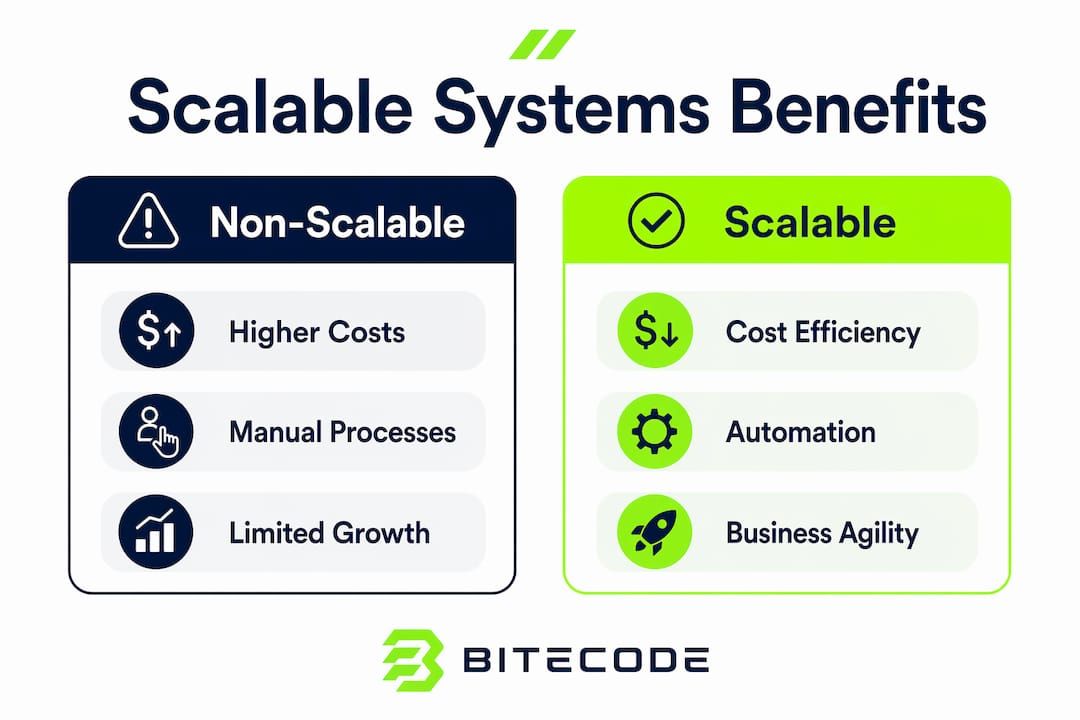
Non-scalable enterprise software creates a direct, linear relationship between growth and operational cost. Every new customer requires more manual intervention. Every new market requires another fragile workaround. Scalable systems invert this relationship, allowing organizations to add customers, products, or geographies without proportional increases in headcount or manual overhead.

The practical difference is significant. A non-scalable order processing system might require one additional operations staff member for every 500 new daily orders. A well-designed system handles that same growth with a configuration change and a server addition. The cost curve bends in the organization’s favor.
| Growth scenario | Non-scalable system | Scalable system |
|---|---|---|
| 2x transaction volume | 2x manual processing staff | Horizontal server addition |
| New geographic market | Custom integration per region | Configuration and localization layer |
| Compliance requirement added | Manual audit trail construction | Built-in observability and logging |
| Sudden demand spike | System degradation or outage | Auto-scaling capacity adjustment |
Cloud providers’ auto-scaling capabilities allow systems to adjust capacity on demand, avoiding both overprovisioning during quiet periods and degradation during peaks. That dynamic capacity management is what separates modern scalable architecture from the fixed-capacity systems that dominated enterprise IT a decade ago.
Pro Tip: Map your current cost-per-transaction at your present volume, then model what that number looks like at 3x volume. If the answer is “roughly 3x cost,” your system is not scaling. It is just growing.
What architectural principles actually support scalable enterprise software?
Building software that scales requires specific architectural decisions made early, but not all of them at once. The most common mistake organizations make is over-engineering for infinite scale before they understand their actual growth patterns. Premature optimization for infinite scale leads to expensive complexity and lost agility. The better approach is to design for current needs while preserving future options.
Four architectural principles consistently support scalable enterprise software:
-
Stateless application servers. Stateless servers can be replicated horizontally, adding capacity by adding instances rather than upgrading single machines. State lives in the database or cache layer, not in the application process. This single decision makes horizontal scaling straightforward.
-
Asynchronous processing via job queues. Reliable async processing with retry logic and monitoring handles business complexity that simple request-response patterns cannot. Invoice generation, report compilation, and notification delivery all belong in job queues, not in synchronous API calls.
-
Caching with discipline. Caching reduces database load and improves response times for read-heavy workloads. The discipline part matters: incorrect cache invalidation creates consistency problems that are harder to debug than the performance issues caching was meant to solve.
-
Modular design with clear boundaries. Modules that own their data and expose defined interfaces can be scaled, replaced, or upgraded independently. This is the architectural equivalent of designing for the organization’s growth, not just the system’s throughput.
Scalability inflection points are predictable. Batch processing times that exceed business windows, transaction volumes that saturate a single database, and report generation that blocks user-facing operations are all known thresholds. Designing around predictable inflection points produces better outcomes than designing for hypothetical infinite load.
Pro Tip: Before any architectural decision, ask: “Does this close off a future scaling option?” If the answer is yes, find an alternative. If the answer is no, proceed. Preserving options costs less than reversing decisions.
Why is scalability a strategic concern for executives, not just IT?
Growth magnifies organizational strengths and weaknesses. A minor process inefficiency at 100 transactions per day becomes a critical bottleneck at 10,000. A compliance gap that was manageable at small scale becomes a regulatory exposure at enterprise scale. This is why scalability belongs on the executive agenda, not just the IT roadmap.
As software becomes platform-like, non-functional requirements become critical survival parameters. Security, compliance, integration contracts, and observability are not features to add later. They are the foundation that determines whether the platform can be trusted at scale. Organizations that embed these requirements early avoid the exponential cost of retrofitting them later.
The strategic dimensions of enterprise scalability include:
- Integration readiness: Systems that scale must connect to new partners, regulators, and internal tools without custom point-to-point integrations that multiply with every addition.
- Compliance continuity: Audit trails, data residency controls, and access logging must hold up as transaction volumes grow, not degrade.
- Risk management: Systems that were inconvenient at small scale become major business obstacles at larger scale, increasing risk exposure across operations, finance, and customer experience.
- Talent and ownership: Scalability decisions made without clear ownership create systems that no one fully understands. That knowledge gap is itself a business risk.
Executives who treat scalability as a technical project delegate a strategic decision. The organizations that scale well are the ones where leadership understands that the system architecture either enables or constrains the business model. Exploring tailored enterprise systems designed with these constraints in mind is a practical starting point for that conversation.
Key Takeaways
Scalable enterprise systems matter because they prevent operational costs, compliance risks, and architectural complexity from rising in proportion to business growth.
| Point | Details |
|---|---|
| Scalability is a capability test | Systems must maintain reliability, observability, and correctness at volume, not just raw throughput. |
| Cost curves can be inverted | Well-designed systems add customers and markets without proportional increases in manual overhead or staff. |
| Architecture decisions compound | Stateless servers, async processing, and modular design preserve future options without over-engineering now. |
| Scalability is an executive concern | Growth magnifies existing weaknesses, making system architecture a strategic risk factor, not an IT project. |
| Embed non-functional requirements early | Security, compliance, and integration contracts cost exponentially more to retrofit than to build in from the start. |
What building scalable systems actually taught us
The most persistent misconception Bitecode encounters is that scalability is a problem to solve once the business grows. Teams delay architectural decisions, accumulate technical debt, and then face a painful rebuild at exactly the moment when the business needs stability most.
The harder lesson is that scalability is not a feature. It is a property of how decisions are made from the beginning. The organizations that scale well are not the ones that built for infinite load on day one. They are the ones that made reversible decisions, preserved architectural options, and treated observability as a first-class requirement rather than an afterthought.
Cross-disciplinary ownership matters more than most teams expect. When scalability decisions live only with the engineering team, the business context that shapes those decisions gets lost. Finance does not know why the monthly close takes six hours. Operations does not understand why adding a new product category requires a three-month development cycle. Bringing those conversations together, early and regularly, is what separates systems that accelerate work from systems that quietly constrain it.
The modular foundation approach that Bitecode uses exists precisely because of this pattern. Starting with up to 60% of the baseline system pre-built means teams spend their time on business-domain complexity, not boilerplate infrastructure. That is where the real scalability work happens: in the logic that reflects how the organization actually operates, not in the plumbing that every enterprise system needs.
— Bitecode
Bitecode’s AI Assistant Module for enterprise-scale workflows
Enterprise teams that have solved the architectural side of scalability often hit a different ceiling: the volume of decisions, approvals, and communications that still require human attention at every step.
Bitecode’s AI Assistant Module addresses that ceiling directly. It embeds an AI-driven chat interface into enterprise workflows, handling routine queries, routing approvals, and surfacing relevant data without adding headcount. For organizations managing workflow automation at scale, the module connects to existing system logic rather than operating as a separate black-box platform. The result is automation that grows with the business rather than creating a new integration burden. Teams that want to see how it fits their current architecture can review the module specifications on the Bitecode platform.
FAQ
What is enterprise system scalability?
Enterprise system scalability is the ability of a software system to maintain reliable, observable, and correct business operations as transaction volumes, user counts, and organizational complexity increase. It covers operational stability and maintainability, not just technical throughput.
Why does scalability matter in enterprise software specifically?
Enterprise software carries compliance, integration, and audit requirements that must hold up at scale. Systems that degrade under load do not just slow down. They create regulatory exposure and operational risk that affect the entire organization.
What is the biggest architectural mistake in scalable enterprise software?
Over-engineering for infinite scale before understanding actual growth patterns is the most common and costly mistake. Designing for current needs while preserving future options produces better outcomes with less wasted investment.
How do scalable systems reduce operational costs?
Scalable systems invert the relationship between growth and cost by eliminating the manual overhead and fragile workarounds that non-scalable systems require at every growth stage. Adding customers or markets becomes a configuration exercise rather than a staffing decision.
When should executives get involved in scalability decisions?
Executives should treat scalability as a strategic concern from the beginning, not after a system failure. Growth magnifies existing organizational weaknesses, and the system architecture either enables or constrains the business model at every stage of expansion.