TL;DR:
- Tailored enterprise systems are custom-built platforms that match a company’s unique workflows and data needs. They offer better integration, control, and flexibility than generic off-the-shelf solutions, often delivering faster deployment using modular and AI-assisted development. These systems reduce SaaS sprawl, enable process automation, and provide long-term strategic advantages for complex organizations.
Tailored enterprise systems are custom-built software platforms designed to align precisely with an organization’s unique workflows, data structures, and integration requirements. Unlike off-the-shelf tools such as generic ERP or CRM packages, these bespoke solutions are architected from the ground up around how a specific business actually operates. Providers like Corexta and SystemLabs have demonstrated that modular architectures and AI-assisted development now make custom enterprise solutions accessible to mid-sized organizations, not just Fortune 500 companies. The result is software that fits the business rather than forcing the business to fit the software. Understanding what tailored enterprise systems are is the first step toward deciding whether they belong in your technology roadmap.
What is tailored enterprise systems, and how do they differ from off-the-shelf software?
Tailored enterprise systems are purpose-built platforms that replace generic, one-size-fits-all software with solutions engineered around a company’s specific processes, compliance requirements, and integration landscape. The industry term for this category is custom enterprise software, and the two phrases are used interchangeably across procurement, IT leadership, and vendor conversations.
The core distinction from off-the-shelf software is ownership of the workflow logic. A packaged ERP forces your finance team to adapt its approval chains to the vendor’s data model. A tailored system encodes your approval chains directly into the platform. That difference compounds over time: every workaround a generic tool requires adds friction, training overhead, and integration debt.
Custom enterprise solutions also differ in their integration posture. Off-the-shelf platforms connect to other systems through fixed APIs with limited configuration. Bespoke enterprise software is built with the integration map in mind from day one, whether that means connecting to a legacy HRMS, a proprietary POS system, or a third-party financial processor.
Why do enterprises choose tailored systems over generic solutions?
Organizations invest in customized business solutions when the cost of working around a generic platform exceeds the cost of building something purpose-built. Custom development is advisable when standard tools do not support complex workflows or when workaround costs surpass the investment in proprietary software. That threshold arrives faster than most leaders expect.
Three business drivers consistently push enterprises toward bespoke software:
- Competitive workflow differentiation. When a process is a source of competitive advantage, encoding it in a black-box platform relocates control to the vendor. A logistics company with a proprietary routing algorithm cannot afford to have that logic buried inside a SaaS tool it does not own.
- Multi-departmental data complexity. Large organizations generate data across finance, operations, HR, and sales that generic tools struggle to unify without expensive middleware layers.
- Security and compliance specificity. Regulated industries such as healthcare, financial services, and defense require access controls and audit trails that generic platforms support only partially.
Generative AI is dissolving the economic logic of standardized enterprise software, enabling leaders to focus on owning the workflows they need rather than selecting from a catalog of standard tools.
The economic case has also shifted. AI-assisted development and modular component libraries have reduced the cost and time required to build custom platforms, making bespoke enterprise software a realistic option for organizations that previously could not justify the investment.
What are the key features of tailored enterprise systems?
The functional depth of a custom enterprise solution depends on the architectural decisions made during design. The table below compares the capabilities of tailored systems against typical off-the-shelf platforms across the dimensions that matter most to enterprise decision-makers.

| Capability | Tailored enterprise system | Off-the-shelf platform |
|---|---|---|
| Workflow logic | Encoded to match your exact process | Fixed to vendor’s standard model |
| Integration depth | Built around your specific system map | Limited to supported connectors |
| Role-based permissions | Configured per department and branch | Predefined role templates |
| Scalability | Cloud-native, scales with your architecture | Vendor-controlled scaling tiers |
| AI and automation | Custom modules for your use cases | Generic automation features |
| Data ownership | Fully owned and portable | Vendor-controlled data structures |
Custom software built with microservices and role-based access provides superior scalability and flexibility compared to generic off-the-shelf tools. Microservices architecture is particularly valuable because it allows individual components, such as a billing engine or a reporting module, to be updated or replaced without touching the rest of the system.
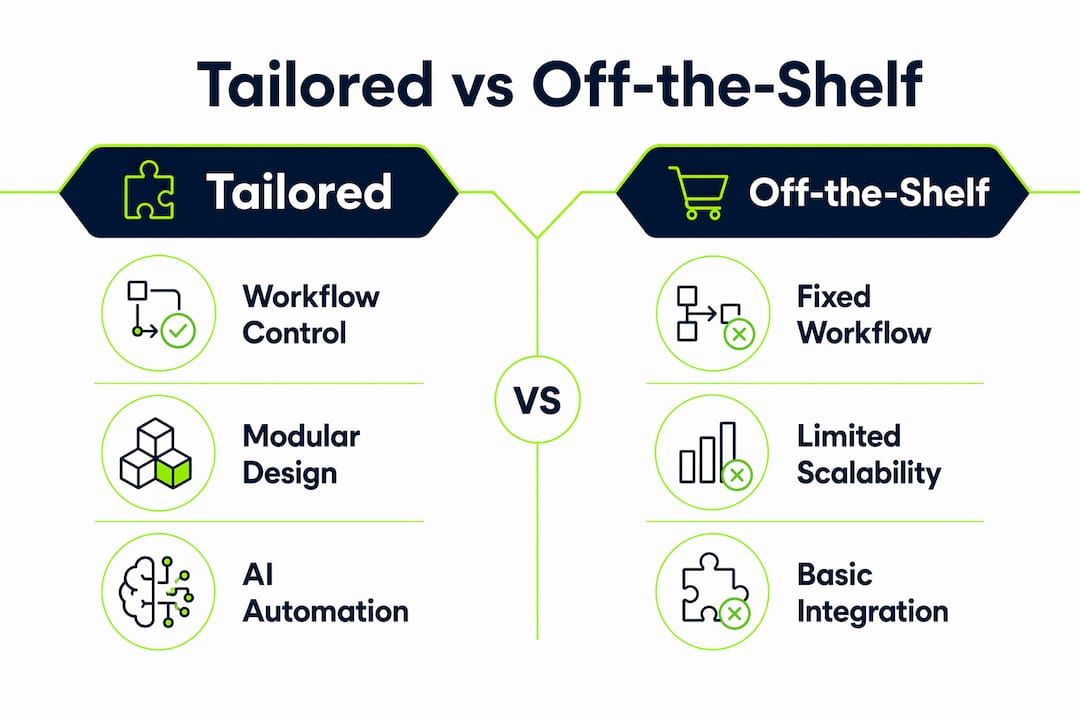
Modular design also enables phased delivery. A company can launch with a core operations module and add CRM, BI, and financial processing layers as the organization’s needs evolve. This approach reduces initial risk while preserving the long-term architecture.
Pro Tip: When evaluating enterprise system customization options, ask vendors to show you the integration layer first. The quality of the API design and the data model reveals more about long-term flexibility than any feature list.
AI-driven workflow automation is now a standard expectation in tailored systems. This includes intelligent document processing, predictive reporting, and AI assistants that surface relevant data within the workflow context rather than requiring users to query separate tools.
How are tailored enterprise systems implemented, and what do they cost?
Implementation cost is the most common barrier to entry, and the range is wide. Mid-sized tailored enterprise platforms typically cost between $80,000 and $300,000. Large-scale, complex systems often exceed $300,000 to over $1 million, with some specialized modular options starting at $15,000. That starting figure reflects platforms built on pre-assembled component libraries rather than greenfield development.
The primary cost drivers are not what most teams expect. Integration depth, data migration, security controls, workflow complexity, and rollout risk account for the majority of budget, not the user interface. A clean UI built on top of a poorly designed data model will cost far more to maintain than a functional interface built on a well-structured foundation.
Timeline has changed dramatically. Modern tailored enterprise systems move from costly, long deployments to rapid rollouts in 10–14 days due to modular development, AI-assisted coding, and pre-built components. Traditional custom development ran 6–18 months. That compression changes the risk profile of the entire project.
Key factors that influence both budget and timeline include:
- Number of system integrations. Each connection to an external platform, whether ERP, HRMS, or payment processor, adds scoping, testing, and maintenance overhead.
- Data migration complexity. Moving historical data from legacy systems requires validation, transformation, and rollback planning.
- Compliance and security requirements. SOC 2, HIPAA, and PCI DSS certifications each add audit trail, encryption, and access control requirements that extend development scope.
- User role complexity. Organizations with multiple branches, departments, or geographic regions require more granular permission structures.
Enterprise system integration is consistently where projects encounter the most friction. Teams that invest in integration architecture early avoid the most expensive rework.
How do tailored enterprise systems deliver measurable business value?
The business case for bespoke enterprise software becomes concrete when you examine what unified, purpose-built platforms replace. Custom platforms today replace dozens of siloed SaaS tools, consolidating CRM, invoicing, project management, and reporting into unified, tailored systems. SystemLabs demonstrated this by merging multiple functions into one tailored platform, reducing subscription costs and improving operational control simultaneously.
The measurable outcomes follow a consistent pattern across industries:
- Process automation at scale. Tailored systems encode approval workflows, exception handling, and escalation paths directly into the platform. Finance teams stop chasing email approvals; operations teams stop reconciling data across three spreadsheets.
- Unified reporting and visibility. A single data model across CRM, finance, and supply chain means executives see one version of the truth. Generic tools require middleware and manual reconciliation to approximate this.
- Reduced SaaS subscription sprawl. Organizations running 15–30 point solutions often find that a tailored platform consolidates 60–70% of those tools, with better data fidelity and lower total cost.
- AI readiness. Tailored platforms automate complex workflows and improve data consolidation, creating the clean, structured data layer that AI models require to function reliably.
Pro Tip: Before scoping a custom platform, audit your current SaaS stack for redundant data entry points. Every place where a team member re-enters data that already exists in another system is a direct measure of what a tailored system will recover in productivity.
The advantages of tailored systems extend beyond efficiency. Organizations that own their workflow logic are better positioned to adapt when market conditions shift, because they are not waiting for a vendor to release a feature update.
Key takeaways
Tailored enterprise systems deliver measurable competitive advantage when an organization’s workflows are complex enough that generic software forces costly workarounds, and modern modular development has made custom solutions faster and more affordable than most decision-makers assume.
| Point | Details |
|---|---|
| Definition clarity | Tailored enterprise systems are custom-built platforms aligned to specific workflows, not adapted from generic tools. |
| Cost range | Mid-sized platforms cost $80,000–$300,000; modular options can start at $15,000 depending on scope. |
| Deployment speed | AI-assisted and modular development compresses timelines from 6–18 months down to 10–14 days. |
| Primary cost drivers | Integration depth, data migration, and compliance requirements drive budget more than UI complexity. |
| Business value | Custom platforms consolidate SaaS sprawl, unify data, and create the clean data layer AI automation requires. |
Bitecode’s perspective on the enterprise software shift
The conventional wisdom that custom software is inherently slower and riskier than buying a packaged solution is no longer accurate. It was true when greenfield development meant writing every line from scratch, managing a large engineering team, and hoping the requirements held steady for 18 months. That model is gone.
What we see now is a different risk profile. The risk does not disappear when you buy a packaged platform. It relocates into the vendor relationship, the integration constraints, and the ceiling on what you can build. Organizations that have outgrown their off-the-shelf tools often discover that switching costs are higher than building correctly the first time would have been.
The shift that matters most is in the starting point. When 60% of a system’s baseline is already assembled from proven, modular components, the remaining 40% is where business-domain complexity gets encoded. That is where the real value is built. Teams can accelerate work without accelerating chaos, because the boilerplate is already solved.
The leaders who get the most from custom enterprise solutions are not the ones who treat software as a procurement decision. They are the ones who treat it as an architectural decision about which workflows they want to own permanently.
— Bitecode
How Bitecode accelerates tailored enterprise system delivery
Building a tailored enterprise system does not have to start from zero. Bitecode’s modular platform delivers up to 60% of the baseline system pre-built, covering financial processing, workflow automation, and multi-role access control before a single line of business-specific code is written.
The AI Assistant Module integrates directly into custom enterprise platforms, adding an intelligent chat interface that surfaces workflow data, automates routine tasks, and connects to existing system layers without a separate integration project. For organizations that need AI capabilities inside their tailored system rather than bolted on afterward, this module provides a production-ready foundation. Bitecode’s approach is designed for medium to large organizations that need reliable, secure, and scalable systems without the timeline and cost of traditional custom development.
FAQ
What is the difference between tailored and off-the-shelf enterprise software?
Tailored enterprise systems are built around an organization’s specific workflows and integration requirements, while off-the-shelf software requires the organization to adapt its processes to the vendor’s fixed data model. The core difference is ownership of the workflow logic.
How long does it take to implement a tailored enterprise system?
Modern implementations using modular development and AI-assisted coding can deploy in 10–14 days for baseline systems, compared to the traditional 6–18 month timeline for greenfield custom development. Complexity of integrations and compliance requirements are the primary variables.
What does a tailored enterprise system typically cost?
Mid-sized custom enterprise platforms range from $80,000 to $300,000. Large-scale systems with complex integrations and compliance requirements often exceed $1 million. Specialized modular options can start at $15,000 depending on scope and pre-built component use.
When should an organization choose custom enterprise solutions over packaged software?
Custom development is the right choice when an organization’s workflows provide a competitive advantage that cannot be replicated in a generic tool, or when the cost of workarounds in an off-the-shelf platform exceeds the cost of building a proprietary solution.
What are the main cost drivers in enterprise system customization?
Integration depth, data migration complexity, security and compliance controls, and workflow logic are the primary cost drivers. User interface design accounts for a smaller portion of total budget than most organizations initially expect.