Secure webhooks require signature verification over the raw request body, constant-time comparison, timestamp and replay protection paired with idempotency, enforced TLS, and disciplined secret management. We walk through each control below with the framework-specific pitfalls, code-level guidance, and pre-launch tests that separate a theoretical implementation from a production-ready one.
TL;DR:
- Verify HMAC signatures against the exact raw request bytes before parsing; framework middleware can alter whitespace or key order, and failed verification must never fall back.
- Reject timestamps outside a 300 second window, store deduplication keys per endpoint and event ID, and make handlers idempotent against retries.
- Store signing secrets in a secrets manager, use distinct keys per endpoint, and revoke the old key after a new signed delivery succeeds.
- Require TLS 1.2 or higher, reject untrusted certificates, and validate the full certificate chain for inbound endpoints and outbound requests.
- Treat every signed payload as untrusted: enforce its content type, validate an allowlisted schema, cap request size, and sanitize fields before database or template use.
Verify signatures against the raw request body
HMAC signature verification only works when it runs against the exact bytes the sender transmitted. The moment a framework parses the body into JSON before your handler sees it, whitespace and key ordering shift, and the computed HMAC no longer matches what the provider sent. This is the single most common cause of “valid” webhooks failing verification, as Stripe’s own troubleshooting guidance confirms.
- In Express, mount
express.raw()on the webhook route before any global JSON body parser touches the request. - In Next.js API routes, disable the built-in body parser for that route and read the raw stream manually.
- In AWS Lambda behind API Gateway, confirm the integration passes the body through unparsed and account for Base64 encoding of the event payload.
- Parse provider signature headers correctly: Stripe’s
Stripe-Signatureheader carries a timestamp and one or more signature values separated by commas, and each part needs its own parsing step.
Reject any request where verification fails, with no fallback path that processes an unverified payload.
Pro Tip: Write an integration test that sends a request through your actual middleware stack, not just a unit test against your verification function in isolation — techniques from API contract testing with CI/CD can help ensure your tests are robust and comprehensive.
Compare signatures in constant time
A naive == or .equals() check on two strings returns as soon as it finds a mismatched byte, and that timing difference is measurable. An attacker who can send enough requests can use those timing variations to reconstruct a valid signature byte by byte. Constant-time comparison functions eliminate that leak by always examining the full length of both values regardless of where they diverge.
- Python:
hmac.compare_digest(computed_signature, received_signature). - Node.js:
crypto.timingSafeEqual(bufferA, bufferB), after converting both signatures to buffers of equal length. - Java:
MessageDigest.isEqual(expected, received).
Compute your expected HMAC as a binary buffer rather than a hex string before comparing, and confirm both buffers are the same length before calling the comparison function, since most constant-time implementations throw or behave unpredictably on mismatched lengths.
Timestamp validation, replay windows, and idempotent handling
Signature verification confirms a payload came from the right sender. It says nothing about whether that payload was already processed five minutes ago. Replay protection closes that gap, and it needs two layers working together rather than one alone.
- Reject any webhook whose timestamp falls outside a tolerance window, commonly 300 seconds, and keep server clocks synchronized with NTP so legitimate deliveries do not get rejected over drift.
- Persist every processed event or delivery ID in a durable store, Redis or a database table, with a TTL at least as long as your tolerance window, and check that store before doing any work.
- Design handlers to be idempotent: if an event ID has already been processed, return a 2xx response immediately without repeating side effects like charging a card or sending a notification twice.
A 2026 CVE in OpenClaw showed that Base64 re-encoding of a signature could bypass replay detection when dedup keys were too broad, which is why canonicalizing signatures before storage and scoping dedup keys per destination matters as much as the timestamp check itself.
Pro Tip: Shard your dedup keys by webhook endpoint and event ID together, never by event ID alone, to prevent a replay against one integration from slipping past checks meant for another.
Signing secret management: storage, rotation, and redaction
A webhook signing secret is a credential, and it deserves the same handling as a database password or an API key, never a hardcoded string in your repository or a plain environment variable dumped into a log file.
- Store secrets in a dedicated secrets manager such as HashiCorp Vault or the equivalent AWS, GCP, or Azure secret store, rather than configuration files.
- Use a distinct secret per endpoint or per subscriber where your provider supports it, so a leak in one integration does not compromise every webhook consumer you run.
- Rotate secrets on a schedule using a dual-secret acceptance window: the sender signs with both the old and new secret (or your handler accepts either) until you confirm new signed deliveries succeed, then revoke the old one.
- Redact secrets from application logs and error messages entirely; a stack trace that prints a signing key is a breach waiting to be discovered.
Transport security: HTTPS/TLS configuration and certificate checks
Signature verification and transport encryption solve different problems, and skipping either one leaves a gap the other cannot close. TLS protects the payload in transit; signature verification confirms who sent it.
- Require TLS 1.2 at minimum for every webhook endpoint, and prefer TLS 1.3 where your infrastructure supports it.
- Use valid, CA-signed certificates in production and reject self-signed certificates outright, both on your receiving endpoint and on any outbound calls your system makes.
- Validate the full certificate chain rather than trusting a single leaf certificate.
- Enable HSTS and configure your server to offer only modern, secure cipher suites, dropping legacy ciphers that predate current TLS guidance.
Payload validation: schema, content type, and size limits
Every webhook payload is untrusted input the moment it reaches your server, regardless of how confident your signature check makes you feel. Treat it the way you would treat any externally submitted data.
- Enforce the expected
Content-Typeheader and reject anything that doesn’t match before parsing begins. - Validate the payload against a strict schema that allowlists expected fields and types, rather than accepting arbitrary additional keys.
- Set a maximum payload size and reject oversized requests early, before they consume memory or processing time.
- Sanitize any field before it reaches a database query or a template renderer, since a webhook payload can carry injection attempts just as easily as a public form submission.
Pro Tip: Generate your schema validator from the provider’s published event documentation rather than hand-writing it from a handful of sample payloads, since undocumented optional fields are a common source of schema drift.
Rate limiting, async processing, and keeping responses fast
Providers expect a fast response, often within a few seconds, and a slow handler risks triggering retries that compound into a backlog. The fix is to separate acknowledgment from processing.
- Verify the signature, validate the payload, and return a 2xx response immediately, then enqueue the actual work for background processing through a queue like SQS, Kafka, or Redis.
- Apply per-subscriber rate limits on your endpoint, and respond with a proper 429 status plus a
Retry-Afterheader when a sender exceeds it. - Route persistently failing messages to a dead-letter queue instead of retrying indefinitely, so one bad payload doesn’t block the rest of the pipeline.
This pattern also absorbs traffic spikes without forcing your database or downstream services to handle every event synchronously.
SSRF and outbound request protections when webhooks trigger fetches
When a webhook handler needs to fetch a URL embedded in the payload, such as a callback or a linked resource, you’ve created an outbound request that an attacker can potentially steer toward internal infrastructure. OWASP’s API security guidance flags webhooks specifically as an SSRF vector because they are public-facing by design.
- Resolve the hostname and block requests to loopback, private, and link-local ranges, including the cloud metadata address at 169.254.0.0/16.
- Disable automatic redirect following, since a redirect chain can route an otherwise-valid request to a blocked destination.
- Allowlist both the URL scheme (HTTPS only) and the set of trusted origins rather than accepting any URL the payload supplies.
- Re-resolve DNS at request time rather than caching a resolved address, since DNS rebinding can swap a validated hostname for an internal IP between the check and the fetch.
Monitoring, logging, and incident response
Controls you can’t observe in production are controls you can’t trust. Build visibility into rejection rates and failure modes from day one rather than retrofitting it after an incident.
- Track signature rejection rates, duplicate event counts, processing latency, and any spike in a specific failure type, since each points to a different root cause.
- Log enough context to debug an issue, the event ID, timestamp, and source, but redact signing secrets and personal data before anything reaches a log aggregator.
- Sample full payload logging rather than capturing every request at full fidelity, which keeps storage and compliance exposure manageable.
- Configure alerts tied to your dead-letter queue and to sustained rejection spikes, backed by a written playbook for what an on-call engineer checks first.
Pre-launch and testing checklist for webhook endpoints
Before a webhook integration goes live, run through a deliberate test pass rather than trusting that each control works because it compiled.
- Confirm raw-body signature verification succeeds across every deployment target you run, including local development, containers, and serverless functions, since middleware order often differs between them.
- Simulate a replayed delivery and a duplicate delivery with the same event ID, and confirm your dedup store catches both without double-processing.
- Rotate a signing secret in a staging environment and confirm the dual-secret window accepts both old and new signatures without dropping deliveries.
- Validate the full TLS certificate chain against your production domain, not a self-signed staging certificate.
- Test your SSRF allowlist against a crafted payload pointing at an internal address or a redirect chain.
- Load-test the endpoint to confirm it returns 2xx quickly under burst traffic, and confirm your timeout and queue configuration behave as expected under that load.
A related handover checklist for custom web application development covers the broader deployment verification steps that a webhook launch fits inside.
Bitecode perspective: integrating webhook security into enterprise systems
In modular enterprise systems, webhook controls map cleanly onto components that already exist: a secrets manager handles signing-key storage and rotation, a queueing layer absorbs bursty delivery traffic, and schema enforcement sits alongside the audit logging that financial and compliance workflows already require. For high-stakes events, such as payment confirmations or ledger updates, durable deduplication stores and dual-secret rotation windows aren’t optional extras; they’re the difference between a reconciled system and a quietly duplicated transaction. We’ve found that treating webhook security as an extension of existing secure integration practices rather than a bolt-on produces more maintainable results.
Authentication and authorization mechanisms beyond signature verification
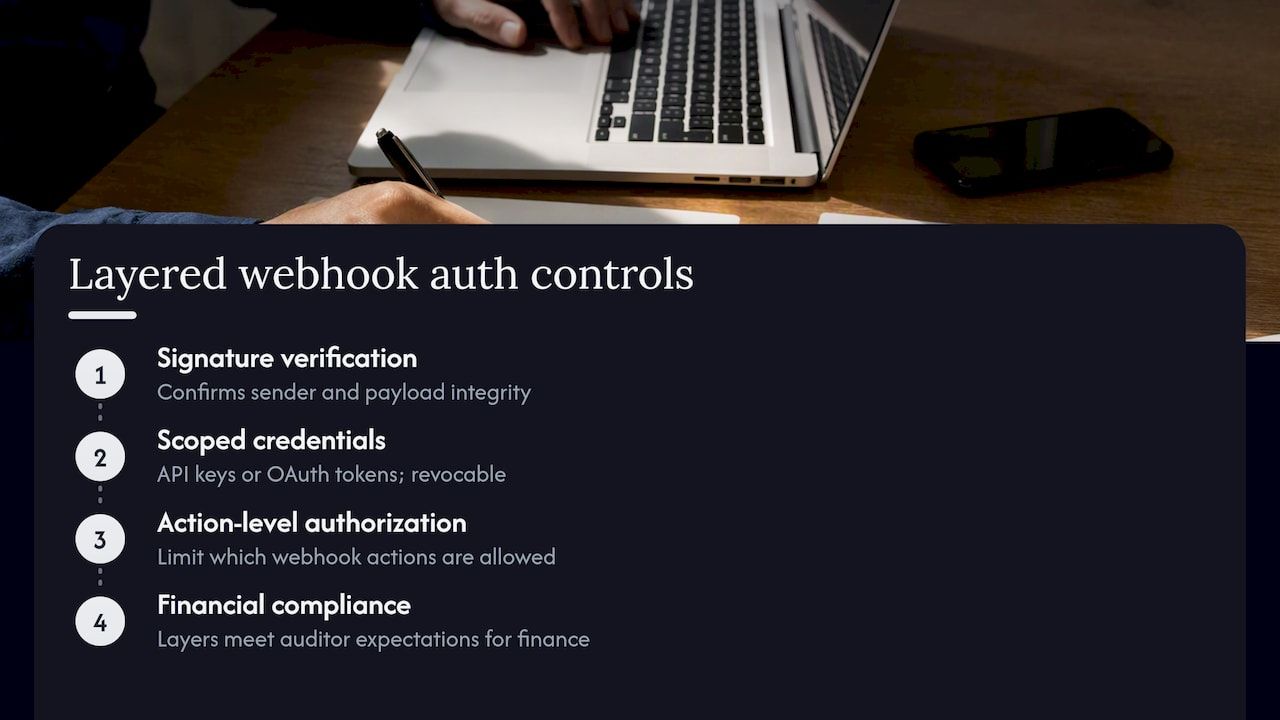
Signature verification confirms that a payload came from the expected sender and hasn’t been tampered with, but it doesn’t by itself answer a separate question: should this specific endpoint, client, or integration be allowed to trigger this action at all. Layering additional authentication and authorization controls on top of signature checks closes that gap.
API keys scoped to a specific webhook subscriber add a second factor an attacker would need to compromise alongside the signing secret, and they let you revoke access for one integration without affecting others. OAuth tokens serve a similar purpose in systems where a webhook consumer needs delegated access to perform follow-up API calls after processing an event, such as fetching additional order details or writing back a status update; scoping those tokens narrowly limits the blast radius if one is ever exposed.
Authorization should also account for which actions a given webhook source is permitted to trigger. A payment provider’s webhook might be authorized to update order status but not to issue a refund directly, with refund logic gated behind a separate internal authorization check rather than trusting the webhook payload’s instructions at face value.
For systems handling financial events specifically, this layered approach, signature verification plus scoped credentials plus action-level authorization, aligns with the kind of financial data security practices that auditors expect to see documented, not just implemented.
Securing webhook endpoints against injection and common web vulnerabilities
A webhook endpoint is still a web endpoint, and the standard web vulnerability classes apply even though the “user” sending the request is an automated system rather than a browser.
CSRF protection usually needs to be explicitly disabled for webhook routes rather than left on by default, since the request legitimately comes from a third-party server with no browser session or CSRF token attached. GitHub’s webhook best practices recommend exempting the webhook route from CSRF middleware while keeping signature verification as the actual authenticity check in its place.
XSS risk arises less from direct rendering and more from indirect paths: a webhook payload field that later gets displayed in an admin dashboard without escaping becomes a stored XSS vector, even though the original request was server-to-server rather than browser-submitted. Treat every string field as unescaped HTML until your rendering layer proves otherwise.
Injection attacks follow the same logic as any untrusted input: a payload field dropped directly into a SQL query or a shell command is exploitable regardless of whether it arrived through a form or a webhook. Parameterized queries and strict schema validation at the point of ingestion close most of this risk before it reaches a database or template layer.
Secret management lifecycle: rotation policies and breach response
Secret management isn’t a one-time setup step; it’s a lifecycle with distinct phases that each need a defined policy rather than ad hoc handling when something goes wrong.
Generation should produce secrets with sufficient entropy from a cryptographically secure source, never a predictable string or a value reused across environments. Storage belongs in a dedicated secrets manager, with access scoped to the specific services that need it rather than broad organizational access.
Rotation policy should define a fixed interval, commonly tied to compliance requirements or risk tolerance, and should always use the dual-secret acceptance window described earlier: both old and new secrets remain valid during a transition period so in-flight deliveries don’t fail, and the old secret is revoked only after confirming new signed deliveries succeed.
Breach response needs a documented runbook, not an improvised sequence of steps under pressure. When a signing secret is suspected compromised, immediate rotation takes priority over investigation, since every minute a compromised secret remains valid is a window for forged deliveries. After rotation, review logs for any signature that validated against the old secret during the suspected compromise window, since those requests warrant closer inspection even if they passed verification at the time.

Logging webhook events with privacy and compliance in mind
Logs are essential for debugging a failed delivery, but a webhook payload often carries data that shouldn’t sit in a log aggregator indefinitely: customer names, email addresses, payment details, or other personal data depending on what the event represents.
Log the metadata you need for operational debugging, event ID, timestamp, source, and processing outcome, as a default practice. Full payload logging should be the exception, applied through sampling rather than capturing every request at full fidelity, and even sampled payloads need field-level redaction for anything that qualifies as personal or financial data.
Retention policy matters as much as redaction. A log entry that outlives its operational usefulness is pure liability, and compliance frameworks that apply to the underlying data, such as those governing payment or health information, typically extend to logs derived from that data as well. Set retention windows deliberately rather than letting logs accumulate by default, and make sure access to webhook logs is scoped the same way access to the underlying data would be.
Handling retries and backoff strategies for failed webhook deliveries
Most webhook providers retry failed deliveries automatically, which means your endpoint needs to handle both sides of that relationship: responding correctly so the sender knows whether to retry, and handling a retried delivery correctly when it arrives.
Return a 2xx status only once your handler has successfully validated and either processed or safely enqueued the event; any other outcome should return an error status so the sender’s retry logic engages. Returning 2xx prematurely, before confirming the payload is valid, risks losing events that fail during actual processing with no retry to recover them.
On the receiving side, idempotent handling (covered earlier alongside replay protection) means a retried delivery with the same event ID produces the same outcome as the first attempt, without duplicating side effects. This is what makes aggressive provider-side retry policies safe rather than risky.
If your system makes its own outbound webhook calls to downstream consumers, apply exponential backoff with jitter between retry attempts rather than fixed intervals, which helps avoid synchronized retry storms when multiple deliveries fail at once. Cap the total retry window and route persistently failing deliveries to a dead-letter queue for manual review rather than retrying indefinitely.
Using mutual TLS for enhanced webhook security
Standard TLS verifies the server’s identity to the client, which in a webhook context means your endpoint proves its identity to the sender. Mutual TLS adds the reverse: the sender also presents a certificate, and your endpoint verifies it before accepting the connection at all.
This is most relevant in enterprise and B2B integrations where both parties control their own infrastructure and can manage certificate issuance and rotation, rather than in consumer-facing SaaS webhooks where requiring a client certificate would create friction for every subscriber. mTLS adds a transport-layer identity check that happens before your application code ever sees the request, which means a connection from an unrecognized client certificate gets rejected at the TLS handshake rather than reaching your signature verification logic.
Implementing mTLS means provisioning a certificate authority for client certificates, distributing certificates to authorized senders, and configuring your server or load balancer to require and validate a client certificate on the webhook route specifically rather than site-wide. It complements signature verification rather than replacing it. Signature verification confirms payload integrity and authenticity at the application layer; mTLS confirms connection-level identity at the transport layer. Running both gives you defense at two separate layers, which matters most for webhook integrations carrying financial transactions, health data, or other high-sensitivity events where the cost of a forged or intercepted delivery is high enough to justify the added operational overhead of certificate management.
What actually matters most in webhook security
Most webhook security writing treats every control as equally weighted, a checklist to complete rather than a set of trade-offs to understand. In practice, two controls carry disproportionate risk when skipped: durable replay protection and secret rotation discipline. Signature verification gets implemented correctly far more often than replay protection does, because a missing or weak dedup store doesn’t cause visible failures during development, it causes quiet duplicate processing in production months later.
The conventional advice also underweights secret rotation. Teams verify signatures carefully and then leave the same signing secret in place indefinitely, because rotating it without a dual-secret window risks breaking production traffic, and building that window correctly takes real engineering time. If we had to prioritize one investment beyond the baseline checklist, it would be building the dual-secret rotation path before the first incident forces an emergency rotation under worse conditions than a planned one.
— Bitecode
How Bitecode supports secure webhook-driven integrations
Building webhook security correctly across signature verification, replay protection, secret rotation, and monitoring takes real engineering time, and that time multiplies across every integration a growing system depends on. We build these controls into the modular components behind our AI business process automation workflows, so secure, audit-ready webhook handling comes as part of the foundation rather than a separate project for every new integration.

If your team is evaluating a webhook-heavy integration or wants a review of an existing implementation against the controls above, we’re glad to walk through what that looks like for your system.
FAQ
How secure is a webhook?
A webhook is as secure as the controls built around it: signature verification, TLS, replay protection, and secret management together, not any single one in isolation. Implemented well, webhooks are a standard and widely trusted integration pattern; implemented without those layers, they’re vulnerable to replay, spoofing, and SSRF.
What does webhook stand for?
“Webhook” isn’t an acronym; it describes a web-based callback hook, a URL that a system calls automatically when a specific event occurs. The term combines “web” with “hook,” referring to a mechanism that lets one system notify another in near real time without polling.
What are the disadvantages of webhooks?
Webhooks require the receiving endpoint to be publicly reachable and always available, which creates attack surface that needs signature verification, TLS, and SSRF protections to manage safely. They also push the burden of retry handling, deduplication, and ordering onto the receiver, unlike a polling model where the client controls the pace.
Is a webhook legit?
Webhooks are a legitimate, widely used integration pattern supported by major platforms, and provider documentation like GitHub’s best practices outlines the standard security model behind them. Legitimacy in any specific case depends on verifying the sender’s signature rather than trusting the source address or payload content alone.
Sources
- Stripe docs — Webhook signature troubleshooting
- OWASP API Security — SSRF guidance (webhook-related examples)
- NVD — CVE-2026-41351 (OpenClaw replay detection bypass)