Test data management (TDM) is the discipline of defining, creating, protecting, delivering and retiring the data your tests run on, so that every environment has data that is realistic, safe and repeatable. Teams that treat it as an afterthought end up copying production databases into test, waiting days for refreshes, or debugging failures that turn out to be bad data rather than bad code. Teams that build it into the system from the start test faster and carry less compliance risk. This guide covers the data sources, the masking and synthetic options, a strategy you can implement, and the metrics that show whether it works.
TL;DR
- Test data management covers the whole lifecycle of non-production data: requirements, creation, protection, provisioning, refresh and retirement, not just masking.
- Use masked production data where real-world fidelity matters (integration, regression, reconciliation) and synthetic data where privacy, speed and edge-case coverage matter more.
- Masking is a transformation, not an access control. Referential integrity, deterministic rules and tight permissions decide whether it actually protects anyone.
- A strategy is only real when it is enforced in the pipeline: named owners, self-service provisioning, a refresh cadence and measurable targets.
- Systems built on a modular foundation with audit-ready data handling make all of this easier, because test data rules are designed in rather than retrofitted.
What test data management actually covers
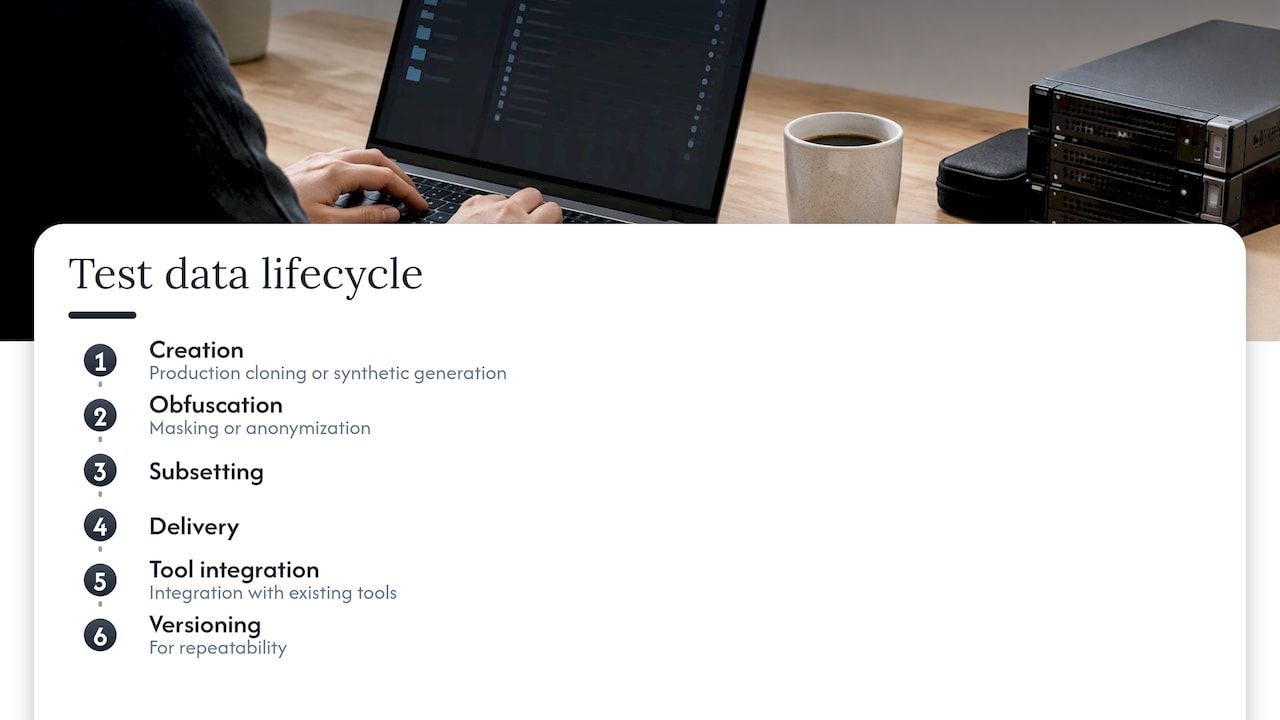
Test data is the set of inputs, records and system states a test needs: a username and password pair, or a customer with three past orders and one failed payment. Test data management is everything around it. The IEEE Computer Society describes it as the process of creating, managing and delivering a supply of high-quality test data to application teams, moving through creation (production cloning or synthetic generation), obfuscation (masking or anonymization), subsetting, delivery, integration with existing tools and versioning for repeatability.
The point of the discipline is that data stops being something each tester assembles by hand. It becomes a managed asset with an owner, a source, a refresh schedule and a privacy status. For an enterprise running financial workflows, multi-currency ledgers or blockchain settlement logic, that shift matters more than for a simple web app, because the interesting defects live in combinations of records: an account with a pending transfer, a reversal and a currency conversion.
Why it becomes a bottleneck
The cost of ignoring it is measurable. The Capgemini, Sogeti and Broadcom Continuous Testing Report 2019 found that 55% of respondents spend 30 to 60% of total testing time on test data management. The top challenge, named by 33%, was extracting data spread across multiple databases, followed by limited production access that depends on database administrators (28%) and maintaining multiple versions of test data sets (27%).
More recent survey data points the same way. In the World Quality Report 2025-26, organizations named lack of test data quality (51%), difficulty creating large data sets (49%), lack of accuracy (48%), compliance with data privacy rules (47%) and high costs of creation, maintenance and storage (45%) as their top pain points. Only 34% treat test data management as strategic, and while 80% automate some aspect of it, none have automated all of it.
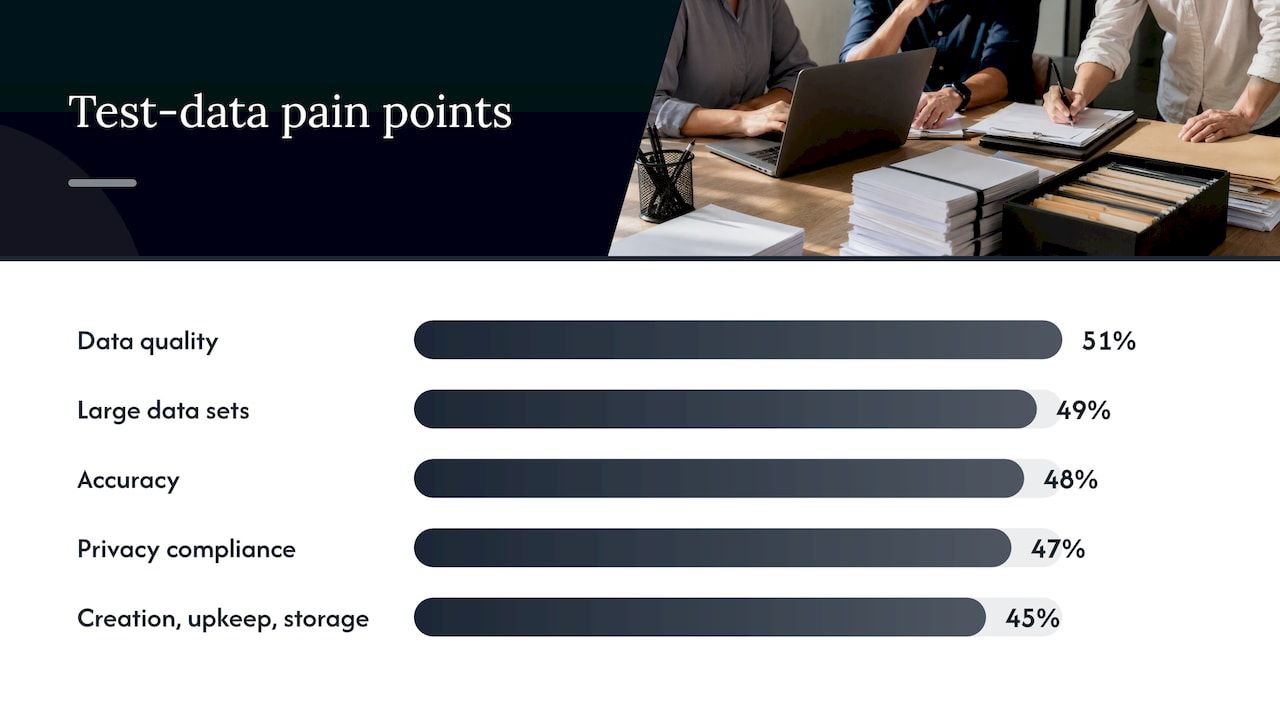
Those numbers describe a process problem, not a tooling problem. Slow, ticket-based provisioning, stale copies and unmasked data in lower environments are symptoms of nobody owning the data supply.
The main sources of test data
Every dataset in a test environment comes from one of a handful of sources. Choosing deliberately for each test type is the core of TDM.
| Source | What it is | Best for | Main risk |
|---|---|---|---|
| Production copy | A direct clone of live data | Rarely appropriate outside tightly controlled settings | Exposes personal and financial data |
| Masked production data | Production data with sensitive values replaced by realistic substitutes | Integration, regression, UAT, reconciliation defects | Weak masking can be reversed; refresh can be slow |
| Subset | A smaller, referentially complete slice of production | Developer environments, faster refresh | Slice may miss edge cases |
| Synthetic data | Artificially generated records that follow your rules | CI pipelines, negative testing, greenfield systems, large volumes | May miss real-world correlations |
| Hand-crafted data | Records written for a specific scenario | Known edge cases, regression fixtures | Does not scale |
By input category, good suites also need valid data the system must accept, invalid data that exercises error handling, and boundary values at the edge of accepted ranges. A payment module, for example, needs amounts of exactly zero, the maximum permitted transfer, and a currency with no decimal places, not just ordinary purchases.
Test data masking: how it protects and where it fails
Masking creates a structurally similar but false version of a dataset. AWS lists three principles a masking approach must meet: semantic integrity (masked values still follow the original formats and rules), non-reversibility, including resistance to inference attacks, and referential integrity (the same value is masked consistently across records).
That last principle is where most projects stumble in financial systems. If a customer ID is masked one way in the accounts table and another way in the transactions table, joins break and tests fail for reasons unrelated to the code. Deterministic masking, where the same input always produces the same output, solves this, and the Percona documentation on data masking notes the failure mode directly: without it, the same identifier can end up masked to different values in different tables.
The same documentation is clear about the limits. Masking is a data transformation, not a substitute for access control. Small value domains such as gender or state codes can be revealed by frequency analysis, partial masking such as keeping the last four digits can allow re-identification when combined with other data, and users with direct SELECT access to the base table can bypass view-level masking.
In practice, this gives four working rules:
- Mask statically, before data reaches the test environment, so real values never sit there waiting behind a view.
- Use deterministic, schema-preserving rules so relationships survive.
- Mask quasi-identifiers (dates, postal codes, rare attribute combinations), not only names and account numbers.
- Restrict who can reach the source and the masked copy separately.
For a deeper walk through methods and compliance obligations, see our guide to PII data masking.
Synthetic test data: when it beats masked data
Synthetic data is generated from rules, schemas or models rather than derived from real records, so there is nothing sensitive to leak. It is fast to produce, scales to any volume, and lets you create the cases production rarely contains: a ten-million-row ledger, a malformed payload, a settlement that fails halfway.
The trade-off is fidelity. Synthetic generators capture the rules you give them, and real data holds correlations nobody wrote down. That is why the sensible answer is rarely either-or. A common pattern is to use a small, approved production-derived baseline to calibrate generators, then produce large synthetic variants for daily testing.
A practical split looks like this:
- Synthetic first: CI pipelines, exploratory test design, performance and load models, negative and boundary testing, API contract tests, and any new product with no production history.
- Masked production first: legacy migrations, reconciliation defects, production-parity sampling, and late-stage integration and UAT where real-world distributions matter.
- Hand-crafted fixtures: the small set of golden scenarios every release must pass, such as a refund after a currency conversion.
The ratio depends on your risk profile. A fintech handling cardholder data will lean heavily on synthetic data in lower environments, while an internal workflow system with low-sensitivity records may use masked subsets more freely.
Building a test data strategy that holds up
A strategy is not a document stating which tests use which data. It is the combination of code, procedure and infrastructure that controls how tests interact with data, and it needs to be enforced on every pipeline run. Otherwise the same problems return the moment a new team or service is added.
Assign ownership and policy once
Decide who owns classification of sensitive data, masking rules and regulatory mapping (for example PCI DSS, GDPR or HIPAA, whichever applies to your business). Make that decision once at the policy level so that individual teams do not renegotiate it for every project.
Map environments to datasets
Write down which environment gets which data, at what size and how often it refreshes. A simple matrix works:
| Environment | Data source | Refresh | Typical size |
|---|---|---|---|
| Developer and CI | Synthetic seed | Every pipeline run | Small |
| QA | Masked production subset | Weekly | Medium |
| Staging and performance | Masked or synthetic at scale | Each release | Large |
| UAT | Curated masked set | Each release | Small, realistic |
Sizes are yours to set from your own systems, but the discipline of writing the matrix down exposes gaps quickly.
Make provisioning self-service
When testers must raise a ticket and wait days for a database refresh, they route around the process and copy data themselves. Self-service provisioning, triggered from the pipeline, removes the incentive. Isolate records per test run so parallel tests do not collide, and decide whether each test creates and cleans up its own data or generates unique data each run, in which case cleanup may be unnecessary and the only constraint is environment size.
Version and audit the data
Versioned data definitions make failures reproducible. Access logging and retention rules make audits painless. If your compliance team expects tamper-evident records, the principle behind audit trail logging, where entries are written once and never altered, applies just as well to who accessed which dataset and when.
Connect it to the wider test plan
Data needs flow from test cases, so the strategy belongs inside your testing approach rather than beside it. Our guides on software testing methodology, integration testing plans and quality assurance in software cover that context.
The lifecycle in practice
A workable end-to-end flow has seven steps:
- Define needs from test cases. List the entities, states and volumes each suite requires.
- Discover and classify sensitive data. Find where personal and financial fields live, including free-text columns and logs.
- Choose a source per need. Synthetic, masked, subset or hand-crafted, using the split above.
- Prepare and provision. Generate or mask, validate referential integrity, deliver through a pipeline step.
- Use and isolate. Give each test run its own records or a reset state.
- Refresh, reset and retire. Remove stale data on a schedule so environments do not drift.
- Govern and audit. Keep access logs, retention rules and written assumptions per dataset.
Data quality does not stop at provisioning. Checks that catch nulls, duplicates and broken relationships in production also belong on your test datasets, and our piece on data quality monitoring shows which checks and metrics to automate.
Measuring whether it works
Set targets from your own baseline rather than borrowing someone else’s, and track a short list:
- Provisioning time: from request to data ready in the environment.
- Data-related failure rate: the share of failed tests caused by data, not defects. It tells you whether a red build can be trusted.
- Sensitive data incidents: the target for personal data in non-production is zero.
- Refresh frequency and data freshness: how old the data is when tests run.
- Maintenance effort: hours spent repairing and rebuilding datasets.
If provisioning takes days and a large share of failures trace back to data, you have found where automation pays back first.
Common mistakes to avoid
- Copying production into staging “temporarily.” Temporary copies become permanent, and they carry the full compliance burden.
- Masking only the obvious fields. Dates, locations and rare combinations can identify people even when names are gone.
- Oversized copies. Full clones slow refreshes and inflate storage cost; subsets or synthetic volume generation are usually enough.
- Treating the strategy as a document. If nothing in the pipeline enforces it, it will erode with the next new service.
- Ignoring data drift between environments. When QA and staging differ in structure, passing tests mean little.
Why architecture decides how hard this is
Test data pain is often an architecture symptom. When business logic, financial calculations and integrations are tangled together, no one knows which records a scenario needs, so teams clone everything. When the system is built from clearly bounded modules, each with its own data contract, the dataset for a test is small and obvious.
This matters most in regulated domains. A ledger, a multi-currency payment flow or a token settlement process needs reproducible, audit-ready test scenarios, and those are far simpler when the underlying components are consistent and documented from day one.
Our perspective
We build custom enterprise systems from modular, ready-made components, and our experience points to one conclusion about test data: it is cheapest to get right when the system is designed for it.
A modular foundation gives every domain, such as financial processing, workflow automation, CRM or token handling, a defined boundary. That makes it clear what data each test needs and which fields are sensitive. Because our projects can start with up to 60% of the baseline system already built, teams spend their effort on business-specific logic and on testing it properly, instead of rebuilding plumbing and then guessing at the data around it.
Our modules are designed to be audit-ready and self-hosted, so organizations keep control over where their data lives and who can reach it. We think that control is the real foundation of a sound test data strategy: policy decided once, data supplied through the pipeline, nothing sensitive sitting in places it should not.
Bitecode
Build the test data foundation with the system
If you are planning a new internal platform, a financial product or a SaaS application, the most effective moment to settle test data is before the first sprint. We deliver custom business software and ready-made modules for AI assistance, financial processing, automation, CRM and blockchain tokens, all designed around a low-code, modular approach with multi-currency, audit-ready and self-hosted capability.
To see how the modules fit together, explore the Bitecode module overview or contact us through bitecode.tech about an MVP or a larger project. Compliance-heavy teams may also want to read how automated compliance workflows reduce audit effort.
FAQ
What is the difference between test data and test data management?
Test data is the set of records and states a test needs to run and verify a result. Test data management is the surrounding process: defining requirements, creating or masking the data, provisioning it to environments, refreshing it and retiring it. Masking and generation are techniques within it.
Is synthetic data better than masked production data?
Neither wins everywhere. Synthetic data suits CI pipelines, negative testing, large volumes and systems with no production history, because it carries no real personal data and generates quickly. Masked production data suits integration, regression and reconciliation work where real-world distributions matter. Most mature teams combine both.
Is masked data safe to use in non-production?
It is safe when the masking is static, deterministic and covers quasi-identifiers such as dates and rare attribute combinations. Masking does not replace access control, so restrict who can reach both the source and the masked copy, and log that access.
Who should own test data management?
Assign a named owner for policy and classification, typically a data protection or compliance lead working with QA. Sourcing sits with test architects, provisioning with the platform or DevOps team, and day-to-day lifecycle with product teams. Deciding policy once and making provisioning self-service keeps teams from working around it.
How do we know our test data management is improving?
Track provisioning time, the share of test failures caused by data, sensitive data incidents, data freshness and maintenance effort. Take your current numbers as the baseline and set targets from there, with personal data in non-production at zero.
Sources
- A Guide To Test Data Management, IEEE Computer Society
- Continuous Testing Report 2019, Capgemini, Sogeti and Broadcom
- World Quality Report 2025-26, Sogeti
- What is Data Masking, AWS
- Data masking overview, Percona Server for MySQL 8.4
- Time Tracking Audit Trails: Why WORM Logs Matter, Clock-Me Blog