PII data masking is the process of replacing, obscuring, or transforming personally identifiable information in a dataset so that the data remains usable for its intended purpose while the original sensitive values cannot be read or recovered by unauthorized parties. If your team is starting a masking project today, three steps should happen before any code is written:
- Scope sensitive fields first. Inventory every data store and classify fields by sensitivity tier (direct identifiers, quasi-identifiers, and non-sensitive attributes).
- Pick an approach by environment. Static masking for dev/test copies, dynamic masking for production query interfaces, and on-the-fly transforms for streaming pipelines each carry different engineering and compliance implications.
- Run a discovery scan before masking anything. Automated profiling and regex-based detection catch fields your schema documentation missed.
One critical distinction: masking is not the same as full de-identification. Masking protects data in transit and at rest within controlled environments. True de-identification, as defined by NIST SP 800-188 and HHS HIPAA guidance, requires measuring and mitigating re-identification risk, not merely substituting values. Regulatory alignment with NIST and HIPAA should be a design input, not an afterthought.
Key Takeaways
Effective PII data masking requires pairing the right technique to the right environment, measuring re-identification risk, and maintaining a versioned policy catalog that serves as your primary compliance evidence.
| Point | Details |
|---|---|
| Match masking type to environment | Use static masking for dev/test copies, dynamic masking for production interfaces, and on-the-fly transforms for pipelines. |
| Hashing alone is not compliant | SHA-256 of a finite-format field like an SSN is reversible; use HMAC or FPE with proper key controls instead. |
| NIST and HIPAA require risk measurement | Masking-only tools that substitute values without scoring re-identification risk do not satisfy NIST SP 800-188 or HIPAA de-identification standards. |
| Referential integrity is the top engineering risk | Deterministic pseudonymization or FPE is required when masked fields appear as foreign keys across multiple tables. |
| Bitecode accelerates masking deployments | Modular discovery pipelines, key management integration, and audit logging reduce time from field inventory to production-ready masking. |
What counts as PII and why quasi-identifiers complicate the picture
The standard definition of PII covers any information that can identify a specific individual, either directly or in combination with other data. Direct identifiers include Social Security Numbers, full legal names, email addresses, phone numbers, passport numbers, and credit card fragments. These fields are unambiguous: mask them wherever they appear outside a secure production context.
Quasi-identifiers are subtler and more dangerous from a re-identification standpoint. A single field like a five-digit ZIP code, a birth year, or a job title is not PII on its own. Combined with two or three other quasi-identifiers in the same record, it can uniquely identify an individual in a dataset.
Fields that frequently act as quasi-identifiers in practice:
- IP addresses and device identifiers (especially persistent advertising IDs)
- Geolocation coordinates or precise GPS traces
- Timestamps at high granularity (minute-level event logs)
- Demographic combinations (age band + gender + employer size)
- Pseudonymous user IDs that are consistent across sessions or systems
Example: A dataset containing only ZIP code, birth date, and gender appears benign. Research by Latanya Sweeney demonstrated that combinations of this type can uniquely identify a large share of the U.S. population. A masked dataset that suppresses SSN but retains all three of those fields may still carry significant re-identification risk.
The practical implication: your field classification exercise must account for combinations, not just individual columns. Discovery tooling that scores fields in isolation will miss this.
Why masking PII matters: breach exposure, regulation, and operational risk
Masking reduces exposure when data is copied, shared, or processed outside the secure production perimeter. The most common failure mode is not a sophisticated attack on production systems; it is a developer pulling a real customer database into a test environment, a data analyst exporting a CSV to a shared drive, or a vendor receiving a full dataset for a proof-of-concept engagement.
Statistic callout: According to IBM’s Cost of a Data Breach Report, the average total cost of a data breach in the United States is among the highest globally, the highest of any country measured. Healthcare breaches averaged even higher. Masking PII before data leaves the production perimeter directly reduces the blast radius of these incidents.
U.S. regulatory obligations that drive masking decisions:
- HIPAA: Covered entities and business associates must de-identify protected health information (PHI) before using or disclosing it for purposes outside treatment, payment, or operations. HHS defines two formal methods: expert determination and safe harbor.
- CCPA/CPRA: California’s privacy law grants consumers rights over their personal information and imposes obligations on businesses that collect, sell, or share it. Pseudonymization and masking reduce the scope of data subject to these rights when implemented correctly.
- GDPR (cross-border): U.S. teams handling EU resident data must apply appropriate technical safeguards. Pseudonymization is explicitly recognized as a risk-reduction measure under GDPR Article 25. For teams choosing LLM providers or cloud infrastructure, GDPR compliance considerations intersect directly with masking decisions.
Beyond regulatory fines, the operational risks are concrete: a single unmasked test database shared with a third-party vendor can trigger breach notification obligations across multiple states, generate class-action exposure, and require forensic investigation that costs far more than the masking project would have.
Core masking types: static, dynamic, on-the-fly, reversible, and synthetic
ISO’s data masking guidance identifies four primary masking types and positions each as a privacy-enhancing technique that trades off utility against disclosure risk. Synthetic data generation sits adjacent to these as a fifth category.
| Masking Type | When to Use | Key Trade-off |
|---|---|---|
| Static data masking | Non-production copies (dev, test, QA, training) | Irreversible; safe for sharing but requires a full copy of the dataset |
| Dynamic data masking | Production query interfaces; role-based access control | Reversible at the DB layer; original data unchanged, masking applied at query time |
| On-the-fly / stream masking | ETL pipelines, real-time event streams, API responses | Low latency required; masking logic must be embedded in the pipeline |
| Reversible / pseudonymization | Analytics that require re-linking records; audit trails | Requires secure key management; re-identification risk if keys are compromised |
| Synthetic data | ML model training; load testing; third-party demos | No real PII; statistical properties may drift from production distribution |
Format-preserving encryption (FPE) fits under reversible approaches. It keeps the ciphertext in the same format and length as the plaintext, which matters when legacy applications validate field formats (a 9-digit SSN field that must remain 9 digits). NIST SP 800-38G specifies the FF1 and FF3 modes for FPE and documents the security parameter constraints teams must respect. FPE adds implementation complexity and carries specific performance overhead compared to simple substitution, so it should be chosen only when format preservation is a genuine system constraint.
Masking techniques: how each one transforms data and what you trade away
Each technique below operates differently on the source value and produces a different risk/utility profile. Choosing among them is an engineering and compliance decision, not just a tooling question.
A few notes on technique selection:
- Substitution is the workhorse for dev/test environments. Use a deterministic mapping (same input always produces the same output) when referential integrity across tables matters.
- Pseudonymization under HIPAA requires that coded identifiers not be derived from or related to the original PHI, and that the mapping table be held separately with access controls.
- Hashing (SHA-256, for example) is often misapplied as a masking technique. A hash of a known-format field like an SSN is trivially reversible by brute force across the finite input space. NIST and HHS both note that hashing alone does not constitute compliant de-identification.
- FPE is the engineering fallback when field format must be preserved for legacy systems, but NIST SP 800-38G is explicit about parameter selection constraints and the security implications of tweak reuse.
How to discover PII in your datasets before you mask it
Discovery is where most masking projects underestimate the work. Schema documentation is almost always incomplete. The practical discovery sequence:
- Inventory all data sources. Include databases, data lakes, object storage, message queues, log aggregators, and third-party SaaS exports. Shadow IT sources (shared drives, BI tool caches) are frequently missed.
- Run automated data profiling. Profile column names, data types, value distributions, and cardinality. High-cardinality string columns with consistent length patterns are strong SSN/phone/email candidates.
- Apply regex and pattern rules. Standard patterns cover SSN (
\d{3}-\d{2}-\d{4}), email, phone, credit card (Luhn-valid 16-digit sequences), and IP addresses. Pattern libraries like those built into AWS Glue DataBrew and Azure Data Factory reduce the boilerplate here. - Layer ML classifiers on top. Regex catches structured fields; ML classifiers catch unstructured text (free-form notes, support tickets, PDF extracts) where PII appears in natural language. AWS Glue DataBrew’s PII detection transforms and the Azure Data Factory PII detection and masking template both integrate external detection services into the pipeline before the masking step.
- Apply contextual rules. A column named
noteswith low cardinality might still contain PHI. Context rules (field name + adjacent field names + sample values) improve precision. - Sample and manually review. Automated tools produce false negatives. A structured sample review by a data engineer and a compliance officer catches edge cases before they become incidents.
Prioritize fields by two axes: sensitivity tier (direct identifier vs. quasi-identifier) and exposure surface (who can query this field and where does it flow downstream). A direct identifier in a table accessible only to two DBAs is lower urgency than a quasi-identifier in a table replicated to a third-party analytics vendor nightly.
Pro Tip: Build your field inventory as a living catalog, not a one-time spreadsheet. Every new data source onboarded should trigger a discovery scan before it enters any pipeline that touches non-production environments.
Where and how to apply masking: environment patterns and engineering notes
The environment determines the masking type. Applying the wrong type to the wrong environment is one of the most common engineering mistakes in masking projects.
| Environment | Recommended Approach | Engineering Notes |
|---|---|---|
| Dev / test / QA | Static data masking on a full copy | Run masking at copy time; never refresh test DBs from production without re-masking |
| Analytics pipelines | Aggregation, generalization, or synthetic data | Preserve statistical distributions; validate aggregate queries against masked data |
| Production query interfaces | Dynamic data masking (role-based) | Original data unchanged; masking applied at query time by DB engine or middleware |
| Real-time APIs / event streams | On-the-fly masking in the pipeline | Embed masking transforms in the ETL/ELT layer; monitor latency impact |
| Third-party data sharing | Irreversible masking or synthetic data | Never share reversible masks unless the recipient has a legitimate re-identification need and a signed DPA |
| Logs and audit trails | Suppression or tokenization of PII fields | Log correlation IDs, not raw identifiers; rotate tokens periodically |
Engineering details that trip up teams:
Referential integrity is the most common source of post-masking breakage. If customer_id in the orders table is pseudonymized, the same pseudonym must appear in the customers table and every foreign key reference. Deterministic pseudonymization (keyed HMAC or FPE) solves this; random substitution does not.
Key management for reversible masks must be treated with the same rigor as encryption key management. Keys stored in the same database as the masked data eliminate the security benefit. Use a dedicated secrets manager (AWS Secrets Manager, Azure Key Vault, or HashiCorp Vault) with least-privilege access policies.
Downstream joins on masked fields require that the masking function be consistent across all tables and pipeline runs. Document the masking function version and key version alongside the dataset.
Pro Tip: Maintain a masking policy catalog: a structured document that maps each sensitive field to its masking level, the technique applied, the key reference (for reversible masks), and the environments where the mask is active. This catalog becomes the primary evidence artifact for compliance audits.
Platform and tooling references: where to start in your stack
Three platforms have well-documented, production-ready masking capabilities that teams can start with rather than building from scratch.
-
AWS Glue DataBrew includes built-in PII detection transforms that identify and mask sensitive columns during data preparation jobs. DataBrew’s detection uses pattern matching and ML-based classification across structured and semi-structured datasets. The masking transforms support substitution, hashing, and suppression out of the box, and jobs can be scheduled or triggered as part of a Glue workflow. Documentation is available in the AWS Glue DataBrew developer guide.
-
Azure Data Factory solution template provides an end-to-end pipeline pattern: read from Azure Data Lake Storage Gen2, call an external PII detection and masking service within a data flow activity, and write the masked output to the sink. The Azure Data Factory PII detection and masking template is a practical starting point for teams already on Azure; it demonstrates how to wire detection and masking as discrete, testable stages in a pipeline rather than embedding them in application code.
-
SQL Server supports both static and dynamic data masking natively. Dynamic Data Masking (DDM) in SQL Server applies masking rules at the column level and enforces them at query time based on user roles, without altering stored data. Static masking is achieved through T-SQL scripts that transform data in a copy of the database. Both approaches are documented in the SQL Server documentation with concrete examples for common field types.
When choosing between built-in platform masking and dedicated tooling or custom ETL scripts: platform-native tools reduce integration overhead and are easier to audit, but they may not support every masking technique (FPE, for example, is rarely built in). Dedicated tooling or custom scripts give more control over technique selection and key management but increase maintenance burden. For financial data security use cases where FPE or complex pseudonymization is required, custom pipeline components are often necessary.
Decision checklist for choosing a masking approach
The right masking approach follows from the data-sharing model and the re-identification tolerance, not from what the platform makes easiest to configure.
- Define the data-sharing model. Is the data staying internal (dev/test), going to an analytics team, being shared with a third party, or being published? Each model carries a different re-identification risk baseline.
- Quantify re-identification tolerance. For HIPAA-covered data, this means choosing between expert determination (a qualified statistician certifies the risk is very small) or safe harbor (remove all 18 specified identifiers). For non-HIPAA data, document the acceptable risk threshold explicitly.
- Set utility preservation targets. Which downstream queries, joins, or ML training tasks must still work on the masked data? This determines whether suppression is acceptable or whether format-preserving or deterministic techniques are required.
- Choose reversible vs. irreversible. Reversible masking (pseudonymization, FPE) is appropriate when re-linking records is a legitimate operational need. Irreversible masking is appropriate for any sharing scenario where re-identification should be structurally impossible.
- Assess performance and latency budgets. Dynamic masking adds query overhead. On-the-fly pipeline masking adds transform latency. FPE is computationally heavier than substitution. Benchmark before committing to a technique in a high-throughput path.
- Map to regulatory requirements. HIPAA safe harbor requires removing or generalizing all 18 identifier categories. Expert determination requires documented risk assessment. ISO/IEC 27559 and NIST SP 800-188 both recommend measurable performance levels and governance structures.
The decision flow: scope fields → run discovery → select technique by environment and utility need → test re-identification risk → validate analytic utility → deploy with audit logging.
Testing masked data and avoiding common pitfalls
Masking that has not been tested is masking that has not been validated. Three categories of testing are non-negotiable before a masked dataset enters any downstream use.
- Unit tests on masking transforms. Verify that each masking function produces the expected output format, that deterministic functions produce the same output for the same input across runs, and that no original values appear in the output.
- Regression tests for joins and referential integrity. Run the full set of downstream queries against the masked dataset and compare result shapes (row counts, join cardinalities) against a known baseline. A broken foreign key relationship will surface here.
- Statistical utility tests. For analytics use cases, compare aggregate statistics (means, distributions, correlation coefficients) between the original and masked datasets. Significant drift indicates over-masking or a masking technique that distorts the analytic signal.
- Re-identification attack simulations. Apply k-anonymity and l-diversity checks to the masked dataset. Tools that score re-identification risk (including some built into data governance platforms) can estimate the probability that a record in the masked dataset can be linked back to a real individual.
Common pitfalls that undermine masking programs:
- Treating hashing as sufficient. SHA-256 of a 9-digit SSN is reversible in seconds with a precomputed table. Hashing is not masking unless combined with a secret key (HMAC) and proper controls, as HHS HIPAA guidance makes clear.
- Accidental exposure through logs and backups. Application logs that capture request parameters, database query logs, and backup snapshots taken before masking runs are common sources of unmasked PII leakage. Masking policy must extend to these artifacts.
- Reversible masks without key governance. A pseudonymized dataset is only as secure as the key that maps tokens back to originals. Keys stored in version control, shared Slack channels, or unencrypted config files negate the masking entirely.
Pro Tip: Include audit trails and versioned masking policies in your governance framework. Every masked dataset should carry metadata: which masking policy version was applied, when, by which pipeline run, and which key version was used. Enforce key rotation on a defined schedule and restrict re-identification access to a named, audited role.
What NIST SP 800-188 and HIPAA guidance actually require
Both NIST and HHS frame de-identification as a risk management discipline, not a checkbox exercise. The practical implications for engineering and compliance teams are more demanding than most masking tool vendors suggest.
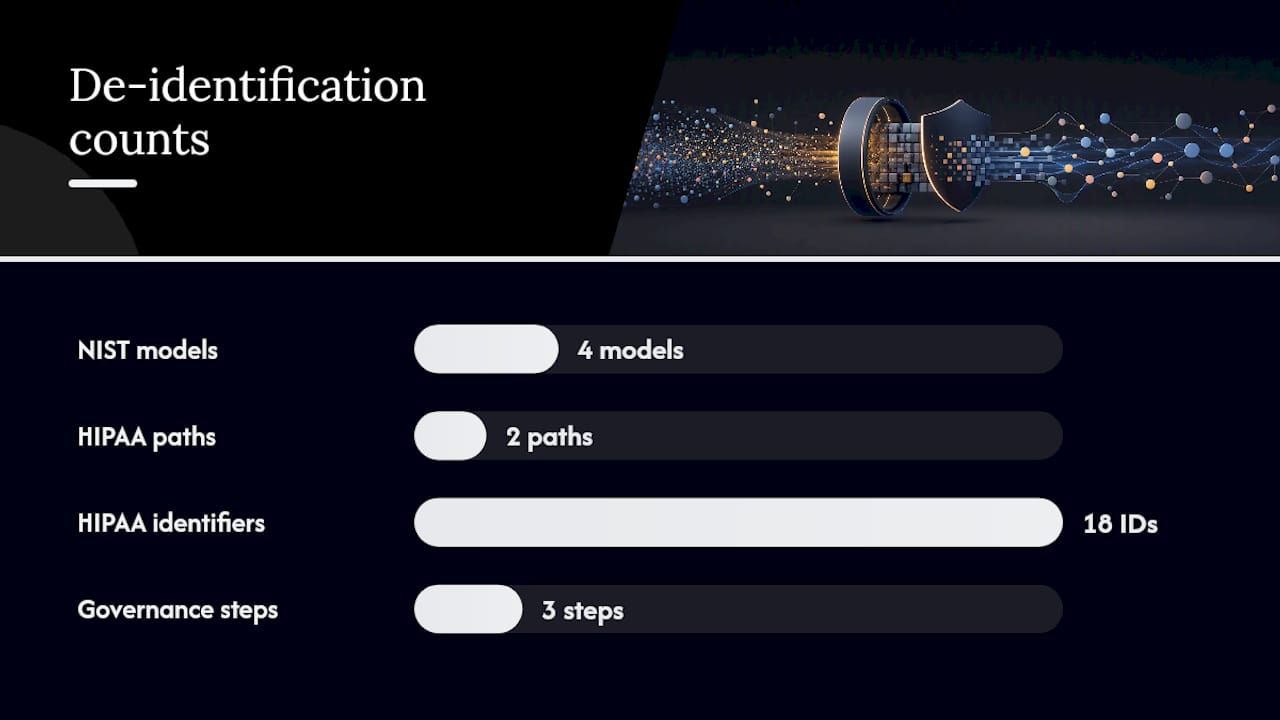
NIST SP 800-188 advises that organizations evaluate de-identification goals and re-identification risk before selecting an approach. The guidance recommends choosing among four data-sharing models: publishing de-identified data, publishing synthetic data, providing query interfaces, or using protected enclaves. Critically, NIST warns that tools that only mask values may not meet de-identification goals without re-identification risk measurement. A masking pipeline that substitutes SSNs but leaves ZIP code, birth date, and gender intact may produce a dataset that fails any reasonable re-identification risk threshold.
HIPAA de-identification, per HHS guidance, follows two formal paths:
- Expert determination: A qualified statistician applies generally accepted principles to certify that the risk of identifying an individual is very small. This method allows more flexibility in which fields are retained, but requires documented methodology and a named expert.
- Safe harbor: Remove or generalize all 18 specified identifier categories (name, geographic data below state level, dates more specific than year for individuals over 89, phone, fax, email, SSN, medical record numbers, health plan numbers, account numbers, certificate/license numbers, VINs, device identifiers, URLs, IP addresses, biometric identifiers, full-face photos, and any other unique identifier). Safe harbor is deterministic but conservative.
Cryptographic transforms, including hashing and pseudonymization, can be part of a compliant de-identification approach under either method, but only when used within the method’s controls. A hash of PHI that is stored alongside the original data, or that can be reversed by any party with access to the dataset, does not satisfy either method.
Recommended governance steps:
- Establish a Disclosure Review Board or equivalent governance body to approve de-identification methodologies before data is shared.
- Document re-identification risk assessments and retain them as compliance evidence.
- Set measurable performance levels for de-identification (acceptable re-identification probability thresholds) and test against them on each dataset release.
Compact example recipes: static masking, dynamic masking, and on-the-fly transforms
These patterns are starting points for prototyping, not production-ready implementations. Adapt key management, error handling, and logging to your environment.
Static masking recipe (SQL Server, dev/test copy)
-- Deterministic pseudonymization using HASHBYTES for referential integrity
-- Replace with HMAC + secret key in production; plain hash is not sufficient for compliance
UPDATE dbo.Customers
SET
    Email       = CONCAT('user_', ABS(CHECKSUM(NEWID())), '@masked.example.com'),
    Phone       = REPLICATE('X', LEN(Phone)),
    SSN         = '***-**-' + RIGHT(SSN, 4),  -- retain last 4 for QA matching only
    FirstName   = 'Test',
    LastName    = 'User' + CAST(CustomerID AS VARCHAR(10))
WHERE DataEnvironment = 'TEST';
Notes: The LastName pattern preserves a unique identifier per record so foreign key joins still resolve. For cross-table consistency, apply the same deterministic function to every table that holds CustomerID.
Dynamic masking snippet (SQL Server DDM policy)
-- Apply a dynamic mask to the Email column; unmasked only for members of the 'DataOwner' role
ALTER TABLE dbo.Customers
ALTER COLUMN Email ADD MASKED WITH (FUNCTION = 'email()');

-- Grant unmasked access to privileged role
GRANT UNMASK TO DataOwner;
Dynamic Data Masking in SQL Server applies the mask at query time. Users without UNMASK permission see [email protected]; users with the permission see the original value. The underlying data is never altered.
On-the-fly pipeline recipe (ETL pseudocode, Azure Data Factory pattern)
Pipeline: MaskAndLoad
  Source: AzureDataLakeGen2 (raw/customers/*.parquet)
  Activity 1 - DataFlow: DetectAndMask
    → Call: ExternalPIIDetectionService(column_sample)
    → For each flagged column:
        Apply: SubstitutionTransform(column, masking_policy[column.sensitivity_tier])
    → Output: masked_stream
  Activity 2 - Sink: AzureDataLakeGen2 (masked/customers/*.parquet)
  Logging: Write masking_run_metadata (policy_version, key_version, timestamp) to audit_log table
This pattern mirrors the structure documented in the Azure Data Factory solution template. The detection and masking steps are discrete activities, which means each can be unit-tested and replaced independently as requirements evolve. The audit log write is not optional: it is the evidence artifact for compliance reviews.
For teams building synthetic datasets to support ML training or load testing, the considerations around synthetic data generation for model training and privacy-preserving use cases are worth reviewing together with your masking strategy.
How masking projects actually succeed: a practical perspective
The teams that deliver masking projects on time share one characteristic: they treat the field inventory as the project’s critical path, not the tooling selection. Tooling decisions take an afternoon once the field catalog is complete. Building the catalog across a mature data estate with undocumented legacy systems, shadow IT, and inconsistent naming conventions takes weeks.
A realistic timeline for a medium-complexity masking deployment covering three to five data domains:
- Weeks 1–2: Discovery and field classification. Data engineers run profiling scans; compliance reviews output against regulatory field lists; security signs off on sensitivity tiers.
- Weeks 3–4: Technique selection and policy drafting. Compliance and engineering align on reversible vs. irreversible choices per environment; masking policy catalog is drafted.
- Weeks 5–7: Implementation and unit testing. Engineers build or configure masking transforms; referential integrity tests run against a staging copy.
- Weeks 8–9: Re-identification risk assessment and utility validation. Statistical tests on masked datasets; k-anonymity checks; compliance sign-off on risk documentation.
- Week 10: Production deployment and audit logging activation.
The roles that matter most: data engineers own the pipeline implementation and referential integrity; security owns key management and access controls; compliance owns the risk assessment documentation and regulatory mapping; product owners arbitrate utility trade-offs when masking breaks a downstream feature; operations owns key rotation schedules and audit log retention.
The most common scope creep vector is analytic utility. A business intelligence team discovers that generalization of a date field breaks a quarterly cohort analysis, and the project stalls while the team debates whether to use a less aggressive technique. Resolve utility requirements in week 3, not week 8.
Bitecode’s approach to masking and de-identification projects
Masking projects fail most often not because the techniques are hard, but because the engineering, compliance, and governance workstreams are not coordinated from the start. Bitecode’s modular development approach addresses exactly this coordination problem: discovery pipelines, masking transforms, key management integration, and compliance documentation are built as discrete, testable modules rather than monolithic scripts that are difficult to audit or extend.

For teams that need to move from field inventory to a production-ready masking pipeline without a lengthy greenfield build, Bitecode’s automation services cover the full stack: automated PII discovery, configurable masking transforms by environment, secrets manager integration for key governance, and audit log generation that maps directly to NIST and HIPAA documentation requirements.
To scope a masking project or run a discovery pilot against your data estate, contact Bitecode through the web app development service page or reach out directly to discuss your environment and compliance requirements.
Sources
Every team running a masking or de-identification program should have these sources in the compliance binder and linked from internal runbooks.
- SP 800-188, De-Identifying Government Datasets: Techniques and Governance | CSRC
- Hhs
- What is data masking? Types, techniques and best practice | ISO
- PII detection and masking - Data Factory | Microsoft Learn
For teams managing SaaS security compliance alongside masking requirements, linking these references into your internal compliance checklist ensures masking decisions stay connected to the broader audit and control framework.