Subledger architecture is the design that keeps transaction-level detail in dedicated records, such as payables, receivables, inventory or customer wallets, and passes summarized accounting entries up to the general ledger. The general ledger answers “what is the balance?” The subledger answers “which transactions make up that balance, and who or what do they belong to?” Getting the boundary between the two right determines whether your close is fast, your audits are quiet and your system can scale.
This guide covers the components, the posting flow, the reconciliation and audit mechanics, and the design decisions technical teams and finance leaders face when they build or integrate a subledger layer.
TL;DR
- A subledger stores detailed, operational transactions for one domain (payables, receivables, assets, customer accounts) and posts summaries or details to the general ledger.
- The general ledger is built for account-level aggregation and period-end reporting. The subledger preserves the detail needed to explain every balance.
- A sound architecture has four parts: source events, accounting rules, a subledger journal repository and a controlled posting interface to the ledger.
- Reconciliation is easiest when the subledger and the control account update together, and when every entry carries a shared reference back to its source document.
- Decide early on batch versus real-time posting, rule ownership, multi-currency handling and whether to build, buy or start from a modular foundation.
What a subledger does in the accounting stack
A subledger, also called a subsidiary ledger, is a transaction-level record system. In Microsoft Dynamics 365 Finance, subledgers capture document details relevant to each module, and their detailed journal entries are transferred to the ledger. Accounts Payable and Inventory are typical examples, holding details such as tax codes and costs that the general ledger has no reason to carry.
The same idea appears in banking and payments, with different nouns. A US banking-infrastructure provider describes subledgers holding detailed financial information at the customer, wallet, program or merchant level, while rolling up to master accounts for general ledger reporting. The unit of detail changes with the business. The pattern does not: granular records underneath, a controlled summary on top.
This separation exists for a practical reason. A general ledger with a line for every invoice line, card authorization or fee would be slow to report on and hard to govern. A subledger with no connection to the ledger would be a spreadsheet with ambitions. Architecture is the discipline of connecting the two with explicit rules.
Subledger vs general ledger
The most common question behind this topic is how the two differ. The short version: the general ledger is the book of record for financial statements, and subledgers are the books of record for the detail behind selected accounts. Oracle’s documentation describes detailed transactional data segregated in subledgers, which is periodically imported and posted to the ledger in summary or in detail.
| Dimension | Subledger | General ledger |
|---|---|---|
| Granularity | Individual transactions, documents, customers, wallets | Account-level balances and summarized entries |
| Typical content | Invoices, payments, refunds, fees, asset records | Control accounts, revenue, expense, equity |
| Primary users | Operations, AP/AR teams, product and payments engineers | Controllers, finance leadership, external auditors |
| Update pattern | Continuous, as business events occur | On posting, usually summarized per period or batch |
| Main purpose | Explain and support balances | Produce financial statements |
| Link to the other | Posts entries to control accounts | Holds control accounts that subledgers must agree with |
The control account is the hinge. Each subledger rolls into one or more control accounts in the ledger, and the invariant you defend is simple: the sum of subledger balances equals the control account balance.
The core components of a subledger architecture
Whether the system is a commercial ERP or a custom platform, the same building blocks recur.
Source events and documents
Everything starts with a business event: a vendor invoice, a customer payment, a card transaction, a token transfer. In Oracle’s accounting hub model, transactions are uploaded from source systems and then imported for processing. The design question is how complete your event model is. Fintech practitioners often describe a three-layer model of platform events, payment events and accounting events, so that even non-cash movements such as coupons become first-class accounting events rather than side effects.
Accounting rules
Rules translate a source document into debits and credits. In Dynamics 365, subledger journal entries are created through posting profiles or accounting rules that turn document details into main account entries following double-entry bookkeeping. Those profiles are defined per module and use main accounts from the ledger’s chart of accounts.
Two consequences follow. First, rules are configuration with financial consequences, so they need versioning, review and an owner. Second, the chart of accounts is a shared contract: change it in the ledger and every rule that references it is affected. Our walkthrough of an audit-ready double-entry ledger shows how that discipline looks at the smallest scale.
The subledger journal repository
This is the store of detailed entries. Oracle notes that its Accounting Hub’s detailed subledger journal entry repository enables audit and reconciliation of balances, with configurable analytical balances for analysis. Treat it as append-only in spirit: corrections are new entries, not edits.
The posting interface to the ledger
The last component moves entries upward. It decides summary or detail, batch or immediate, and what happens on failure. Oracle lets users create subledger accounting entries online per transaction or through offline batch processing, with the option to post directly to the general ledger on completion. That flexibility is worth copying: different transaction volumes justify different modes.
How a transaction moves through the architecture
A typical flow, in the order the data travels:
- Capture. A source system emits an event or document: an invoice, a payment, a transfer.
- Validate and enrich. The event is checked for completeness and given the attributes the rules need, such as currency, counterparty, product and tax code.
- Apply accounting rules. The rule set creates subledger journal entries that balance under double-entry principles.
- Store in the subledger. Entries are written with a timestamp, amount, currency and affected accounts, and linked to the source document.
- Summarize and post. Entries are aggregated, or passed through in detail, and imported into the general ledger.
- Reconcile. Control account balances are compared with subledger totals, and exceptions are routed to an owner.
In Oracle’s description, transactions are imported into the hub, processed with subledger journal entry rule sets, then summarized and imported into the general ledger. The vocabulary varies across products, but the six steps hold.
Batch or real time
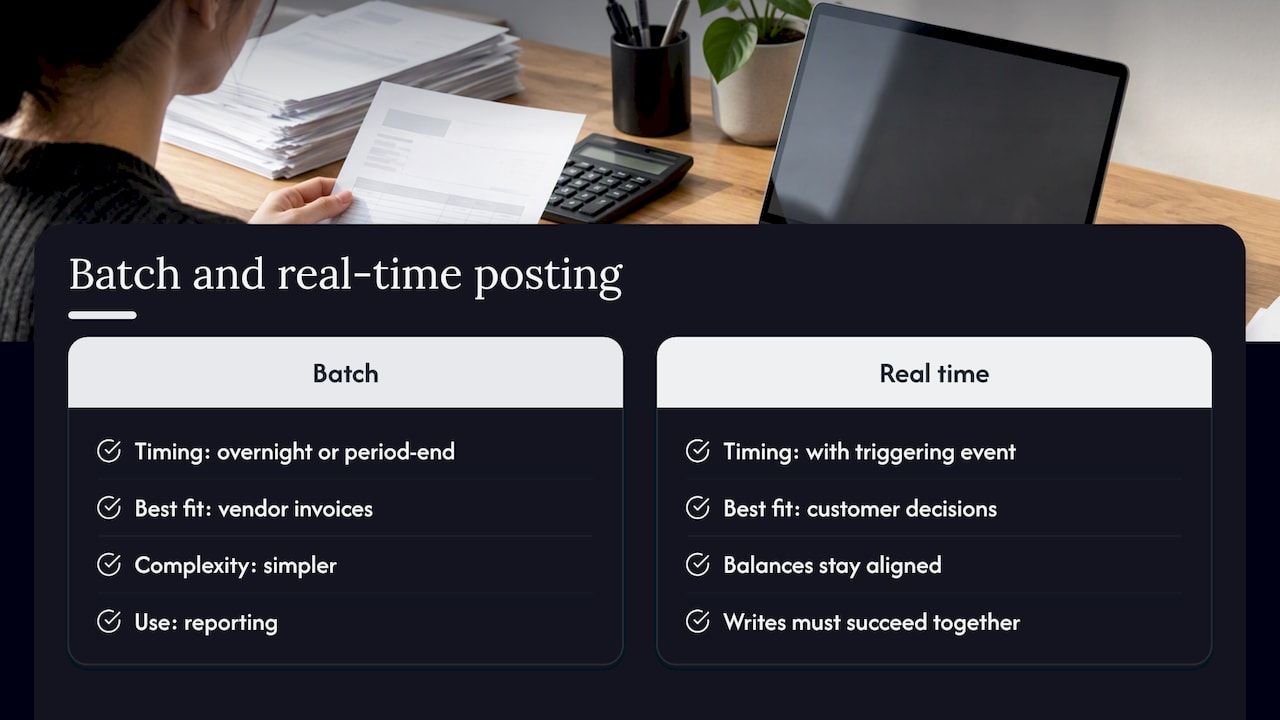
ERP-style subledgers have historically posted in batches: the day’s invoices are accounted and summarized overnight or at period end. Payments and card programs often cannot wait. A US bank’s guide to subledger management says that in real-time environments subledgers update atomically with the triggering event, so subledger balances and the master account balance stay mathematically aligned and reconciliation breaks are prevented because the two are never out of sync.
That is a strong property, and it has a cost: the subledger write and the master account write must succeed or fail together, which pushes you toward transactional guarantees, idempotent event handling and careful failure design. If your product lets customers spend funds, real-time certainty over available balance is usually worth that engineering effort. If you are accounting for vendor invoices, batch posting is simpler and perfectly adequate.
A useful rule of thumb: choose real time where the subledger balance drives a customer-facing decision, and batch where it only feeds reporting. Many systems need both, which is an argument for a posting interface that supports either mode, not for two separate architectures.
Reconciliation, controls and audit trails
The reason finance teams care about this architecture is what it does for control, not how it looks on a diagram.
A shared reference
Tracing a number from the general ledger back to its origin needs an identifier that both sides carry. In Dynamics 365, the voucher serves as the shared reference between the subledger document and the resulting ledger entries. Whatever you call it, define it on day one and never allow an entry to post without it.
Automated reconciliation
Professional-services guidance on journal entry processing describes centralizing accounting calculation rules to improve efficiency and align entries with the target general ledger, with automated processes reconciling the ledger summary against the subledger. Centralized rules matter because duplicated logic across systems is where silent mismatches begin. For concrete patterns, see our financial reconciliation automation examples.
Clearing and net transfers
Some banking models add an implicit subledger that acts as a clearinghouse. In one US bank’s documentation of partner-managed card programs, net balance changes from other subledgers are posted as book transfers through that clearing subledger. It is a good reminder that subledgers need not map one-to-one to business departments. They map to whatever you must be able to prove.
The audit trail itself
An audit trail in this architecture is the ordered sequence of postings, each recording timestamp, amount, currency and impacted accounts. Auditors rarely need clever dashboards. They need to select a ledger balance, see the entries behind it, open the source document for any entry and confirm that nothing was changed in place. Append-only entries, immutable identifiers and access logs get you most of the way. Our guide to financial close automation explains how to build this up one module at a time.
Design decisions that shape the result
Decide the unit of detail
Is the subledger per customer, per wallet, per program, per merchant or per document? Pick the finest grain you will ever need to explain a balance, because aggregating up is cheap and decomposing later is not. A banking-core provider documents subledgers as first-class accounts that can originate payments such as ACH, wire and RTP directly. That is only possible because the subledger was modeled as an account, not as a report.
Decide who owns the rules
Accounting rules should be owned by finance and implemented by engineering, with changes reviewed by both. Embedding rules deep in application code makes them invisible to controllers. Externalizing them as configuration, with version history and effective dates, keeps them auditable.
Plan for multiple currencies early
Each posting should record amount and currency, as the audit trail requirement above implies. Decide where revaluation and translation happen, and whether the subledger holds transaction currency only or functional currency alongside. Retrofitting this is among the more expensive changes in any ledger design.
Handle integration deliberately
Subledgers sit between operational systems and the ledger, so they inherit every integration weakness around them: retries, duplicates, out-of-order events and partial failures. Idempotency keys, replay tooling and clear dead-letter handling are part of the architecture. Our piece on ERP integration patterns goes through the patterns that keep these failures from reaching a pager. Teams in Canada weighing ERP integration work may also want to see how ERP integration SR&ED eligibility is assessed.
Secure and govern it
A subledger holds the most sensitive operational data a company has. Segregation of duties between those who define rules, those who post and those who approve is a control, not a courtesy. See our fintech security guide for IT leaders and the fintech compliance checklist for the surrounding requirements.
Build, buy or start from a modular foundation
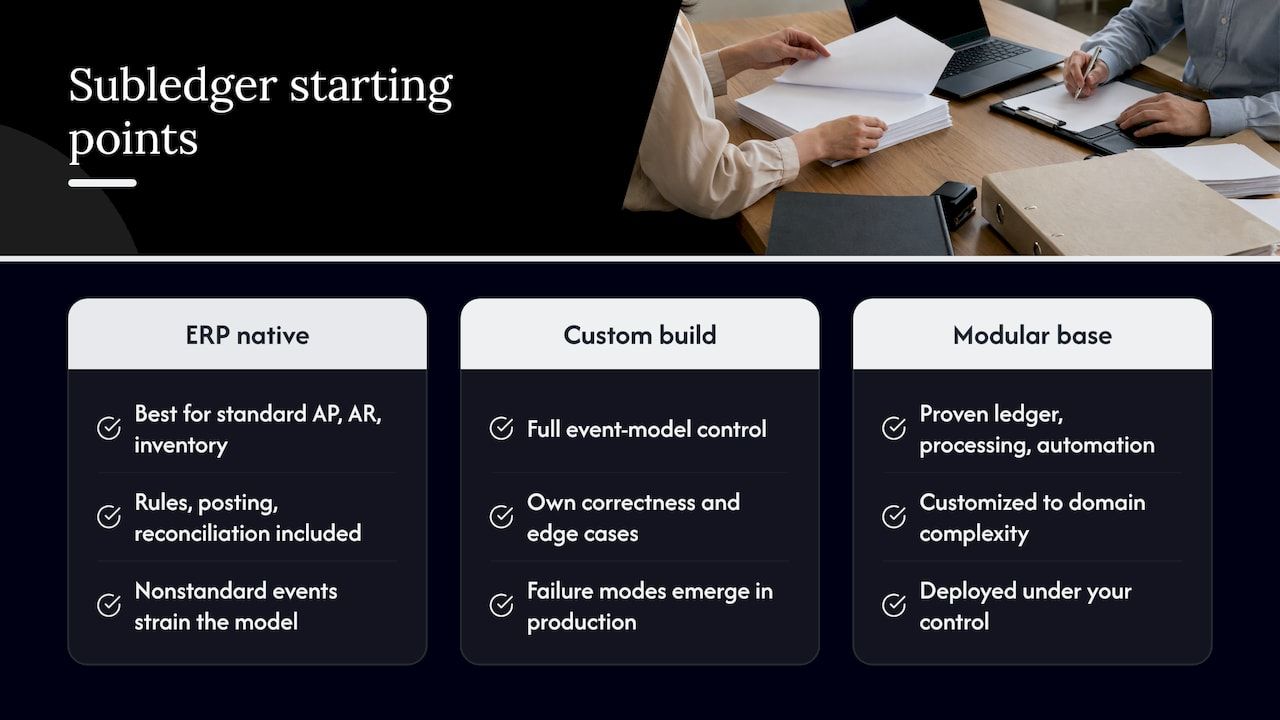
There are three realistic starting points, and each relocates complexity somewhere different.
An ERP’s native subledgers are the right answer when your processes look like standard payables, receivables and inventory. The accounting rules, posting and reconciliation arrive working. The trade-off is that products with non-standard events, such as wallets, tokens or usage-based fees, strain the model.
A fully custom build gives complete control over the event model and posting behavior. It also means you own double-entry correctness, rounding, idempotency, audit evidence and every edge case from a standing start. This is a greenfield effort that tends to be underestimated, because the first version works and the failure modes appear in production.
A modular foundation sits between the two: proven components for ledger, financial processing and automation, customized to your business-domain complexity, and deployed under your control. This is the approach we advocate, and the reasoning is in the next section. If you are scoping the broader platform, our financial processing systems guide and rapid fintech solution setup guide cover the surrounding decisions.
Build your subledger layer on a modular base
Bitecode builds custom enterprise systems from modular, ready-made components, including a financial module, an automation module and a token module for blockchain settlement. Projects can start with up to 60% of the baseline system pre-built, which is our own claim about how we shorten delivery compared with starting from an empty repository. Modules can be self-hosted, and the resulting system is designed to be multi-currency and audit-ready.
If you are planning a ledger or subledger layer, explore the financial and automation modules, or talk to us about custom business software shaped around your accounting model.
For settlement on tokenized rails, the same ledger discipline applies, and our blockchain payment module is built with that in mind.
Our perspective
Most subledger problems we see are not accounting problems. They are boundary problems: the place where an operational event becomes a financial fact was never designed, only grown.
We start from the position that the boundary should be explicit. Events enter through one door, rules turn them into balanced entries in one place, and every entry carries a reference back to its source. When teams skip this step, they often end up with reconciliation work that scales with transaction volume instead of staying flat.
That is why we favor a modular foundation over both a black-box platform and a blank page. A black-box platform relocates complexity into the vendor relationship: you cannot see or change the rules that matter most. A blank page puts risk into every layer at once. Pre-built financial, automation and token modules let a team accelerate work without accelerating chaos, while keeping the rules, the data and the hosting under the client’s control.
Our approach is to begin with the smallest module that proves the posting flow, reconcile it against the control account, and extend from there. Self-hosted deployment, multi-currency support and audit-ready entries are part of the foundation we design for, not features added after the first audit.
Bitecode
FAQ
Is a subledger the same as a sub-account?
No. A sub-account is usually a segment or child of an account within the ledger’s chart of accounts. A subledger is a separate record system holding transaction detail, which then posts to a control account in the ledger. The two can coexist, since a subledger entry still references main accounts from the chart.
Should a subledger post to the general ledger in summary or in detail?
Both are common, and Oracle’s documentation describes posting in summary or in detail. Summary posting keeps the ledger lean and fast to report on. Detail posting suits cases where finance wants line-level visibility in the ledger. Whichever you choose, the detail must remain recoverable in the subledger.
Do I need a subledger if I only process a few hundred transactions a month?
You need the function, not necessarily a separate system. At low volume, a well-structured ledger with tagged entries may suffice. The case for a dedicated subledger grows with transaction count, the number of counterparties you must report on and any requirement to explain balances per customer or wallet.
How do subledgers support audits?
They provide the transaction-level evidence behind each ledger balance. With a shared reference such as a voucher, an auditor can move from a ledger entry to the source document and back. Append-only postings with timestamps, amounts, currencies and affected accounts make that path repeatable.
What breaks reconciliation most often?
Timing gaps and duplicated logic. When the subledger and the control account are written at different times, or when rules exist in more than one system, the totals drift. Writing both atomically where balances matter, and centralizing rules, removes the two most common causes.
Sources
- Ledger, subledger, and subledger journal accounting entries (Microsoft Learn)
- Ledgers and Subledgers (Oracle Fusion Cloud Financials)
- How Subledger Journal Entries are Created and Processed (Oracle)
- How Oracle Accounting Hub Cloud Works (Oracle)
- Using Subledger Accounting (Oracle)
- Understanding Subledgers (Cross River)
- Balance and ledger models (Cross River docs)
- Subledgers (Cross River docs)
- Journal Entry Processing Services (KPMG)
- ERP integration SR&ED eligibility (HLP)