Financial close automation uses software to orchestrate close tasks, match reconciliations, draft journal entries, consolidate entities and feed reporting, so the period-end close runs faster with less manual work. The highest-impact first move is not buying a tool. Standardize your chart of accounts and intercompany rules, then pilot rules-based automation on one close module.
TL;DR:
- A roughly 1.2 million transaction pilot cut close time from 9 days to 2.8, raised automated reconciliation from 52% to 94%, and achieved 99.2% accuracy.
- Capture a preautomation baseline, then track close days, automated reconciliation, aging exceptions, resolution time, and manual posting hours to measure results.
- A team with one ERP should prioritize reconciliation, recurring journals, and task orchestration; enterprises should emphasize consolidation, intercompany controls, and audit logs.
- Every automated posting should retain its source data, applied rule or model, reasoning, and approval trail; material items need human review.
- A standard stack with one mainstream ERP favors buying, while unusual integrations, custom consolidation rules, or restrictive hosting requirements can justify a custom build.
What does financial close automation actually cover?
Think of the close as five connected layers, and most teams automate them in a different order than they appear on the calendar.
Close task orchestration is the scheduler: it assigns tasks, enforces dependencies and shows who is blocking whom. Account reconciliation automation matches bank, subledger and general ledger balances, then routes only the mismatches to a person. Journal entry automation generates recurring accruals, allocations and reclasses from rules instead of spreadsheets. Intercompany matching and consolidation pairs entity-to-entity balances, eliminates them and rolls results into group totals. Connected reporting and disclosure pulls the consolidated numbers into management and statutory packs without retyping.
These layers depend on one another. Data flows from your ERPs into the reconciliation engine, cleared balances and approved journals feed the consolidation step, and consolidated results feed reporting. If a reconciliation stays open, the task engine should hold the downstream consolidation task. That dependency logic is what turns a pile of scripts into a close process.
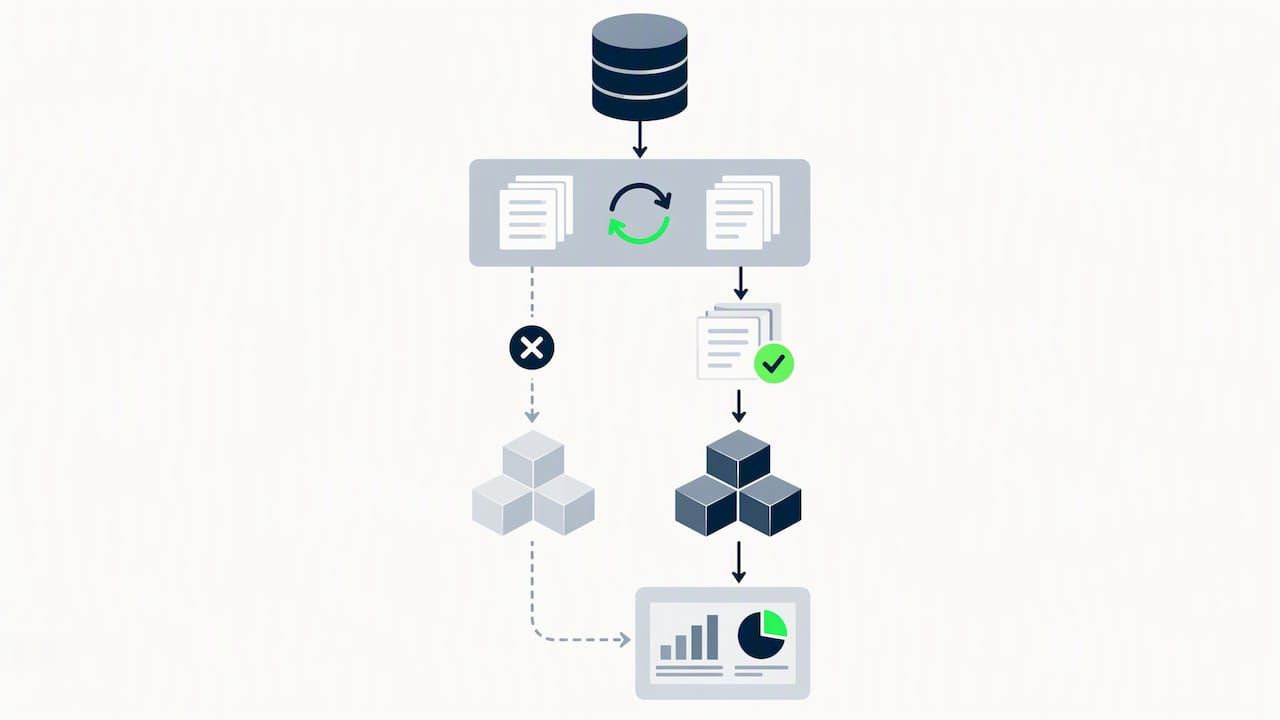
None of it works without clean inputs. Certified ERP connectors and reliable data sourcing are preconditions, not extras: an automated match built on inconsistent account structures only produces wrong answers faster. For concrete patterns, our financial reconciliation automation examples show how teams structure matching rules and exception queues.
The demand is real. A SAPinsider survey of 108 SAP finance practitioners found that pressure to cut manual tasks was the top driver (55%), and that 30% of organizations had automated 75–100% of recording tasks while 43% had automated less than half.
How does automation shorten the close, and which KPIs prove it?
Automation shortens the close by removing the waiting and rework between steps. Fewer open reconciliations at day three means fewer surprises at day six, and exceptions get fixed while the context is still fresh.
Published pilot results show what a realistic ceiling looks like. A multi-agent pilot processing roughly 1.2 million transactions reported the following outcomes, and we treat them as one example of what is possible, not a promise for your stack.
Close cycle time fell from 9 days to 2.8 days, automated reconciliation rose from 52% to 94%, and exception resolution dropped from 16 hours to 3 hours, with 99.2% posting accuracy, according to this self-driving close pilot. Manual controller workload fell by roughly two-thirds.
Why do these numbers matter to finance leadership? Close days drive how quickly the business sees its own results. Automated reconciliation rate shows how much judgment time your people get back. Posting accuracy and exception age are what auditors look at first.
Start with a small dashboard instead of a sprawling scorecard:
- Close days, measured from period end to final sign-off.
- Automated reconciliation percentage, by account group.
- Exceptions older than a set threshold, such as a defined review threshold.
- Average exception resolution time.
- Hours spent on manual postings.
Capture a baseline before you automate anything. Without it, you will not be able to show the board what changed. Our post on how to automate financial transactions and measure the efficiency gain covers how to frame those before-and-after comparisons.
Which features should you require before you buy or build?
Write the requirements down before you see a demo. Vendor reviews, such as those on Gartner’s close and consolidation market page, compare platforms on workflow, reconciliation depth, AI capability, ERP integration, audit readiness, multi-entity support, implementation speed and total cost of ownership. Use the same dimensions for a custom scope.
Functional must-haves:
- Reconciliation and matching logic that handles one-to-many and many-to-many matches, not just exact amounts.
- Auto-certification thresholds so low-risk, fully matched accounts close without a reviewer.
- Close task orchestration with dependencies, deadlines and escalation.
- Certified ERP connectors for every system that feeds the ledger.
- An intercompany elimination and consolidation engine for multiple currencies and entities.
- Reporting and disclosure support that reads from the consolidated data, not from exports.
Nonfunctional must-haves:
- Explainable AI metadata on every automated action.
- Role-based access and segregation of duties.
- Immutable audit logs that cannot be edited after the fact.
- Multi-entity scale that survives your next acquisition.
Prioritize by size and regulatory exposure. A mid-market team with one ERP usually gets the most from reconciliation, recurring journals and task orchestration first. An enterprise with many entities and statutory filings should weight consolidation, intercompany and audit logging much higher, because that is where manual effort and control risk concentrate.
Pro Tip: Ask every vendor, and every internal build team, to show you one automated posting end to end: the source data, the rule or model applied, the approver and the log entry. If they cannot trace it in one screen, an auditor will struggle too.
What does a phased implementation roadmap look like?
The strongest guidance points to the same order: standardize first, automate low-risk work next, and add intelligence last. Deloitte’s guidance on automating finance operations describes a granular, phased approach built on standardized intercompany and chart-of-accounts structures, rules-based automation of low-hanging fruit, and then explainable AI with metadata attached to automated postings.
- Phase 0, foundation: map the current close, standardize the chart of accounts and intercompany rules, fix data-quality defects and assign master-data owners. Go/no-go test: the same transaction type is coded the same way across entities.
- Phase 1, rules-based automation: automate recurring journal entries and bank and subledger matching. Keep reviewers in the loop and compare results against the manual close for at least one period. Go/no-go test: automated postings match manual postings.
- Phase 2, reconciliation and orchestration: roll out reconciliation automation across account groups, centralize close tasks with dependencies and start tracking the KPI dashboard. Go/no-go test: automated reconciliation rate rises and exception age falls for consecutive periods.
- Phase 3, explainable AI agents: add anomaly detection and proposed postings with materiality thresholds and human approval for anything above them. Go/no-go test: every AI action carries its data sources, rules and reasoning, and reviewers accept most proposals without rework.
Timelines depend on how many entities and ERPs you run, so set them against your own calendar. Our enterprise financial process automation checklist is a handy companion for scoping each phase.
What governance and audit controls must be built in?
Auditors do not object to automation. They object to automation they cannot explain. A black-box model that posts a journal with no recorded reasoning fails the basic test of traceability, no matter how accurate it is.
The fix is explainability metadata. Deloitte’s guidance on attaching sources and reasoning to automated postings calls for recording the data sources, the rules applied and the reasoning chain behind every automated entry. In practice, that means any posting can be traced from the ledger line back to the source record, the rule or model version, and the person or threshold that approved it.
Three controls carry most of the weight:
- Materiality thresholds. Below the line, automation may certify and post. Above it, a named human reviews. Set the line deliberately and revisit it regularly.
- Segregation of duties. The person who configures a rule should not approve its outputs, and no automated path should bypass review for high-risk accounts.
- A control library. Map each automated action to a business rule and an owner, and keep it current. Auditors typically sample against exactly this mapping.
Review the AICPA’s SOC resources when you design reporting on controls, since they frame how service and control environments are examined. A broader view of operating these controls at scale is in our guide to scalable financial process automation.
What can agentic AI realistically do in the close?
Traditional robotic process automation replays keystrokes. It works until a screen changes or a transaction looks slightly different, then it stalls and drops the item on a human. Agentic AI is built differently: CDT’s analysis of agentic AI in financial services describes systems that understand financial intent and context, adapt to variable transaction data and handle edge cases that normally stall standard automation.
For the close, the practical uses are:
- Intelligent matching of items whose descriptions, dates or amounts do not line up cleanly.
- Anomaly detection that flags unusual balances before a reviewer finds them.
- Suggested accruals and journal entries with the supporting evidence attached.
- Continuous flux analysis during the month instead of a scramble after it.
Caveats matter here. Agents need confidence thresholds so low-certainty proposals go to a person. They need explainability dashboards so reviewers can see why an agent acted. And material postings should always keep a human in the loop. Teams exploring agent setup in other business functions may find the implementation guidance for business AI agents a useful starting reference for integration patterns.
Should you build a custom modular solution or buy a platform?
Buy when your stack is standard. If you run one mainstream ERP, a typical entity structure and no unusual hosting rules, a commercial close platform usually gets you to value faster, and a packaged product has already solved the common problems.
Consider a custom build when one or more of these apply:
- Your ERP landscape is unusual, fragmented or heavily customized.
- Consolidation rules do not fit a packaged model.
- Compliance or policy requires self-hosting.
- Long-term total cost of ownership favors owning the integration layer.
- You need deep connections that a generic connector cannot reach.
The modular route changes the economics. We start projects with parts of the baseline system pre-built, which can shorten the path to tailored integrations and let us embed custom approval workflows from the first release instead of retrofitting them. That is a claim about our approach, and your timeline will depend on scope. Our guide to scalable financial process automation walks through this decision in more depth.
Our view: pilot one module and fix the data first
Most failed close projects fail on data, not technology. Put governance and explainability in place before you let any agent post anything, and prove value on one module, either reconciliation or recurring journals, with the KPI dashboard watching. Where deep integration, self-hosting or an unusual workflow is non-negotiable, a modular build is a leading option because it lets you design for auditability from day one.
— Bitecode
How we help you automate the close faster and safely
Starting from modular, pre-built components means less integration risk and faster delivery than building from a blank page. Our AI business process automation workflows and Financial Module and AI Assistant building blocks are designed for exactly this kind of work.
-
Shorter time-to-value through pre-built components
-
AI-enabled reconciliation with human review rules
-
Deep ERP connectivity, including self-hosted setups
Book a discovery call through our services page and we will map your close to a phased plan.
FAQ
What is financial close automation in simple terms?
It is software that handles the repetitive parts of the period-end close: scheduling tasks, matching reconciliations, drafting journals, consolidating entities and feeding reports. People focus on exceptions and judgment instead of data entry. Done well, it shortens the close and improves accuracy.
How long does it take to automate the financial close?
It depends on how clean your data is and how many entities and ERPs you run. A phased rollout that starts with standardization and one pilot module is realistic, and you should validate each phase against your KPIs before moving on. Expect the foundation work to take longer than the first automation.
Is AI safe to use in the financial close?
It can be, when every automated posting carries its data sources, rules and reasoning, and material items go to a human reviewer. Deloitte’s guidance recommends attaching that metadata to preserve auditability. Black-box automation without a trail is what auditors reject.
What should we automate first?
Start with recurring journal entries and bank or subledger matching, after standardizing your chart of accounts and intercompany rules. These tasks are repetitive, low risk and easy to compare against the manual process. Add orchestration and AI after those results are stable.
Sources
- Architecture for the Self-Driving Financial Close
- Automating the Record-to-Report and Financial Close Process
- Cdt
- Deloitte