Multi-entity accounting means keeping separate books for each legal entity a group owns, then combining them into controlled group-level reporting. The number of companies is not what makes it hard. The hard part is intercompany balances, ownership and control analysis, different currencies, and an audit trail that leads from a consolidated number back to the entry that created it.
This guide covers what the discipline involves, where common tools stop working, and how finance and IT leaders can choose between an off-the-shelf platform and a custom modular build.
TL;DR
- Multi-entity accounting is separate books per legal entity plus a repeatable, auditable consolidation. Running several company files is not the same thing.
- Under U.S. GAAP, consolidation turns on controlling financial interest, not on shared branding, management or bank accounts.
- Entry-level tools usually keep each company separate. Group reporting then depends on exports, which becomes a control problem as the close gets more demanding.
- Test four capabilities on their own: a mapped group chart of accounts, intercompany matching and eliminations, currency translation, and a timestamped close workflow.
- Software preserves accounting judgments but cannot replace them. Keep the policy memo and the evidence behind each consolidation conclusion.
What multi-entity accounting actually covers
A multi-entity environment is a set of legally or operationally distinct entities managed inside one coordinated finance architecture. That architecture can take several forms: separate company files, a shared ERP tenant with an entity dimension, or a consolidation layer on top of separate ledgers. What defines it is the requirement to preserve entity-level accountability while allowing controlled aggregation.
The core concepts are consistent whichever form you choose:
- Entity-level books. Each legal entity keeps its own ledger, because it files, borrows, contracts and pays tax as itself.
- Chart-of-accounts mapping. Local accounts roll up to a group chart so that “marketing expense” means one thing across the group.
- Ownership and control data. Who owns what, and whether control exists, determines what gets consolidated.
- Intercompany recording and eliminations. Transactions between group members must cancel out in the combined view.
- Currency translation. Foreign subsidiaries report in their functional currency and are translated for the group.
- Noncontrolling interests, statutory reporting and tax adjustments, where they apply.
- An audit trail from consolidated figures back to source entries.
If you are earlier in the process and mostly struggling with several currencies, our guide to multi-currency accounting for finance teams covers that layer in more depth.
Control, not headcount of companies, drives consolidation
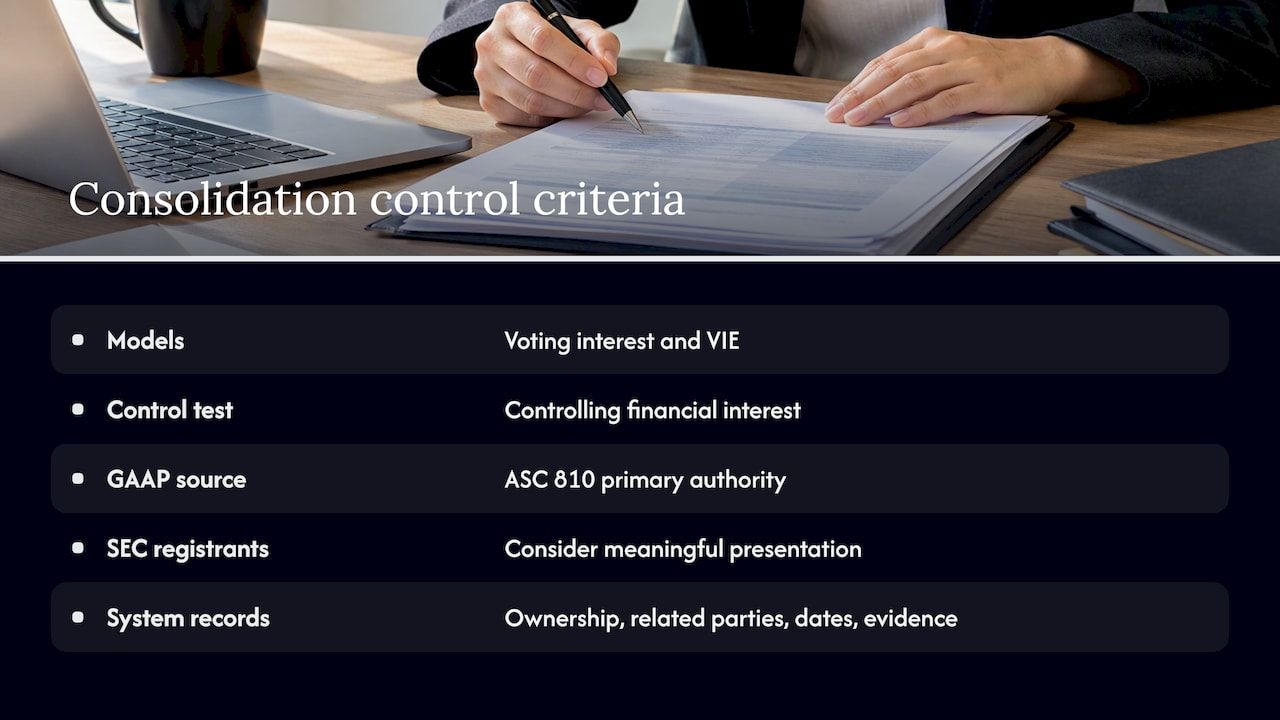
The most common misconception is that owning several companies automatically means consolidating them, or that sharing a brand or management team does. Under U.S. GAAP there are two primary consolidation models, the voting interest entity model and the variable interest entity (VIE) model, and both ask whether the reporting entity holds a controlling financial interest. PwC’s financial statement presentation guide identifies ASC 810 as the primary authoritative source on consolidation and deconsolidation.
For SEC registrants, Regulation S-X tells the registrant to consider which financial presentation is most meaningful in the circumstances. Private companies are not bound by that rule, but lenders, investors and acquirers tend to ask the same question.
The practical consequence for system design is that your software has to hold more than balances. It should store ownership percentages, related-party relationships, effective dates and the evidence behind each conclusion. FASB has refined its consolidation guidance repeatedly because VIE and common-control arrangements involve judgment and cost. A system cannot make that judgment for you, but it can keep the assumptions visible when an auditor asks.
Consolidation, statutory books and tax are three different populations
A frequent implementation surprise is that the group you consolidate for GAAP is not necessarily the group you file taxes for, and neither equals the list of entities with statutory books. Each can have its own membership and its own elimination logic.
The IRS shows the pattern in its Schedule M-3 instructions, where consolidated tax groups may need a separate schedule for each corporation plus one for consolidation eliminations. That is a 2011 edition, so confirm the current form before relying on its details, but the principle holds: entity-level figures and elimination entries must stay separable.
In practice this means designing for three views from one set of source data:
- Entity books for statutory filings, local banks and entity-level audits.
- GAAP consolidation for investors, lenders and the board.
- Tax reporting, with adjustments between book and tax kept visible.
A system that forces one elimination logic onto all three will eventually need spreadsheets to patch the differences.
Where multi-company tools stop and multi-entity accounting starts
Many groups begin with a small-business accounting product and add companies as they grow. That is reasonable for loosely connected businesses. It is worth knowing exactly what it does and does not give you.
Take the most common US example. Intuit’s documentation says you can add multiple companies under one QuickBooks Online account with the same sign-in, but each company requires its own paid subscription. A QuickBooks Community answer from April 2026 adds that there is no multi-company plan, and that consolidated reporting across files is not natively supported. Users, bank connections and lists are configured per company, and changes do not flow between files.
That architecture relocates group reporting into exports or an added reporting layer. For two or three independent businesses, fine. Once management needs the same consolidation every month, with intercompany matching and a defensible audit history, it becomes a close-process and control issue rather than a licensing one.
Warning signs you have outgrown separate files
- The consolidation lives in a workbook that one person understands.
- Intercompany balances are reconciled by email after the period closes.
- The group chart of accounts exists only as a mapping tab.
- Auditors ask for the source of a consolidated figure and the answer takes days.
- Adding a new entity means copying lists and bank feeds by hand.
The four capabilities to test separately
Practitioners evaluating software should test four capabilities independently, because a demo that shows one rarely proves the others. A platform that only aggregates exported trial balances is not equivalent to native multi-entity accounting.
| Capability | What to test | Failure looks like |
|---|---|---|
| Group chart of accounts | Shared or mapped accounts, with entity-specific accounts allowed | Mappings maintained outside the system |
| Intercompany matching and eliminations | Both sides recorded at entry, differences flagged, eliminations generated | Matching done after close by hand |
| Currency translation | Functional-currency books, rates by period, translation adjustments traceable | Rates pasted into a spreadsheet |
| Close workflow and audit history | Task ownership, timestamps, approvals, drill-down to source | No record of who changed what |
Add integration to this list. Group finance rarely lives in one system, and bank feeds, billing, payroll and procurement all need to reach the ledger of the correct entity. Our overview of financial data integration challenges and the guide to enterprise software integration cover the pitfalls we see most often.
Three ways to build the finance stack
There is no universal best choice. The right one depends on entity count, consolidation depth, currencies, controls, integrations and your capacity to implement.
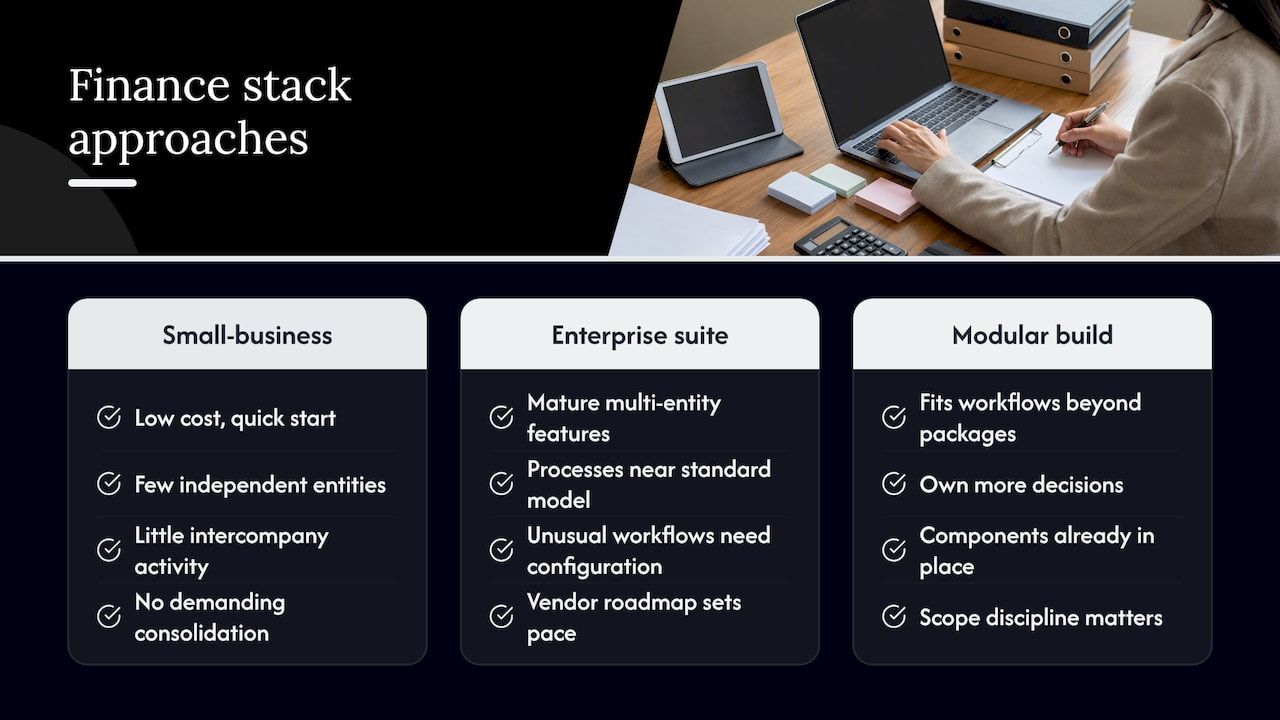
Small-business multi-file tools. Low cost and quick to start. Best for a few independent entities with little intercompany activity and no demanding consolidation.
Enterprise ERP or mid-market financial suites. Mature multi-entity features, broad coverage and an ecosystem of implementation partners. Best when your processes are close to the standard model and you accept the vendor’s way of working. The trade-off is that unusual workflows become configuration projects or license-tier decisions, and the vendor roadmap sets your pace.
A modular custom build. Best when your entity structure, approval rules, settlement flows or product logic do not fit a packaged model, or when finance is part of what you sell. The trade-off is that you own more decisions, so scope and maintainability discipline matter.
The third path has become more practical because teams no longer need to start from a blank repository. A modular foundation lets you begin with accounting, audit and workflow components already in place and spend the budget on the parts that are distinctive to your business.
Multinational groups: what changes
Once entities sit in several countries, add local statutory reporting, multicurrency remeasurement and translation, and local banking. Independent software reviewers generally treat large multinational finance as a requirement-driven choice, not a ranking exercise: global coverage, local reporting, intercompany automation, controls, APIs and implementation partner capability all matter.
The non-software work is just as real. A new subsidiary needs a bank account, merchant processing and a compliance onboarding process before the first transaction is posted. If a UAE entity is on your roadmap, this overview of what banks check when opening a merchant account for a UAE startup shows the KYC groundwork to plan for, so the ledger for that entity is not waiting on paperwork.
Our perspective
We build finance and workflow systems for a living, and the pattern we see most often is not a wrong tool but a mismatched architecture. Teams buy for the entity count they have today, then discover that their real complexity is business logic: who approves an intercompany charge, how a settlement in another currency is recognized, what evidence an auditor wants.
Three convictions shape how we approach it:
- Consolidation is a process, not a report. If intercompany matching, eliminations and close tasks happen after the fact, the system is only presenting numbers, not controlling them.
- Avoid the black-box trade. A closed platform can relocate complexity into the vendor relationship. That is a fair choice for standard needs, and a costly one when you need to change how a rule works.
- Start from a modular foundation, not a blank page. We start projects with up to 60% of the baseline system already built, so the team’s time goes into entity structure, rules and integrations rather than boilerplate. That is our own claim about our delivery model, and the saving on any project depends on scope.
We also keep a firm line on what software cannot do. It should preserve ownership data, assumptions and evidence, but the consolidation conclusion belongs to your accounting policy and your auditors.
— Bitecode
Where Bitecode fits
If your group needs a finance layer that matches its structure, our Financial Module provides an accounting foundation with audit and subscription capabilities, built for multi-currency, audit-ready and self-hosted deployments. It can be combined with AI business process automation for matching and reconciliation workflows, or delivered as custom business software shaped around your entities. Pricing is scoped per engagement, so the quickest way to compare it with a packaged platform is to bring your entity map and close calendar to a scoping conversation.
How to run the selection
- Map the entities. List every legal entity, owner, ownership percentage, currency and jurisdiction. Mark which ones you consolidate for GAAP and which for tax.
- Document the policy. Write the consolidation conclusions and keep the evidence next to the data.
- Measure the current close. Count intercompany transactions per month, days to close and manual adjustments. These are your baseline.
- Write scenario scripts. Build a test in which entity A bills entity B in another currency, B pays late, and the difference must eliminate. Ask every candidate to run it live.
- Check controls. Use a financial software audit checklist to review permissions, approvals and logs.
- Plan the reconciliation layer. Look at reconciliation automation examples to see what can be matched automatically.
- Price the whole lifecycle. Include implementation, integrations, support and what each added entity costs.
FAQ
Does QuickBooks support multiple companies?
Yes, with limits. QuickBooks Online lets you add several company files under one sign-in, but each company needs its own paid subscription and its data stays separate. Intuit staff state that native consolidated reporting across files is not available, so groups export data or add a reporting layer.
What is a multi-entity environment?
It is a finance setup in which several legally or operationally distinct entities are managed together while each keeps its own books. It can use separate files, a shared ledger with entity dimensions, or a consolidation layer. The defining feature is entity-level accountability combined with controlled group reporting.
What are the key concepts of business entity accounting?
The essentials are entity-level books, chart-of-accounts mapping, ownership and control, intercompany recording, eliminations and currency translation. Noncontrolling interests, statutory reporting and tax adjustments apply in many groups. All of it should connect to an audit trail.
Do I have to consolidate every company I own?
Not automatically. Under U.S. GAAP the question is whether you hold a controlling financial interest, under either the voting interest or VIE model. Common ownership alone does not settle it, so take the specific structure to your CPA or auditor.
Sources
- Deloitte DART: which consolidation model to apply
- PwC: consolidation scope and relevant guidance
- eCFR: 17 CFR 210.3A-02
- FASB news release on consolidation guidance
- IRS: Schedule M-3 instructions (2011)
- Intuit: create or add another company file
- QuickBooks Community: pricing, multiple companies and consolidated reporting