A stablecoin payout is a disbursement in which a business sends a dollar-pegged digital token, usually USDC or a similar fiat-backed coin, straight to a recipient’s wallet instead of routing money through ACH, wires or correspondent banks. The business triggers it through an API or payout platform, the transfer settles on a blockchain in seconds to minutes, and the recipient either holds the tokens or converts them to dollars or local currency. For the right payment flow, that is faster and more predictable. For the wrong one, it adds compliance and operational weight with little return. This guide explains how the mechanics work, what U.S. obligations apply, where the risks sit, and how to decide.
TL;DR
- Stablecoin payouts move fiat-backed tokens from a funded source wallet to a recipient wallet, typically around the clock and often within seconds to minutes.
- The value is greatest in cross-border, high-frequency or off-hours payments to contractors, creators, vendors and marketplace sellers.
- Most U.S. companies should use a licensed provider for the on-ramp, off-ramp and Travel Rule work rather than build licensing infrastructure themselves.
- Address errors, unsupported networks, depegging and weak reserve transparency are the risks that need written controls before the first live payout.
- The hard part is rarely the transfer. It is reconciliation, approvals, audit trails and integration with your existing finance stack.
What a stablecoin payout actually is
The term covers a narrow thing. A business authorizes a disbursement, and instead of sending bank money, it sends tokens that are designed to hold a steady value against the dollar. Industry explainers describe the flow as an API call that triggers a direct on-chain transfer to the recipient’s wallet address, which skips the chain of intermediary banks that a traditional cross-border payment passes through.
Three distinctions keep the topic clear:
- Payout versus payment. A payout is outbound and usually one-to-many: payroll for contractors, creator earnings, marketplace seller settlements, supplier remittances. A payment is typically a single customer-to-merchant exchange.
- Stablecoin versus other crypto. A payout in a volatile asset exposes both sides to price swings. A payment stablecoin is built to be redeemable at a fixed amount, which is why businesses consider it for disbursements at all.
- Payout versus settlement. The payout is the instruction and transfer. Settlement is the point at which the recipient can rely on the funds. On a blockchain these are nearly the same moment, which is the main appeal.
Some providers keep the platform balance in fiat and convert at the moment of payout, so the sending business never has to hold tokens on its own balance sheet. Others require you to hold a funded wallet. Which model you choose shapes your accounting, custody and control design more than any other single decision.
How a stablecoin payout moves, step by step
The mechanics are consistent across most providers, even when the vocabulary differs.
- Fund the source. You top up with dollars by bank transfer, or you hold stablecoins in a source wallet. Provider documentation for a U.S. payout product lists a funded source wallet, a destination on a supported blockchain and an API integration as the basic requirements.
- Register the recipient. The recipient supplies a wallet address and the network it lives on, and passes identity checks (KYC for individuals, KYB for businesses) with you or your provider.
- Screen and approve. Sanctions screening runs, limits are checked, and for larger amounts a second approver signs off.
- Submit the transfer. Your system calls the payout API with amount, token, network and destination.
- Confirm on-chain. The network confirms the transaction. Webhooks report status back to your system so the payment can be marked complete.
- Reconcile. The transaction hash, the internal payout ID and the ledger entry are matched, ideally automatically.
Integration guides commonly describe the same three layers: a wallet layer, an API for triggering payouts, and webhooks for status updates. If you already run payout operations at volume, the surrounding discipline (batching, retries, idempotency, exception queues) matters as much as the chain. We cover that in our guide to payout automation for high-volume payouts.
How recipients receive, hold and cash out
A payout only helps if the recipient can use it. There are three common outcomes.
- Hold the stablecoin. Recipients in markets with unstable local currencies or limited dollar access often prefer to keep the tokens. Holding is also useful for people who pay their own suppliers in the same asset.
- Convert through an exchange or off-ramp. The recipient sells tokens for dollars or local currency and withdraws to a bank account. Fees and spreads here are where the real cost of a stablecoin payout hides.
- Provider-managed conversion. Some providers handle the stablecoin transfer and deliver local currency to a supported bank account, so the recipient never touches a wallet.
For U.S. recipients who want dollars, the cleanest path is an off-ramp that lands funds in a U.S. bank account via ACH. For recipients abroad, the last mile often ends in cash or local bank deposits, where fast currency exchange services still shape what people actually take home.
One point for your support team: a recipient who cannot cash out cannot be paid, whatever the transfer receipt says. Test the off-ramp in each target country before you promise anyone a payout method.
Speed, cost and where the gain is real
The speed claim is broadly accurate. Stablecoin transfers typically settle in seconds to minutes, compared with one to five business days for traditional cross-border banking, and they run 24 hours a day, including weekends and bank holidays. That matters most when a contractor is waiting on a wire that stalls over a weekend, or when a marketplace seller expects earnings the moment a sale closes.
The cost claim needs more care. The network fee is usually small. The full cost includes on-ramping dollars into tokens, off-ramping them again, provider fees, foreign exchange spreads and the internal work of reconciliation. Guides that compare rails advise including fiat off-ramp costs when weighing cross-border options, and that is the right instinct: compare total landed cost per payout, not the headline network fee.
A useful comparison looks like this:
| Criterion | ACH / domestic wire | International wire | Stablecoin payout |
|---|---|---|---|
| Availability | Business days, cutoffs | Business days, cutoffs | 24/7 |
| Typical settlement | Same day to a few days | Often several business days | Seconds to minutes on-chain |
| Cost drivers | Bank fees | Bank and intermediary fees, FX | On/off-ramp fees, spreads, provider fees |
| Reversibility | Returns and recalls possible | Recall possible but slow | Generally irreversible once confirmed |
| Recipient needs | Bank account | Bank account | Wallet or provider-managed account |
| Best for | Domestic payroll, vendors | Large, infrequent transfers | Frequent cross-border or off-hours payouts |
The irreversibility row deserves emphasis. It is a feature when you want certainty and a hazard when someone pastes a wrong address.
Where businesses use them
The use cases that hold up in practice share a pattern: many recipients, many borders, small to mid-sized amounts, and a business that is tired of waiting for banks.
- Contractor and freelancer pay. Distributed teams paid in dollars, where recipients value same-day access.
- Marketplace and platform payouts. Sellers, drivers or creators in multiple countries, paid on a rolling basis.
- Supplier and vendor settlement. Cross-border invoices where correspondent banking adds days and fees.
- Treasury movement. Moving dollar value between entities or accounts outside banking hours.
- Programmable payments. Because tokens can carry logic, recurring transfers and links to trade finance events can be automated in ways legacy rails do not easily allow.
Notice what is missing: domestic payroll for salaried employees, where ACH is cheap, reliable and reversible. Replacing a rail that works is rarely a good project.
U.S. legal, tax and compliance obligations
This is the section where companies get into trouble by assuming the provider handles everything. Responsibilities are divided, and your counsel and compliance lead should confirm your exact position before you launch. What follows is the framework, not legal advice.
Money transmission and the Bank Secrecy Act
FinCEN has said that a business accepting and transmitting convertible virtual currency can be a money transmitter under the Bank Secrecy Act, and that stablecoin administrators must register as money services businesses and that the Funds Travel Rule applies to such transactions. That statement dates from 2019, so treat it as a foundation and check current FinCEN guidance for your model. Whether you are transmitting for others or only paying your own obligations changes the analysis considerably, which is why most companies route payouts through a licensed provider.
The Travel Rule
If you use a provider, the Travel Rule duties typically sit with them, but you still supply data. One U.S. payout provider’s documentation states that for transfers of $3,000 USD-equivalent or more, originator identity information must accompany the payout. Build your payout form so that data is collected at the time of payment, not reconstructed later.
Stablecoin issuer rules
The regulatory environment for the tokens themselves changed in 2025. Congress passed the GENIUS Act, which defines a payment stablecoin as a digital asset redeemable at a fixed amount and requires U.S. issuers to be approved by a regulator and to hold at least one dollar of permitted reserves for every dollar issued. For a payer, the practical effect is a better basis for issuer due diligence: ask which issuer stands behind the token you pay in, where reserves are held, and how redemption works.
Tax reporting
The IRS has finalized broker reporting for digital assets: gross proceeds for transactions on or after January 1, 2025, and basis for certain transactions on or after January 1, 2026, on Form 1099-DA. That falls mainly on brokers, but your provider’s reporting affects your recipients, and your own books must treat each payout correctly. Payments to U.S. contractors still need the usual information returns, and token-denominated payouts raise questions about valuation at the time of payment. Your tax advisor should settle these before launch.
Who does what
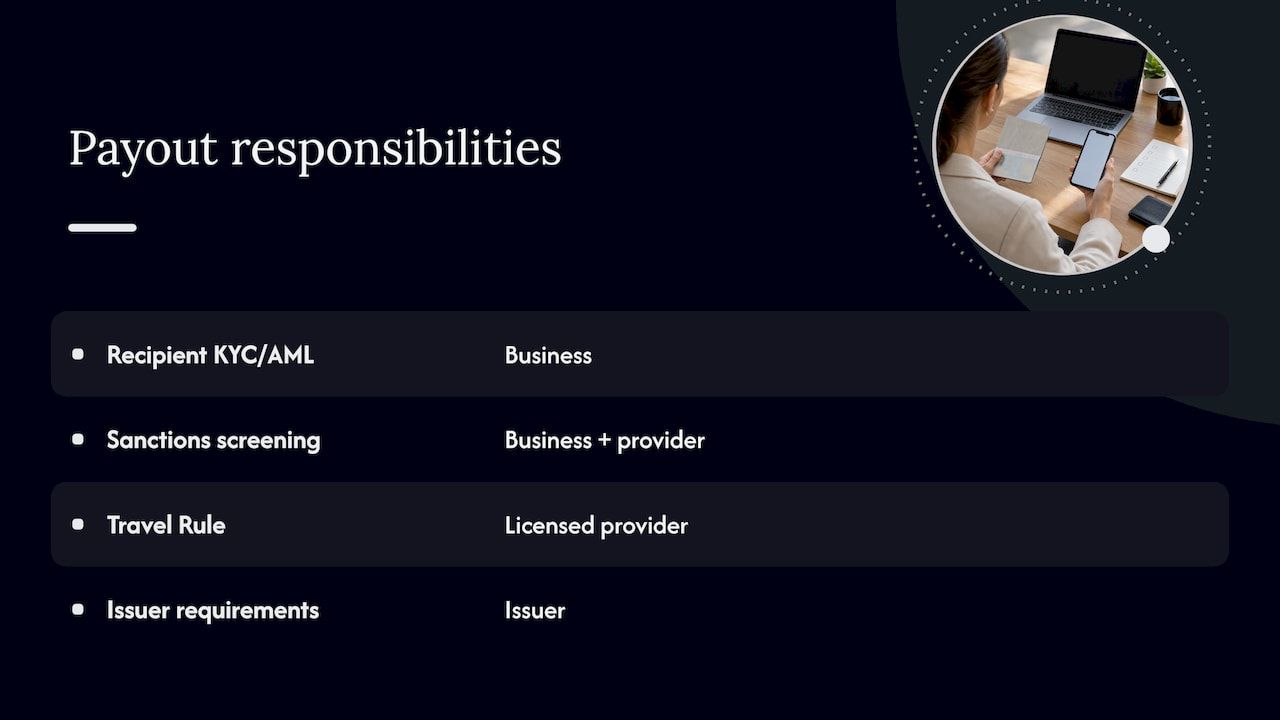
A practical split, as commonly described: the business handles standard KYC and AML on its own recipients and works with its provider on sanctions screening, while the licensed provider manages on-chain duties such as the Travel Rule and the issuer handles issuer requirements. Write this down in a responsibility matrix. Gaps appear where each party assumes another owns a task.
For deeper checklists, see our crypto compliance framework checklist, our fintech compliance requirements checklist and our walkthrough of KYC onboarding automation.
Risks to assess before the first payout
Stablecoin risk is not one risk. It is a set, and each needs an owner.
- Address and network errors. Sending to the wrong address or on an unsupported network leads to permanent loss of funds. Controls: address allowlists, test transfers for new recipients, network validation in code, and no free-text address entry by operators.
- Depegging and reserve quality. A token can trade below its peg when confidence in reserves drops. Enterprise risk lists consistently flag reserve transparency, smart contract vulnerabilities and interoperability. Choose issuers that publish reserve reports, and limit the time funds sit in tokens.
- Custody. Who holds the keys to your source wallet? Single-signer wallets are an internal fraud and compromise risk. Use approval workflows and segregated roles.
- Fraud and phishing. Payout changes are a classic target. Require re-verification when a recipient changes a wallet address.
- Regulatory divergence. Digital assets are regulated differently across countries, which complicates global treasury strategy. A payout that is routine in one country may be restricted in another.
- Limited redemption. Not every holder can redeem directly with the issuer. Recipients often depend on an exchange or off-ramp, which is a counterparty risk of its own.
The international standard-setting view is useful here: the Committee on Payments and Market Infrastructures argues that the same risks should be subject to the same standards regardless of the underlying technology. Treat a stablecoin rail with the control discipline you apply to any payment system, not a lighter version because it is new.
Deciding whether stablecoin payouts fit
Start with the flows, not the technology. Pull twelve months of outbound payments and mark the ones with friction: delayed wires, high intermediary fees, failed returns, recipients chasing status, off-hours demand. Those are candidates. Finance leaders advising on this tend to frame the question as which high-friction flows justify the technical, accounting, tax and compliance work of supporting digital assets.
A short decision test:
- Is the flow cross-border or time-critical? If not, ACH probably wins.
- Do recipients want or can they use stablecoins? A payout that requires onboarding to a wallet can lose more in recipient friction than it saves in fees.
- Can your finance systems record it? Legacy ERPs often lack native blockchain compatibility, which is an integration constraint PwC highlights for broader enterprise adoption.
- Is instant settlement worth its price? Some providers charge a premium for instant versus standard settlement. One treasury analysis suggests the premium pays off when liquidity speed prevents operational delays, which depends on your cost of capital.
- Who owns compliance? If the answer is unclear, you are not ready.
A pilot with one corridor, one token, one provider and a capped monthly volume teaches more than a broad rollout. Our guide to crypto treasury management and audit controls describes how to keep a corporate pilot defensible.
Build versus buy
There are two questions hiding here. The first is whether to build licensed infrastructure: for nearly every company outside financial services, no. Licensing across jurisdictions takes years, and the practical path is to integrate a licensed provider’s APIs for the on-ramp, off-ramp and Travel Rule work.
The second question is what you build around the provider, and this is where the real engineering sits: the approval workflow, the recipient directory, the ledger, multi-currency reporting, exception handling and the audit trail. Off-the-shelf payout tools cover the transfer. They rarely cover how your company approves, records and reconciles it. Our overview of blockchain integration for enterprises and of enterprise blockchain payment integration for U.S. compliance walks through that layer.
Our perspective
We see stablecoin payouts as an integration problem wearing a payments costume. The transfer itself is a solved problem: a provider API and a funded wallet get you there in days. The projects that stall are the ones where nobody planned for approvals, reconciliation, audit evidence and the finance team’s need to close the books.
Three convictions shape how we build:
- Start from a modular foundation, not a blank page. Payout approvals, ledgers, multi-currency balances and audit logs are not differentiators. Starting with roughly 60% of the baseline system pre-built lets a team spend its budget on the parts specific to its business.
- Keep control with the client. Black-box platforms relocate complexity into the vendor relationship. Self-hosted modules and client-owned customization keep key management, data and logic where your security and compliance teams can inspect them.
- Accelerate work without accelerating chaos. Speed on-chain should not mean speed past your controls. Dual approval, allowlists and audit-ready records belong in the first release, not the second.
The honest trade-off: a modular foundation suits companies with real business-domain complexity, such as marketplaces, fintechs and multi-entity finance teams. A company paying five contractors a month is better served by a provider’s dashboard.
— Bitecode
Building payout workflows around your own rules
If your payout volume, approval chain or reporting needs go beyond a provider’s dashboard, we build custom payout and finance systems from ready-made components. The Financial Module covers multi-currency accounting, audit trails and subscriptions, and our blockchain payment module handles token-based settlement. Our automation services connect them to your approvals, KYC steps and ERP. To scope a project, start from the Bitecode home page.
FAQ
How do you get paid in stablecoin?
You give the payer a wallet address on a network they support, or you register with their payout provider, which collects the address and identity details for you. Confirm the network before sharing the address, because sending on the wrong one can mean permanent loss. To turn the tokens into dollars, use an exchange or off-ramp that deposits to your bank account.
Are stablecoin payouts faster than wires?
Usually, yes. On-chain settlement typically takes seconds to minutes and runs around the clock, while traditional cross-border banking can take one to five business days. The gain narrows if the recipient must still wait for an off-ramp or bank withdrawal to receive local currency.
Does a business need a license to send stablecoin payouts?
It depends on how the payout is structured. Transmitting value for others can bring money transmitter obligations under the Bank Secrecy Act, which is why most companies use a licensed provider that carries those duties. Your counsel should confirm your specific model, state requirements included.
Are stablecoin payouts safe?
The transfer technology is mature, but the surrounding risks are real: wrong-address errors that cannot be reversed, reserve quality and depegging, wallet compromise and phishing. Allowlists, dual approvals, reputable issuers with published reserves and short holding periods address most of them.
Sources
- Stablecoin Payout glossary
- How to send a stablecoin payout, developer documentation
- Stablecoin offramp guide for fintechs and enterprises
- Global payouts and stablecoins
- Stablecoin payments introduction for banks and fintechs
- B2B payments guide 2026
- FinCEN Director remarks, Chainalysis symposium
- IRS final regulations for digital asset broker reporting
- Stablecoin payments and the law, 2026 guide
- GENIUS Act overview, Congressional Research Service
- Stablecoins, Cash App help
- Stablecoin for treasurers, PwC
- Considerations for the use of stablecoin arrangements, BIS CPMI
- Standard vs instant stablecoin settlement
- Fast currency exchange services