Automated KYC onboarding lets us verify identity, screen for risk, and document decisions in minutes instead of days, while the regulatory responsibility stays with the institution that opens the account. The approach combines digital identity verification, AI-assisted data extraction, sanctions and PEP screening, and human-in-loop review for edge cases. What follows covers the implementation steps, the regulatory checklist, and the vendor due diligence that make this work in practice.
TL;DR:
- Automated KYC reduces onboarding time by streamlining identity verification, screening, and data collection, but the process still requires human review for flagged cases.
- Ensuring continuous compliance involves verifying vendor documentation, negotiating contractual protections, and maintaining ongoing performance monitoring.
- The success of automation depends on phased implementation, defining clear risk-based segments, and testing thresholds against real customer data for accuracy and false alerts.
- Automation allows limited re-verification of beneficial owners, provided firms demonstrate controls, but does not eliminate the need for human validation of complex cases.
- Regulatory evidence must be properly captured and retained, with an emphasis on documentation, audit trails, and clear processes, especially for third-party integrations.
What automated KYC is and how it transforms onboarding
Automated KYC replaces manual document review and spreadsheet-driven checks with a connected system that verifies identity, screens against watchlists, and collects beneficial ownership data as part of a single workflow. It typically covers identity proofing, document verification, sanctions and politically exposed person (PEP) screening, and beneficial ownership (BO) collection for entity customers.
The automation layer does not replace a bank’s or fintech’s AML program. It augments existing customer due diligence controls by handling the repetitive, pattern-matching work and routing exceptions to analysts. A document scan that fails a liveness check, or a name that triggers a partial watchlist match, still lands on a human desk.
Teams that deploy this well track a specific set of outcomes:
- Time-to-verify: how long it takes from application start to a pass or fail decision.
- Onboarding completion rate: the share of applicants who finish the process rather than abandoning it.
- Review backlog: the volume of cases sitting in manual queues at any given time.
These three metrics tell us whether automation is actually reducing friction or just moving it somewhere else in the pipeline.
Why automation matters now: benefits, ROI, and operational impacts
The case for automation rests on three pillars: throughput, consistency, and a regulatory environment that increasingly rewards demonstrable control effectiveness.
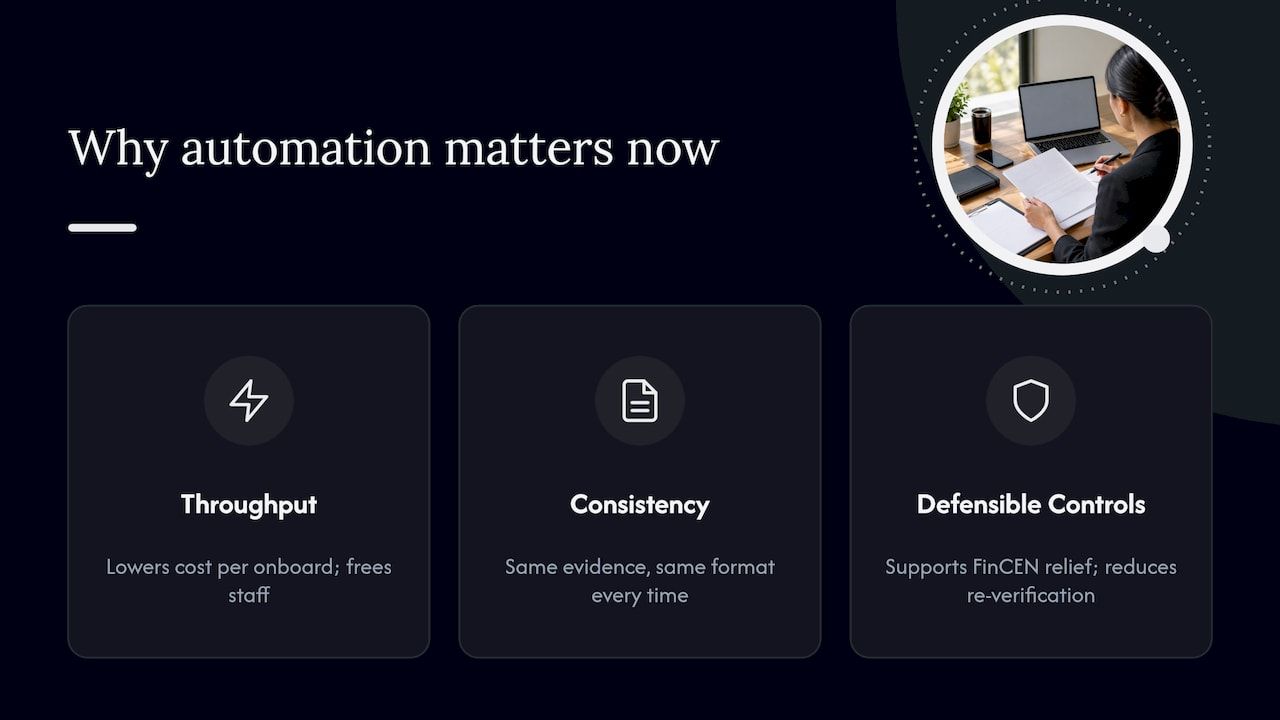
On throughput, automation reduces the manual labor spent on repetitive identity checks, which lowers cost-per-onboard and frees compliance staff for the cases that actually require judgment. On consistency, an automated workflow captures the same evidence, in the same format, every time, which produces a cleaner audit trail than a mix of manual notes and scanned PDFs.
FinCEN’s exceptive relief order allows institutions to limit beneficial owner re-verification to account opening, or to moments when new facts call the existing information into question, when appropriate controls are in place. That is a direct regulatory signal: strong, well-documented automation can reduce redundant verification work instead of just speeding up the first pass.
This matters for budgeting and planning. Automation is not a one-time efficiency project. It is an ongoing reduction in the compliance burden tied to repeat verification, provided the underlying controls hold up to examination, illustrating some of the key advantages of automated SEO for business growth.
Core components and technologies of automated KYC
A working automated KYC stack has four functional layers, and skipping any one of them tends to create a gap that shows up later as either fraud exposure or an examiner finding.
- Identity proofing: document OCR paired with biometric liveness checks, often relying on a digital ID provider whose assurance level has been assessed rather than assumed.
- Data feeds and watchlists: sanctions lists, PEP databases, adverse media screening, and beneficial ownership registries, pulled in near real time rather than batch-updated.
- AI functions: extraction of structured data from unstructured documents, risk scoring based on customer and transaction attributes, and anomaly detection for patterns that do not fit expected behavior. Each of these needs explainability and logging, not just a score.
- Orchestration: a workflow engine that connects these pieces through APIs, inserts human-in-loop gates at defined risk thresholds, and retains records in a format that survives an audit request.
FATF’s guidance on digital identity treats digital ID systems as technology-neutral tools: they can cut onboarding cost and friction, but the regulated firm still has to assess the assurance level and document why it is relying on that system. Reliance without documentation is the gap examiners tend to find first.
How to build automation into KYC due diligence: phased implementation steps
A phased rollout limits the blast radius of a bad configuration and gives compliance teams evidence to show examiners that controls were tested before they went live.
- Assess risk before building anything. Segment customers by product type and risk profile, and decide which segments are appropriate for automation first.
- Pilot on a narrow slice. Choose one product line and a limited customer cohort, and run the automated workflow in parallel with manual checks so discrepancies surface early.
- Expand and tune. Add data sources, refine screening rules, and adjust risk thresholds based on pilot results rather than vendor defaults.
- Transition to full production. Launch across the intended customer base, with operational monitoring and a fixed governance cadence for reviewing exceptions.
- Govern data and exceptions. Define retention periods, logging standards, and a clear path for cases that fail automated checks to reach a human reviewer within a set time window.
Our guide to AI automation in fintech walks through a similar phased approach for broader financial workflows, which maps closely onto KYC-specific rollouts.
Pro Tip: Run the parallel manual-check phase for at least one full reporting cycle before retiring the manual process entirely, so you have a baseline to defend if an examiner questions the automated results.
Regulatory and compliance checklist for automated onboarding
Automation does not change what the rules require. It changes how the evidence of compliance gets captured and stored.
- CIP and the CDD Rule: under 31 CFR § 1020.220, institutions must run a risk-based Customer Identification Program and verify beneficial owners who hold a quarter or more equity interest in a legal entity customer or who control it.
- FinCEN’s exceptive relief: the February 2026 order lets institutions limit beneficial owner re-verification to account opening, or to when new facts arise, provided controls are demonstrably effective.
- Third-party risk expectations: interagency guidance requires due diligence, contract negotiation, and ongoing monitoring for any vendor supporting the onboarding workflow.
- Recordkeeping and testing: AML program elements, including independent testing, need to document how automated decisions were made, not just that a decision occurred.
A single missed step here, particularly around beneficial ownership verification, tends to surface in examinations well before anyone notices a model performance issue. Our compliance checklist for fintech covers the broader set of obligations that sit alongside these onboarding-specific rules.
Third-party risk and vendor due diligence for KYC automation
Most automated KYC stacks rely on at least one external vendor for identity proofing, data feeds, or risk scoring, which means vendor due diligence is not optional. It is part of the compliance program.
- Request documentation upfront: SOC 2 reports, penetration test results, model documentation, and a clear data lineage showing where identity and screening data originates.
- Negotiate contractual protections: data access rights, a defined transition or termination plan, service level agreements, and the right to audit.
- Monitor continuously: performance metrics, incident reporting obligations, and periodic independent reviews rather than a single onboarding assessment.
- Watch for red flags: opaque data sourcing, a thin testing history, or heavy dependency on a single subcontractor that the vendor cannot name.
Federal guidance on third-party relationships is explicit that the bank or fintech retains ultimate responsibility for a vendor’s performance, which is why these checks cannot be a one-time box to tick.
Pro Tip: Ask every KYC vendor for their subcontractor list in writing. A vendor that cannot name who processes the underlying data is a vendor you cannot properly audit.

Roadmap, common pitfalls, and validation before launch
A realistic rollout runs six to twelve months from pilot to full production, with distinct milestones rather than a single go-live date.
- Months 1 to 3: pilot on a narrow segment, parallel manual checks, baseline metrics established.
- Months 4 to 8: parallel run expanded across more segments, thresholds tuned, exception handling refined.
- Months 9 to 12: full launch, governance cadence set, post-launch monitoring in place.
The most common pitfalls are predictable: over-relying on automated scoring without scenario testing against edge cases, and assuming document validation alone can catch coercion or relationship-based fraud, which it cannot. Before launch, validate against real customer segments and track false positive and false negative rates alongside time-to-decision, adjusting thresholds until both sit within an acceptable range for the risk appetite set during scoping.
Author perspective: our modular approach to automated KYC projects
Automated KYC systems often use modular identity, workflow, and AI components rather than a single black-box platform, to support auditability by enabling inspection and testing of each piece independently. Off-the-shelf components handle standardized checks like document verification well; custom integration matters most where a firm’s risk model or BO structure does not fit a generic template.
— Bitecode
How we help teams automate KYC onboarding
Modular, auditable KYC automation can be designed and deployed using Automation Modules, Financial Modules, and AI Assistants, connected through custom workflow orchestration rather than a single rigid platform. That modular foundation means a change to one screening rule or data feed does not require rebuilding the entire onboarding system.

If you are scoping a pilot, our AI business process automation workflows page outlines how we structure these projects, and our custom business software services cover the integration layer that connects identity vendors, screening data, and your existing case management tools. Reach out through our services overview to request an assessment of your current onboarding workflow before committing to a build.
FAQ
What is automated KYC onboarding?
Automated KYC onboarding uses digital identity verification, AI-assisted document extraction, and automated watchlist screening to verify customer identity and collect required due diligence data without manual document review for most cases. Human reviewers still handle exceptions and higher-risk cases flagged by the system.
How does automation affect CDD Rule compliance?
Automation does not change the underlying requirement under 31 CFR § 1020.220 to verify beneficial owners holding 25% or more equity interest in a legal entity customer. It changes how that verification evidence gets captured, logged, and retained for examination.
Can automated KYC reduce repeat verification requirements?
Yes, under specific conditions. FinCEN’s exceptive relief order allows institutions to limit beneficial owner re-verification to account opening, or to when new facts arise, when the institution’s controls are demonstrably effective.
What should we check before trusting a KYC vendor?
Request SOC reports, penetration test history, model documentation, and clear data lineage before signing, then negotiate audit rights and a termination plan into the contract. Interagency third-party risk guidance treats ongoing monitoring as a continuing obligation, not a one-time review.
Does digital identity verification remove the need for human review?
No. FATF guidance treats digital ID as technology-neutral: it can lower onboarding cost and friction, but the regulated firm remains responsible for assessing assurance levels and keeping human review in place for cases automated checks cannot resolve confidently.
Sources
- 31 CFR § 1020.220 — Customer identification programs (CIP)
- FinCEN issues exceptive relief to streamline customer due diligence requirements
- Guidance on Digital Identity (FATF)
- Interagency guidance on third-party relationships: Risk management
- Third-Party Risk Management Guidance (OCC/2026 proposed guidance)