TL;DR:
- Blockchain workflow automation uses event-driven agents and smart contracts to execute business processes without manual input. Teams should build reliable, auditable pipelines with a multi-toolchain, including Hardhat, Foundry, and Remix, and integrate secure signing practices. Proper environment setup, testing, and error handling are critical for reducing failures and optimizing costs in multi-chain automation.
Blockchain workflow automation is defined as the deployment of event-driven, stateful agents integrated with smart contracts and standardized runtime environments to execute business processes without manual intervention. The industry term for this practice is smart contract automation, and understanding the distinction between legacy script-based approaches and modern agent frameworks is the first decision every team faces. The DTCC is implementing large-scale collateral automation processing $4.7 quadrillion in securities transactions, with production go-live targeted for Q4 2026. That scale proves blockchain automation has moved well past proof-of-concept. For business leaders and IT professionals, the question is no longer whether to automate, but how to build pipelines that are reliable, auditable, and cost-efficient from day one.
How to automate blockchain workflows: tools and prerequisites
The right toolchain is the foundation of any production-grade automation project. A multi-layered development workflow combines Hardhat for scripting and deployment, Foundry for security testing and fuzzing, and Remix for interactive debugging. Each tool covers a different phase of the pipeline. Trying to use a single tool for all three phases creates gaps that surface as production failures.
Core tools and their roles
- Hardhat handles task scripting, deployment pipelines, and network configuration. It integrates with TypeScript and supports plugin ecosystems for gas reporting and contract verification.
- Foundry runs property-based fuzzing and invariant tests. It catches edge cases that unit tests miss, which is critical before any contract handles real assets.
- Remix IDE provides a browser-based environment for rapid iteration, ABI interaction, and transaction debugging. Teams use it to inspect revert reasons and test function calls against live testnets.
Beyond the toolchain, infrastructure choices determine whether automation survives real-world conditions. Multi-provider RPC failover prevents a single node outage from halting your entire pipeline. Local containerized environments using Docker with five or more nodes let teams simulate complex multi-contract workflows without risking assets on a live network. This approach also supports local LLM integration for AI-assisted debugging during development.
For teams using Chainlink Automation, smart contracts must implement two specific functions: checkUpkeep and performUpkeep. The recommended starting configuration sets a starting balance of 1 LINK and a gas limit of 1,000,000 for complex operations. Setting the gas limit too low is one of the most common causes of silent automation failures in early deployments.

Pro Tip: Run your Foundry fuzzing suite against every contract that will receive automated calls. A contract that passes unit tests can still fail under the parameter combinations an agent will generate at scale.
How do event-driven agents differ from script-based automation?
Script-based automation, typically cron jobs or one-shot deployment scripts, was the first generation of blockchain automation. It worked well for simple, predictable tasks. Production environments have outgrown it.
The core architectural difference is state awareness. Scripts lack native on-chain awareness, which means they make blind RPC calls and fail silently when a transaction reverts. An agent reads its own state, detects the revert reason, and retries with adjusted parameters. That single capability eliminates an entire category of production incidents.
| Property | Script-based automation | Event-driven agents |
|---|---|---|
| State persistence | None. Restarts from zero after each run. | Persists state across crashes and restarts. |
| On-chain awareness | Blind RPC calls, no revert handling. | Reads chain state, handles reverts intelligently. |
| Nonce management | Manual or error-prone sequential logic. | Built-in nonce sequencing and conflict resolution. |
| Error recovery | Silent failure or full stop. | Self-healing retries with adjusted parameters. |
| Network support | Single network, hardcoded RPC. | Supports 10+ EVM networks with automatic RPC failover. |
| Security model | Signing keys often exposed in scripts. | Signing delegated to backend services; no direct key access. |
Event-driven agents also include built-in gas optimization logic. They monitor mempool conditions and adjust gas pricing dynamically, which reduces transaction costs over time. For teams running high-frequency automation across multiple chains, that optimization compounds into meaningful savings.
Pro Tip: Never store signing keys inside an agent process. Delegate all signing to a dedicated backend service or hardware security module. Agents should request signatures, not hold them.
Step-by-step workflow for enterprise blockchain automation
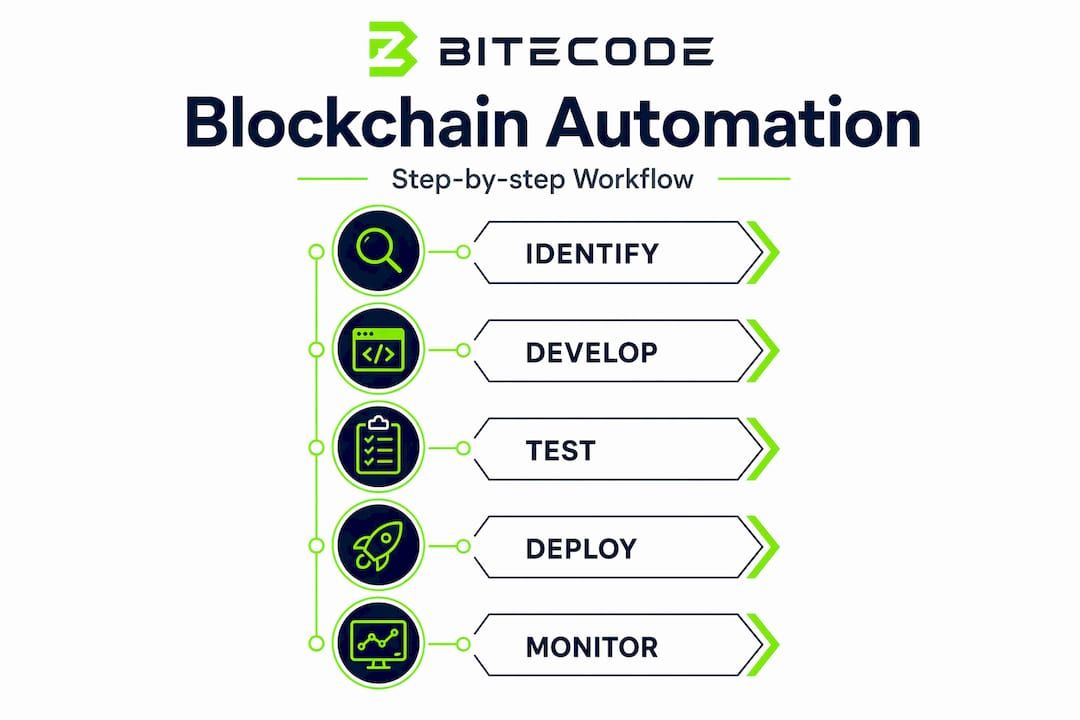
Implementing blockchain automation for enterprise use cases follows a clear sequence. Skipping steps, particularly testing and environment configuration, is where most projects accumulate technical debt.
-
Define the automation scope. Identify which business processes generate the most reconciliation errors or require the fastest execution. Collateral management, settlement confirmation, and cross-chain asset transfers are the highest-value targets for most financial operations teams.
-
Configure your development environment. Install Hardhat and Foundry, then set up a local Docker network with multiple nodes. This environment mirrors production conditions closely enough to catch configuration errors before they reach a testnet.
-
Write automation-compatible smart contracts. For Chainlink Automation, implement
checkUpkeepto define trigger conditions andperformUpkeepto execute the automated action. KeepperformUpkeeplogic minimal. Heavy computation belongs off-chain in the agent layer. -
Integrate an event-driven agent framework. Connect the agent to your contract’s event logs. The agent listens for specific on-chain events, validates conditions, and submits transactions only when criteria are met. This eliminates the polling overhead that makes script-based systems expensive at scale.
-
Run a full test suite before any testnet deployment. Use Foundry’s fuzzing capabilities to test contract behavior under unexpected inputs. Review security-focused testing practices to catch signing and access-control vulnerabilities before deployment.
-
Deploy to testnet with monitoring active. Treat testnet deployment as a production rehearsal. Monitor gas consumption, transaction latency, and revert rates. Adjust gas limits and retry logic based on observed behavior.
-
Deploy to mainnet with multi-chain configuration. Use a standardized runtime environment to manage connections across networks. Scaling multi-blockchain workflows requires a unified data layer to avoid rebuilding pipelines for each network or asset class.
The goal throughout is to accelerate work without accelerating chaos. Each step produces an artifact, whether a tested contract, a configured agent, or a monitoring dashboard, that the next step depends on.
Common challenges in automating blockchain workflows
Every production automation pipeline encounters the same categories of failure. Knowing them in advance shortens the time from incident to resolution.
- Stuck transactions and nonce mismatches. These occur when a previous transaction fails to confirm and the agent submits a new transaction with the same nonce. Agent frameworks with built-in nonce management detect this condition and resubmit with a higher gas price automatically.
- RPC node failures. A single RPC provider going offline can halt an entire pipeline. Multi-provider failover, configured at the infrastructure level, switches to a backup node within seconds. This is not optional for production deployments.
- Signing key exposure. Agents that hold private keys directly are a security liability. Event-driven agents handle signing through backend services, keeping keys out of the agent process entirely.
- Data fragmentation between legacy and blockchain systems. Reconciliation errors multiply when data formats differ across systems. Standardizing data formats between legacy infrastructure and blockchain layers reduces errors and supports near real-time decision-making.
- Audit gaps. Automation pipelines that lack structured logging create compliance risks. Every automated transaction should write a structured log entry with timestamp, trigger event, gas used, and outcome.
Treating a blockchain automation pipeline like a fire-and-forget script is the single most expensive mistake teams make. Production pipelines require the same observability, alerting, and incident-response discipline as any critical backend service. The chain does not forgive silent failures.
Key Takeaways
Blockchain workflow automation delivers the most value when teams combine event-driven agent frameworks, a multi-layered toolchain of Hardhat, Foundry, and Remix, and a standardized runtime environment that unifies data across networks.
| Point | Details |
|---|---|
| Agent frameworks over scripts | Event-driven agents handle state, retries, and nonce management that scripts cannot. |
| Multi-toolchain development | Hardhat, Foundry, and Remix each cover a distinct phase; using all three reduces production failures. |
| Standardized runtime environments | A unified data layer prevents pipeline rebuilds when adding new networks or asset classes. |
| Security at the signing layer | Signing keys must stay outside the agent process; delegate to a backend service or hardware module. |
| Test before every deployment | Foundry fuzzing and containerized simulations catch failures that unit tests miss. |
The architecture shift most teams underestimate
At Bitecode, we have worked through enough enterprise blockchain projects to recognize a pattern: teams invest heavily in smart contract development and almost nothing in the agent layer that runs those contracts in production. The contract is the easy part. The agent, with its state management, retry logic, gas optimization, and security boundaries, is where the real complexity lives.
The multi-toolchain approach, combining Hardhat, Foundry, and Remix, has become the industry norm not because any single tool is insufficient, but because each one addresses a failure mode the others do not. Teams that skip Foundry fuzzing discover this the hard way when an edge-case input triggers an unexpected revert in production.
The next shift coming in 2026 and beyond is the integration of AI-assisted agents into these pipelines. Local LLMs running inside containerized environments can already assist with anomaly detection and parameter adjustment during development. The teams preparing now by building clean, observable, modular pipelines will integrate AI capabilities without rebuilding their architecture from scratch. The teams still running cron jobs will face a much harder migration.
Secure signing layers are not optional as automation scales. Every additional network and asset class increases the attack surface. Building the signing boundary correctly from the start is far less expensive than retrofitting it after a security incident.
— Bitecode
Bitecode’s approach to blockchain workflow automation
Bitecode builds enterprise blockchain automation systems using the same multi-toolchain architecture described in this article. Hardhat, Foundry, and Remix form the development core, and every project includes event-driven agent integration with secure signing boundaries from day one. Teams get blockchain automation pipelines that are auditable, multi-chain ready, and built on a modular foundation that covers up to 60% of the baseline system before custom development begins. For business leaders and IT professionals evaluating automation strategies for 2026, Bitecode offers a direct path from planning to production without the overhead of assembling a greenfield architecture from scratch. Contact Bitecode to discuss your specific workflow requirements.
FAQ
What is blockchain workflow automation?
Blockchain workflow automation is the use of event-driven agents and smart contracts to execute business processes on-chain without manual intervention. It replaces manual transaction submission and monitoring with stateful, self-healing pipelines.
How do I start automating blockchain processes?
Start by identifying high-value processes with frequent reconciliation errors or time-sensitive execution requirements. Then configure a development environment with Hardhat, Foundry, and Remix, and implement checkUpkeep and performUpkeep functions for Chainlink Automation compatibility.
Why are event-driven agents better than cron job scripts?
Script-based automation fails silently because it lacks on-chain state awareness. Event-driven agents persist state, manage nonces, handle reverts, and support automatic RPC failover across 10+ EVM networks.
What are the best practices for blockchain automation security?
Keep signing keys outside the agent process by delegating all signing to a dedicated backend service. Sandbox agent environments, use Foundry for security-focused fuzzing, and maintain structured audit logs for every automated transaction.
Can blockchain automation reduce transaction costs?
Yes. Event-driven agents include gas optimization logic that adjusts pricing based on mempool conditions. Combined with smart contract automation techniques like batching and conditional execution, teams reduce unnecessary transaction submissions and lower per-operation costs over time.