AI automation cost is not one number. It is the sum of a build, a run cost that keeps growing after launch, and a layer of data, integration and governance work that business cases often leave out. The most reliable way to keep that sum predictable is to avoid paying for the same foundation twice: authentication, workflow engine, audit trail, payments and integrations are the same in almost every system. Starting from a modular base with those parts already built is designed to move the budget toward the business logic that is actually yours. That is how we scope projects at Bitecode, and it shapes the rest of this guide.
TL;DR
- Cost splits into build, run, maintain, govern and evolve. The build is rarely the largest line over the system’s life.
- Data readiness is the biggest hidden driver: TechTarget reporting from May 2026 cites about $60 of every $100 of AI project spend going to data work rather than the model.
- Agentic workflows make usage-based bills hard to forecast, so budget for run costs with a ceiling and monitoring from day one.
- A modular foundation lowers the build and risk lines because the common 60% of a system is not written from scratch. Our approach is designed to start projects with up to 60% of the baseline system pre-built.
- Fixed or scoped fees per engagement work best when the scope is split into modules with a clear acceptance test each.
Why published price ranges disagree so much
Search for the cost of AI automation and you will find ranges that run from a few thousand dollars to well into six figures, sometimes in the same results page. The gap is not dishonesty. The pages are pricing different things.
A low figure usually describes a single workflow connected to a hosted model: a form arrives, a model classifies it, a record is updated. A high figure describes a system with several integrations, role-based access, audit requirements, and a team that maintains it. Both are “AI automation”. They share a name and little else.
For an executive or IT manager, the useful question is therefore not “what does AI automation cost?” but “which of these cost layers does my project contain?” The sections below take them in order.
The five cost layers of an AI automation project
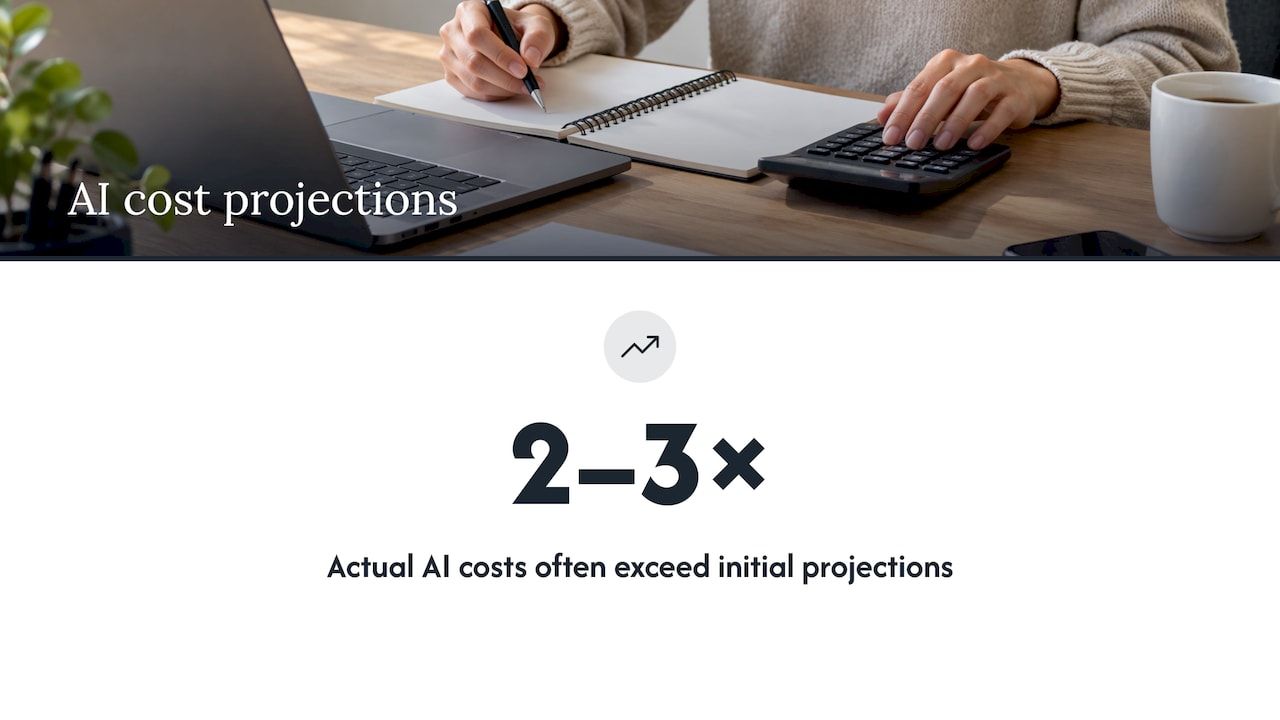
RSM US frames AI spend as a lifecycle with five stages: build, run, maintain, govern and evolve. In its August 2026 total cost of ownership analysis, it reports that AI costs span infrastructure, talent, integration, reskilling, governance and long-term operations, and that actual totals often run two to three times the initial projection. That is a useful frame because it explains why a quote for the build alone understates the budget.
Build
The build covers discovery, workflow design, integration with your systems, the interface people use, the AI components, testing and deployment. It is the only layer most proposals price explicitly. It is also the layer where the starting point matters most. A greenfield build pays for boilerplate: user management, permissions, logging, notification services, an admin panel. None of this differentiates your business, yet it consumes weeks.
Run
Run costs are compute, model inference, storage, monitoring and hosting. RSM identifies run costs as the fastest-growing category in AI total cost. They scale with usage, not with the project plan, which is why a pilot with 50 users and a rollout with 5,000 can differ by an order of magnitude in monthly spend.
Agentic designs deserve particular care. Hugo Huang of Canonical told TechTarget that a single user query can set off a cascade of model interactions across several agents, each consuming tokens, so bills can come in far above expectations. The practical response is architectural: cap the number of model calls per task, route simple steps to rules or small models, and log token usage per workflow so finance can see which process drives the bill.
Maintain
Integrations change. A CRM vendor alters an API, a bank changes a file format, a model version is retired. Maintenance is the budget line that keeps the automation correct after launch. Plan for it as a recurring cost from the first quote, not as a surprise in year two.
Govern
RSM notes that governance and risk costs, such as compliance, auditability and model validation, are often left out of initial business cases but become unavoidable as deployments mature. For financial institutions and fintech companies this is not optional: every automated decision that touches money needs a trail someone can inspect. Building audit-ready logging into the foundation is cheaper than retrofitting it after a regulator or auditor asks.
Evolve
A workflow that works for one department will be requested by three more. Evolution cost is the price of extending the system without rewriting it. This is where modular architecture pays off most clearly, because new capabilities arrive as modules rather than as changes to a monolith.
Where the money actually goes: data, integration, people
Three drivers account for most budget overruns.
Data readiness. Kunal Agarwal, CEO of Unravel Data, told TechTarget that data infrastructure and readiness consume about $60 of every $100 spent on AI projects, mostly on pipelines, pre-processing and retraining loops. If your invoices live in three formats and your customer records are duplicated across two systems, the automation cannot be better than the data feeding it. Budget a data assessment before the build, not during it.
Integration with legacy systems. Canonical’s Huang also points out that legacy systems require expensive engineering work that is rarely budgeted upfront. If the process you want to automate depends on an aging ERP or a database nobody fully documents, read our legacy system modernization guide before you commit to a number. A phased plan that automates around the legacy core, then replaces it in stages, usually costs less in risk than a single large replacement.
People. Talent is often the largest sustained cost in mature deployments, according to RSM. That covers engineers, data specialists, process owners and the reskilling of the staff whose work changes. For a view on how AI staffing and skills costs show up across implementation and mature deployments, it helps to separate one-time project effort from the standing team you need to keep the system healthy.
Cost by type of project
Rather than quote ranges we cannot source to a primary page, here is how scope shapes cost. Use it to place your own project.
| Project type | What it contains | What drives the cost |
|---|---|---|
| Single workflow automation | One process, one or two integrations, a hosted model | Data quality, number of exception cases |
| AI assistant for staff or customers | Knowledge retrieval, permissions, conversation logging | Document preparation, access control, usage volume |
| Finance operations automation | Reconciliation, approvals, multi-currency handling, audit trail | Accounting integration, compliance, accuracy thresholds |
| Custom internal system with AI | Roles, workflows, reporting, several integrations | Breadth of workflows, migration of existing data |
| Blockchain or token settlement | Wallet handling, transaction logic, reporting | Security review, custody model, regulatory fit |
If you are deciding between rule-based automation and AI components, our comparison of RPA and AI automation tradeoffs shows why many enterprise programs use both, and why that choice moves the budget more than the model itself.
How pricing models work
Three structures cover most engagements, and each moves risk in a different direction.
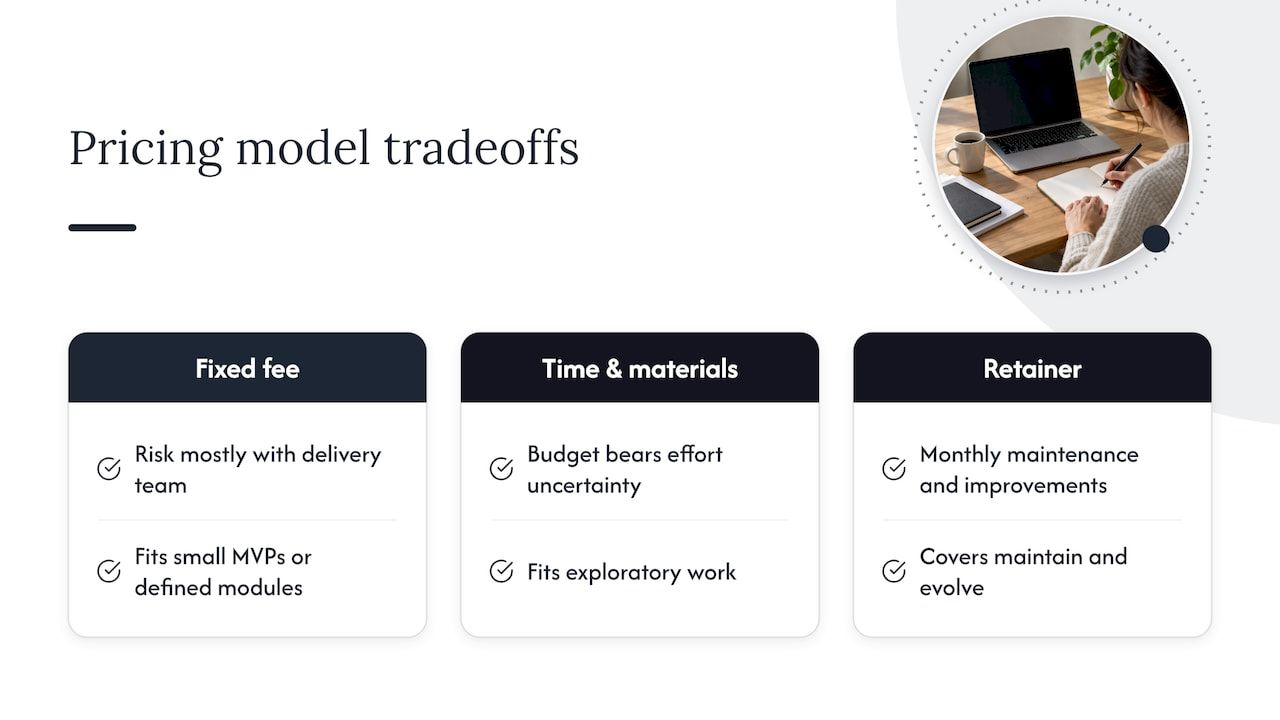
Fixed fee per scoped deliverable. You agree the scope, the acceptance criteria and the price. Risk sits mostly with the delivery team, which is why scope has to be precise. This suits a small MVP or a well-defined module.
Time and materials. You pay for effort. It suits exploratory work, but it relocates uncertainty to your budget, and without tight governance it can drift.
Retainer or subscription for run and evolution. A monthly arrangement for maintenance, monitoring and improvements. This is where the maintain and evolve layers live, and it should be priced separately from the build so you can see each.
Our own model is project-based: fixed or scoped fees per engagement and per module integration. We do not publish a price list, because the right figure depends on which modules your system needs and how much of your process is unusual. A scoping conversation produces a number tied to named deliverables rather than a generic range.
Why a modular foundation changes the arithmetic
Most of the cost in a traditional custom build goes into parts that every enterprise system needs. Two things follow from reusing them.
First, the build line shrinks. Bitecode’s approach is to start projects with up to 60% of the baseline system pre-built, which is designed to shorten development time and reduce delivery risk compared with starting from a blank repository.
Second, the risk line shrinks. Components that have already run in production carry fewer unknowns than code written this quarter. That matters for the layers where mistakes are expensive: payments, permissions and audit logs.
The modules we offer map onto the layers above:
- An AI assistant, financial, automation, CRM and token module set covers the common building blocks for automation, financial processing and blockchain features.
- The financial module covers accounting, audit and subscriptions, which addresses the govern layer directly with multi-currency, audit-ready functionality.
- Self-hosted modules keep data and customization under your control, which bears on both the run cost and the governance cost.
The tradeoff worth naming in any approach is lock-in. A black-box platform relocates complexity into the vendor relationship: you save time at the start and pay in flexibility later. A modular foundation that you control and can host yourself avoids that, which is why we favor it.
Building a realistic budget in six steps
- Define the process, not the technology. Write down the workflow, who touches it, how often, and what an error costs. A process that runs ten times a month rarely justifies the same investment as one that runs ten thousand times.
- Audit the data. Check formats, duplication and ownership. Given the TechTarget finding on data spend, this step often decides the real size of the project.
- List the integrations. Every system the automation reads from or writes to is a line item with its own failure modes. Include the legacy ones.
- Split the scope into modules. Each module gets its own acceptance test and its own price. This is what keeps a fixed-fee model honest on both sides.
- Model the run cost at three volumes. Pilot, expected and peak. Set a spending ceiling and alert thresholds for model usage.
- Reserve for governance and evolution. RSM’s observation that totals often reach two to three times initial projections is a reason to hold an explicit reserve, rather than discover the gap later.
For finance teams, the savings side of the equation is covered in our piece on finance automation ROI, and for SaaS operators in SaaS automation ROI. Cost only means something against the process cost it replaces.
What a small MVP changes
Startups and SaaS providers often ask whether to build a full system or prove the idea first. A small MVP limits the build line and produces real usage data, which is exactly what you need to estimate run cost accurately. The cheapest mistake is the one you find at 50 users. With a modular base, the MVP and the larger system share the same foundation, so the first release is not thrown away when the product grows.
Promo: scoping an automation project with Bitecode
If you are weighing a custom automation build, we scope it module by module: AI workflows, a financial module, CRM, an AI assistant or token functionality, on a foundation designed to arrive with up to 60% of the baseline system already built. Start with our AI business process automation workflows service, or look at custom business software if the system is broader than one process.
For a wider project, the Bitecode site lists how we handle both a small MVP and larger software development engagements.
Perspective
The question we hear most is how much a custom AI system costs, and the honest answer starts with another question: how much of it do you want to pay for twice?
Every enterprise system needs identity, permissions, a workflow engine, logging and integrations. Writing them again for each project is where budgets disappear, and where risk hides. Our approach is to begin from modules that already exist, so that money goes into the part of the system that reflects your business.
We also think the cost conversation should include governance from day one. Financial and blockchain workflows need audit-ready records, multi-currency handling and clear control over where the system runs. That is why our modules are built with those functions and can be self-hosted: your team keeps control of the data and the customization.
Fast does not have to mean chaotic. A scoped, modular engagement lets you accelerate work without accelerating chaos: each module has defined deliverables, each can be accepted or adjusted, and the system grows without a rewrite.
Bitecode
FAQ
How much does AI automation cost for a business?
It depends on which cost layers your project contains. A single workflow with one integration sits at one end, and a multi-system platform with audit and compliance needs sits at the other. RSM notes that full ownership costs often run two to three times initial projections, so budget for run, maintenance and governance as well as the build.
What are the hidden costs of AI automation?
The largest is data readiness, which TechTarget reporting puts at about $60 of every $100 of AI project spend. Legacy system engineering, governance and usage-based model bills follow. A scoping phase that covers data, integrations and run volume surfaces them before you sign.
How do AI automation pricing models work?
Projects are typically priced as a fixed fee per scoped deliverable, as time and materials, or as a retainer for run and evolution. We work with fixed or scoped fees per engagement and per module integration, which ties each payment to a defined deliverable.
Why does a modular foundation reduce cost?
Because the shared parts of an enterprise system are already built and tested. Our approach starts projects with up to 60% of the baseline system pre-built, so effort goes into your specific workflows, which is designed to cut development time and delivery risk.
Sources
- The hidden costs of AI: What leaders must budget, TechTarget
- Rethinking AI total cost of ownership, RSM US
- AI staffing and skills costs