RPA handles stable, rules-based execution; AI handles variable, judgment-heavy inputs; most enterprises deploy both to capture the strengths of each. The standard pattern puts AI upstream to interpret unstructured data and RPA downstream to execute deterministic steps. Roughly 70% of enterprise automation programs already combine RPA and AI, a consensus that spans analyst research and vendor architecture guides alike.
TL;DR:
- Combining RPA and AI is common, with 70% of enterprise automation programs deploying both to handle different process needs.
- RPA is best suited for structured data, deterministic processes, and legacy system integration, while AI handles unstructured data and judgment-heavy inputs.
- Implementation timelines differ, with RPA projects often taking weeks and AI initiatives requiring months, mainly due to data preparation and model tuning.
- Monitoring and governance are crucial; RPA failures are usually UI-related, while AI requires ongoing tracking of model drift and explainability.
- Hybrid automation architectures, with AI upstream or downstream of RPA, are the dominant pattern for scalable enterprise solutions.
RPA vs AI Automation: Comparing the Decisive Dimensions
The RPA vs AI automation debate collapses once you look at the dimensions that actually determine fit: what kind of input the process handles, how much deviation it tolerates, and how much oversight the outcome requires. Neither technology wins outright. Each wins a specific set of conditions.
Input type decides the starting point. RPA reads structured data: fixed-format fields, defined portals, consistent templates. AI reads unstructured or semi-structured input: scanned PDFs, free-text emails, images, conversational queries. A structured invoice submitted through a supplier portal is a clean RPA job. A stack of vendor invoices in five different layouts is an AI-plus-RPA job.
Determinism is where the two technologies diverge philosophically. RPA is deterministic: the same input produces the same output every time, which is exactly what a compliance officer wants to see. AI is probabilistic. It infers a likely answer from patterns, which makes it powerful on ambiguous inputs and risky on decisions that demand certainty.
Learning capability favors AI by design; RPA has none. A bot follows the script it was given until someone edits that script. A machine learning model improves as it sees more examples, though that improvement needs monitoring, not blind trust.
Implementation speed and cost split sharply. RPA projects on stable processes often reach production in weeks. AI projects typically run months, given the need for training data, tuning, and validation, which also raises upfront cost.
Auditability leans toward RPA, since rule-based bots leave a fully predictable audit trail that satisfies regulators without extra tooling. AI requires added logging and explainability work to reach the same comfort level.
Legacy-system fit is RPA’s quiet advantage. When a core banking or ERP system has no usable API, RPA operates through the existing user interface like a universal adapter, without touching legacy code.
Use this quick checklist when applying the matrix to a real process:
- Is the input format fixed or does it vary by source? (Fixed favors RPA; variable favors AI.)
- Does the decision require judgment, sentiment, or interpretation? (If yes, AI.)
- Does compliance demand a fully deterministic audit trail? (If yes, keep RPA in the execution path.)
- Is there an API, or only a legacy UI? (No API often means RPA is the pragmatic bridge.)
Which Enterprise Use Cases Fit RPA, AI, or Both?
Mapping a real process to the right technology gets easier once you see it applied across common enterprise functions.
- Finance and accounts payable. Invoices submitted through a standardized supplier portal are a textbook RPA case: extract fields, match to purchase order, post to the ledger. Vendor invoices arriving as scanned PDFs in a dozen formats need AI-driven document understanding to extract the data before RPA finishes the transaction. Enterprises that properly orchestrate this hybrid flow report 30 to 50 percent faster execution and 20 to 40 percent cost reduction in the targeted process. A closer breakdown of finance automation ROI shows how those savings compound across accounts payable cycles.
- Customer support. Scripted, single-intent requests (password resets, order status) run fine on RPA alone. Requests requiring intent detection, sentiment reading, or free-text interpretation need AI triage feeding into RPA for fulfillment, such as issuing a refund once intent is confirmed.
- HR and onboarding. Structured form processing, such as provisioning accounts or routing approvals, is squarely RPA territory. Resume parsing, candidate ranking, and sentiment analysis on exit interviews require AI’s language understanding.
- Legacy system integration. Where a core system predates modern APIs, RPA remains the pragmatic choice: it operates the interface the way a human would, without waiting on an IT modernization project that may never get funded.
What Are the Real Implementation Trade-offs?
Cost and timeline differences between RPA and AI show up early, and they compound if a team ignores them during planning.
RPA on a stable, well-documented process typically reaches production in weeks, with cost concentrated in process mapping and bot configuration. AI automation typically needs months for data preparation, model tuning, and validation, with cost weighted toward data engineering and ongoing model governance. Neither timeline is fixed. A poorly scoped RPA project can drag on just as long as a rushed AI one.
Maintenance fragility differs by failure mode. RPA bots break when a UI element moves, a login screen changes, or a field gets renamed, which is a known and fixable failure. AI models degrade more subtly through drift or occasional hallucination, and that requires ongoing monitoring rather than a one-time fix.
Governance responsibilities scale with how much judgment the system exercises:
- Maintain a full audit trail for every automated decision, not just the ones flagged as sensitive.
- Set confidence thresholds that route low-confidence AI outputs to a human reviewer instead of auto-executing.
- Version every model and workflow change so a regression can be traced to its source.
- Log every human override, since override patterns often reveal where the model needs retraining.
Pro Tip: Before scaling any AI component into production, run it against a held-out test set that mirrors your messiest real-world documents, not your cleanest samples. A model that scores well on tidy data and poorly on your actual invoice pile will surface that gap in production instead of in testing, where it’s far more expensive to fix.
A financial process automation checklist is worth walking through before signing off on either approach. Procurement teams routinely underestimate the governance line item.
How Do RPA and AI Work Together in Practice?
Intelligent automation is not a single product category. It is an architecture pattern, and enterprises tend to converge on a small number of variations.
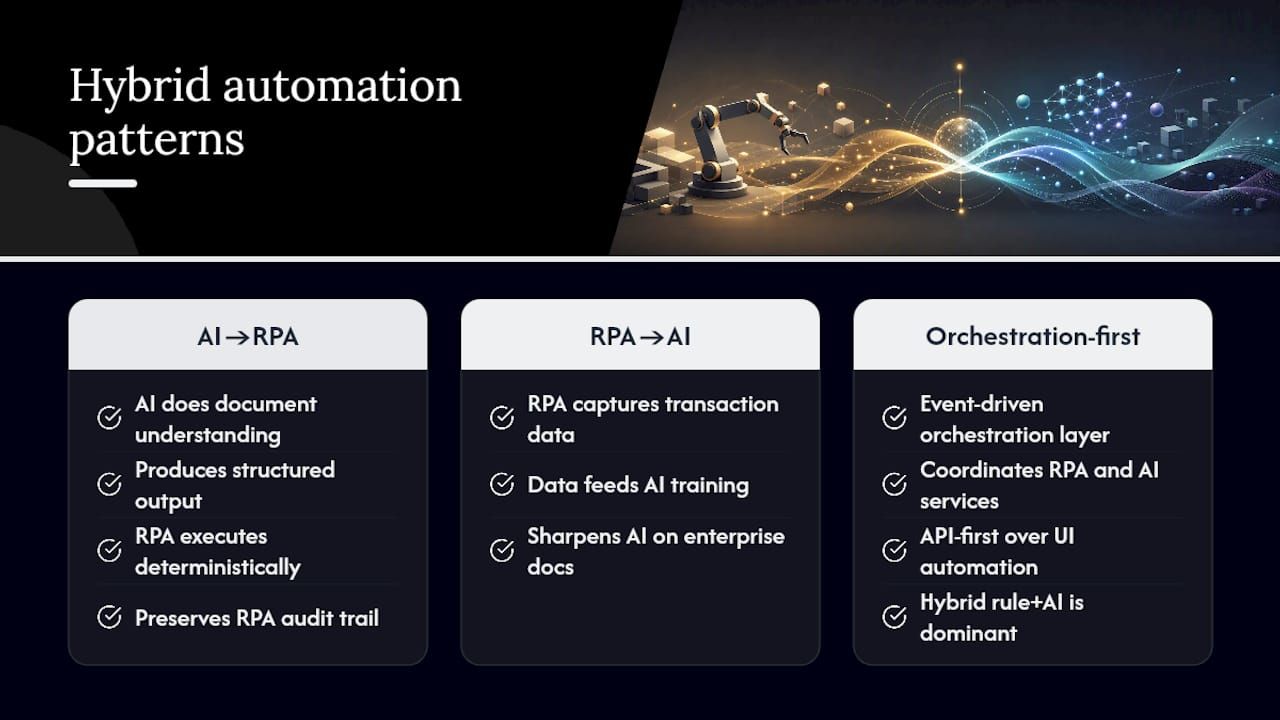
Pattern one puts AI upstream and RPA downstream: an AI model performs document understanding or natural language processing on unstructured input, then hands a structured output to an RPA bot for deterministic execution. This preserves the audit trail RPA is known for while extending reach into messy inputs.
Pattern two reverses the data flow. RPA bots capture transaction data across a process, and that data feeds back into training or refining an AI model, gradually sharpening the AI component’s accuracy on the enterprise’s own documents rather than generic training sets.
Pattern three is orchestration-first: an event-driven layer coordinates both RPA and AI components as services, favoring API-first integration over UI automation wherever an API actually exists. Hybrid architectures that pair rule-based execution with AI-driven interpretation are now the dominant enterprise pattern rather than the exception.
Agentic and multi-agent AI, where a system plans and executes multi-step tasks with less human scripting, is advancing quickly but remains experimental for regulated production environments as of this writing. Treat agentic pilots as exactly that: pilots, with human review on every consequential action until the track record justifies otherwise. A deeper look at workflow orchestration patterns covers how these layers connect in practice.
Bitecode’s Perspective: Building Automation That Holds Up in Production
Most automation failures we see trace back to one decision: treating RPA and AI as competing choices instead of complementary layers. Bitecode starts every engagement from a modular baseline, with up to 60% of the core system pre-built, then adds AI components only where the process genuinely requires interpretation rather than execution.
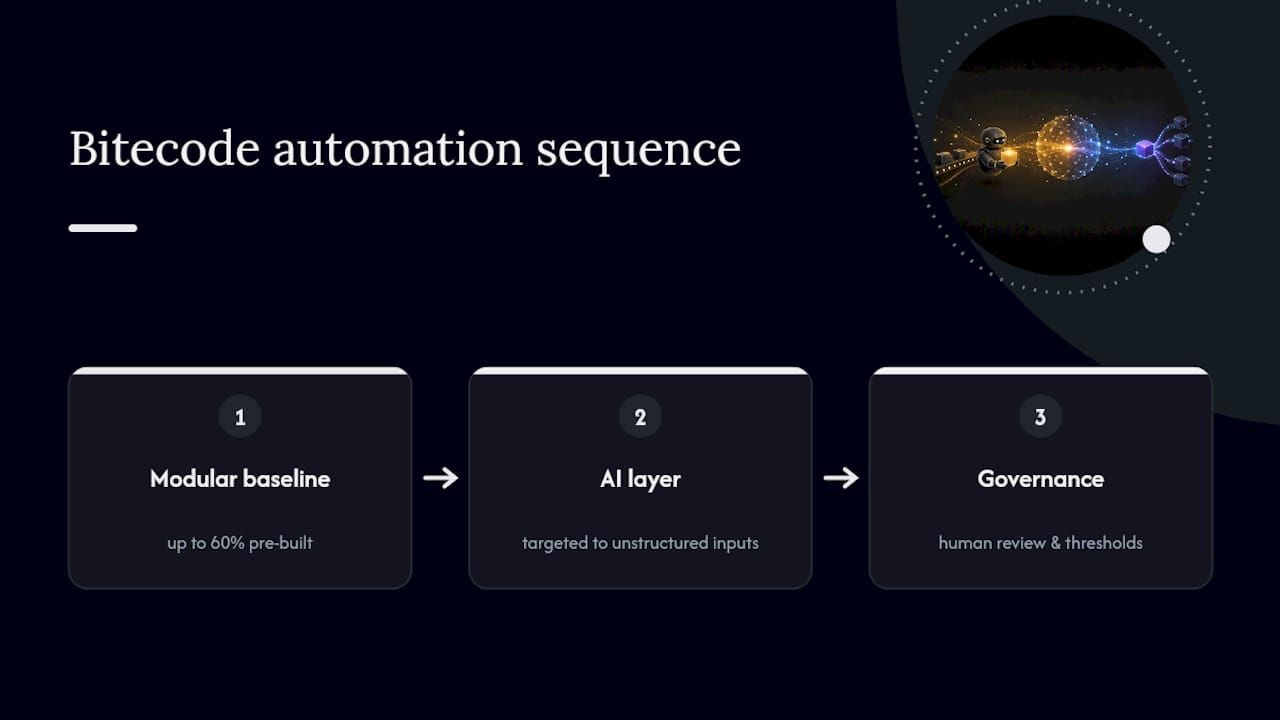
That sequencing matters. A modular foundation gives a team deterministic execution and a working audit trail from day one. AI gets layered in afterward, scoped to the specific unstructured inputs that justify it, with confidence thresholds and human-in-the-loop review built into the workflow rather than bolted on after an incident. Our AI automation services follow this same sequence: baseline first, targeted intelligence second, governance throughout.
The enterprises that get the most value from either technology are rarely the ones chasing the newest agentic demo. They are the ones who scoped their process correctly the first time.
— Bitecode
Sources
The comparison above draws on AliceLabs’ RPA vs AI breakdown for the adoption statistic and timeline guidance, SS&C Blue Prism’s analysis for audit trail and legacy-system framing, ScienceDirect’s hybrid architecture overview for orchestration patterns, and NeuralCoreTech’s ROI figures for cost and execution-speed ranges.
Ready to map your own processes against this framework? Bitecode’s business process automation service builds the modular baseline first, then adds AI where the input actually demands it, so you get RPA’s reliability without sacrificing AI’s flexibility on the inputs that need it.
- AI vs RPA: What’s the Difference & Which Should You Use?
- AI-driven automation (hybrid architectures) — ScienceDirect overview
- AI Automation Platforms (2026): Best Tools, Pricing, Architecture & ROI - NeuralCoreTech
- Robotic Process Automation (RPA) and AI for Smarter Work | SS&C Blue Prism